Within Iceland Forteana
Do Icelanders Really Believe in Elves?
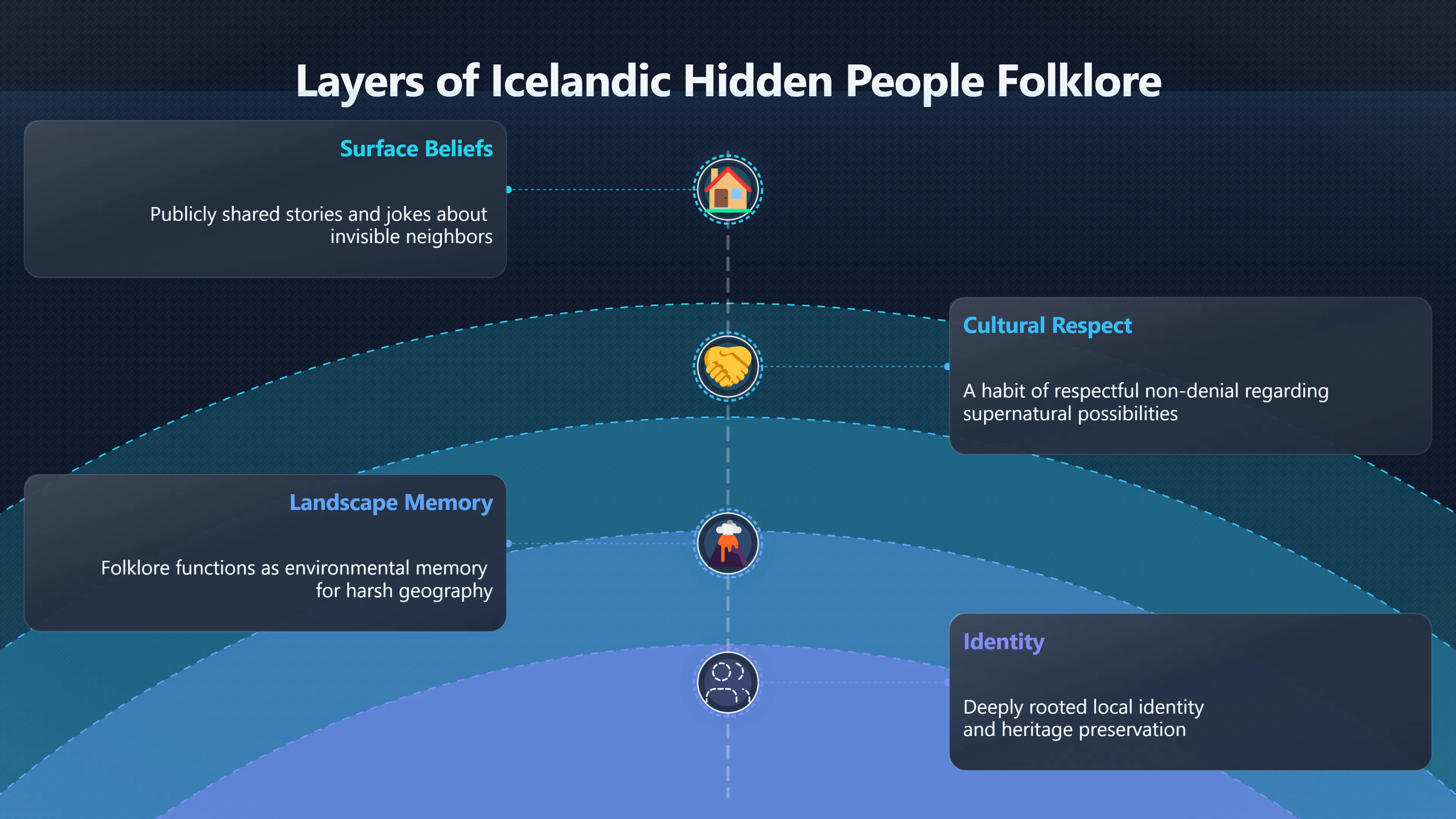
Icelandic elf stories are less a punchline than a way of talking about land, heritage, caution and respectful non-denial.
On this page
- What hidden people are said to be
- Roads, rocks and local heritage disputes
- Belief, humour and respectful non denial
Page outline Jump by section
Introduction
Do Icelanders really believe in elves? The shortest accurate answer is: some do, many do not, and a much larger number are reluctant to dismiss the possibility altogether. More importantly, the hidden people tradition is not simply about invisible beings. It is a way of talking about the relationship between people and landscape, especially lava fields, unusual rock formations and places regarded as culturally significant. That helps explain why stories about “elf rocks” still appear in news reports about road schemes, housing developments and conservation disputes. Rather than proving supernatural belief, these episodes show how folklore, heritage, environmental concern and local identity continue to overlap in modern Iceland.[Georgetown Journal]gjia.georgetown.eduGeorgetown JournalPART I: Encounters of Humans and Hidden Powers in…July 30, 2020 — 30 Jul 2020 — The Icelandic belief in elves and hi…

What hidden people are said to be
The hidden people are traditionally described as human-like neighbours who live inside rocks, hills and lava formations while remaining invisible to most people. Unlike the tiny winged fairies of later European folklore, Iceland’s hidden people are generally imagined as living ordinary parallel lives: they keep homes, raise families, celebrate festivals and occasionally interact with humans.
Older folklore collections portray encounters as rare and often morally instructive. People who treated hidden neighbours with courtesy might receive unexpected help, while those who disturbed sacred places risked illness, accidents or persistent bad luck. Whether these tales were understood as literal history or cautionary stories varied from one community to another, but they consistently encouraged careful behaviour around particular places.[Georgetown Journal]gjia.georgetown.eduGeorgetown JournalPART I: Encounters of Humans and Hidden Powers in…July 30, 2020 — 30 Jul 2020 — The Icelandic belief in elves and hi…
Modern surveys reinforce that the tradition cannot be reduced to a simple “believe” or “disbelieve” divide. Recent Icelandic social research found that many respondents chose answers such as “possible” or “probable” rather than absolute certainty or denial. Folklorists argue that this reflects a cultural habit of respectful non-denial rather than straightforward supernatural conviction.[Wikipedia]WikipediaOpen source on wikipedia.org.
Why rocks matter more than elves
The most important feature of the tradition is not the beings themselves but the places associated with them.
Across Iceland, striking lava outcrops, isolated boulders and unusual hills may be regarded as places that should not be disturbed. Such locations are often treated as culturally significant even by people who would never claim to have seen hidden people. Many belong to a wider category of places surrounded by traditional prohibitions: locations where people were advised not to move stones, damage vegetation or interfere without good reason.[Wikipedia]WikipediaOpen source on wikipedia.org.
These beliefs make practical sense within Iceland’s landscape. Lava fields can be difficult and dangerous to cross, unusual rocks become memorable landmarks, and stories attached to them help communities remember local geography. Folklore scholars have long argued that the tales function partly as environmental memory, encouraging respect for a landscape shaped by volcanoes, earthquakes and harsh weather rather than presenting a systematic supernatural doctrine.[Wikipedia]WikipediaOpen source on wikipedia.org.
Roads, rocks and local heritage disputes
International headlines often claim that Iceland “stops roads because of elves”. The reality is more complicated.
The best-known modern disputes involve developments that would affect prominent rock formations associated with hidden people traditions. Environmental campaigners, local residents, heritage advocates and, in some cases, people who personally accepted the folklore have all participated in these campaigns.
The widely reported dispute over a planned road between Álftanes and Garðabær in 2013 illustrates the point. Protesters objected to construction that would affect a large rock regarded by some as an elf dwelling. Officials from the Icelandic Road and Coastal Administration explained that rerouting was considered not because the state officially recognised elves, but because the rock formation itself had cultural value and could be preserved without major difficulty. The resulting international headlines often exaggerated the role of supernatural belief while overlooking heritage and environmental considerations.[Wikipedia]WikipediaOpen source on wikipedia.org.
Other stories have similarly grown in the retelling. A famous 1971 account about a bulldozer breaking down near an alleged elf rock became part of the international myth that Icelandic construction is routinely halted by invisible beings. Historians of folklore note that newspapers played a major role in transforming isolated incidents into enduring national stereotypes.[Wikipedia]WikipediaOpen source on wikipedia.org.
Belief, humour and respectful non-denial
One reason outsiders misunderstand the tradition is that Icelanders often answer questions about elves in deliberately careful language.
Instead of declaring firm belief, many people simply avoid saying that hidden people definitely do not exist. Folklore professor Terry Gunnell and other researchers have argued that this openness reflects cultural attitudes towards mystery, storytelling and respect for inherited traditions more than literal acceptance of invisible neighbours. Different survey questions produce noticeably different results because respondents interpret “belief” in different ways.[Wikipedia]WikipediaOpen source on wikipedia.org.
Humour also plays an important role. Icelanders frequently joke about elves, especially with tourists, while still treating certain stories and places with affection. That combination can confuse visitors expecting either wholehearted belief or complete scepticism. The tradition comfortably accommodates irony, family storytelling, local pride and genuine personal experience without insisting that everyone interpret events in the same way.[Wikipedia]WikipediaOpen source on wikipedia.org.

Why the tradition still matters
From a Fortean perspective, hidden people occupy an unusual position. Unlike many paranormal claims, they are rarely presented as evidence that the supernatural has been scientifically demonstrated. Instead, they survive because they remain useful.
The stories reinforce local identity, preserve memorable landmarks, provide a language for discussing respect towards the landscape and occasionally strengthen arguments for conserving distinctive natural features. Modern environmental writers have even described hidden people as symbolic allies in protecting vulnerable lava fields and geological formations from unnecessary development.[Atmos]atmos.earthan elven alliance is protecting icelands natural wondersAn Elven Alliance Is Protecting Iceland's Natural Wonders6 Jan 2025 — In the last century, environmental activists have used local b…
That does not mean Icelandic planning policy is secretly based on belief in elves. Decisions are made through ordinary legal, environmental and heritage processes. Yet folklore can influence which places communities value enough to defend, making the hidden people tradition an example of living cultural heritage rather than a relic confined to medieval legend.
For readers interested in Iceland’s stranger history, that is perhaps the most remarkable aspect of all. The enduring mystery is not whether invisible neighbours inhabit the lava fields, but how an old body of folklore continues to shape conversations about identity, conservation and the meaning of landscape in a modern democratic society.
Amazon book picks
Further Reading
Books and field guides related to Do Icelanders Really Believe in Elves?. Use these as the next step if you want deeper reading beyond the article.

Icelandic folktales and legends
Best English-language source on hidden people and elves.

The secret commonwealth of elves, fauns, and fairies
Provides comparative context for elf traditions.

The prose Edda of Snorri Sturluson
First published 1954. Subjects: Norse Mythology, Scalds and scaldic poetry.
eBay marketplace picks
Marketplace Samples
Live-tested eBay searches with available results related to this page.
Endnotes
1.
Source: gjia.georgetown.edu
Link:https://gjia.georgetown.edu/society-culture/encounters-of-humans-and-hidden-powers-in-sacrosanct-places-part-i-the-politics-of-sacrosanctity-and-elf-belief-in-iceland/
Source snippet
Georgetown JournalPART I: Encounters of Humans and Hidden Powers in...July 30, 2020 — 30 Jul 2020 — The Icelandic belief in elves and hi...
Published: July 30, 2020
2.
Source: Wikipedia
Link:https://en.wikipedia.org/wiki/Hulduf%C3%B3lk
3.
Source: Wikipedia
Link:https://en.wikipedia.org/wiki/%C3%81lagablettur
4.
Source: atmos.earth
Title: an elven alliance is protecting icelands natural wonders
Link:https://atmos.earth/political-landscapes/an-elven-alliance-is-protecting-icelands-natural-wonders/
Source snippet
An Elven Alliance Is Protecting Iceland's Natural Wonders6 Jan 2025 — In the last century, environmental activists have used local b...
Additional References
5.
Source: facebook.com
Link:https://www.facebook.com/BBCCymruWales/posts/-do-icelanders-really-believe-in-little-hidden-people-hulduf%C3%B3lk-or-elves/1223082563185071/
Source snippet
Do Icelanders really believe in little hidden people - huldufólk54.4% of Icelanders believe in elves, and many houses have their elf vers...
6.
Source: facebook.com
Link:https://www.facebook.com/guidetoiceland.is/posts/have-you-heard-of-icelands-hidden-people-the-elves-that-live-in-rocks-and-lure-h/2096531410446588/
Source snippet
lure humans into their hidden world 🧝♀️🧝♂️✨...
7.
Source: youtube.com
Title: Huldufólk: The Inhabitants of Iceland’s Faërian Realm by Becca Tarnas
Link:https://www.youtube.com/watch?v=vp97EyZQ9yo
Source snippet
Huldufolk: The Hidden People - Documentary...
8.
Source: youtube.com
Title: Huldufolk: The Hidden People
Link:https://www.youtube.com/watch?v=0O1hr1qGR-Q
Source snippet
PFF 2010: Huldufólk 102 (Iceland, 2006, 74 mins.)...
9.
Source: yourfriendinreykjavik.com
Title: elves of iceland
Link:https://yourfriendinreykjavik.com/elves-of-iceland/
Source snippet
They are very similar to us but just slightly taller, thinner, and more beautiful.Read more...
10.
Source: youtube.com
Link:https://www.youtube.com/watch?v=pZgKz4RXpIc
Source snippet
Huldufólk: The Inhabitants of Iceland's Faërian Realm by Becca Tarnas...
11.
Source: youtube.com
Link:https://www.youtube.com/watch?v=1qLW_KROg2o
12.
Source: youtube.com
Title: Supernatural Iceland: Elves
Link:https://www.youtube.com/watch?v=bNLQAxLYpfM
Source snippet
Hidden People (2018)...
Topic Tree