Within Malta Mysteries
Why Did Malta Imagine Giants?
Gozo's giantess traditions turn enormous prehistoric stones into stories about Sansuna, memory and impossible-looking labour.
On this page
- Ggantija and the problem of huge stones
- Sansuna's Rock and local legend
- Folklore as an explanation for engineering
Page outline Jump by section
Introduction
The huge limestone blocks of Ġgantija on Gozo have inspired one of Malta’s most enduring pieces of folklore: the belief that only a giant could have built them. Long before archaeology showed that the temples were raised by Neolithic farming communities around 3600–2500 BC, local people explained the seemingly impossible engineering with a memorable story about a giantess called Sansuna. Rather than competing with archaeology, the legend reveals how later generations made sense of monuments that already seemed unimaginably ancient. It has become one of Malta’s defining examples of how folklore transforms baffling prehistoric remains into stories about strength, motherhood, memory and the human need to explain the extraordinary.[UNESCO World Heritage Centre]whc.unesco.orgUNESCO World Heritage CentreMegalithic Temples of MaltaSeven megalithic temples are found on the islands of Malta and Gozo, each the resu…

Ggantija and the problem of huge stones
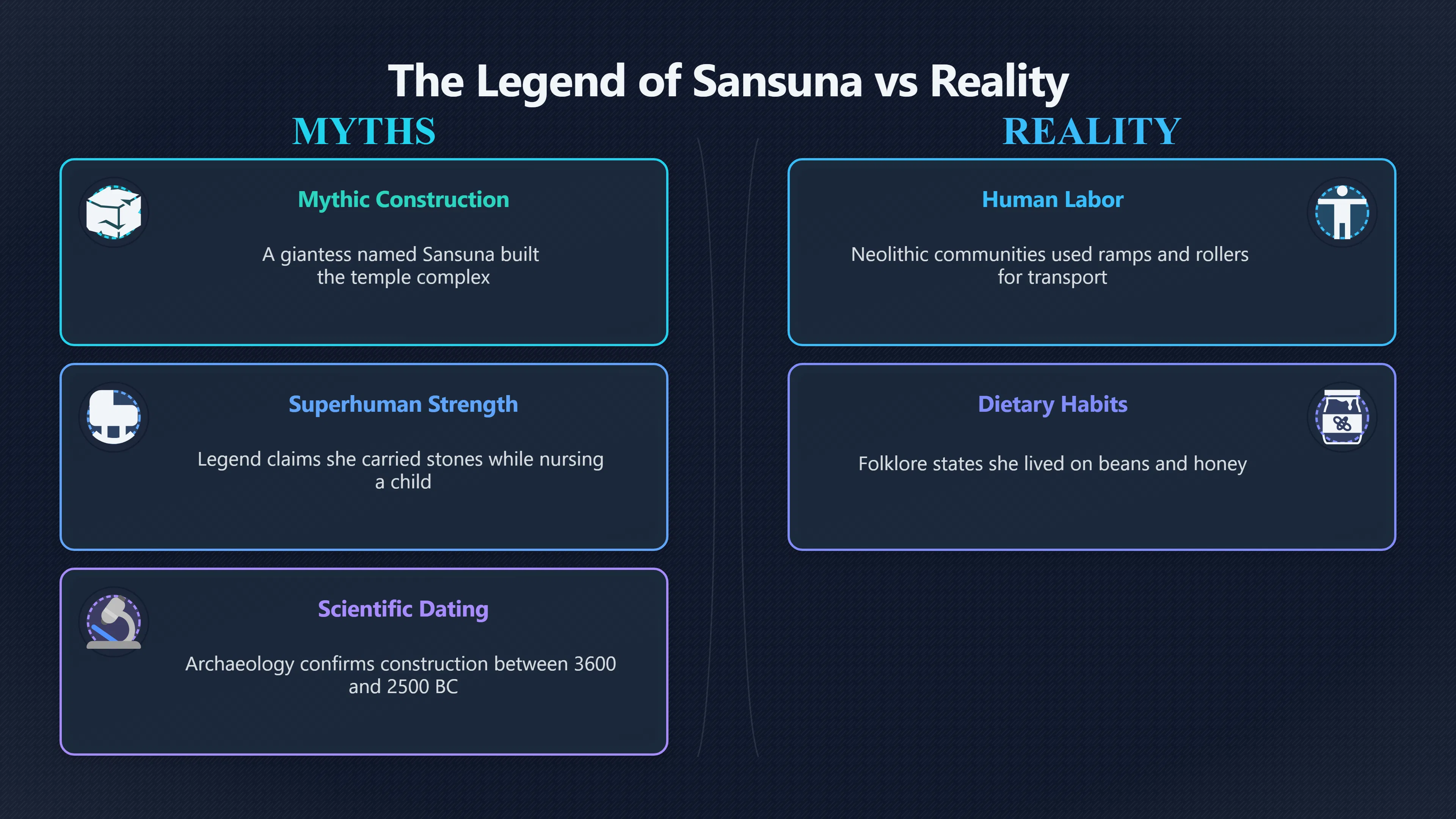
The name Ġgantija is itself a clue to the legend’s origins. It derives from the Maltese word for “giant”, reflecting the long-held belief that ordinary people could never have moved stones weighing many tonnes. Even today, visitors confronted by walls rising around six metres high often instinctively ask how such a structure could have been built without metal tools or wheeled vehicles.
Modern archaeology provides practical answers. The temples were constructed by Neolithic communities using locally available limestone, carefully shaped blocks, earth ramps, rollers and large organised workforces over many generations. UNESCO recognises the temples as among the world’s earliest free-standing monumental buildings, remarkable precisely because they demonstrate sophisticated engineering achieved with comparatively simple technology.[UNESCO World Heritage Centre]whc.unesco.orgUNESCO World Heritage CentreMegalithic Temples of MaltaSeven megalithic temples are found on the islands of Malta and Gozo, each the resu…
For earlier generations, however, these explanations were unavailable. Faced with monuments vastly older than living memory, giant-builders offered a perfectly reasonable cultural answer. Similar traditions appear around megalithic monuments across Europe, but Malta’s version became unusually rich because the islands contain some of the oldest surviving stone temples anywhere in the world.
Sansuna’s Rock and the giantess legend
The best-known figure in this tradition is Sansuna, a giantess whose story survives in Maltese folklore and later written collections of traditional tales. According to the classic version, Sansuna lived on Gozo, sustained herself on broad beans and honey, bore a child by a human father, and carried enormous stones on her shoulder while simultaneously carrying her baby. She then assembled the great temple complex so that local people could worship there.[Heritage Malta]heritagemalta.mtHeritage MaltaSansuna's RockSansuna's Rock is an irregularly shaped slab of hard Coralline limestone located at Ġnien Imrik in the outski…
Several features make the tale distinctive.
- Impossible strength becomes domestic: Sansuna is not merely a destructive giant. She combines superhuman labour with motherhood, carrying both child and megaliths at the same time.
- The legend explains the name: The association between giants and Ġgantija became so strong that the monument itself inherited the identity of its mythical builder.
- Human and giant worlds overlap: By giving Sansuna a human partner, the story narrows the gap between mythic beings and ordinary islanders, rooting the legend in local rather than distant fantasy.
The tradition also extends beyond the temples themselves. Heritage Malta preserves Sansuna’s Rock, a large limestone slab near Xagħra that folklore identifies with the giantess. Archaeologists note that it may represent part of a Bronze Age dolmen, although this interpretation has never been confirmed by excavation. The site therefore illustrates an interesting overlap between archaeology and folklore: the rock is genuinely ancient, but its connection to Sansuna belongs to cultural memory rather than historical evidence.[Heritage Malta]heritagemalta.mtHeritage MaltaSansuna's RockSansuna's Rock is an irregularly shaped slab of hard Coralline limestone located at Ġnien Imrik in the outski…
Why giants became the obvious explanation
The Sansuna story belongs to a widespread pattern sometimes called “megalith folklore”. Across Europe, prehistoric monuments whose builders had been forgotten were frequently attributed to giants, heroes or supernatural beings. These explanations emerged not because people rejected reality but because they attempted to explain something genuinely puzzling with the cultural tools available to them.
In Malta, several factors encouraged giant traditions.
First, the scale of the architecture is immediately striking. Massive upright stones appear almost exaggerated on relatively small islands, inviting questions about transport and construction.
Second, the true builders had vanished thousands of years before historical records began. Unlike Roman ruins or medieval churches, the temples had no surviving written history explaining their purpose or construction.
Finally, giant stories transform engineering into narrative. Instead of describing techniques, labour organisation or prehistoric logistics, the legend compresses an immense communal achievement into a single memorable character whose extraordinary strength stands in for the effort of an entire society.
In this sense, the myth is less an attempt to deceive than an imaginative explanation for forgotten technology.
Folklore and archaeology are telling different stories
It is tempting to ask whether archaeology has “disproved” the giantess. That question misses the point of the tradition.
Archaeological evidence overwhelmingly supports human construction during Malta’s Neolithic temple-building period. Excavations, radiocarbon dating, architectural analysis and associated artefacts all place Ġgantija within a broader prehistoric culture responsible for the other Maltese megalithic temples. There is no evidence that literal giants built the monuments.[UNESCO World Heritage Centre]whc.unesco.orgUNESCO World Heritage CentreMegalithic Temples of MaltaSeven megalithic temples are found on the islands of Malta and Gozo, each the resu…
The folklore, however, addresses a different question altogether. Rather than explaining how the temples were physically built, it explains how later communities emotionally understood them. The giantess gives the landscape personality, turning anonymous prehistoric builders into a memorable local character whose story can be retold across generations.
This distinction helps explain why the legend has survived even after archaeology established the monuments’ true age and origins. Scientific explanation answers the engineering problem; folklore answers the human desire for narrative.
Why the story still matters in Malta’s strange history
Among Malta’s many unusual traditions, the Sansuna legend occupies a special place because it demonstrates how extraordinary landscapes generate extraordinary stories without requiring supernatural claims to be historically true.
The tale remains culturally significant because it:
- connects modern Gozo with a prehistoric landscape otherwise separated by over five millennia;
- illustrates how oral tradition preserves wonder even when historical knowledge disappears;
- shows how enormous monuments naturally invite explanations beyond everyday experience;
- has become part of the identity of Ġgantija itself, shaping how visitors understand the site before they even arrive.
For readers interested in Malta’s Fortean traditions, Sansuna represents an important category of “strangeness”. She is not a cryptid to be hunted or a paranormal entity awaiting proof. Instead, she is an example of how communities transform baffling archaeology into living folklore, creating stories that reveal as much about later generations as they do about the monuments that inspired them.
Amazon book picks
Further Reading
Books and field guides related to Why Did Malta Imagine Giants?. Use these as the next step if you want deeper reading beyond the article.


The Megalithic Temples of Malta
Directly covers Ġgantija and Malta's prehistoric temples.
eBay marketplace picks
Marketplace Samples
Live-tested eBay searches with available results related to this page.



Endnotes
1.
Source: whc.unesco.org
Link:https://whc.unesco.org/en/list/132/
Source snippet
UNESCO World Heritage CentreMegalithic Temples of MaltaSeven megalithic temples are found on the islands of Malta and Gozo, each the resu...
2.
Source: heritagemalta.mt
Link:https://heritagemalta.mt/explore/hagra-ta-sansuna/
Source snippet
Heritage MaltaSansuna's RockSansuna's Rock is an irregularly shaped slab of hard Coralline limestone located at Ġnien Imrik in the outski...
3.
Source: heritagemalta.mt
Link:https://heritagemalta.mt/explore/ggantija-archaeological-park/
Source snippet
Ġgantija Archaeological ParkThe Neolithic builders made use of both locally sourced Globigerina and Coralline Limestone. The hard-wearing...
4.
Source: heritagemalta.mt
Link:https://heritagemalta.mt/news/a-giant-anniversary-for-unesco-listed-temples/
Source snippet
A Giant Anniversary for UNESCO listed TemplesIn Gozitan folklore, the Neolithic temples of Ġgantija were actually believed -on account of...
Additional References
5.
Source: garryjshaw.com
Link:https://www.garryjshaw.com/malta-island-of-giants/
Source snippet
Malta: Island of GiantsSansuna, a giantess on the island of Gozo, went to the town of Ta' Cenc, placed huge stones upon one of her should...
6.
Source: islandofgozo.org
Link:https://www.islandofgozo.org/what-to-see/temples/
Source snippet
TemplesThe most famous prehistoric temple in Gozo is the Ggantija. Its name comes from the legend that it was built by a giantess, a stor...
7.
Source: Wikipedia
Link:https://en.wikipedia.org/wiki/%C4%A0gantija
Source snippet
ĠgantijaAccording to local Gozitan folklore, a giantess named Sansuna who ate nothing but fava beans and honey bore a child from a man...
8.
Source: facebook.com
Link:https://www.facebook.com/ziguzajg/posts/thump-thump-whats-that-sound-its-sansuna-the-giantess-who-lived-in-gozo-during-p/2698655000190117/
Source snippet
ŻiguŻajgDid you know that the megalithic temples of Ġgantija, on the island of Gozo, are a UNESCO World Heritage Site? Or that Ġgantija m...
9.
Source: axhotelsmalta.com
Link:https://axhotelsmalta.com/discover-activities-in-malta/history-culture/ggantija-gozo/
Source snippet
A Giant on a Tiny Island: Exploring Ġgantija Temples in GozoBut according to local legends, a giantess once lived on the island Gozo...
10.
Source: youtube.com
Link:https://www.youtube.com/watch?v=kIfJyaIsyAU
Source snippet
The Mystery of Malta's Ġgantija & the Giantess SansunaAccording to Maltese legend, a giantess named Sansuna carried the stones on her hea...
11.
Source: lovemalta.com
Title: ggantija the legend of the giantess and her children
Link:https://lovemalta.com/ggantija-the-legend-of-the-giantess-and-her-children/
Source snippet
Ġgantija: The Legend of the Giantess and Her Children23 Mar 2024 — To anyone visiting Gozo, seeing the Ġgantija temples is a must. In tru...
12.
Source: facebook.com
Link:https://www.facebook.com/groups/archeologyandcivilizations/posts/25282841118049407/
Source snippet
Its name means "from the giantess." Ġgantija was built during...Read more...
13.
Source: hunebednieuwscafe.nl
Title: place of the giants megalithic temples in malta
Link:https://www.hunebednieuwscafe.nl/2022/02/place-of-the-giants-megalithic-temples-in-malta/
Source snippet
Place of the Giants; megalithic temples in Malta19 Feb 2022 — Sansuna, a giantess on the island of Gozo, once went to the town of Ta' Cen...
14.
Source: pilgrimaps.com
Link:https://www.pilgrimaps.com/ggantija-where-humans-first-spoke-to-the-sacred/
Source snippet
Ġgantija: Where humans first spoke to the sacredOct 24, 2025 — According to local legend, a giantess named Sansuna built them while nursi...
Topic Tree