Within Armenia Weird
Were Armenia's Dragon Stones Really About Water?
Armenia's prehistoric dragon stones turn monster lore into a tangible landscape of water, ritual and highland survival.
On this page
- What the vishap stones are
- Water, altitude and ritual placement
- How archaeology changes the dragon story
Page outline Jump by section
Introduction
Armenia’s prehistoric “dragon stones” are among the country’s most intriguing archaeological monuments because they turn a legendary creature into something surprisingly practical. Rather than providing evidence that people believed literal dragons roamed the mountains, the stones point towards an ancient relationship between water, seasonal survival and ritual. Most stand in high-altitude landscapes close to springs, streams, natural ponds or traces of prehistoric irrigation, where dependable water mattered enormously to communities moving livestock between mountain pastures and valley settlements. Recent archaeological research has strengthened a long-standing theory that these monuments formed part of an organised water cult, giving a material foundation to later Armenian stories about powerful water dragons.[nature.com]nature.comVishap stelae as cult dedicated prehistoric monuments of…by V Gurzadyan · 2025 — Vishaps, or dragon stones, are prehistoric stel…

The result is a rare case where folklore and archaeology illuminate one another. The dragons belong to myth, but the stones themselves are real, measurable monuments whose locations, carvings and landscape setting reveal how prehistoric societies understood one of their most precious resources.
What the vishap stones are
The monuments commonly known as vishap or “dragon” stones are large prehistoric stelae carved from basalt or andesite. Most stand between two and five metres high, although some are considerably larger. They are found across the Armenian Highlands, particularly on the slopes of Mount Aragats, in the Gegham Mountains and around other upland areas, with related examples also recorded in parts of eastern Turkey and southern Georgia.[unesco.org]whc.unesco.orgUNESCO World Heritage CentreThe Vishaps and the Cultural Landscape of TirinkatarThe site of Tirinkatar contains the largest accumulation…
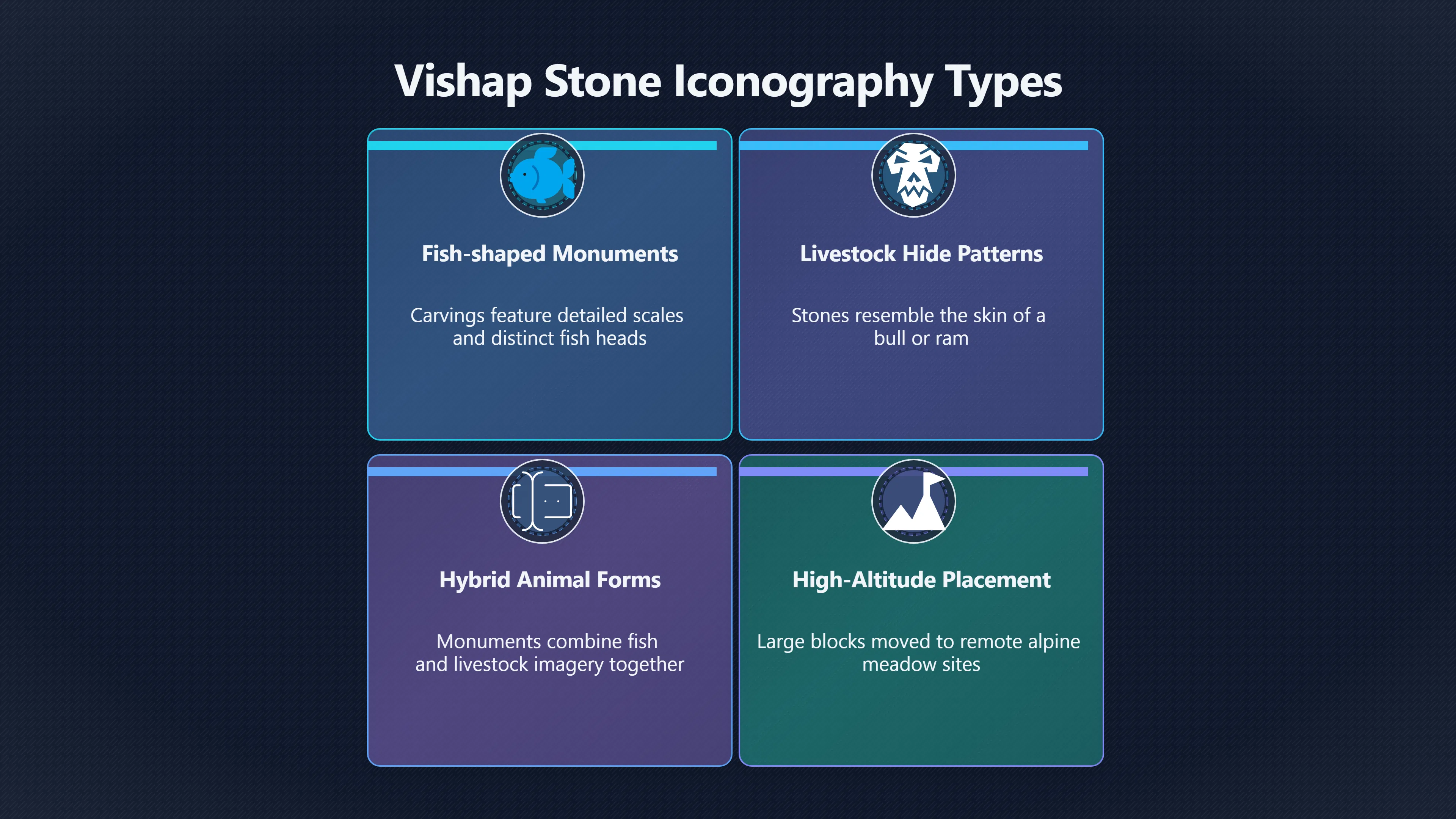
Despite their modern nickname, the carvings usually depict animals rather than dragons. Archaeologists recognise three principal forms:
- Fish-shaped monuments, often with carefully carved scales or heads.
- Stones resembling the hide of a bull or ram draped over the surface.
- Hybrid examples combining fish and livestock imagery.
This iconography puzzled researchers for decades because it did not resemble the monumental traditions of neighbouring regions. Early investigators in the twentieth century noticed another striking pattern: the stones repeatedly appeared near water rather than beside settlements or burial grounds. That observation eventually became one of the central questions in their interpretation.[Academia]academia.eduThey originally stood upright in secluded, water-rich, high-altitude meadows in the mountains…Read more…
Why are they found so high in the mountains?
The most surprising feature of the dragon stones is not their appearance but their location.
Many stand at elevations between roughly 1,900 and 2,700 metres in remote alpine meadows. Moving multi-tonne blocks into such places demanded considerable planning, labour and organisation. Modern statistical analysis has shown that the largest stones were not restricted to easier terrain, suggesting their placement reflected deliberate ritual choices rather than simple convenience.[Nature]nature.comVishap stelae as cult dedicated prehistoric monuments of…by V Gurzadyan · 2025 — Vishaps, or dragon stones, are prehistoric stel…
This high-altitude setting makes practical sense once water enters the picture. Snowfields and mountain springs feed the streams that sustain farming communities below. By placing monuments close to these sources, prehistoric groups may have marked places where the landscape itself was understood as sacred and life-giving.
The UNESCO nomination for the Tirinkatar cultural landscape argues that the surrounding archaeological remains—including ritual platforms, stone circles, petroglyphs and seasonal pastoral sites—form one of the earliest organised ritual landscapes known from the Armenian Highlands. Rather than isolated monuments, the dragon stones appear to have been components within a much larger ceremonial landscape connected with herding, seasonal movement and water management.[UNESCO World Heritage Centre]whc.unesco.orgUNESCO World Heritage CentreThe Vishaps and the Cultural Landscape of TirinkatarThe site of Tirinkatar contains the largest accumulation…
Water, altitude and ritual placement
For many years the idea that the stones represented a prehistoric water cult rested largely on landscape observations. Archaeologists repeatedly noticed their proximity to springs, reservoirs and ancient channels but lacked enough systematically recorded examples to test the pattern.
A major 2025 study analysed 115 documented dragon stones across the Armenian Highlands using spatial and statistical methods. The researchers found strong support for the earlier hypothesis that the monuments were intentionally associated with water sources, including natural springs and prehistoric irrigation systems. They also identified two preferred elevation bands, suggesting that placement may have reflected seasonal movements between valleys and upland grazing grounds or different ritual functions within the same landscape.[Nature]nature.comVishap stelae as cult dedicated prehistoric monuments of…by V Gurzadyan · 2025 — Vishaps, or dragon stones, are prehistoric stel…
That does not mean the stones functioned as engineering structures or practical water markers alone. Instead, the evidence suggests that ritual and environmental management were closely linked. In prehistoric mountain societies, protecting water supplies, honouring seasonal cycles and maintaining community identity may all have formed part of the same ceremonial tradition.
This interpretation also explains why fish imagery appears so frequently despite the monuments standing far above major lakes. The fish symbol seems to represent water itself rather than literal fishing, expressing the source of life descending from the mountains into the valleys below.[Academia]academia.eduThey originally stood upright in secluded, water-rich, high-altitude meadows in the mountains…Read more…
How archaeology changes the dragon story
The archaeological evidence has significantly altered how the “dragon” label is understood.
Earlier interpretations often began with later Armenian folklore, where powerful dragons are associated with springs, lakes, storms and the control of water. In many stories, dragons either guard precious water or prevent people from accessing it until defeated by heroic figures such as the dragon-slayer Vahagn. Those traditions remain culturally important, but they belong to much later periods than the prehistoric monuments themselves.[Wikipedia]WikipediaOpen source on wikipedia.org.
Modern archaeology reverses the direction of interpretation. Rather than asking whether the stones depict mythical dragons, researchers ask whether later dragon stories preserved memories of an older symbolic relationship between water and powerful supernatural beings.
The answer remains uncertain, but the continuity is suggestive. The monuments predate the Iron Age, yet many continued to attract attention for thousands of years. Some acquired Urartian inscriptions, while others were later marked with Christian crosses, showing that successive cultures repeatedly reinterpreted the same ancient stones instead of simply destroying or ignoring them.[academia.edu]academia.eduThey originally stood upright in secluded, water-rich, high-altitude meadows in the mountains…Read more…

Why the evidence matters
The dragon stones remain mysterious, but not in the sense often presented by popular media.
There is no archaeological evidence that they record encounters with unknown creatures or represent proof of lost supernatural civilisations. Their mystery lies elsewhere: they reveal a remarkably sophisticated prehistoric landscape in which ritual, ecology and survival were inseparable.
Several conclusions now enjoy broad scholarly support:
- The monuments were intentionally erected in difficult high-altitude locations.
- Their association with springs and water sources is unlikely to be accidental.
- They belonged to an organised ritual tradition rather than isolated acts of monument building.
- Their symbolic importance endured through Urartian and medieval periods, when older monuments were reused rather than abandoned.[nature.com]nature.comVishap stelae as cult dedicated prehistoric monuments of…by V Gurzadyan · 2025 — Vishaps, or dragon stones, are prehistoric stel…
For readers interested in Armenia’s Fortean heritage, this makes the vishap stones especially compelling. The strange element is real, but it emerges from the landscape itself. Instead of proving dragons existed, the monuments demonstrate how stories about dragons, sacred springs and mountain powers could grow from an environment where water determined whether communities flourished or failed. That blend of solid archaeology and enduring folklore is precisely what gives Armenia’s dragon stones their lasting fascination.
Amazon book picks
Further Reading
Books and field guides related to Were Armenia's Dragon Stones Really About Water?. Use these as the next step if you want deeper reading beyond the article.
Cosmos
The best-selling science book ever published in the English language, COSMOS is a magnificent overview of the past, present, and future o...
The Eerie Silence
"Refreshing . . . A penetrating analysis of the assumptions that underlie SETI and the entire enterprise of searching for life beyond Ear...
The Archaeology of Armenia in the South Caucasus
Provides context for prehistoric Armenian monuments and landscapes.
The Mammoth Encyclopedia of the Unexplained
Adds comparative folklore and mystery background.
eBay marketplace picks
Marketplace Samples
Live-tested eBay searches with available results related to this page.




Endnotes
1.
Source: nature.com
Link:https://www.nature.com/articles/s40494-025-01998-z
Source snippet
Vishap stelae as cult dedicated prehistoric monuments of...by V Gurzadyan · 2025 — Vishaps, or dragon stones, are prehistoric stel...
2.
Source: whc.unesco.org
Link:https://whc.unesco.org/en/tentativelists/6702/
Source snippet
UNESCO World Heritage CentreThe Vishaps and the Cultural Landscape of TirinkatarThe site of Tirinkatar contains the largest accumulation...
3.
Source: academia.edu
Link:https://www.academia.edu/40446189/Prehistoric_Sacred_Landscapes_in_the_High_Mountains_The_Case_of_the_Vishap_Stelae_between_Taurus_and_Caucasus
Source snippet
They originally stood upright in secluded, water-rich, high-altitude meadows in the mountains...Read more...
4.
Source: Wikipedia
Link:https://en.wikipedia.org/wiki/Vishap
5.
Source: Wikipedia
Link:https://en.wikipedia.org/wiki/Vishapakar
Source snippet
VishapakarSupposedly they are images of vishaps, a water dragon of Armenian folklore. There are about 150 known extant vishap stelae...
6.
Source: archaeology.org
Link:https://archaeology.org/news/2025/09/22/researchers-solve-mystery-of-armenias-dragon-stones/
Source snippet
Researchers Solve Mystery of Armenia's "Dragon Stones"22 Sept 2025 — Known as vishaps after the Armenia word for dragon, the monoliths ca...
Additional References
7.
Source: mirrorspectator.com
Link:https://mirrorspectator.com/2025/09/18/mystery-of-armenias-dragon-stones-discovered-an-ancestral-water-cult-in-the-highlands/
Source snippet
Mystery of Armenia's “Dragon Stones” Discovered18 Sept 2025 — The natural motivation for placing the vishaps at higher altitudes may be r...
8.
Source: researchgate.net
Link:https://www.researchgate.net/publication/395176933_Vishap_stelae_as_cult_dedicated_prehistoric_monuments_of_Armenian_Highlands_data_analysis_and_interpretation
Source snippet
tude mountainous regions of modern-day Armenia and adjacent regions.Read more...
9.
Source: facebook.com
Link:https://www.facebook.com/thearmenianreport/posts/high-in-the-mountains-of-armenia-mysterious-stone-monuments-known-as-vishaps-hav/1575820356970498/
Source snippet
shaps shows they were placed near springs, streams, and...Read more...
10.
Source: instagram.com
Link:https://www.instagram.com/p/DOtkRzmD3AX/
Source snippet
's prehistoric “dragon stones,” known as vishaps (or...Read more...
11.
Source: archaeologymag.com
Title: mystery of armenia s dragon stones solved
Link:https://archaeologymag.com/2025/09/mystery-of-armenia-s-dragon-stones-solved/
Source snippet
Mystery of Armenia's 6000-year-old dragon stones solved23 Sept 2025 — New research reveals Armenia's ancient dragon stones as sacred wate...
12.
Source: arxiv.org
Title: Armenia and adjacent regions.Read more
Link:https://arxiv.org/pdf/2508.11324
Source snippet
Vishap stelae as cult dedicated prehistoric monuments of...by V Gurzadyan · 2025 — Vishaps, or dragon stones, are prehistoric stelae dis...
13.
Source: armenianexplorer.com
Link:https://www.armenianexplorer.com/article/tirinkatar-sacred-valley%3A-armenia%E2%80%99s-high-altitude-valley-of-dragon-stones
Source snippet
ragon Stones—spread across a 40-hectare core, offering a glimpse into Armenia's...Read more...
14.
Source: labrujulaverde.com
Link:https://www.labrujulaverde.com/en/2025/09/mystery-of-armenias-dragon-stones-discovered-an-ancestral-water-cult-in-the-highlands/
Source snippet
They are found in the high mountain...Read more...
15.
Source: facebook.com
Link:https://www.facebook.com/100064415032446/posts/ancient-dragon-stones-older-than-stonehenge-reveal-a-lost-water-cult-hidden-high/1426641592826328/
Source snippet
Ancient Dragon Stones Older Than Stonehenge Reveal...They are commonly carved from one piece of stone, into cigar-like shapes with fish...
16.
Source: armgeo.am
Title: Armenian Geographic
Link:https://www.armgeo.am/en/vishaps-of-armenian-highland/
Source snippet
Dragon Stones of Armenian Highland - VishapakarsIn some legends, vishap is the spirit of water and wealth. In other legends, it brings di...
Topic Tree