Within Congo Mysteries
When Explorers Searched Congo's Unknown Wilds
Searches for mysterious Congo creatures reveal how exploration, media and scientific investigation shaped modern legends.
On this page
- Twentieth century expeditions and investigators
- Media attention and public fascination
- Science, uncertainty and the search for proof
Page outline Jump by section
Introduction
Congo monster hunts are among the most famous examples of modern expeditions chasing the possibility of an unknown animal. The best-known target has been Mokele-mbembe, a creature reported from the Congo Basin that was later popularised as a possible “living dinosaur”. From the 1950s onwards, explorers, journalists, cryptozoologists and local guides travelled into remote swamps and waterways hoping to find proof.[Wikipedia]WikipediaOpen source on wikipedia.org.

These searches produced dramatic journeys, eyewitness accounts and disputed clues, but no confirmed animal, specimen, DNA sample or clear photograph. The importance of Congo’s monster hunts therefore lies less in a solved zoological mystery and more in the way wilderness exploration, local traditions, scientific curiosity and popular media combined to create one of the twentieth century’s most enduring strange-history stories.[Skeptical Inquirer]skepticalinquirer.orgOpen source on skepticalinquirer.org.
Twentieth-century expeditions and investigators
How the “living dinosaur” hunt began
The modern Mokele-mbembe hunt developed from reports of a large, unusual creature said to inhabit rivers, lakes and swamps in the Congo Basin. Descriptions varied, but many later accounts presented it as an elephant-sized animal with a long neck, large body and tail. Western writers increasingly compared it with sauropod dinosaurs, especially during the period when public fascination with dinosaurs and prehistoric life was growing.[Wikipedia]WikipediaOpen source on wikipedia.org.
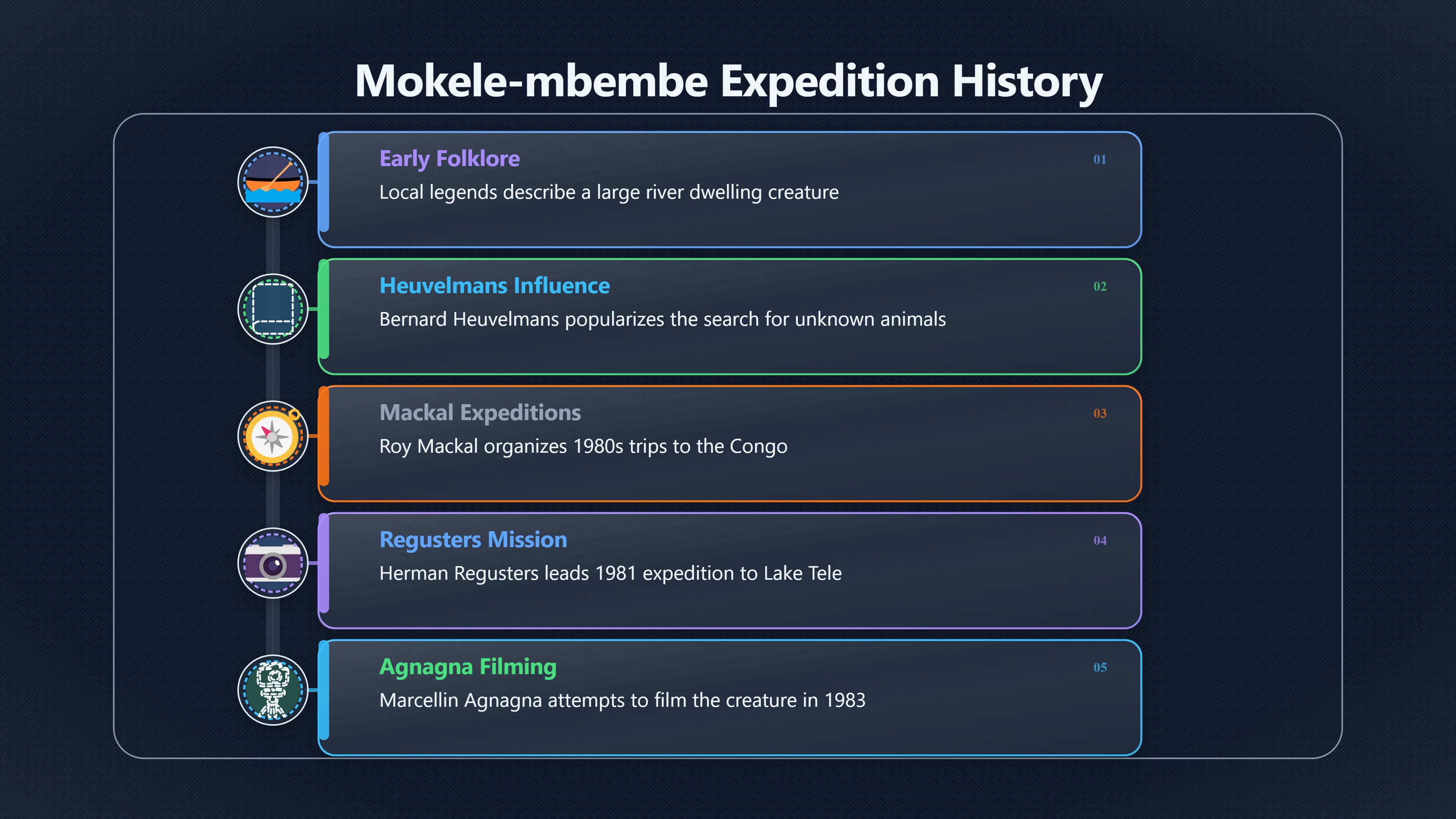
The idea attracted the attention of early cryptozoologists, a movement focused on investigating animals reported in folklore or disputed sightings. The Belgian-French researcher Bernard Heuvelmans helped popularise the search for unknown animals through works such as On the Track of Unknown Animals, encouraging later investigators to examine reports from remote regions.[Wikipedia]WikipediaBernard HeuvelmansBernard Heuvelmans
One of the most influential investigators was Roy Mackal, who organised expeditions to the Congo region in 1980 and 1981. Mackal and explorer James Powell travelled through areas associated with the Likouala swamps, interviewing local people and collecting reports about the creature. They returned with accounts from witnesses but no physical proof.[Wikipedia]WikipediaOpen source on wikipedia.org.
For supporters of the search, these interviews were important because witnesses sometimes gave similar descriptions of a large river-dwelling animal. For critics, the same material showed the limitations of expedition-based investigation: stories could be sincere without necessarily identifying an unknown species, and memory, translation, expectation and cultural context could all influence reports.[Wikipedia]WikipediaOpen source on wikipedia.org.
Lake Tele and the race for evidence
The most famous destination in the Mokele-mbembe search was Lake Tele in the Republic of the Congo, a remote wetland area that became the symbolic centre of the mystery. Reaching such places was itself a major challenge, requiring long journeys through difficult waterways and forest environments.[CaltechAUTHORS]authors.library.caltech.edu1sbtg gx017AUTHORSMokele-Mbembe: an investigation into rumors concerning a strange animal in the Republic of the Congo, 1981 | CaltechAUTHORS…
In 1981, American engineer Herman Regusters led an independent expedition to Lake Tele. Regusters reported a possible sighting of a long-necked creature and returned with claims of photographs, sound recordings and other possible traces. However, the material remained inconclusive, with no evidence accepted by zoologists as proof of an unknown large animal.[CaltechAUTHORS]authors.library.caltech.edu1sbtg gx017AUTHORSMokele-Mbembe: an investigation into rumors concerning a strange animal in the Republic of the Congo, 1981 | CaltechAUTHORS…
Other searches followed, including an expedition led by Congolese biologist Marcellin Agnagna in 1983. Agnagna reported seeing and filming the creature, but the footage did not provide verifiable evidence. These repeated failures became a central part of the debate: each expedition added to the legend, but none crossed the line from intriguing report to scientific discovery.[Institute for Creation Research]icr.orgInstitute for Creation Research The Institute for Creation ResearchInstitute for Creation Research The Institute for Creation Research
Media attention and public fascination
Why Congo became the setting for monster quests
Congo expeditions captured public imagination because they combined genuine exploration with one of humanity’s oldest stories: the hope of finding something thought impossible. The Congo Basin was portrayed in popular culture as a vast, mysterious wilderness where unknown creatures might survive beyond modern knowledge.[Wikipedia]WikipediaOpen source on wikipedia.org.
This image was strengthened by real discoveries from other parts of Africa and the wider natural world. The twentieth century had already shown that unusual animals could remain unknown to Western science until relatively recently, making the idea of hidden species seem plausible to many readers. However, the leap from discovering a new animal to finding a surviving dinosaur was much larger and required much stronger evidence.[Scientific American]scientificamerican.comOpen source on scientificamerican.com.
Books, newspapers and television programmes transformed the expeditions into adventure narratives. The Mokele-mbembe story became a kind of African counterpart to famous lake-monster legends elsewhere, with explorers replacing traditional monster hunters. The appeal came from the journey itself: remote rivers, uncertain sightings, mysterious sounds and the possibility of discovery.[Wikipedia]WikipediaOpen source on wikipedia.org.
The role of documentaries and popular culture
Media coverage often focused on the most dramatic possibility — a dinosaur surviving in the modern world — because it created a powerful story. Yet many investigators themselves were dealing with a much broader question: whether an unknown large animal might exist in poorly studied environments. The popular “living dinosaur” label narrowed a more complicated situation into a simpler adventure narrative.[Scientific American]scientificamerican.comOpen source on scientificamerican.com.
The media also amplified the problem of evidence. A blurred image, unexplained sound or unusual footprint could become famous long before experts had enough information to judge it. The history of Mokele-mbembe hunts shows how modern monster legends are built not only from sightings, but from the way stories travel through newspapers, television and books.[Skeptical Inquirer]skepticalinquirer.orgOpen source on skepticalinquirer.org.
Science, uncertainty and the search for proof
What the expeditions actually found
The strongest evidence produced by Congo monster hunts has been testimony: reports from people who said they had seen unusual creatures. Such accounts are historically valuable because they reveal local beliefs, environmental knowledge and how communities interpret unfamiliar animals. However, testimony alone cannot establish the existence of a new species.[Wikipedia]WikipediaOpen source on wikipedia.org.
The searches did not produce the kinds of evidence scientists would normally expect from a large unknown animal: a body, bones, reliable biological samples, repeated high-quality photographs or genetic material. The lack of physical evidence after decades of interest has led most zoologists to regard Mokele-mbembe as an unconfirmed creature rather than a discovered species.[Skeptical Inquirer]skepticalinquirer.orgOpen source on skepticalinquirer.org.
Several ordinary explanations have been proposed. Some researchers suggest that sightings may involve known animals viewed in difficult conditions, including large forest animals, aquatic species or unusual combinations of movement and landscape. Others argue that some reports belong more properly to folklore, where a creature’s meaning matters as much as its physical existence.[Wikipedia]WikipediaOpen source on wikipedia.org.
Why the search continues
The failure to find proof has not ended interest because the Congo Basin remains a powerful symbol of exploration. For believers, the lack of discovery can be explained by the region’s size and difficulty of access. For sceptics, repeated searches without evidence make a surviving dinosaur increasingly unlikely. Both sides are responding to a genuine feature of the story: the Congo is remote enough to inspire mystery, but not isolated enough to avoid decades of investigation.[Reddit]reddit.comA big problem in cryptozoology is the inability to let a cryptid goA big problem in cryptozoology is the inability to let a cryptid goOctober 18, 2023…
The lasting importance of Congo monster hunts is therefore cultural as much as zoological. They show how rumours become expeditions, how expeditions become legends, and how the search for the unknown can remain fascinating even when the final answer is uncertainty. Mokele-mbembe has survived not because explorers proved a monster exists, but because the hunt itself became one of the modern era’s great stories of wilderness, belief and discovery.
Amazon book picks
Further Reading
Books and field guides related to When Explorers Searched Congo's Unknown Wilds. Use these as the next step if you want deeper reading beyond the article.

On the Track of Unknown Animals
Covers the investigative tradition behind searches for unknown animals.
eBay marketplace picks
Marketplace Samples
Live-tested eBay searches with available results related to this page.



Endnotes
1.
Source: Wikipedia
Link:https://en.wikipedia.org/wiki/Mokele-mbembe
2.
Source: Wikipedia
Title: Bernard Heuvelmans
Link:https://en.wikipedia.org/wiki/Bernard_Heuvelmans
3.
Source: reddit.com
Title: A big problem in cryptozoology is the inability to let a cryptid go
Link:https://www.reddit.com/r/Cryptozoology/comments/17aw4vx/a_big_problem_in_cryptozoology_is_the_inability/
Source snippet
A big problem in cryptozoology is the inability to let a cryptid goOctober 18, 2023...
Published: October 18, 2023
4.
Source: new-cryptozoology.fandom.com
Link:https://new-cryptozoology.fandom.com/wiki/Mokele-Mbembe
Source snippet
fandom.comMokele-Mbembe | New Cryptozoology Wiki | Fandom1981: REGUSTERS[EDIT] In 1981, American engineer Herman Regusters led his own...
5.
Source: scientificamerican.com
Link:https://www.scientificamerican.com/blog/tetrapod-zoology/misreading-the-mokele-mbembe-the-mokele-mbembe-part-1/
6.
Source: skepticalinquirer.org
Link:https://skepticalinquirer.org/2024/12/fringe-zoology-the-inconvenience-of-disappearing-evidence/
7.
Source: icr.org
Link:https://www.icr.org/article/8922
Source snippet
The Institute for Creation ResearchAugust 4, 2015 — NEWS CREATION SCIENCE UPDATE MEN AND DINOSAURS COEXISTED A Real Jurassic World? BY...
Published: August 4, 2015
8.
Source: authors.library.caltech.edu
Title: 1sbtg gx017
Link:https://authors.library.caltech.edu/records/1sbtg-gx017
Source snippet
AUTHORSMokele-Mbembe: an investigation into rumors concerning a strange animal in the Republic of the Congo, 1981 | CaltechAUTHORS...
9.
Source: icr.org
Title: Institute for Creation Research The Institute for Creation Research
Link:https://www.icr.org/articles/print/306
10.
Source: science.howstuffworks.com
Link:https://science.howstuffworks.com/science-vs-myth/strange-creatures/cryptozoology.htm
Source snippet
HowStuffWorksAugust 1, 2023 — CRYPTOZOOLOGY: HUNTING BIGFOOT AND OTHER MYSTERIOUS BEASTS By: Nathan Chandler & Desiree Bowie | Updated...
Published: August 1, 2023
11.
Source: cryptidarchives.fandom.com
Title: Herman Regusters
Link:https://cryptidarchives.fandom.com/wiki/Herman_Regusters
Source snippet
Regusters | Encyclopaedia of Cryptozoology | FandomHERMAN REGUSTERS Sign In to Save Save Edit * History * Purge * Talk (0) iframe Herman...
12.
Source: creationwiki.org
Link:https://creationwiki.org/Mokele-mbembe
Source snippet
He was supposed to be joined by Herman Regusters, but they came in conflict in terms of finance, equipmen...
13.
Source: openlibrary.org
Link:https://openlibrary.org/works/OL12484505W/Mokele-Mbembe
Source snippet
Regusters | Open LibraryAn edition of Mokele-Mbembe (1982) MOKELE-MBEMBE AN INVESTIGATION INTO RUMORS CONCERNING A STRANGE ANIMAL IN THE...
Additional References
14.
Source: sciencedirect.com
Link:https://www.sciencedirect.com/science/article/abs/pii/S1464343X10001767
Source snippet
origin - ScienceDirectNovember 1, 2010 — JOURNAL OF AFRICAN EARTH SCIENCES Volume 58, Issue 4, November 2010, Pages 667-679 LAC TÉLÉ STRU...
Published: November 1, 2010
15.
Source: tvi.show
Link:https://www.tvi.show/legends-lore/the-mokele-mbembe-congos-living-dinosaur-and-the-mystery-of-africas-elusive-legend
Source snippet
Mokele-Mbembe: Congo’s Legendary Dinosaur-Like Creature of the Congo River BasinMAJOR EXPEDITIONS AND INVESTIGATORS YouTube embed Numerou...
16.
Source: tvi.show
Link:https://www.tvi.show/nexus/mokele-mbembe-the-living-dinosaur-of-congo-basins-unexplored-wilderness
Source snippet
Mokele-mbembe: Hunt for Africa's "Living Dinosaur" in the Congo Basin | Cryptozoology ExpeditionMOKELE-MBEMBE: THE LIVING DINOSAUR OF CON...
17.
Source: genesispark.com
Link:https://www.genesispark.com/exhibits/evidence/cryptozoological/apatosaurs/mokele-mbembe/
Source snippet
The “Mokele-mbembe” of the Congo | Genesis ParkTHE “MOKELE-MBEMBE” OF THE CONGO (mow-kay’-lee em-bem-bee) “In the swampy jungles of weste...
18.
Source: headcountcoffee.com
Link:https://www.headcountcoffee.com/blogs/coffee-news/the-mokele-mbembe-expeditions-inside-the-congo-s-most-enduring-cryptid-search
Source snippet
November 19, 2025 — THE MOKELE-MBEMBE EXPEDITIONS: INSIDE THE CONGO’S MOST ENDURING CRYPTID SEARCH November 19, 2025 Updated November 19...
Published: November 19, 2025
19.
Source: contingentmagazine.org
Link:https://contingentmagazine.org/2019/03/18/hunting-dinosaurs-africa/
Source snippet
Hunting Dinosaurs in Central AfricaMarch 18, 2019 — To at least some Africans, this was the legendary mokele-mbembe, but Hagenbeck was su...
Published: March 18, 2019
20.
Source: ufomagazines.com
Link:https://www.ufomagazines.com/pursuit-situ-sanderson-pursuit-no-55-vol-14-no-3-1981/
Source snippet
September 30, 1981 — ARTICLE: THE CONGO WATER-DRAGON BY PHILIP AVERBUCK This article discusses the investigation into a cryptid known as...
Published: September 30, 1981
21.
Source: ninefornews.nl
Title: De zoektocht naar Mokele-mbembe: Het Congolese Monster van Loch Ness
Link:https://www.ninefornews.nl/de-zoektocht-naar-mokele-mbembe-het-congolese-monster-van-loch-ness/
Source snippet
29, 2011 — DE ZOEKTOCHT NAAR MOKELE-MBEMBE: HET CONGOLESE MONSTER VAN LOCH NESS Robin de Boer29 december 2011 12:57 0 2 minuten leestijd...
Published: december 2011
22.
Source: nationalgeographic.com
Title: What’s behind the strange rash of ’dinosaur’ sightings in the Congo?
Link:https://www.nationalgeographic.com/environment/article/congo-basin-mokele-mbembe-deforestation
Source snippet
National GeographicFebruary 4, 2025 — Image: A lush green jungle and horizon from a high angle. Odzala-Kokoua National Park is a vital...
Published: February 4, 2025
23.
Source: nationalgeographic.com
Title: The Science Behind Bigfoot and Other Monsters | National Geographic
Link:https://www.nationalgeographic.com/adventure/article/130907-cryptid-crytozoology-bigfoot-loch-yeti-monster-abominable-science
Source snippet
Photographer Roger Patterson compares his foot with cast in Los Angeles on Nov. 3, 1967 he says he made of California's Legendary "Bigfoot...
Topic Tree