Within Tunisia Uncanny
How Spirits Live in Tunisian Stories
Tunisia's spirit lore ranges from jinn stories to Stambeli trance healing and urban hammam legends rooted in memory and community.
On this page
- Jinn as everyday explanation and warning
- Stambeli music, trance and healing
- The hammam maiden and urban haunting
Page outline Jump by section
Introduction
Tunisia’s spirit lore is not a separate world of ghost stories reserved for dark nights. It is woven into everyday life through ideas about jinn, healing rituals, old neighbourhoods, bathhouses and family warnings passed from one generation to the next. For many Tunisians, stories about unseen beings have traditionally existed alongside Islamic belief, local custom and practical explanations for illness, misfortune or places that simply feel unsettling. At the same time, anthropologists and historians have shown that these traditions often preserve memories of slavery, migration, urban life and changing social relationships rather than functioning simply as tales of the supernatural.[University of Chicago Press]press.uchicago.eduOpen source on uchicago.edu.

From a Fortean perspective, Tunisia is especially interesting because its most persistent “hauntings” are rarely presented as spectacular ghost cases. Instead, they emerge through ordinary settings: a family home where strange noises are blamed on jinn, a healing ceremony where music invites communication with invisible spirits, or an old hammam whose reputation has become inseparable from an enduring urban legend. Whether interpreted as genuine spiritual encounters, psychological experiences or cultural storytelling, these traditions continue to shape how many people think about places, illness and memory.
Jinn as everyday explanation and warning
Unlike European ghost traditions centred on the spirits of the dead, Tunisian supernatural folklore is dominated by jinn, invisible beings recognised within Islamic tradition. Religious belief distinguishes jinn from human ghosts: they are understood as a separate order of creation rather than deceased people returning from the grave. Folk tradition, however, gives these unseen beings a rich everyday presence.
In many parts of Tunisia, jinn have historically been invoked to explain experiences that resist ordinary explanation. Sudden illness, recurring bad luck, frightening dreams, unexplained sounds or abandoned places might all become associated with unseen inhabitants. Such beliefs coexist with more ordinary explanations rather than replacing them. A family might seek medical treatment while also asking a respected religious figure to recite Qur’anic verses or prayers for protection.
The stories also perform practical social work. Children are warned against wandering into deserted buildings after dark. People may avoid isolated wells, caves or abandoned ruins not only because they are physically dangerous but because they are said to belong to jinn. In this sense, supernatural belief reinforces sensible caution through memorable narratives.
Modern Tunisia remains diverse in its attitudes. Many people understand jinn primarily through religious teaching, while others regard popular stories as folklore rather than literal truth. Urbanisation, higher education and social media have not eliminated these traditions; instead they have created lively debates between sceptics, believers and those who occupy a middle ground, accepting the cultural value of the stories without insisting that every reported encounter represents objective evidence of supernatural activity.
Why Stambeli matters beyond the paranormal
Among Tunisia’s most remarkable spirit traditions is Stambeli, a musical and healing practice whose significance extends far beyond ideas of possession. Ethnomusicologists trace its roots to communities descended from enslaved people brought from sub-Saharan Africa into Tunisia between the eighteenth and nineteenth centuries. Rather than being merely an exotic ritual, Stambeli preserves memories of displacement, identity and survival through music, dance and ceremonial performance.[University of Chicago Press]press.uchicago.eduOpen source on uchicago.edu.
From the outside, Stambeli ceremonies can appear mysterious. Musicians perform repetitive rhythms that gradually intensify while participants dance, sing and sometimes enter altered states of consciousness. Within the tradition, these experiences are not necessarily understood as frightening possessions. Instead, they may represent encounters with recognised spirit beings whose presence requires acknowledgement, respect or reconciliation.
Researchers who have observed Stambeli emphasise that its purpose is therapeutic rather than sensational. Ceremonies have been used to address emotional distress, chronic misfortune, the evil eye or illnesses interpreted as involving spiritual imbalance. The musical structure itself—with steadily increasing rhythmic intensity—helps participants enter trance states that facilitate healing according to the community’s beliefs.[Sage Journals]journals.sagepub.comSage JournalsStambali: Dissociative Possession and Trance in a Tunisian Healing Dance - Eli Somer, Meir Saadon, 2000…
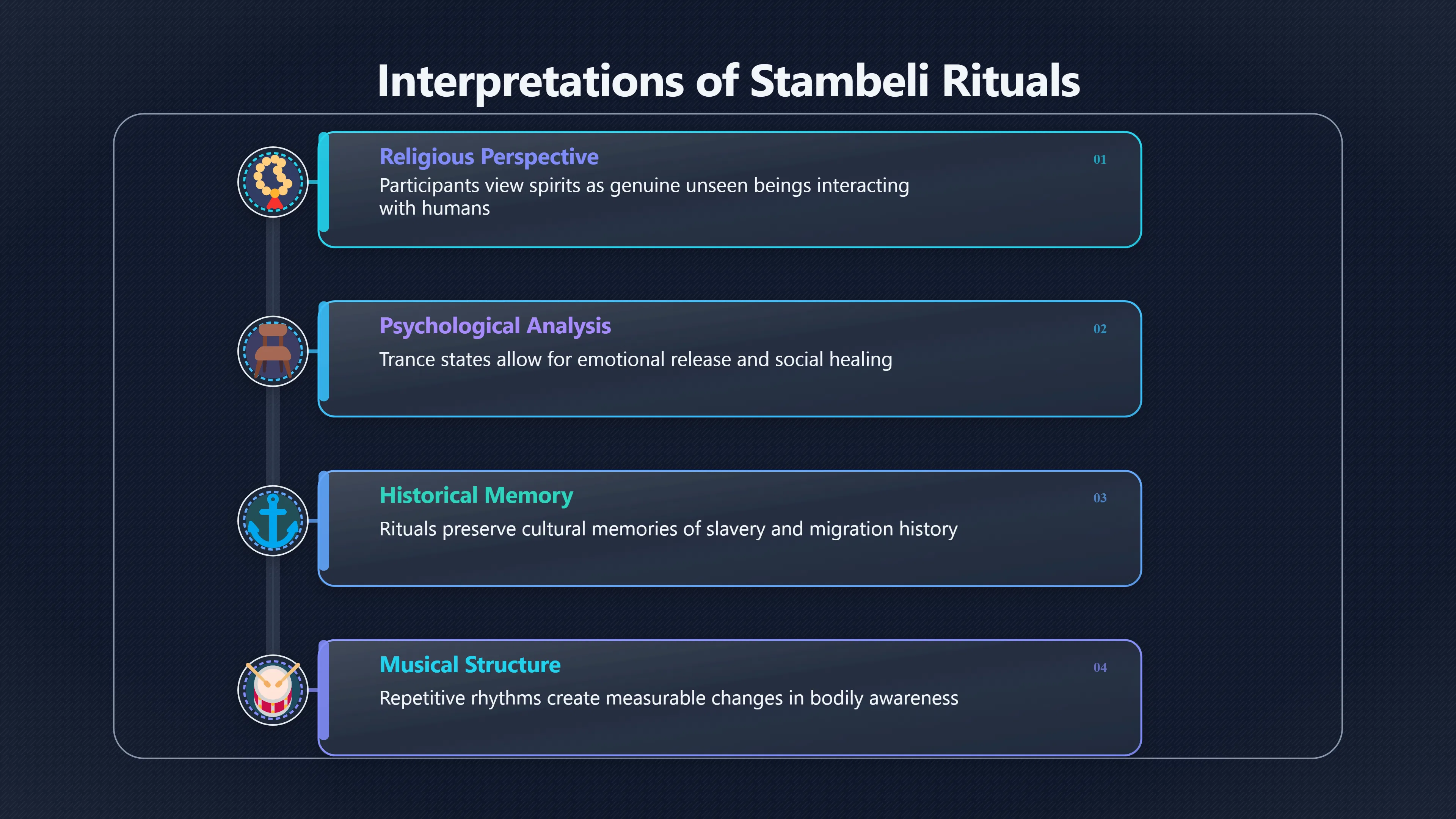
For Fortean readers, Stambeli illustrates an important distinction. Reports of possession cannot simply be filed as evidence for or against the paranormal. Anthropologists instead examine several overlapping interpretations:
- Religious interpretation: participants may understand spirits as genuine unseen beings interacting with people.
- Psychological interpretation: trance can be viewed as an altered state of consciousness that allows emotional release and social healing.
- Historical interpretation: the rituals preserve cultural memory of slavery, migration and African heritage within Tunisian society.
- Musical interpretation: carefully structured rhythm, repetition and movement create measurable changes in attention, emotion and bodily awareness.
These explanations need not exclude one another. What makes Stambeli culturally distinctive is precisely its ability to combine music, religion, community identity and healing into a single practice that different observers understand in different ways.

The haunted hammam and the “Hammam Maiden”
Tunisia’s best-known urban ghost legend centres not on a ruined castle or lonely cemetery but on a public bathhouse.
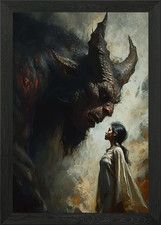
The story associated with Hammam Ed-Dahab in the old Medina of Tunis exists in several versions, but its central image remains remarkably consistent. A poor widow and her daughter spend the night inside the hammam after receiving permission to shelter there. As darkness falls, the ordinary bathhouse becomes a meeting place between the human and unseen worlds. A supernatural being emerges from beneath the floor, tempting the young woman with visions of immense wealth before carrying her away into the realm of the jinn. In some tellings she returns transformed; in others she vanishes forever.[Al Jazeera]aljazeera.comAl JazeeraSpooky Arab tales for Halloween: Tunisia’s hammam maiden | Arts and Culture | Al JazeeraOctober 31, 2023…
Like many urban legends, the story serves several functions at once. It warns against greed, reinforces traditional advice about avoiding empty public spaces after dark and invests a familiar neighbourhood with an atmosphere of mystery. Local storytellers often present it less as established history than as a tale everyone has heard from someone older.
The legend also demonstrates how haunted places emerge without requiring claims of documented paranormal events. The bathhouse itself becomes culturally haunted because generations continue telling the same story. Visitors who already know the legend naturally experience the building differently from someone encountering it without its folklore.
From a Fortean standpoint, this is an example of narrative shaping perception rather than proof that a location is objectively haunted. Yet the legend’s persistence says something important about how communities create and preserve places of memory.
Why these stories endure
Tunisian spirit traditions survive because they address experiences that purely factual explanations often leave emotionally unresolved. Illness, grief, unexplained coincidence, anxiety and historical trauma all find expression through stories about unseen beings.
Stambeli demonstrates how ritual can preserve collective memory of slavery while offering communal healing. Jinn stories provide moral lessons, encourage caution and help people discuss misfortune in culturally meaningful ways. Haunted hammam legends transform ordinary city spaces into landscapes rich with shared imagination.
Modern media have not erased these traditions. Instead, newspapers, documentaries, tourism and social media have given them new audiences. Some stories are retold for entertainment, others as expressions of religious belief, while scholars increasingly study them as windows into Tunisian history rather than simply cataloguing them as examples of superstition.[uchicago.edu]press.uchicago.eduOpen source on uchicago.edu.

Reading Tunisia’s spirit lore as Forteana
For readers interested in Fortean traditions, Tunisia offers an instructive pattern. The country’s most enduring supernatural narratives are rarely isolated ghost cases with identifiable witnesses and dramatic investigations. Instead, they exist where folklore, religion, music and everyday experience overlap.
That makes them difficult to classify. A Stambeli trance may be understood simultaneously as spiritual communication, psychological transformation and historical remembrance. A jinn story may express sincere religious belief while also functioning as social guidance. A haunted hammam may be less important as evidence for ghosts than as an example of how cities accumulate layers of narrative over centuries.
Rather than asking whether these traditions “prove” the supernatural, the more revealing question is why they have remained meaningful for so long. In Tunisia, the answer often lies not in spectacular paranormal claims but in the enduring power of stories to explain uncertainty, preserve memory and give familiar places an unseen dimension.
Amazon book picks
Further Reading
Books and field guides related to How Spirits Live in Tunisian Stories. Use these as the next step if you want deeper reading beyond the article.

Legends of the fire spirits
Directly explores jinn traditions across the Islamic world, including North Africa.
Magic and Divination in Early Islam (The Formation of the Cla...
First published 2004. Subjects: Magic, Occultism, Divination, Islamic empire, history, Islam.
Carthage must be destroyed
First published 2010. Subjects: History, Hannibal, 247 b.c-182 b.c., Carthage (extinct city), Rome, history, Rome, history, republic, 510...
eBay marketplace picks
Marketplace Samples
Live-tested eBay searches with available results related to this page.
Endnotes
1.
Source: stambeli.com
Link:https://www.stambeli.com/the-book/
Source snippet
The bookJanuary 1, 2010 — Image: Stambeli: Music, Trance, and Alterity in Tunisia STAMBELI: MUSIC, TRANCE, AND ALTERITY IN TUNISIA RICHARD C...
Published: January 1, 2010
2.
Source: stambeli.com
Title: The stambeli BLACK SPIRITS, WHITE SAINTS RICHARD C
Link:https://www.stambeli.com/the-stambeli/
Source snippet
JANKOWSKY Stambēlī is a music and trance healing tradition first developed in Tunisia by slaves and other displaced sub-Saharans who brou...
3.
Source: press.uchicago.edu
Link:https://press.uchicago.edu/ucp/books/book/chicago/S/bo9299440.html
4.
Source: journals.sagepub.com
Link:https://journals.sagepub.com/doi/10.1177/136346150003700406
Source snippet
Sage JournalsStambali: Dissociative Possession and Trance in a Tunisian Healing Dance - Eli Somer, Meir Saadon, 2000...
5.
Source: aljazeera.com
Link:https://www.aljazeera.com/features/2023/10/31/spirittales-tunisias-hammam-maiden
Source snippet
Al JazeeraSpooky Arab tales for Halloween: Tunisia’s hammam maiden | Arts and Culture | Al JazeeraOctober 31, 2023...
Published: October 31, 2023
6.
Source: uqu.edu.sa
Link:https://uqu.edu.sa/jss/129872
Source snippet
أنثروبولوجيا السحر والشعوذة في المجتمع التونسي: دراسة اثنوجرافية | مجلة جامعة أم القرى للعلوم الاجتماعية | جامعة أم القرىMarch 26, 2023 —...
Published: March 26, 2023
7.
Source: uqu.edu.sa
Link:https://uqu.edu.sa/en/jss/129872
Source snippet
Umm Al-Qura UniversityMarch 26, 2023 — THE ANTHROPOLOGY OF MAGIC AND SORCERY IN TUNISIAN SOCIETY: AN ETHNOGRAPHIC STUDY Share Page: Said...
Published: March 26, 2023
8.
Source: books.google.com
Link:https://books.google.com/books/about/Stambeli.html?id=TDXHtXRjZbQC
Source snippet
Jankowsky - Google BooksDecember 15, 2010 — STAMBELI: MUSIC, TRANCE, AND ALTERITY IN TUNISIA Richard C. JankowskyUniversity of Chicago Pr...
Published: December 15, 2010
9.
Source: journals.sagepub.com
Link:https://journals.sagepub.com/doi/pdf/10.1177/136346150003700406
Source snippet
sagepub.comStambali: Dissociative Possession and Trance in a Tunisian Healing Dance - Eli Somer, Meir Saadon, 2000December 1, 2000 — Firs...
Published: December 1, 2000
10.
Source: degruyterbrill.com
Link:https://www.degruyterbrill.com/document/doi/10.7208/chicago/9780226392202/html
Source snippet
Music, Trance, and Alterity in TunisiaPresented to you through Paradigm Publishing Services UNIVERSITY OF CHICAGO PRESS Visit our Partner...
Additional References
11.
Source: researchgate.net
Link:https://www.researchgate.net/publication/340251032_Les_Sept_Dormants_dans_le_Sud_tunisien_de_la_legende_au_culte_vivantThe_Seven_Sleepers_in_Southern_Tunisia_from_legend_to_living_worship
Source snippet
(PDF) Les Sept Dormants dans le Sud tunisien: de la légende au culte vivantThe Seven Sleepers in Southern Tunisia: from legend to living...
12.
Source: academic.oup.com
Link:https://academic.oup.com/book/10190/chapter-abstract/157761731
Source snippet
OUP AcademicVoicing the Between in Tunisian Sṭambēlī | Resounding Transcendence: Transitions in Music, Religion, and Ritual | Oxford Acad...
13.
Source: theses.fr
Link:https://theses.fr/1994PA010537
Source snippet
Jinn: croyances et pratiques traditionnelles en Tunisie | Theses.frJINN: CROYANCES ET PRATIQUES TRADITIONNELLES EN TUNISIE FR | EN Aute...
14.
Source: tandfonline.com
Link:https://www.tandfonline.com/doi/abs/10.1080/17411910701554021
Source snippet
eptember 27, 2007 — Ethnomusicology Forum Volume 16, 2007 - Issue 2 Submit an article Journal homepage 2,082 Views 16 CrossRef citations...
15.
Source: amideastedabroad.org
Link:https://www.amideastedabroad.org/home/spooky-stories
Source snippet
Welcome! Our site features the work of our blog abroad correspondents and has everything you need to know about our study abroad programs...
16.
Source: researchgate.net
Title: (PDF) Stambali: Dissociative Possession and Trance in a Tunisian Healing Dance
Link:https://www.researchgate.net/publication/254446776_Stambali_Dissociative_Possession_and_Trance_in_a_Tunisian_Healing_Dance
Source snippet
December 1, 2000 — Article PDF Available STAMBALI: DISSOCIATIVE POSSESSION AND TRANCE IN A TUNISIAN HEALING DANCE * December 2000 * Trans...
Published: December 1, 2000
17.
Source: carthagemagazine.com
Title: The Evil Eye, the Khomsa, and Other Tunisian Superstitions — Carthage Magazine
Link:https://carthagemagazine.com/tunisian-superstitions/
Source snippet
June 13, 2026 — THE EVIL EYE, THE KHOMSA, AND OTHER TUNISIAN SUPERSTITIONS 7 MIN READ By Editorial Staff June 13, 2026 Written by Editori...
Published: June 13, 2026
18.
Source: raseef22.net
Title: الجن الأحمر وأساطير الرعب في حمام “بلاع النساء” و”خطاف الصبايا”
Link:https://raseef22.net/article/1078923-%D8%A7%D9%84%D8%AC%D9%86-%D8%A7%D9%84%D8%A3%D8%AD%D9%85%D8%B1-%D9%88%D8%A3%D8%B3%D8%A7%D8%B7%D9%8A%D8%B1-%D8%A7%D9%84%D8%B1%D8%B9%D8%A8-%D9%81%D9%8A-%D8%AD%D9%85%D8%A7%D9%85-%D8%A8%D9%84%D8%A7%D8%B9-%D8%A7%D9%84%D9%86%D8%B3%D8%A7%D8%A1-%D9%88%D8%AE%D8%B7%D8%A7%D9%81-%D8%A7%D9%84%D8%B5%D8%A8%D8%A7%D9%8A%D8%A7
Source snippet
رصيف22July 9, 2020 — Image: الجن الأحمر وأساطير الرعب في حمام الجن الأحمر وأساطير الرعب في حمام "بلاع النساء" و"خطاف الصبايا" الأكثر قراء...
Published: July 9, 2020
19.
Source: si.edu
Title: Stambeli: music, trance, and alterity in Tunisia / Richard C
Link:https://www.si.edu/object/stambeli-music-trance-and-alterity-tunisia-richard-c-jankowsky%3Asiris_sil_1010737
Source snippet
Jankowsky | Smithsonian InstitutionSTAMBELI: MUSIC, TRANCE, AND ALTERITY IN TUNISIA / RICHARD C. JANKOWSKY Smithsonian Libraries and Arc...
20.
Source: blog.proximeety-maghreb.com
Title: rencontre avec la femme tunisienne et le hammam
Link:https://blog.proximeety-maghreb.com/rencontre-avec-la-femme-tunisienne-et-le-hammam/
Source snippet
Pour l’esprit populaire fertile, les sources minérales sont toutes entourées de légendes mystérieuses. En voici quelques exemples...
Topic Tree