Within Netherlands Weird
Did Goat Riders Haunt Limburg's Skies?
The Bokkenrijders show how robbery fears, torture-era confessions and devilish folklore fused into a lasting Limburg legend.
On this page
- Robbery, poverty and borderland fear
- Confessions, prosecutions and suspicion
- From demon panic to regional memory
Page outline Jump by section
Introduction
The Bokkenrijders, or “Goat Riders”, occupy a distinctive place in the strange history of Dutch Limburg. At first glance they sound like classic supernatural villains: servants of the Devil who flew through the night on goats, robbing farms and churches before vanishing into the darkness. Yet the historical reality is more unsettling than the legend. Behind the stories lay genuine waves of violent robbery in the eighteenth century, but also torture-driven confessions, judicial panic and a widespread belief that criminals had literally sworn themselves to Satan. The result was a remarkable fusion of organised crime, folklore and moral panic that still shapes Limburg’s identity today.[Wikipedia]WikipediaOpen source on wikipedia.org.

Rather than offering evidence for supernatural events, the Bokkenrijders story demonstrates how fear can transform ordinary crime into demon legend. It stands as one of the Netherlands’ clearest examples of the point where folklore, religion, criminal justice and collective imagination became almost impossible to separate.
Robbery, poverty and borderland fear
The historical Bokkenrijders operated across what is now southern Dutch Limburg, Belgian Limburg and neighbouring parts of Germany during the eighteenth century. The region was politically fragmented, economically uneven and difficult to police. Small bands of robbers exploited isolated farms, rectories and country houses, often attacking at night and using extreme violence to force victims to surrender money or valuables.[Visit Zuid-Limburg]visitzuidlimburg.comVisit Zuid-LimburgBokkenrijders | Visit Zuid-LimburgAccording to popular belief, the Goat Riders were persons or spirits who rode through…
The name “Bokkenrijders” appears relatively late in the surviving records. By the 1770s threatening letters claimed to come from mysterious Goat Riders and sometimes invoked Satan directly. One famous extortion letter from the 1774 Wellen investigations repeatedly mentioned the Devil, helping fuse criminal intimidation with existing folk beliefs about demonic powers.[Wikipedia]WikipediaOpen source on wikipedia.org.
This combination proved terrifying because the robbers appeared able to strike over surprisingly wide areas. Rural communities struggled to understand how apparently disconnected attacks could occur so quickly. Folklore supplied an answer: the criminals did not travel by horse or foot at all, but flew through the sky on enchanted goats provided by the Devil.
According to tradition, they chanted a spell while flying:
“Across houses, across gardens, across fences, even to Cologne into the wine cellar.”
Whether anyone genuinely believed the chant mattered less than the atmosphere it created. If criminals were thought capable of supernatural travel, ordinary explanations for their movements no longer seemed sufficient.[Wikipedia]WikipediaOpen source on wikipedia.org.
Why goats and the Devil became inseparable
The image of the flying goat did not appear from nowhere. Across early modern Europe, goats had long been associated with witchcraft, the Devil and forbidden gatherings. Christian imagery frequently portrayed Satan with goat-like features, while folklore linked nocturnal goat-riding with people who had renounced God.
By the eighteenth century these older beliefs blended naturally with reports of violent robberies. The Goat Riders were no longer merely thieves; they became people who had entered into an “ungodly oath”, abandoning Christianity in exchange for supernatural assistance. This transformed criminal investigations into something resembling the last echoes of European witch persecutions.[Wikipedia]WikipediaOpen source on wikipedia.org.
The supernatural elements also served practical purposes. Criminals who encouraged rumours of demonic powers could frighten victims into surrendering without resistance, while frightened witnesses became more likely to interpret unusual events through a supernatural lens.
Confessions, prosecutions and suspicion
The most disturbing part of the Bokkenrijders story is not the legend itself but the legal response.
Authorities increasingly treated alleged Goat Riders as both robbers and servants of the Devil. Ordinary criminal procedure gave way to investigations centred on supposed satanic oaths, secret societies and devil worship. Torture became a routine means of extracting confessions, and once one suspect named accomplices under interrogation, many more arrests followed.[Wikipedia]WikipediaOpen source on wikipedia.org.
Modern historians generally regard many of these confessions as profoundly unreliable. Under torture, prisoners frequently admitted impossible acts, including flying on goats across great distances. Statements often contradicted one another, yet were still accepted as evidence.
The scale of the prosecutions illustrates how panic expanded beyond the original robberies:
- Around 1,200 people were accused across several waves of investigations.
- Between roughly 425 and 468 people were executed, while others died during imprisonment or interrogation.
- The prosecutions occurred in multiple phases between the 1740s and the 1790s, rather than during one single conspiracy.[Wikipedia]WikipediaOpen source on wikipedia.org.
Many researchers now argue that there was never one enormous criminal organisation. Instead, there were probably numerous unrelated gangs operating over several decades, with judicial authorities mistakenly connecting them into a vast satanic network. The fear of hidden conspiracy proved as influential as the robberies themselves.[Wikipedia]WikipediaOpen source on wikipedia.org.
Were there really Bokkenrijders?
The answer depends on which question is being asked.
If “Bokkenrijders” means flying servants of the Devil, there is no historical evidence that such beings existed. The supernatural features belong to folklore, religious belief and confessions obtained under coercion.
If it refers to violent eighteenth-century robbers, the answer is clearly yes. Numerous documented raids, extortion attempts and criminal trials demonstrate that organised crime was a genuine problem in the Limburg borderlands.
The real historical debate concerns the relationship between these two realities.
Some nineteenth-century writers accepted the trials largely at face value, portraying the Goat Riders as a vast secret brotherhood. More recent historians have been far more sceptical, pointing to contradictory testimony, torture and the legal culture of the period. In this interpretation, the legend reveals less about supernatural criminals than about the dangers of combining fear, religious certainty and unreliable evidence.[Wikipedia]WikipediaOpen source on wikipedia.org.
From demon panic to regional memory
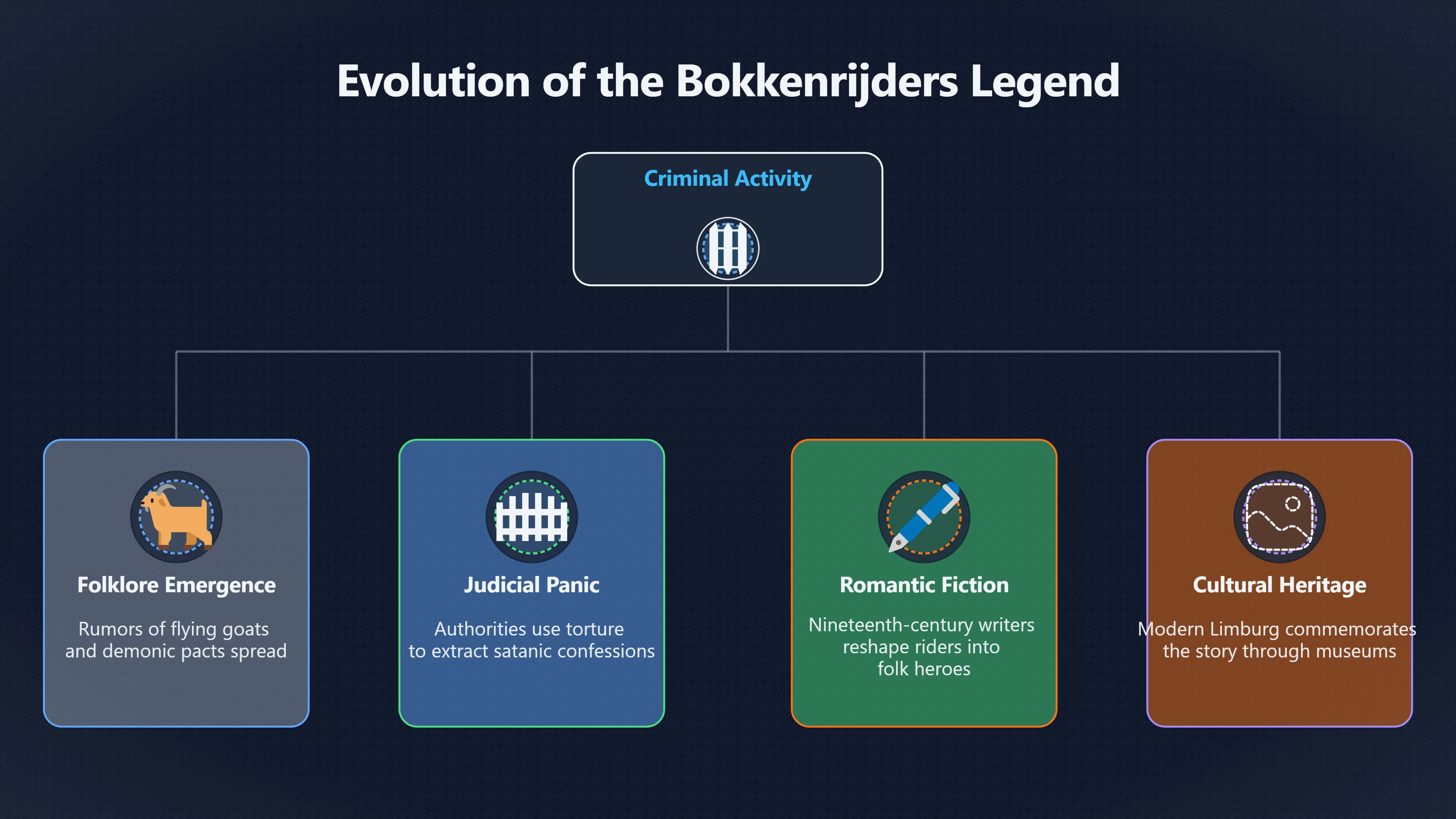
During the nineteenth century the Bokkenrijders underwent another transformation. Romantic writers reshaped the story into dramatic historical fiction, sometimes portraying the Goat Riders as tragic rebels or even folk heroes rather than satanic criminals. As more novels, plays and later television adaptations appeared, the historical record became increasingly intertwined with legend.[Wikipedia]WikipediaOpen source on wikipedia.org.
Today the Bokkenrijders are firmly embedded in Limburg’s cultural identity. Statues, museums, walking routes and festivals commemorate the story, while local attractions explore both the robberies and the folklore surrounding them. Modern presentations usually emphasise that many convictions were probably unsafe because torture played such a central role in the investigations.[Visit Zuid-Limburg]visitzuidlimburg.comVisit Zuid-LimburgBokkenrijders | Visit Zuid-LimburgAccording to popular belief, the Goat Riders were persons or spirits who rode through…
This dual memory is significant. Visitors encounter both the colourful image of ghostly riders crossing the night sky and the sobering reminder that fear of invisible evil contributed to the execution of many people who may never have belonged to any criminal gang.
Why the Bokkenrijders remain important in Dutch weird history
Among Dutch Fortean traditions, the Bokkenrijders stand apart because the mystery is not whether demons really flew over Limburg. The enduring fascination lies in how easily supernatural explanation attached itself to real violence.
The legend illustrates several recurring themes in the Netherlands’ strange history:
- genuine criminal events becoming embellished by folklore;
- religious belief shaping criminal investigations;
- torture producing spectacular but unreliable testimony;
- local legends preserving memories that are partly historical and partly mythical;
- later generations transforming fear into cultural heritage.
The Goat Riders therefore represent one of the clearest examples of how a country’s weird history can emerge from the meeting point of fact and imagination. Real robberies happened. Flying goats almost certainly did not. Yet belief in them altered investigations, influenced trials and left behind one of the Low Countries’ most enduring legends—a reminder that panic itself can become one of history’s most powerful storytellers.
Amazon book picks
Further Reading
Books and field guides related to Did Goat-Riders Haunt Limburg's Skies?. Use these as the next step if you want deeper reading beyond the article.
Europe's inner demons
Explains demonology, panic and persecution relevant to the Bokkenrijders.

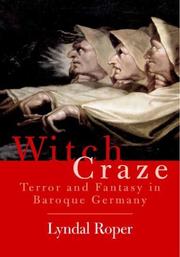

The Oxford illustrated history of witchcraft and magic
Connects folklore, crime and supernatural belief.
eBay marketplace picks
Marketplace Samples
Live-tested eBay searches with available results related to this page.


Endnotes
1.
Source: Wikipedia
Link:https://en.wikipedia.org/wiki/Buckriders
2.
Source: visitzuidlimburg.com
Link:https://www.visitzuidlimburg.com/experience-zuid-limburg/attraction/bokkenrijders/379685/
Source snippet
Visit Zuid-LimburgBokkenrijders | Visit Zuid-LimburgAccording to popular belief, the Goat Riders were persons or spirits who rode through...
Additional References
3.
Source: facebook.com
Link:https://www.facebook.com/61553095976114/posts/the-buckriders-dutch-bokkenrijders-french-les-chevaliers-du-bouc-are-a-part-of-b/122259603944103199/
Source snippet
The Buckriders (Dutch: Bokkenrijders, FrenchThey are ghosts or demons, who rode through the sky on the back of flying goats provided to t...
4.
Source: crossroadsmag.eu
Title: the bokkenrijders ghost riders in the limburg sky
Link:https://crossroadsmag.eu/2008/02/the-bokkenrijders-ghost-riders-in-the-limburg-sky/
Source snippet
goats, aided by the devil. But the history of the Goatriders is really about the interpretation of historical events. We can't take these...
5.
Source: instagram.com
Link:https://www.instagram.com/p/DKp_GpZo80N/
Source snippet
t ordinary criminals, but fear and superstition fueled by torture...
6.
Source: iamexpat.nl
Title: dutch folklore bokkenrijders
Link:https://www.iamexpat.nl/lifestyle/lifestyle-news/dutch-folklore-bokkenrijders
Source snippet
Dutch Folklore: The Bokkenrijders4 Jun 2020 — The Devil's goat riders. According to legend, the Bokkenrijders were demons that rode throu...
7.
Source: youtube.com
Link:https://www.youtube.com/watch?v=Ba3gc5VZ9E0
Source snippet
Robbers or Devils? — The Buckriders | Dutch Folktale for learning Dutch (B2)...
8.
Source: flanderstoday.eu
Title: uneasy riders
Link:https://www.flanderstoday.eu/living/uneasy-riders
Source snippet
3 Jul 2013 — Gang members would trample people and drink magic potions in a ritual to secure a pact with the devil. Arrest and torture. G...
9.
Source: youtube.com
Title: Villa Volta [On-Ride with Queue 4K POV]
Link:https://www.youtube.com/watch?v=BP88eRuN6KI
Source snippet
Efteling's Villa Volta The First Mad House Attraction...
10.
Source: youtube.com
Title: Robbers or Devils? — The Buckriders | Dutch Folktale for learning Dutch (B2)
Link:https://www.youtube.com/watch?v=QLnF51vvT3s
Source snippet
Scapegoats - Official Teaser...
11.
Source: youtube.com
Link:https://www.youtube.com/watch?v=8up3wVfHZa4
Source snippet
Villa Volta [On-Ride with Queue 4K POV] - Efteling...
12.
Source: youtube.com
Title: Efteling’s Villa Volta The First Mad House Attraction
Link:https://www.youtube.com/watch?v=hc0ZXAT7tzM
Topic Tree