Japan's Strangest Stories, Explained Without the Hype
Japan’s strange-history record is not a single shelf of “ghost stories” or “UFO cases”.
Page outline Jump by section
Introduction
The strongest Japanese Fortean material tends to sit on the boundary between folklore and documentation. Some stories survive in manuscripts, prints or museum collections; others are modern media legends with thin evidence but strong cultural afterlives. Japan’s weird-history appeal lies in that tension: the claim may be doubtful, but the reason it endured is often very real.
Why Japan is unusually rich ground for strange reports
Japan’s Fortean landscape is shaped by geography as much as imagination. It is an island country of mountains, rivers, earthquakes, volcanoes, typhoons, deep seas and densely remembered local places. A hazardous river can become the home of a child-snatching water creature; a catastrophic earthquake can be pictured as a giant fish; a mysterious light offshore can become a printed prophecy; a lonely tunnel can become the entrance to a forbidden village. The supernatural language is often doing practical work: warning children, explaining disaster, processing death, mocking authority or turning fear into a shareable image.
Japanese folklore also has a long visual life. The strange is not only told orally; it is drawn, printed, collected, performed and commercialised. Late Edo-period publishing helped turn spirits and monsters into recognisable public figures, while modern tourism, manga, games and online forums have given older patterns new routes of travel. Researchers of Japanese folklore and popular culture often stress that these creatures are not merely “monsters” in the simple horror-film sense. They can be comic, moral, local, protective, satirical or tragic, depending on the story and the moment.[wired.com]wired.comGhostwire: Tokyo Brings Japanese Folklore to the MassesGhostwire: Tokyo Brings Japanese Folklore to the Masses
That makes Japan especially interesting for country-level Forteana. The question is rarely “is this creature real?” in a zoological sense. More often, the revealing questions are: why was this reported in that form, why did people keep repeating it, what anxiety or landscape did it attach to, and how did later media reshape it?
Water monsters: from river warnings to lake legends
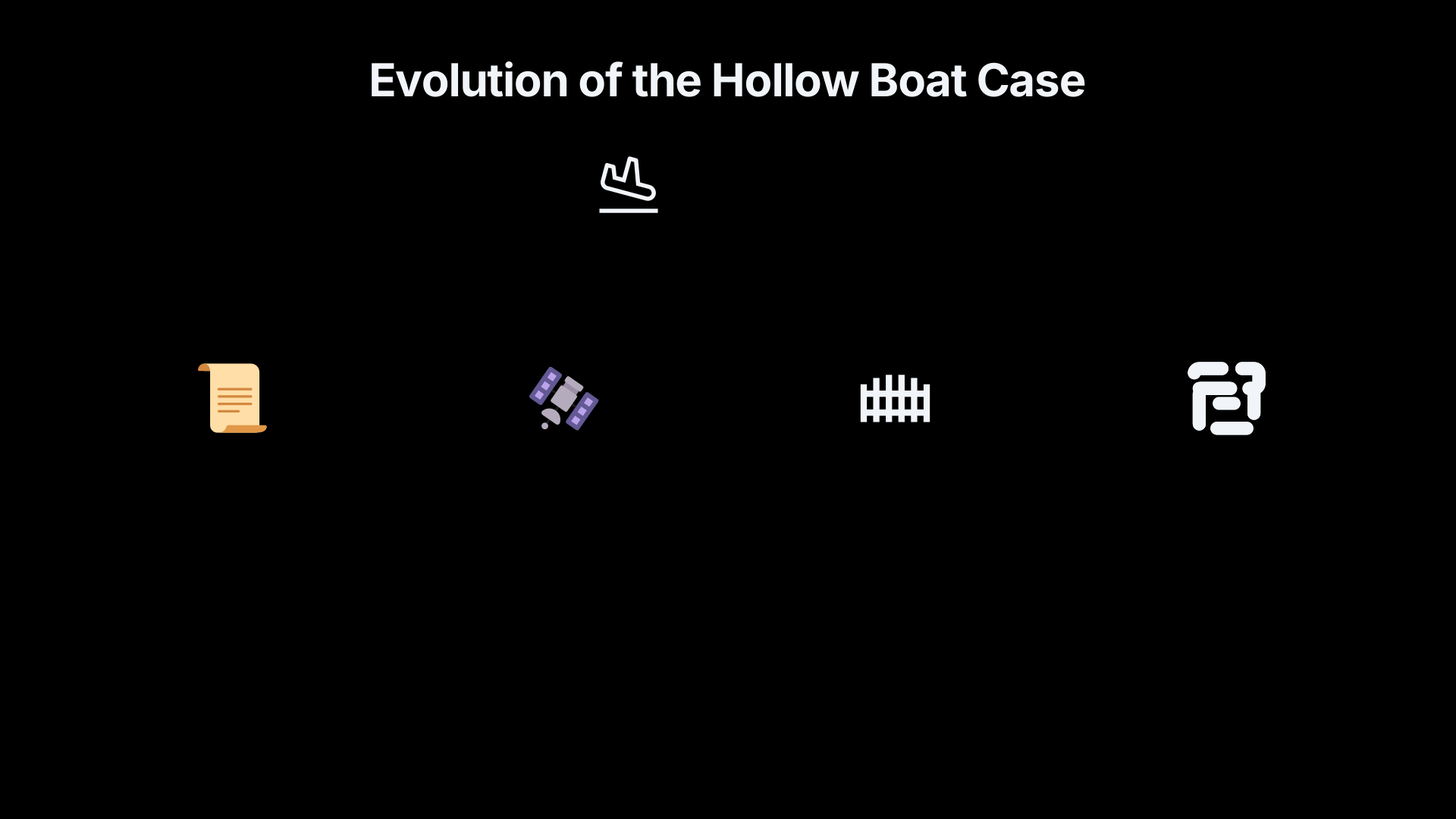
Japan’s best-known water creature is the kappa, usually described as a river-dwelling being with a mixture of childlike, reptilian and turtle-like features. The familiar details vary by region, but common motifs include a hollow or dish on the head that must remain wet, a taste for cucumbers, a fondness for wrestling, and a dangerous habit of dragging people or animals into water. Scholarly discussion has often treated the kappa as an example of folklore’s transformation into “folklorism”: a local, sometimes frightening water being becomes a national mascot, tourist figure and pop-cultural character.[National Diet Library Digital Collection]dl.ndl.go.jpOpen source on go.jp.
The sceptical reading does not need to flatten the story. Kappa tales make obvious sense in a country where rivers, irrigation channels and ponds could be deadly, especially for children. A frightening water-dweller gives shape to drowning risk and makes a rule memorable: do not play carelessly by the water. At the same time, kappa stories are not just safety posters in monster costume. They also carry regional identity, shrine practice, humour and the old habit of treating landscape as socially alive.[WIRED]wired.comGhostwire: Tokyo Brings Japanese Folklore to the MassesGhostwire: Tokyo Brings Japanese Folklore to the Masses
Japan’s modern lake monsters work differently. Lake Ikeda in Kagoshima Prefecture is associated with “Issie” or “Isshi”, often presented as Japan’s answer to the Loch Ness Monster. Local tellings commonly connect the creature to a tragic legend of a mare searching for her foal before transforming into a lake monster, while modern coverage places the story firmly in the world of lake-monster tourism and local curiosity rather than hard biological evidence.[peak-experience-japan.com]peak-experience-japan.comOpen source on peak-experience-japan.com.
This contrast matters. The kappa belongs to a deep river-folklore ecology: danger, ritual, regional names, moral instruction. Issie belongs more to the twentieth-century global lake-monster pattern: a named creature, a scenic body of water, a tourist-friendly comparison with Loch Ness, and sightings that are difficult to test. Both are “mystery animals” in a broad Fortean sense, but their evidential weight and cultural jobs are quite different.
The hollow boat of 1803: Japan’s most tempting “ancient UFO”
Few Japanese strange tales invite modern reinterpretation as strongly as the 1803 “hollow boat” story. In the usual account, an unusual vessel drifted ashore on the coast of Hitachi Province, now broadly associated with Ibaraki Prefecture. Inside was a young woman who could not communicate with the locals and carried or guarded a mysterious box. The craft was described with details that later readers found irresistible: a rounded form, strange materials, windows or glass, unfamiliar writing, and a passenger who seemed foreign in every sense.[Nippon]nippon.com“Utsurobune”: A UFO Legend from Nineteenth-Century Japan“Utsurobune”: A UFO Legend from Nineteenth-Century Japan
The case is valuable because it is not just a modern rumour. Versions appear in multiple nineteenth-century texts, including accounts associated with early Edo-period miscellanies and later collections. The Public Domain Review notes that the hollow boat appears in at least twelve late Edo literary sources, with one of the best-known versions in an 1825 collection by Bakin Takizawa. Specialist retellings also point to earlier manuscript traditions, including an account often dated to around 1815.[publicdomainreview.org]publicdomainreview.orgutsuro buneutsuro bune
That does not make it an alien visitation. The more grounded interpretation is that the story belongs to a wider tradition of drift, foreignness, forbidden contact and wonder-tale storytelling in a period when Japan’s relationship with the outside world was tightly controlled. A strange woman arriving by sea could encode anxieties about shipwrecks, outsiders, sexuality, law, disease or border control. The “UFO” reading is modern and understandable, because the image looks uncannily like a flying-saucer story in reverse; but the sources are Edo-period tale collections, not instrument records or official incident reports.[Nippon]nippon.com“Utsurobune”: A UFO Legend from Nineteenth-Century Japan“Utsurobune”: A UFO Legend from Nineteenth-Century Japan
The hollow boat is therefore one of Japan’s best Fortean cases precisely because it resists a single tidy label. It is not good evidence for extraterrestrials, but it is excellent evidence for how old motifs can be reactivated by new technologies of imagination. A boat becomes a capsule; a foreign woman becomes an alien; unreadable marks become “symbols”; a coastal wonder becomes a prehistory of the UFO.
Prophecy, plague and the strange comfort of Amabie
Amabie is one of the clearest examples of a Japanese strange report moving from nineteenth-century print culture into modern crisis culture. The creature was recorded in an 1846 illustrated broadside now held by Kyoto University Library. In the story, a local official in Higo Province, now Kumamoto Prefecture, investigates mysterious lights at sea and encounters a scaled, three-legged, bird-beaked or mermaid-like being. It gives a prophecy of good harvest and instructs people to show its image if disease spreads.[kyoto-u.ac.jp]rmda.kulib.kyoto-u.ac.jpOpen source on kyoto-u.ac.jp.
During the COVID-19 pandemic, Amabie became a viral image in Japan and beyond. Artists redrew the creature; museums, shops and public bodies used it as a symbol of hope, humour and shared endurance. The revival did not mean that modern Japan had abandoned medicine for magic. Rather, Amabie offered a culturally familiar way to do something emotionally useful: make an image, share it, and feel connected in a frightening period.[Asia Research Institute, NUS]ari.nus.edu.sgOpen source on edu.sg.
As Forteana, Amabie is especially instructive because the “evidence” is not evidence for a real sea-creature. The important artefact is the 1846 print and its afterlife. The odd claim survived because it was simple, visual and actionable: draw me, show me, avert disease. In modern terms, it behaved almost like a pre-digital meme. That makes it a bridge between apparition, public health folklore, print culture and social media.
Earthquake catfish: when disaster needed a body
Japan’s earthquake folklore gives one of the country’s most vivid explanations for invisible natural force: a giant catfish beneath the earth thrashes and causes the ground to shake. The creature is often linked with the deity of Kashima, who restrains it with a foundation stone. When restraint fails, the fish moves and the world convulses. The motif became especially visible after the 1855 Ansei Edo earthquake, when woodblock prints known as catfish pictures were produced in large numbers.[wikipedia.org]WikipediaOpen source on wikipedia.org.
These prints were not simply disaster cartoons. They could be religious, comic, political and socially sharp. Some showed the catfish being subdued; others used it to comment on redistribution, rebuilding and the social order after catastrophe. Gregory Smits’s work on the 1855 prints argues that they allowed common people to talk about politics and society under cover of discussing an earthquake. In other words, the monster gave disaster a face, but it also gave criticism a mask.[meijiat150dtr.arts.ubc.ca]meijiat150dtr.arts.ubc.caOpen source on ubc.ca.
There is also a more empirical edge to the catfish tradition. Some accounts connect fish behaviour with earthquake prediction, and twentieth-century researchers did investigate animal responses before earthquakes. That does not validate the mythic catfish under Japan, and reliable earthquake prediction remains a difficult scientific problem. But it helps explain why the folklore had staying power: anyone living in a seismic country will notice animals, wells, weather, sounds and sensations in the anxious period around a quake. The line between omen, observation and pattern-seeking can be very thin.[Wikipedia]WikipediaOpen source on wikipedia.org.
Ghosts after catastrophe: why the 2011 tsunami stories mattered
After the 2011 Tohoku earthquake and tsunami, stories circulated of ghostly encounters in devastated coastal areas. One widely reported cluster concerned taxi drivers in Ishinomaki who said they picked up passengers who vanished before the end of the journey. These accounts were associated with research by sociology student Yuka Kudo, who interviewed drivers about experiences in the disaster zone.[The Drive]thedrive.comafter japans tsunami taxi drivers carry ghosts trying to get homeafter japans tsunami taxi drivers carry ghosts trying to get home
Handled badly, such stories become ghoulish entertainment. Handled carefully, they are part of the human aftermath of mass death. The 2011 disaster killed thousands, destroyed communities and left survivors living among absences that were not abstract. A driver reporting a passenger who asks to go home, then disappears, is not simply offering a spooky anecdote. The story expresses grief, unfinished journeys and the impossibility of returning to a home that may no longer exist.
Japanese ghost traditions already had room for spirits who remain because something is unresolved. Modern media often reduces such figures to horror imagery, but the older emotional range is broader: sorrow, anger, duty, longing, social wrong and improper closure. The Tohoku taxi stories belong in that wider moral and emotional landscape. They are not verifiable evidence of survival after death; they are evidence that catastrophe produces experiences and narratives that feel ghost-shaped.[Wikipedia]WikipediaOpen source on wikipedia.org.
Modern UFO Japan: from village tourism to defence questions
Japan’s UFO culture includes both local spectacle and official caution. The former is best represented by Iino in Fukushima, known as a “UFO village” and home to a UFO museum. Tourism sources describe the area as associated with sightings of luminous or unexplained flying objects, while the museum presents local material alongside broader UFO history, photographs, documents, models and films.[fukushima.travel]fukushima.travelIino UFO MuseumIino UFO Museum
The more official strand has become more visible since the United States reframed some UFO discussion as “unidentified anomalous phenomena” and a possible airspace-security issue. In 2020, Japan’s Defence Ministry reportedly set out procedures for Self-Defence Forces personnel encountering unidentified aerial objects. In 2024, Reuters reported that Japanese lawmakers, including former defence ministers, were forming a non-partisan group to urge better government capacity to collect and analyse UAP information, partly out of concern that some sightings could represent drones or advanced foreign systems rather than anything extraterrestrial.[The Japan Times]japantimes.co.jpjapan defense ministry ufojapan defense ministry ufo
That distinction is crucial. “Unidentified” does not mean alien. In modern Japan, as elsewhere, a serious UAP question can sit beside a folkloric UFO culture without endorsing flying saucers. A light in the sky may be a balloon, aircraft, drone, satellite, re-entry, optical effect, classified technology, mistake or hoax. The Fortean interest is in how the same category can support tourism, local identity, parliamentary discussion and internet speculation at once.
The Kera incident of 1972 shows the more classic close-encounter pattern. In popular retellings, schoolboys in Kochi Prefecture allegedly found or photographed a small hat-shaped object after seeing it fly above a rice field. The case has the ingredients UFO readers love: youthful witnesses, an object, markings, repeat encounters and later debate over whether it was a hoax, misidentified object or something stranger. The available English-language sourcing is mostly secondary and enthusiast-driven, so the responsible conclusion is modest: Kera is a notable Japanese UFO legend, not a solved case.[pinktentacle.com]pinktentacle.comthe case of the captured mini ufo 1972the case of the captured mini ufo 1972
Manufactured monsters and debunked relics
Japan’s strange record also includes objects that look at first like physical evidence for impossible creatures. The most famous recent example is the so-called mermaid mummy kept at Enjuin temple in Okayama Prefecture. The object was said to resemble a human-fish hybrid and had been treated as a curiosity or relic, but modern analysis using X-rays, CT scans, radiocarbon dating and DNA methods found it was not a genuine animal. Reports on the study describe a constructed object made from materials such as paper, cloth, cotton, fish parts, scales and animal hair, with no complete skeleton inside.[explorersweb.com]explorersweb.comFoot-Long 'Mermaid' Mummy Discovered in JapaneseFoot-Long 'Mermaid' Mummy Discovered in Japanese
This kind of debunking does not make the object worthless. It changes the question. Instead of “is this a mermaid?”, the better question becomes “who made it, for whom, and why?” Japan, like Europe and North America, has histories of showmanship, temple relics, travelling displays and crafted marvels. A fake monster can still be a real cultural artefact.
Kappa and mermaid “mummies” sit in the same uncomfortable but fascinating space. They may borrow the authority of bones, shrines or old boxes, yet their power comes from a public willing to look twice. Modern scans can end the biological claim, but they do not erase the object’s value as evidence of belief, trade, entertainment and the appetite for tangible wonder.[Wikipedia]WikipediaKappa (folkloreKappa (folklore
Urban legends: tunnels, forbidden villages and the internet
Japanese urban legends often work by fastening supernatural dread to a real location. The Inunaki Village legend is a good example. It describes a hidden settlement near the Inunaki mountain area in Fukuoka Prefecture where normal Japanese law supposedly does not apply. The legend is entangled with the real Old Inunaki Tunnel, a place associated with danger, crime, abandonment and later horror tourism. Online versions of the forbidden village story appear to have spread from the late 1990s, and the legend has since fed films, games and trespassing problems.[Wikipedia]WikipediaInunaki VillageInunaki Village
The structure is classic modern folklore. A real place supplies the map coordinates; a crime or dangerous site supplies moral gravity; the internet supplies repetition; horror media supplies imagery; visitors supply new rumours. The result is not a traditional village legend preserved unchanged from the deep past, but a feedback loop between locality, fear and entertainment.
Sceptically, the “village outside Japan” claim collapses quickly. Culturally, it survives because it dramatizes a powerful anxiety: that just beyond the road, tunnel or dam there might be a pocket of lawlessness where normal rules fail. In a highly ordered society, that fantasy of the ungoverned place can be especially potent.
Internet cryptids and the modern Japanese weird
Not all Japanese Forteana is ancient or even old. The “Ningen”, usually described as a pale humanoid or whale-like creature of Antarctic waters, is a modern internet cryptid associated with Japanese online forums and later paranormal media. Its evidential basis is extremely weak, and sceptical explanations include invention, image ambiguity, ice formations, whales or other misread marine imagery.[Wikipedia]WikipediaNingen (folkloreNingen (folklore
The Ningen matters less as a candidate animal than as an example of media-lore. It shows how a story can gain the flavour of a maritime legend without the slow development of traditional oral folklore. A forum post, a suggestive image, a paranormal magazine item and a few retellings can create a creature that feels older than it is. The name, the Antarctic setting and the whaling-research atmosphere give it a bureaucratic chill that suits modern horror.
This is the twenty-first-century version of a much older process. Edo broadsheets turned strange lights and sea-creatures into printed marvels; modern forums turn vague images and anonymous claims into cryptids. The technology changes, but the appetite for a creature at the edge of the map does not.
How to read Japan’s Forteana without spoiling it
A good reading of Japanese strange material has to keep two habits in balance. The first is sceptical discipline: distinguish manuscripts from memories, folklore from journalism, tourism from testimony, hoaxes from honest mistakes, and official UAP caution from alien claims. The second is cultural patience: do not assume that a story loses value when it stops being literally true.
Many of Japan’s strongest cases are best understood as records of social imagination under pressure. The kappa makes water dangerous in a way a child can remember. The earthquake catfish turns invisible seismic force into a body that can be blamed, restrained, mocked or printed. Amabie turns disease anxiety into an image people can share. Tsunami ghosts give grief a passenger seat. The hollow boat lets an isolated society imagine the foreign as beautiful, frightening and unreadable. UFO villages and internet cryptids show that modernity has not ended wonder; it has merely given wonder better distribution.
The result is a national weird-history record that is unusually rich because it is not only about anomalies. It is about how anomalies are made legible. Japan’s Forteana endures because its strange reports often do more than ask “what was that?” They ask what people do when the river, sea, sky, earth or dead refuse to stay ordinary.
Amazon book picks
Further Reading
Books and field guides related to Japan's Strangest Stories, Explained Without the Hype. Use these as the next step if you want deeper reading beyond the article.

Kwaidan: Stories and Studies of Strange Things
Foundational collection of Japanese supernatural tales.
Japanese tales
Provides historical legends and folklore that contextualise strange traditions.

The Book of Yōkai
Useful comparative folklore reading for understanding how cultures transform fears and places into stories.

Pandemonium and Parade
Explores how strange stories and monsters evolved across Japanese history.
eBay marketplace picks
Marketplace Samples
Live-tested eBay searches with available results related to this page.




Endnotes
1.
Source: wired.com
Title: Ghostwire: Tokyo Brings Japanese Folklore to the Masses
Link:https://www.wired.com/story/ghostwire-tokyo-japanese-folklore-yokai-yurei
2.
Source: Wikipedia
Title: Kappa (folklore)
Link:https://en.wikipedia.org/wiki/Kappa_%28folklore%29
3.
Source: peak-experience-japan.com
Link:https://www.peak-experience-japan.com/blog/505
4.
Source: nippon.com
Title: “Utsurobune”: A UFO Legend from Nineteenth-Century Japan
Link:https://www.nippon.com/en/japan-topics/g00879/
5.
Source: hyakumonogatari.com
Link:https://hyakumonogatari.com/2014/06/
6.
Source: hyakumonogatari.com
Link:https://hyakumonogatari.com/page/4/
7.
Source: rmda.kulib.kyoto-u.ac.jp
Link:https://rmda.kulib.kyoto-u.ac.jp/en/item/rb00000122/explanation/amabie
8.
Source: uwinnipeg.ca
Title: amabie an accidental creature of covid 19
Link:https://www.uwinnipeg.ca/east-asian-languages-and-cultures/amabie-an-accidental-creature-of-covid-19.html
9.
Source: ari.nus.edu.sg
Link:https://ari.nus.edu.sg/20331-33/
10.
Source: Wikipedia
Link:https://en.wikipedia.org/wiki/Namazu
11.
Source: meijiat150dtr.arts.ubc.ca
Link:https://meijiat150dtr.arts.ubc.ca/essays/smits/
12.
Source: Wikipedia
Link:https://en.wikipedia.org/wiki/Y%C5%ABrei
13.
Source: fukushima.travel
Title: Iino UFO Museum
Link:https://fukushima.travel/destination/iino-ufo-museum/389
14.
Source: reuters.com
Link:https://www.reuters.com/world/asia-pacific/japan-lawmakers-want-govt-guard-against-security-risks-ufos-2024-05-29/
15.
Source: pinktentacle.com
Title: the case of the captured mini ufo 1972
Link:https://pinktentacle.com/2009/07/the-case-of-the-captured-mini-ufo-1972/
16.
Source: explorersweb.com
Title: Foot-Long ‘Mermaid’ Mummy Discovered in Japanese
Link:https://explorersweb.com/mermaid-mummy-japanese-temple/
17.
Source: Wikipedia
Title: Inunaki Village
Link:https://en.wikipedia.org/wiki/Inunaki_Village
18.
Source: Wikipedia
Title: Ningen (folklore)
Link:https://en.wikipedia.org/wiki/Ningen_%28folklore%29
19.
Source: Wikipedia
Title: [Utsuro bune]({{ ‘utsuro-bune/’ | relative_url }})
Link:https://en.wikipedia.org/wiki/Utsuro-bune
20.
Source: Wikipedia
Title: List of reported UFO sightings
Link:https://en.wikipedia.org/wiki/List_of_reported_UFO_sightings
21.
Source: Wikipedia
Title: Iino, Fukushima
Link:https://en.wikipedia.org/wiki/Iino%2C_Fukushima
22.
Source: Wikipedia
Title: Lake Ikeda
Link:https://en.wikipedia.org/wiki/Lake_Ikeda
23.
Source: Wikipedia
Link:https://en.wikipedia.org/wiki/Amabie
24.
Source: Wikipedia
Link:https://en.wikipedia.org/wiki/Kussie
25.
Source: kappa.com
Link:https://www.kappa.com/
26.
Source: hyakumonogatari.com
Link:https://hyakumonogatari.com/2013/11/page/2/
27.
Source: hyakumonogatari.com
Title: Utsuro Bune – The Hollow Ship
Link:https://hyakumonogatari.com/2014/06/09/utsuro-bune-the-hollow-ship/
28.
Source: hyakumonogatari.com
Link:https://hyakumonogatari.com/category/uncategorized/page/3/
29.
Source: hyakumonogatari.com
Title: funa yurei
Link:https://hyakumonogatari.com/tag/funa-yurei/
30.
Source: hyakumonogatari.com
Title: bakekujira and japans whale cults
Link:https://hyakumonogatari.com/2013/05/10/bakekujira-and-japans-whale-cults/
31.
Source: hyakumonogatari.com
Title: [water monsters]({{ ‘water-monsters/’ | relative_url }})
Link:https://hyakumonogatari.com/tag/water-monsters/
32.
Source: hyakumonogatari.com
Title: what does ayakashi mean in english
Link:https://hyakumonogatari.com/2013/08/21/what-does-ayakashi-mean-in-english/
33.
Source: hyakumonogatari.com
Link:https://hyakumonogatari.com/2020/04/
34.
Source: hyakumonogatari.com
Link:https://hyakumonogatari.com/2012/02/
35.
Source: hyakumonogatari.com
Title: Amabie – The Healing Mermaid
Link:https://hyakumonogatari.com/2020/04/03/amabie-the-healing-mermaid/
36.
Source: hyakumonogatari.com
Title: chikaramochi yurei the strong japanese ghost
Link:https://hyakumonogatari.com/2013/09/30/chikaramochi-yurei-the-strong-japanese-ghost/
37.
Source: nippon.com
Link:https://www.nippon.com/en/japan-topics/b02505/
38.
Source: japan.travel
Title: kyushu lake ikeda summer activities kagoshima
Link:https://www.japan.travel/en/sg/guide/kyushu-lake-ikeda-summer-activities-kagoshima/
39.
Source: dl.ndl.go.jp
Link:https://dl.ndl.go.jp/view/prepareDownload?itemId=info%3Andljp%2Fpid%2F10209528
40.
Source: glam.uoregon.edu
Link:https://glam.uoregon.edu/yokaisenjafuda/page/kappa
41.
Source: publicdomainreview.org
Title: utsuro bune
Link:https://publicdomainreview.org/collection/utsuro-bune
42.
Source: publicdomainreview.org
Title: earthquakes in japanese woodblock prints
Link:https://publicdomainreview.org/collection/earthquakes-in-japanese-woodblock-prints/
43.
Source: thedrive.com
Title: after japans tsunami taxi drivers carry ghosts trying to get home
Link:https://www.thedrive.com/news/2053/after-japans-tsunami-taxi-drivers-carry-ghosts-trying-to-get-home
44.
Source: japantimes.co.jp
Title: japan defense ministry ufo
Link:https://www.japantimes.co.jp/news/2020/09/14/national/japan-defense-ministry-ufo/
45.
Source: businessinsider.com
Title: photos mysterious japanese mermaid mummy origin revealed by researchers 2023 2
Link:https://www.businessinsider.com/photos-mysterious-japanese-mermaid-mummy-origin-revealed-by-researchers
46.
Source: discovermagazine.com
Title: mermaid mummy revealed to be paper mache 44684
Link:https://www.discovermagazine.com/mermaid-mummy-revealed-to-be-paper-mache-44684
47.
Source: science.howstuffworks.com
Link:https://science.howstuffworks.com/science-vs-myth/strange-creatures/ningen.htm
48.
Source: facebook.com
Link:https://www.facebook.com/thejapantimes/posts/the-governments-top-spokesman-said-that-tokyo-is-analyzing-with-great-interest-a/1385554573610127/
49.
Source: youtube.com
Link:https://www.youtube.com/watch?v=UTCkKQvJ98o
50.
Source: yokai.com
Link:https://yokai.com/kappa/?srsltid=AfmBOop5XNa7huBgglFtPvi8rBGfne4H15Gwgbh2XOFycmlIZCoQkiYK
51.
Source: yokai.com
Link:https://yokai.com/amabie/?srsltid=AfmBOoosbvU2tEQKIUjHOMyf0TZI3ZkkZ0WfknkZM-pmRS6mqjYXYK5W
52.
Source: mythus.fandom.com
Link:https://mythus.fandom.com/wiki/Kappa
53.
Source: cryptidz.fandom.com
Link:https://cryptidz.fandom.com/wiki/Ningen
54.
Source: cryptidarchives.fandom.com
Link:https://cryptidarchives.fandom.com/wiki/Issie
55.
Source: mythus.fandom.com
Title: Inunaki Village
Link:https://mythus.fandom.com/wiki/Inunaki_Village
56.
Source: worldhistory.org
Link:https://www.worldhistory.org/kappa/
57.
Source: scribd.com
Link:https://www.scribd.com/document/911051184/inunaki
58.
Source: onmarkproductions.com
Link:https://www.onmarkproductions.com/html/kappa.shtml
59.
Source: thejapanesepage.com
Link:https://thejapanesepage.com/amabie/
60.
Source: japan-avenue.com
Link:https://japan-avenue.com/blogs/japan/yurei?srsltid=AfmBOopuy9TLsJXTlCC-mRG2SghRlN0H3NMhz3D6l59-bgqGqfLg9nJj
61.
Source: jamesmcpheeart.com
Link:https://www.jamesmcpheeart.com/product/yokai-kappa-japanese-mythology-size-5-x-7-/19
Additional References
62.
Source: youtube.com
Link:https://www.youtube.com/watch?v=vf82OS2D1Yo
Source snippet
5 Monsters Of Japanese Mythology Explained - 4K History & Mythology...
63.
Source: youtube.com
Title: The Most Disturbing Japanese Urban Legends Explained In 12 Minutes
Link:https://www.youtube.com/watch?v=y0YoKfA2d0k
Source snippet
2 Japanese Urban Legends From The Red Lantern District Explained In 10 Minutes...
64.
Source: youtube.com
Title: Japanese Tattoo 101: NAMAZU (Catfish)
Link:https://www.youtube.com/watch?v=1o22IgyqQrY
Source snippet
4 Exploring 25+ Monsters & Spirits of Japanese Folklore | The Ultimate Yokai Documentary...
65.
Source: reddit.com
Link:https://www.reddit.com/r/history/comments/11cbnze/mermaid_mummy_at_enjuin_temple_japan_a_mythical/
66.
Source: facebook.com
Link:https://www.facebook.com/groups/2726536164088516/posts/23921234734192018/
67.
Source: researchgate.net
Link:https://www.researchgate.net/publication/381405238_The_cryptoterrestrial_hypothesis_A_case_for_scientific_openness_to_a_concealed_earthly_explanation_for_Unidentified_Anomalous_Phenomena
68.
Source: instagram.com
Link:https://www.instagram.com/reel/DZHloRHtBWz/
69.
Source: facebook.com
Link:https://www.facebook.com/TheCSRJournal/posts/a-mummified-mermaid-was-discovered-in-fukushima-featuring-sharp-teeth-large-hand/1263026032585449/
70.
Source: reddit.com
Link:https://www.reddit.com/r/mythology/comments/p4osna/a_short_intro_to_the_japanese_kappa_more_in/
71.
Source: scribd.com
Link:https://www.scribd.com/document/964773747/Archeological-Anomalies-Graphic-Artifacts-William-R-Corliss
Topic Tree
Follow this branch
Related pages 192
- Afghan Forteana
- Antigua Uncanny
- Bosnian Mysteries
- Botswana Weird
- Brazil Strange
- +187 more in sidebar