What Makes Tajikistan's Weird History So Mountainous?
Tajikistan’s strange-history record is not a neat cabinet of famous ghosts and headline-grabbing monsters. It is more interesting than that: a mountain country where folklore, disaster memory, Soviet-era expedition culture, sacred landscape, meteor science and tourism legend overlap.
Page outline Jump by section
Why Tajikistan Feels Fortean Before Anything Happens
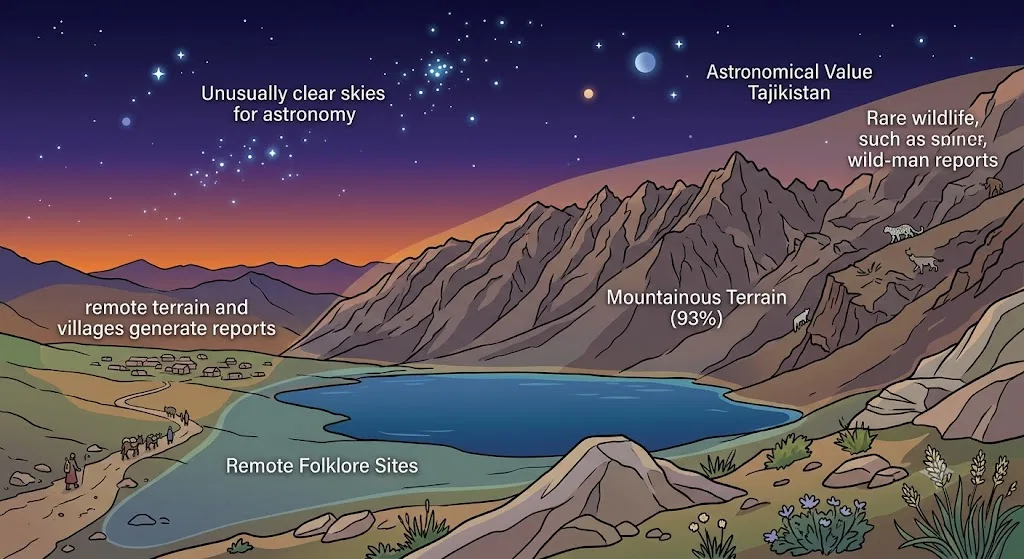
Tajikistan is unusually well suited to strange stories because the landscape itself does much of the work. Official country information describes it as overwhelmingly mountainous, with peaks, ranges and valleys creating sharp differences in climate, ecology and access; roughly 93% of the territory is mountainous.[EGOV.TJ]egov.tjOpen source on egov.tj. That matters because Fortean traditions often grow in places where observation is difficult: high passes, empty valleys, glacier basins, borderlands, lakes with few witnesses, and villages where oral memory travels more reliably than written reports.
The Pamirs, often presented in travel and scientific literature as one of Asia’s great highland regions, are central to this atmosphere. Modern studies of the Eastern Pamirs have even described the region as exceptional for astronomy because of its altitude, dry air and atmospheric stability, making it a literal landscape of unusually clear skies.[arXiv]arxiv.orgarXiv On the benefits of the Eastern Pamirs for sub-mm astronomyarXiv On the benefits of the Eastern Pamirs for sub-mm astronomy For a Fortean reader, that creates an appealing tension: the same country that invites stories of mystery lights and mountain beings is also a place where scientists go because the sky is unusually measurable.
This is why Tajikistan’s weird material is best read as “strange but grounded”. The country offers few well-documented classic poltergeist cases or newspaper-style rains of frogs. What it does offer is a set of stories where folklore, geology and eyewitness uncertainty sit close together.
The Pamir “Snowman”: Wild-Man Reports in Soviet Mountain Country
The most recognisably cryptozoological thread linked to Tajikistan is the “Abominable Snowman” or wild-man tradition of the Pamirs. English-language press reports from January 1988 carried a Soviet news-agency story about a Ukrainian-led research group that claimed to have seen a snowman-like creature in the Gissar range, in Soviet Central Asia near the Afghan border. The Los Angeles Times version said the group, led by Igor Tatsl, claimed to have come within about 35 yards of the creature and hoped to return for closer contact.[Los Angeles Times]latimes.comLos Angeles Times Ukrainians Claim to Have Seen Yeti in Asian MountainsLos Angeles Times Ukrainians Claim to Have Seen Yeti in Asian Mountains UPI likewise reported that a Soviet scientist leading an expedition said researchers had sighted what they believed was the legendary beast.[UPI]upi.comScientist reports seeing Abominable SnowmanScientist reports seeing Abominable Snowman
As evidence, this is weak: press summaries of an expedition claim, filtered through Soviet media, with no specimen, body, clear photograph or repeatable observation. As folklore and Cold War science culture, however, it is valuable. A specialist chapter on Soviet “Abominable Snowman” research argues that the yeti became, after the Second World War, part of a broader mass-cultural roster of elusive beings imagined just beyond the limits of confirmed knowledge.[Cryptozoological Reference Library]cryptozoologicalreferencelibrary.wordpress.comCryptozoological Reference Library Cold War CreaturesCryptozoological Reference Library Cold War Creatures Tajikistan’s mountains fitted that imaginative geography perfectly: remote enough to sustain possibility, inhabited enough to generate reports, and politically exotic enough for foreign readers to project mystery onto them.
A sceptical reading does not need to assume fraud. The Pamirs are home to real, elusive large animals. Snow leopards, for example, are famously difficult to see, and conservation sources estimate that Tajikistan contains roughly 250–280 of them, mainly in the Pamir range, with the country forming an important part of the species’ Central Asian habitat.[Global Snow Leopard]globalsnowleopard.orgOpen source on globalsnowleopard.org. A brief glimpse of a bear, a large ungulate, a person in heavy clothing, or a snow leopard moving at distance can become stranger when seen in poor light, across snow, at altitude, or by witnesses already primed by wild-man lore.
The believer’s reading is simpler: remote ranges still hide things. The evidence-aware answer is more cautious. Tajikistan’s Pamir snowman reports are culturally significant because they connect the country to Soviet cryptozoology and high-mountain folklore, but they remain claims rather than established zoology.
Lake Sarez: A Real Catastrophe That Became a Living Omen
Lake Sarez is one of Tajikistan’s most powerful strange-history sites because its origin sounds like myth but is well documented science. In 1911, a major earthquake in the Pamirs triggered an enormous landslide that blocked the Murghab River and created the Usoi Dam, forming Lake Sarez. A recent review describes the 1911 event as a powerful earthquake in Gorno-Badakhshan that produced one of the world’s highest natural dams, rising about 550 metres above the valley floor, with Lake Sarez stretching more than 60 km and holding roughly 17 cubic kilometres of water.[MDPI]mdpi.com2624 795X2624 795X The US Geological Survey also describes Lake Sarez as the result of a massive earthquake-triggered landslide in the Pamir Mountains.[U.S. Geological Survey]pubs.usgs.govOpen source on usgs.gov.
What makes Sarez Fortean is not that the lake is unexplained. It is that it behaves, in cultural memory, like a sleeping giant. The lake was born from sudden violence, erased settlements, and left behind a natural dam whose future stability has been debated for decades. World Bank documentation records a Lake Sarez Risk Mitigation Project, while ReliefWeb reported in 2004 that an early-warning system was installed to help alert vulnerable downstream communities in the event of disaster.[World Bank]documents.worldbank.orgWorld Bank TajikistanWorld Bank Tajikistan
That is a very modern kind of dread: not a monster in the water, but a mountain lake watched by sensors. The folklore mechanism is familiar. A dramatic landscape feature acquires a story because people need a way to remember danger. With Sarez, the “legend” is partly the hazard itself. A future dam failure is not supernatural, yet the idea of a vast hidden flood waiting above inhabited valleys has the shape of an omen.
For readers of country-level Forteana, Sarez is one of Tajikistan’s key cases because it shows how natural catastrophe can become weird history without leaving the realm of evidence. The mystery is not “did it happen?” The mystery is how long a landscape can hold a disaster in suspension.
Iskanderkul: Alexander’s Horse, a Drowned Legend and a Tourist Lake
Iskanderkul, a mountain lake in the Fann Mountains, is Tajikistan’s most accessible example of legend attached to place. The Embassy of Tajikistan in Berlin presents the lake through the familiar Alexander the Great tradition, saying that Alexander stopped by the shore and that his beloved horse became ill after drinking the icy water.[MFA Tajikistan]mfa.tjiskanderkul lakeiskanderkul lake Other modern retellings state that Alexander’s horse drowned there, while Novastan usefully adds a sceptical correction: if the story refers to Bucephalus, it cannot be literally right, because Alexander’s famous horse is recorded as dying in 326 BC and being commemorated elsewhere.[Novastan France]novastan.orgFrance Alexsander's lakeFrance Alexsander's lake
The importance of Iskanderkul is not whether Alexander truly lost a horse there. It is how the story works. A striking lake receives a name linked to a world-conqueror; the landscape then gathers a memorable grief-story around an animal companion; visitors repeat it because it turns scenery into narrative. That is classic folklore behaviour. The tale survives because it is portable, visual and emotionally tidy.
There are also darker versions of the Alexander material. Some summaries of the lake’s legends say local inhabitants resisted Alexander and that he diverted water against them, while another version centres on the horse.[Wikipedia]WikipediaOpen source on wikipedia.org. These are not reliable historical records, but they are revealing: the lake becomes a stage on which conquest, punishment, loyalty and loss can be replayed. For a Fortean page, Iskanderkul belongs beside other “named lakes” worldwide where tourism, imperial memory and local legend produce a half-believed story that nobody quite wants to discard.
Dragons, Spirits and the Older Folklore Layer
Tajikistan’s folklore sits within a wider Persianate and Central Asian world of spirits, demons, giants, dragons and morally charged landscape beings. The most useful point for readers is not to flatten these traditions into generic “ghost stories”. They are part of a large regional vocabulary in which supernatural beings explain danger, temptation, wilderness and moral disorder.
The figure of the dev or div is especially relevant. In Persian and neighbouring folklore, divs are often powerful, dangerous beings associated with wild places, magic, inversion and conflict with more benevolent beings such as peris.[Wikipedia]WikipediaDiv (mythologyDiv (mythology A Tajik-Afghan cultural explainer likewise presents dev and pary/peri figures as Persian mythical beings that were later absorbed into Islamic frames as good and evil jinn-like presences.[Tajiks of Afghanistan]tajiksofafghanistan.comTajiks of Afghanistan Persian Mythical CreaturesTajiks of Afghanistan Persian Mythical Creatures These traditions are not uniquely Tajik in origin, but Tajikistan is one of the places where Persian-language cultural inheritance, mountain life and Islamic belief have met and continued to reshape one another.
Modern travel retellings of Tajik folklore also preserve dragon motifs, including a seven-headed dragon in the Pamir Mountains and “sleeping knights” in the Fann Mountains.[Travel Land]trvlland.comTravel Land Myths and Legends of TajikistanTravel Land Myths and Legends of Tajikistan Such sources should be handled carefully: they are often polished for visitors and may not preserve exact local variants. Even so, the motifs are meaningful. Multi-headed dragons, sleeping warriors and mountain spirits are the kind of stories that turn difficult terrain into moral geography. A dangerous pass is not merely dangerous; it becomes guarded. A mountain is not merely high; it becomes asleep, watchful or inhabited.
UNESCO’s listing of falak, the traditional folklore music of Tajikistan’s mountain people, is a useful reminder that “heaven”, “fortune” and “universe” are not abstract museum words in this cultural setting. UNESCO describes falak as expressive and philosophical, often concerned with love, suffering and homeland.[Intangible Cultural Heritage]ich.unesco.orgIntangible Cultural Heritage FalakIntangible Cultural Heritage Falak That emotional register helps explain why Tajik strange traditions so often feel cosmic without needing to become sensational. Mountains, fate, grief and the sky are already joined in the cultural imagination.

The 2008 Tajikistan Bolide: A Mystery Light With a Scientific Paper Trail
The cleanest “strange sky” case in Tajikistan is the bolide of 23 July 2008. A bolide is an exceptionally bright meteor or atmospheric fireball, and this one was significant enough to be studied in detail years later. A 2024 Astronomical Journal case study, available through OSTI and arXiv, describes a bolide that disintegrated over Tajikistan and was detected by two infrasound stations 1,530 km and 2,130 km from the source. The analysis placed the main breakup at about 35 km altitude and estimated an energy release of roughly 0.17–0.51 kilotons of TNT equivalent, implying an object perhaps 6.6–23.5 tonnes in mass if chondritic.[arXiv]arxiv.orgOpen source on arxiv.org.
This is exactly the kind of event that, in another evidential setting, might become a UFO flap. A sudden light, explosive sounds, distance, surprise and fragmented witness reports are the raw materials of aerial mystery. A CTBTO conference poster notes that the 23 July 2008 event produced audible sounds reported by casual witnesses and was detected by International Monitoring System infrasound stations.[CTBTO Conferences and Workshops (Indico)]conferences.ctbto.orgOpen source on ctbto.org.
The sceptical explanation here is not dismissive; it is richer than the rumour. The bolide was strange because large meteoroids really do enter the atmosphere, explode and send low-frequency acoustic energy across continents. The scientific reconstruction does not make the story less weird. It makes it more legible. Tajikistan’s 2008 bolide belongs in the country’s Fortean record because it shows how a “mystery light” can move from witness surprise to planetary-defence science.
Ancient Places and the Temptation to Over-Mystify
Tajikistan also has ancient sites that invite speculative storytelling, but the evidence is strongest when kept archaeological rather than paranormal. Sarazm, near Panjakent, is a UNESCO World Heritage Site dating from the 4th millennium BCE to the late 3rd millennium BCE. UNESCO describes it as evidence for early proto-urbanisation in Central Asia, with sophisticated dwellings, infrastructure, metallurgy, handicrafts and long-distance exchange between mountain nomads and agrarian peoples.[UNESCO World Heritage Centre]whc.unesco.orgOpen source on unesco.org.
For strange-history readers, Sarazm matters because it is genuinely old and culturally deep, not because it needs imaginary aliens or lost super-civilisations attached to it. The site’s craft production, trade links and ritual traces are already remarkable. Atlas Obscura notes that finds have included pottery, terracotta figurines, seals, jewellery and bronze objects, while UNESCO stresses the site’s role in regional exchange.[Atlas Obscura]atlasobscura.comAtlas Obscura Sarazm Archaeological Site in DurmanAtlas Obscura Sarazm Archaeological Site in Durman
This is a useful boundary marker for Tajikistan Forteana. Ancient sites can be uncanny without being misrepresented. A fourth-millennium settlement in the Zeravshan Valley changes the reader’s sense of time; it does not need to be turned into a fake mystery. The ethical approach is to let archaeology remain archaeology, while recognising that deep time itself is one of the most powerful forms of strangeness.
How to Read Tajikistan’s Strange Reports Without Flattening Them
Tajikistan’s Fortean material is best sorted into four evidence types.
Documented natural events include the 1911 creation of Lake Sarez and the 2008 bolide. These are not paranormal, but they are dramatic, rare and culturally memorable. They show how real geophysical and astronomical events can generate awe, fear and long-lived stories.[MDPI]mdpi.com2624 795X2624 795X
Expeditionary claims include the Pamir snowman reports. These are historically interesting but evidentially fragile. They should be treated as claims shaped by Soviet-era scientific ambition, mountain hardship and the global appeal of wild-man traditions.[Los Angeles Times]latimes.comLos Angeles Times Ukrainians Claim to Have Seen Yeti in Asian MountainsLos Angeles Times Ukrainians Claim to Have Seen Yeti in Asian Mountains
Place legends include Iskanderkul’s Alexander stories and mountain dragon tales. Their value is not in literal proof but in showing how landscapes become memorable. A lake becomes a drowned horse; a range becomes a dragon’s country; a pass becomes a test of courage.[MFA Tajikistan]mfa.tjiskanderkul lakeiskanderkul lake
Living cultural frameworks include spirit beliefs, dev and peri traditions, jinn-like interpretations, and mountain expressive arts such as falak. These are not “cases” in the modern paranormal-investigation sense. They are cultural languages for fate, danger, beauty, grief and the unseen.[Wikipedia]WikipediaDiv (mythologyDiv (mythology
The common thread is that Tajikistan’s weird history rarely separates cleanly into “true” and “false”. A meteor is real, but witness memory may mythologise it. A lake legend may be historically false, but culturally durable. A snowman report may be zoologically unsupported, but revealing about how people imagine remote mountains. A dragon story may not describe an animal, but it may preserve an older way of thinking about landscape risk.
Why Tajikistan’s Weird History Still Has Pull
Tajikistan’s strange record endures because it is not just a list of oddities. It is a country where the natural world repeatedly behaves on a scale that feels legendary: earthquakes build lakes, mountains hide animals, skies explode, glaciers preserve deep climate histories, and ancient settlements sit beneath modern fields. Even the most sceptical reader can understand why such a place attracts stories.
The most responsible conclusion is also the most interesting one. Tajikistan does not need invented paranormal certainty to be Fortean. Its strongest material lies in the border zone between testimony and terrain: the Pamir snowman glimpsed and never confirmed; Lake Sarez watched like a sleeping catastrophe; Iskanderkul retelling Alexander through a lost horse; devs, dragons and spirits turning mountains into moral landscapes; and the 2008 bolide proving that sometimes the thing that tears across the sky really did come from space.

eBay marketplace picks
Marketplace Samples
Live-tested eBay searches with available results related to this page.




Endnotes
1.
Source: egov.tj
Link:https://egov.tj/article/35?lang=en
2.
Source: arxiv.org
Title: arXiv On the benefits of the Eastern Pamirs for sub-mm astronomy
Link:https://arxiv.org/abs/2012.04647
3.
Source: upi.com
Title: Scientist reports seeing Abominable Snowman
Link:https://www.upi.com/Archives/1988/01/20/Scientist-reports-seeing-Abominable-Snowman/2361569653200/
4.
Source: mdpi.com
Title: 2624 795X
Link:https://www.mdpi.com/2624-795X/7/3/80
5.
Source: reliefweb.int
Title: tajikistan world bank installs early warning system lake sarez
Link:https://reliefweb.int/report/tajikistan/tajikistan-world-bank-installs-early-warning-system-lake-sarez
6.
Source: mfa.tj
Title: iskanderkul lake
Link:https://mfa.tj/en/berlin/view/9098/iskanderkul-lake
7.
Source: novastan.org
Title: France Alexsander’s lake
Link:https://novastan.org/en/photo-of-the-day/alexsanders-lake/
8.
Source: Wikipedia
Link:https://en.wikipedia.org/wiki/Iskanderkul
9.
Source: Wikipedia
Title: Div (mythology)
Link:https://en.wikipedia.org/wiki/Div_%28mythology%29
10.
Source: ich.unesco.org
Title: Intangible Cultural Heritage Falak
Link:https://ich.unesco.org/en/RL/falak-01725
11.
Source: arxiv.org
Link:https://arxiv.org/abs/2405.04127
12.
Source: osti.gov
Link:https://www.osti.gov/pages/biblio/2375923
13.
Source: conferences.ctbto.org
Link:https://conferences.ctbto.org/event/27/contributions/5378/attachments/2707/5054/ITW_poster_bolides_tajikistan.pdf
14.
Source: whc.unesco.org
Link:https://whc.unesco.org/en/list/1141/
15.
Source: Wikipedia
Link:https://en.wikipedia.org/wiki/Tajikistan
16.
Source: Wikipedia
Title: Sarez Lake
Link:https://en.wikipedia.org/wiki/Sarez_Lake
17.
Source: Wikipedia
Title: 1911 Sarez earthquake
Link:https://en.wikipedia.org/wiki/1911_Sarez_earthquake
18.
Source: Wikipedia
Title: Usoi Dam
Link:https://en.wikipedia.org/wiki/Usoi_Dam
19.
Source: Wikipedia
Title: Pamir Mountains
Link:https://en.wikipedia.org/wiki/Pamir_Mountains
20.
Source: Wikipedia
Link:https://en.wikipedia.org/wiki/Sarazm
21.
Source: Wikipedia
Title: Rain of animals
Link:https://en.wikipedia.org/wiki/Rain_of_animals
22.
Source: Wikipedia
Title: Tojikiston Soveti
Link:https://en.wikipedia.org/wiki/Tojikiston_Soveti
23.
Source: unesco.org
Title: Falak | Intangible Heritage
Link:https://www.unesco.org/archives/multimedia/document-4951
24.
Source: ich.unesco.org
Link:https://ich.unesco.org/en/d%C3%A9cisions/16.COM/8.B.41
25.
Source: ich.unesco.org
Link:https://ich.unesco.org/en/video/57939
26.
Source: ich.unesco.org
Link:https://ich.unesco.org/en/Decisions/12.COM/11.b.32
27.
Source: mfa.tj
Title: incusion of falak to the world cultural heritage list
Link:https://mfa.tj/en/london/view/9368/incusion-of-falak-to-the-world-cultural-heritage-list
28.
Source: 2001-2009.state.gov
Link:https://2001-2009.state.gov/r/pa/ei/bgn/5775.htm
29.
Source: latimes.com
Title: Los Angeles Times Ukrainians Claim to Have Seen Yeti in Asian Mountains
Link:https://www.latimes.com/archives/la-xpm-1988-01-24-mn-37932-story.html
30.
Source: cryptozoologicalreferencelibrary.wordpress.com
Title: Cryptozoological Reference Library Cold War Creatures
Link:https://cryptozoologicalreferencelibrary.wordpress.com/wp-content/uploads/2021/03/roeder-afinogenov-2018.pdf
31.
Source: globalsnowleopard.org
Link:https://globalsnowleopard.org/tajikistan/
32.
Source: pubs.usgs.gov
Link:https://pubs.usgs.gov/publication/70205804
33.
Source: documents.worldbank.org
Title: World Bank Tajikistan
Link:https://documents.worldbank.org/en/publication/documents-reports/documentdetail/103761468760793240
34.
Source: tajiksofafghanistan.com
Title: Tajiks of Afghanistan Persian Mythical Creatures
Link:https://tajiksofafghanistan.com/persian-mythical-creatures-pari-and-dev/
35.
Source: trvlland.com
Title: Travel Land Myths and Legends of Tajikistan
Link:https://trvlland.com/tajikistan/myths-and-legends-of-tajikistan/
36.
Source: atlasobscura.com
Title: Atlas Obscura Sarazm Archaeological Site in Durman
Link:https://www.atlasobscura.com/places/sarazm-archaeological-site
37.
Source: researchgate.net
Title: Lake Sarez Risk Mitigation Project
Link:https://www.researchgate.net/publication/260983249Lake_Sarez_Risk_Mitigation_Project-_A_Global_Risk_Analysis
38.
Source: ui.adsabs.harvard.edu
Link:https://ui.adsabs.harvard.edu/abs/2013M%26PS…48.2469K/abstract
39.
Source: documents1.worldbank.org
Link:https://documents1.worldbank.org/curated/en/194071468303546078/txt/ICR363.txt
40.
Source: documents1.worldbank.org
Link:https://documents1.worldbank.org/curated/en/299671468761093002/pdf/multi0page.pdf
41.
Source: pubs.usgs.gov
Link:https://pubs.usgs.gov/publication/70206242
42.
Source: westwards.de
Link:https://westwards.de/2014/10/sarazm-unesco/
43.
Source: traveltajikistan.tj
Title: Lake Sarez
Link:https://traveltajikistan.tj/en/sarez-lake-in-rushon-district/
44.
Source: find-and-update.company-information.service.gov.uk
Title: company-information.service.gov.uk PAMI R LIMITED overview
Link:https://find-and-update.company-information.service.gov.uk/company/05185894
45.
Source: GOV.UK
Title: www.gov.uk Safety and security
Link:https://www.gov.uk/foreign-travel-advice/tajikistan/safety-and-security
46.
Source: ebsco.com
Link:https://www.ebsco.com/research-starters/geography-and-cartography/tajikistan
Additional References
47.
Source: youtube.com
Link:https://www.youtube.com/watch?v=N1NObqMCYGc
Source snippet
At 5,000 Meters: Daily Life and Travel on the Pamir Highway | Full Documentary...
48.
Source: youtube.com
Title: At 5,000 Meters: Daily Life and Travel on the Pamir Highway | Full Documentary
Link:https://www.youtube.com/watch?v=PA1DNt57aiQ
Source snippet
Journey to the Rooftop of the World – Pamir Highway Travel Documentary...
49.
Source: youtube.com
Title: Lake Iskanderkul – the country’s calling card
Link:https://www.youtube.com/watch?v=7jQNqP6beHY
Source snippet
TAJIKISTAN: The Most Unreal Village Life Hidden Along The Legendary Silk Road | Travel Documentary...
50.
Source: youtube.com
Title: Unexplained Archaeological Sites Hidden in Tajikistan’s Mountains
Link:https://www.youtube.com/watch?v=4t4yQntN_Qk
Source snippet
Lake Iskanderkul – the country's calling card - Tajikistan...
51.
Source: loc.gov
Link:https://www.loc.gov/everyday-mysteries/browse-all-questions/item/can-it-rain-frogs-fish-and-other-objects/
52.
Source: wandersmiles.com
Link:https://www.wandersmiles.com/iskanderkul-tajikistan/
53.
Source: instagram.com
Link:https://www.instagram.com/p/DQcGQTOkvpF/
54.
Source: instagram.com
Link:https://www.instagram.com/reel/DZpgnOegd6h/
55.
Source: facebook.com
Link:https://www.facebook.com/13abc/posts/animal-rain-happens-when-small-water-animals-like-fish-frogs-and-crabs-are-swept/10159511629081897/
56.
Source: facebook.com
Link:https://www.facebook.com/RicWTSP/posts/can-fish-really-fall-from-the-sky-actually-yes-but-its-rare-of-course-the-fish-d/1041286680695506/
Topic Tree
Follow this branch
Related pages 192
- Afghan Forteana
- Antigua Uncanny
- Bosnian Mysteries
- Botswana Weird
- Brazil Strange
- +187 more in sidebar