Why Libya's Desert Keeps Making Mysteries
Libya’s strange-history record is not built around one famous monster or a single tidy ghost story. It is stranger, and more interesting, than that: a country where desert folklore, vanished-oasis rumours, prehistoric images, meteorite scars, optical illusions and frontier travel tales keep overlapping.
Page outline Jump by section
Why Libya’s weird history lives in the desert
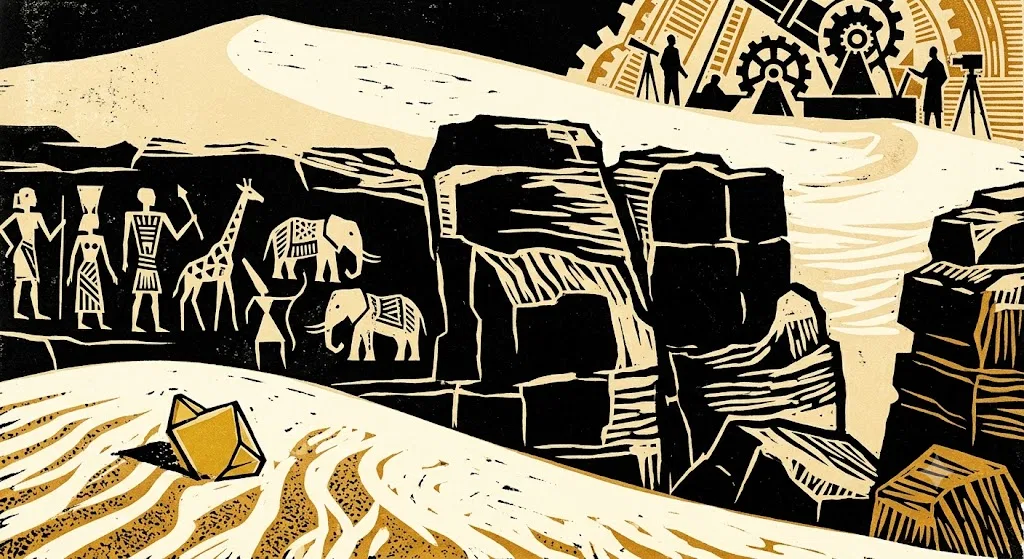
Libya is unusually well suited to Fortean storytelling because so much of its strangeness is tied to landscape. The country contains parts of the Sahara where a traveller can move from pale sand to black volcanic ash, from empty gravel plain to a lake-ringed caldera, from dry wadis to rock walls covered with elephants, giraffes, cattle, hunters and ritual scenes. In such places, the first question is not “is this paranormal?” but “what did people think they were seeing, and why did the setting make that interpretation plausible?”
The Tadrart Acacus rock-art sites in south-west Libya are a useful starting point. UNESCO describes the massif, near the Algerian border, as containing thousands of paintings and engravings in varied styles, dating from roughly 12,000 BC to AD 100, and reflecting major changes in animal life, vegetation and human ways of living in the Sahara. That matters for Forteana because it turns the desert itself into a kind of apparition: elephants, hippos, rhinos, giraffes and cattle appear on stone in a region many modern visitors imagine as eternally dry. The “impossible animals” are not cryptids; they are evidence of a wetter Sahara and of long human memory preserved in images.[UNESCO World Heritage Centre]whc.unesco.orgOpen source on unesco.org.
This is one of the recurring patterns in Libyan strange material. A story may begin as a ghost, a lost city, a cursed mountain or a cosmic mystery, but the best explanation often involves real environmental drama: changing climate, desert navigation, erosion, thermal mirage, remote sensing, oral tradition or the survival of older beliefs in new forms. Libya’s Forteana is therefore less a cabinet of monsters than a map of how people make sense of extreme places.
The Jinn Cave near Ghat: haunted mountain or desert acoustics?
The most obviously folkloric Libyan case is the so-called Jinn Cave, or Kaf Ajnoun, associated with the Idinen rock massif near Ghat in the south-west. Modern local reporting describes it as a dramatic rock formation in the desert city of Ghat, surrounded by stories in which “truth is mixed with imagination”: an elusive deer seen at night, mysterious voices from the cave, and a belief that jinn may appear in animal form. The same account notes a Tuareg belief that iron offers protection against jinn, which helps explain why older desert customs and supernatural interpretation can sit side by side.[Libya Observer]libyaobserver.lyhave you heard jinn cave ghathave you heard jinn cave ghat
Travel and heritage sites add the more gothic version of the legend. Kaf Ajnoun is described as a natural rock fortress about 25 km north of Ghat, near Wadi Tanezuft and the Algerian border, with a summit of about 1,280 metres. The formation is said to have been known as a “Fortress of Ghosts” or “Cave of the Jinn”, and its jagged silhouette makes the name feel almost inevitable. These sources are not neutral academic records, but they are useful as evidence of how the site is presented and remembered in modern Libyan travel folklore.[Temehu]temehu.comOpen source on temehu.com.
A more grounded reading does not require dismissing the stories as foolish. A lonely rock massif in a windy desert can produce strange acoustics; holes, cavities and sharp rock faces can turn gusts into voices, whistles or drum-like sounds. One later retelling explicitly mentions an explanation in which wind passing through openings of different sizes creates layered sounds that people interpret as voices from the cave. That does not prove every local report was caused by wind, but it is a plausible natural mechanism for a “talking” mountain.[Sunna Files Website]sunnafiles.comOpen source on sunnafiles.com.
The folklore also has historical texture. A German-language account of Idinen summarises older traditions in which Tuareg people avoided the massif, believing it to be inhabited by spirits or the dead; it also links the site to the nineteenth-century explorer Heinrich Barth, who reportedly went into the rocks against advice and nearly died after becoming lost. In that version, the haunted reputation and the practical danger are inseparable. The mountain is frightening because it is mythic, but also because heat, thirst, cliffs and disorientation can kill.[Wikipedia]WikipediaOpen source on wikipedia.org.
Zerzura: the lost oasis that belonged partly to Libya
Zerzura is one of North Africa’s great lost-oasis legends, and it sits at the edge of Libya’s Fortean map because it was long imagined somewhere in the Libyan Desert, broadly west of the Nile and in the desert worlds linking Egypt, Libya, Chad and Sudan. The legend appears in several forms: a white city, a hidden oasis, a place of birds, treasure, strange guardians and vanished inhabitants. Its appeal lies in the way it mixes medieval treasure lore, caravan rumour and twentieth-century exploration.
The Royal Geographical Society-era search for Zerzura drew serious desert explorers, not only occult dreamers. Modern summaries of the literature point to Orde Wingate’s 1934 paper “In Search of Zerzura” in The Geographical Journal and to László Almásy’s 1930s expeditions. The point is not that Zerzura was proved to exist as described, but that a legend became a practical mapping problem for aviators, motorists and colonial-era desert surveyors.[Wikipedia]WikipediaOpen source on wikipedia.org.
The best-known modern retellings connect Zerzura to the “Zerzura Club”, a loose circle of interwar desert explorers who drove and flew across the Libyan Desert looking for lost oases and ancient routes. Saul Kelly’s book description frames the story as both romance and wartime prelude: the same people who hunted vanished cities were also gathering knowledge that later mattered militarily in the Western Desert.[Google Books]books.google.comOpen source on google.com.
For a Fortean reader, Zerzura is valuable because it shows how a rumour can remain powerful after literal belief weakens. A lost city with treasure and strange inhabitants is unlikely in the storybook form. Yet the Sahara really did contain forgotten water sources, abandoned settlements, caravan towns and mis-mapped valleys. Recent popular and journalistic treatments still debate whether the myth may preserve distorted memories of real places, including sites outside Libya, such as remote lake regions in Chad. That keeps Zerzura alive as a moving target: not a solved city, but a legend made from geography, hearsay and the human hunger for an oasis just beyond the known map.[El País]elpais.comEl País El oasis perdido de Zerzura aparece en otro sitioEl País El oasis perdido de Zerzura aparece en otro sitio
Libyan Desert Glass: a cosmic mystery you can hold in your hand
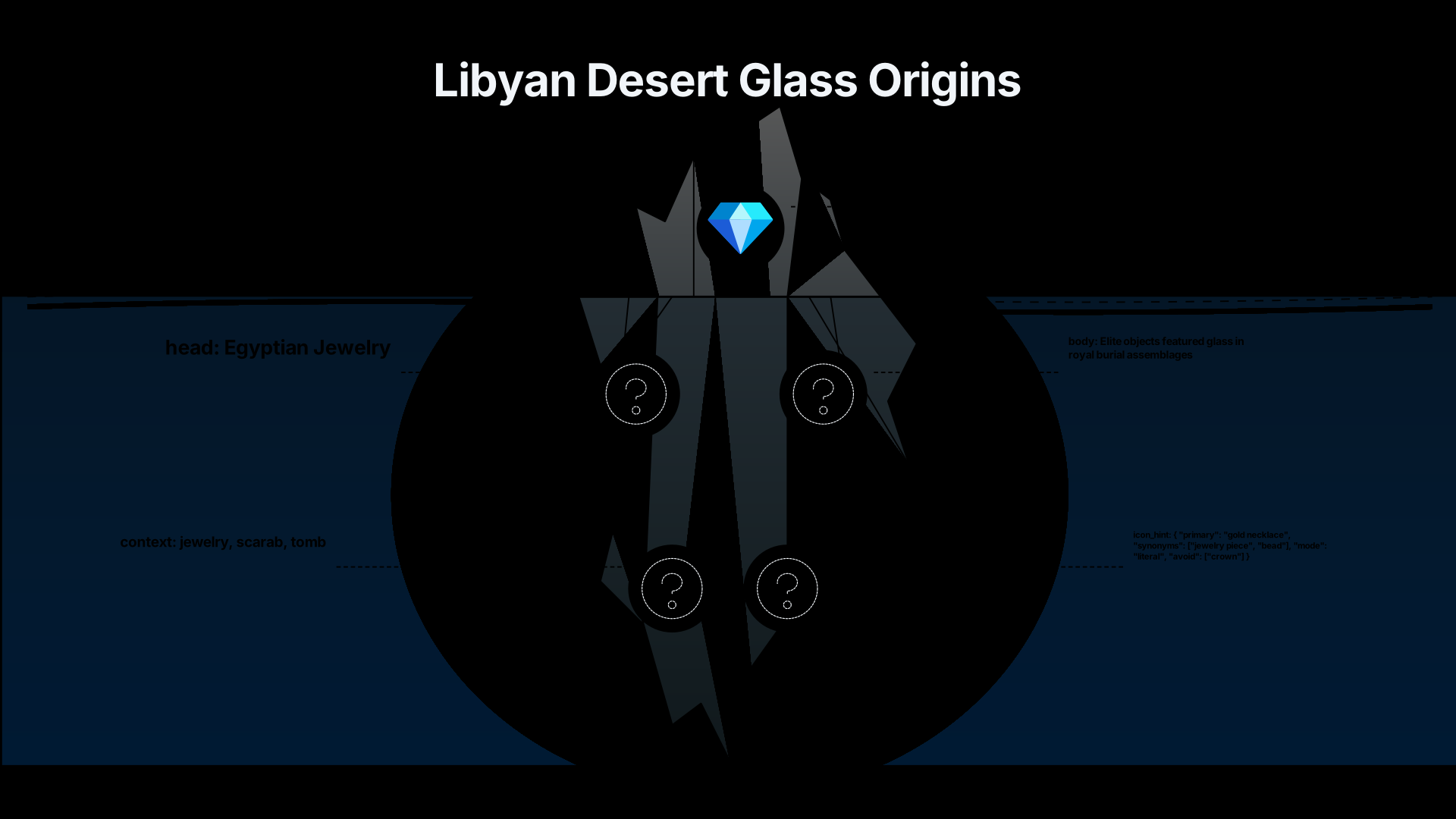
The most scientifically substantial Libyan strange object is Libyan Desert Glass, the pale yellow to greenish natural glass found in the Great Sand Sea region of eastern Libya and western Egypt. It has the right ingredients for a Fortean classic: scattered glass in a remote desert, ancient human use, a possible cosmic origin, and a missing or disputed crater.
The glass is not folklore. It is a real geological material, mostly silica-rich, found over a large desert area. Research summaries note that it has been worked into tools since prehistoric times, while its most famous cultural association is with ancient Egyptian elite objects, especially the scarab-like desert glass element in jewellery from Tutankhamun’s burial assemblage. The “Libyan” name reflects the broader Libyan Desert region, not a neat modern border.[Wikipedia]WikipediaLibyan desert glassLibyan desert glass
The mystery is formation. Older hypotheses included volcanic processes, lightning, ordinary fires and different kinds of meteorite event. A 1984 scientific paper proposed a cometary impact model after arguing that many non-impact explanations did not fit the physical and chemical evidence. More recent work continues to favour an extremely high-temperature origin, with impact or airburst scenarios remaining central to the debate.[ScienceDirect]sciencedirect.comOpen source on sciencedirect.com.
This is where the case becomes properly Fortean in the Charles Fort sense: not “aliens did it”, but “the evidence points to something dramatic, and the exact event is hard to pin down”. Some studies have argued for impact-related mineral evidence in the glass, while the lack of a universally accepted source crater keeps the story unsettled. A 2026 scientific paper on zircon inclusions in Libyan Desert Glass again treated the material as evidence of extreme formation conditions and cited the long history of impact-origin arguments, showing that the question is still scientifically active rather than merely a solved museum curiosity.[JuSER]juser.fz-juelich.deJu SERClues from a dendritic zircon inclusionJu SERClues from a dendritic zircon inclusion
The sober conclusion is more interesting than a wild one. Libyan Desert Glass is not a supernatural substance. It is a rare natural glass whose origin appears to involve extraordinary heat, probably from a cosmic event, in a region where the expected crater evidence is either absent, buried, eroded, disputed or not yet convincingly linked. It is one of Libya’s best examples of a mystery that becomes stranger as the science improves.
Craters, false craters and the danger of seeing circles from space
Libya’s south-eastern desert has several circular structures that have attracted impact-crater claims. Some are confirmed or strongly supported; others are disputed. This matters because satellite imagery has changed how desert mysteries are made. A circular shape on a remote landscape can look like a cosmic scar, but impact geology requires more than a good-looking ring. Researchers look for shock features in minerals, shatter cones, impact breccias, melt rocks and structural deformation.
The Oasis impact structure in south-eastern Libya is a serious example. A 2017 study describes it as a highly eroded impact structure south of the BP impact crater, with debate over its diameter and geological interpretation. Earlier and later estimates vary, but the key point is that Oasis is not just a fanciful ring on a map; it has been studied through remote sensing and field geology.[Springer]link.springer.comOpen source on springer.com.
Arkenu is more contested and therefore more Fortean. In 2003, researchers reported the discovery of a double circular structure in the south-eastern Libyan Desert, partly hidden beneath sand, and argued from fieldwork that the structures were double impact craters, each around 10 km across, with shatter cones and impact breccias. Later work, however, challenged an impact interpretation and proposed an endogenous, non-impact origin involving igneous geology.[sciencedirect.com]sciencedirect.comOpen source on sciencedirect.com.
Kebira, near the Libya-Egypt border, shows the problem even more clearly. It was proposed from satellite and radar data as a huge impact structure, potentially linked to Libyan Desert Glass. Yet field-based criticism found no convincing impact evidence, and a European Space Agency conference paper stated that expedition data failed to find impact evidence in the Kebira structure. In other words: a dramatic circular form became a mystery, then became a cautionary tale about reading too much into remote images.[eorc.jaxa.jp]eorc.jaxa.jpOpen source on jaxa.jp.
This “crater or not?” pattern is central to modern Libyan Forteana. The desert is so vast and visually legible from space that it invites discovery stories. But the ground truth may be slower, duller and more valuable: erosion, tectonics, volcanism, buried strata and old igneous intrusions can mimic cosmic violence.
Waw an Namus: the black oasis that looks invented
Waw an Namus is not paranormal, but it belongs in Libya’s strange-history record because it looks like a fantasy map feature accidentally placed on Earth. The Smithsonian’s Global Volcanism Program describes it as an isolated volcano in south-central Libya, south of the Haruj volcanic field, with a 4 km wide and 100 m deep caldera containing a post-caldera scoria cone. Around the caldera lies a dark basaltic tephra apron stretching roughly 10–20 km, sharply contrasting with the surrounding pale desert sand.[Smithsonian Global Volcanism]volcano.si.eduOpen source on si.edu.
That colour contrast is why Waw an Namus so often appears in travel and satellite-image discussions as an uncanny place. It is a black volcanic island in a sea of sand, with small lakes and vegetation inside the crater. Even the name is practical rather than mystical: it is commonly rendered as “Oasis of mosquitoes”, referring to the insects supported by the water.[Wikipedia]WikipediaWaw an NamusWaw an Namus
For readers of strange places, Waw an Namus is a useful reminder that some “impossible” landscapes need no paranormal embroidery. A remote volcano, black ash, crater lakes, desert light and isolation are enough. It sits naturally beside the Jinn Cave and the lost-oasis tradition because all three depend on the same basic emotional effect: a traveller arrives at a place that appears to break the rules of its surroundings.
Mirages, vanished water and the Libyan Desert as an illusion machine
A good Libyan Forteana page has to treat mirages seriously, because the desert is one of the world’s great engines of false perception. Mirage is not hallucination. It is atmospheric optics: light bends through layers of air at different temperatures, producing apparent pools of water, floating forms, stretched horizons or distorted distant objects. Complex mirages, often called Fata Morgana, can stack upright and inverted images in a narrow band near the horizon, making ordinary features look like towers, cliffs or phantom land.[Wikipedia]WikipediaFata Morgana (mirageFata Morgana (mirage
This matters for Libya because so many desert traditions involve lost water, deceptive distance, impossible buildings or travellers who think they see refuge ahead. Not every lost-oasis story is “just a mirage”, and it would be lazy to reduce Zerzura to a single optical trick. But mirage belongs in the toolkit. In a landscape where genuine oases exist, where old lakes have vanished, and where heat can make the horizon behave badly, the boundary between report, hope and illusion becomes thin.
The rock art of the Acacus adds a deeper layer to this. The animals on the rocks show that the Sahara has not always looked as it does now. When people imagine hidden water in the Libyan Desert, they are not inventing the concept from nothing; they are living in a landscape with geological and archaeological memories of wetter worlds. The mirage is false in the moment, but the idea of a greener desert is historically true.[UNESCO World Heritage Centre]whc.unesco.orgOpen source on unesco.org.
Ancient images that look uncanny but are not alien evidence
Libya’s prehistoric rock art is sometimes pulled into fringe claims about “ancient astronauts” or lost civilisations. That is not necessary, and it usually makes the material less interesting. The Tadrart Acacus and related Libyan rock-art landscapes are remarkable because they record human observation, ritual, environment and memory across thousands of years.
The British Museum’s African Rock Art project notes two main Libyan rock-art areas: the Tadrart Acacus and the Messak Plateau. UNESCO’s description emphasises the thousands of paintings and carvings, their long chronology, and their evidence for changing fauna, flora and human lifestyles. These are exactly the kinds of details that fringe readings tend to flatten into “mystery figures”.[africanrockart.britishmuseum.org]africanrockart.britishmuseum.orgOpen source on britishmuseum.org.
Some images are genuinely uncanny to modern eyes: featureless figures, ceremonial scenes, animals that seem out of place, and human forms that are hard to interpret without cultural context. But “hard to interpret” is not the same as “non-human”. The better reading is that rock art preserves symbolic systems we only partly understand. It is strange because it is old, local and visually powerful, not because it needs extraterrestrial authors.
There is also a modern loss-and-survival story here. Reports from 2014 described vandalism damaging prehistoric rock art in the Tadrart Acacus, and UNESCO’s documents show continuing concern for Libyan World Heritage properties, with the Acacus retained on the List of World Heritage in Danger in recent decisions. The weird-history value of the art is therefore not only interpretive; it is fragile. These are ancient records of a transformed Sahara, and they can be damaged by very modern neglect, conflict and opportunism.[Voice of America]voanews.comVoice of America Vandals Destroy Prehistoric Rock Art in Libya's LawlessVoice of America Vandals Destroy Prehistoric Rock Art in Libya's Lawless
How sceptics and believers read the same Libyan stories
The divide between sceptical and believing readings of Libyan Forteana is rarely a clean fight between reason and superstition. More often, both sides are responding to real features of the country.
A believer’s reading starts with experience: a mountain that seems to speak, a cave locals avoid, glass scattered in the sand, circular scars in the desert, rock art showing vanished animals, a lost city that explorers took seriously. These are not empty prompts. They are vivid, place-bound mysteries.
A sceptical reading asks what kind of evidence each claim would need. For the Jinn Cave, testimony and place-name tradition support the folklore, while wind, terrain and danger explain much of the fear. For Zerzura, texts and exploration history support the existence of a legend, while archaeology has not confirmed the white city of treasure. For Libyan Desert Glass, the object is real and the cosmic-origin debate is scientific, but exaggerated claims outrun the evidence when they assert a known crater or a single dramatic event without qualification. For circular structures, field geology matters more than satellite resemblance.[libyaobserver.ly]libyaobserver.lyhave you heard jinn cave ghathave you heard jinn cave ghat
The most useful position is evidence-aware curiosity. Libya’s strange record does not need to be debunked into boredom or inflated into fantasy. Its strongest stories survive because they sit at the crossing point of real hazards, real geology, real ancient art and real oral tradition.
Why Libya’s Forteana still has cultural pull
Libya’s Forteana endures because it is not simply a set of spooky tales. It answers a deeper imaginative question: what happens when human beings try to read a landscape that is older, larger and less forgiving than they are?
The Jinn Cave gives danger a personality. Zerzura turns the hope of water into a city of rumour. Libyan Desert Glass makes a cosmic event feel intimate enough to hold. Oasis, Arkenu and Kebira show how modern instruments can create new mysteries as well as solve old ones. Waw an Namus proves that a real place can look more artificial than a legend. The Acacus rock art reminds us that the desert itself has changed so completely that ordinary archaeological evidence can feel like a message from another world.
That is the heart of Libya’s weird-history record. The best stories are not those that prove ghosts, jinn, aliens or lost kingdoms. They are the ones that reveal how easily the natural, historical and folkloric can become entangled in a country where a rock can sound alive, a horizon can become water, and a desert can remember animals that vanished thousands of years ago.
Amazon book picks
Further Reading
Books and field guides related to Why Libya's Desert Keeps Making Mysteries. Use these as the next step if you want deeper reading beyond the article.

eBay marketplace picks
Marketplace Samples
Live-tested eBay searches with available results related to this page.
Endnotes
1.
Source: whc.unesco.org
Link:https://whc.unesco.org/en/list/287/
2.
Source: africanrockart.britishmuseum.org
Link:https://africanrockart.britishmuseum.org/country/libya/
3.
Source: temehu.com
Link:https://www.temehu.com/Cities_sites/kaf-ajnoun.htm
4.
Source: temehu.com
Link:https://www.temehu.com/tours/paranormal_sites_in_libya.htm
5.
Source: Wikipedia
Link:https://de.wikipedia.org/wiki/Idinen
6.
Source: Wikipedia
Link:https://en.wikipedia.org/wiki/Zerzura
7.
Source: books.google.com
Link:https://books.google.com/books/about/The_Lost_Oasis.html?id=KIKKWORTYz8C
8.
Source: Wikipedia
Title: Libyan desert glass
Link:https://en.wikipedia.org/wiki/Libyan_desert_glass
9.
Source: sciencedirect.com
Link:https://www.sciencedirect.com/science/article/abs/pii/002230938490173X
10.
Source: link.springer.com
Link:https://link.springer.com/article/10.1186/s40623
11.
Source: sciencedirect.com
Link:https://www.sciencedirect.com/science/article/pii/S1631071303001834
12.
Source: eorc.jaxa.jp
Link:https://www.eorc.jaxa.jp/en/earthview/2008/tp080109.html
13.
Source: sci.esa.int
Link:https://sci.esa.int/documents/33321/35974/1567255413405-ESLAB40-Proc_296053-DiMartino.pdf
14.
Source: Wikipedia
Title: Waw an Namus
Link:https://en.wikipedia.org/wiki/Waw_an_Namus
15.
Source: Wikipedia
Title: Fata Morgana (mirage)
Link:https://en.wikipedia.org/wiki/Fata_Morgana_%28mirage%29
16.
Source: whc.unesco.org
Title: World Heritage Centre Rock-Art Sites of Tadrart Acacus
Link:https://whc.unesco.org/en/list/287/documents/
17.
Source: archive.aramcoworld.com
Link:https://archive.aramcoworld.com/issue/200206/searching.for.zerzura.htm
18.
Source: Wikipedia
Link:https://en.wikipedia.org/wiki/Jinn
19.
Source: Wikipedia
Link:https://en.wikipedia.org/wiki/Libya
20.
Source: Wikipedia
Title: List of reported UFO sightings
Link:https://en.wikipedia.org/wiki/List_of_reported_UFO_sightings
21.
Source: Wikipedia
Link:https://en.wikipedia.org/wiki/Fezzan
22.
Source: Wikipedia
Title: Kebira Crater
Link:https://en.wikipedia.org/wiki/Kebira_Crater
23.
Source: Wikipedia
Title: Oasis Impact Structure
Link:https://en.wikipedia.org/wiki/Oasis_Impact_Structure
24.
Source: Wikipedia
Title: Arkenu structures
Link:https://en.wikipedia.org/wiki/Arkenu_structures
25.
Source: temehu.com
Link:https://www.temehu.com/Cities_sites/meghedet.htm
26.
Source: books.google.com
Title: ATLAS of Tadrart Acacus rock art A UNESC
Link:https://books.google.com/books/about/ATLAS_of_Tadrart_Acacus_rock_art_A_UNESC.html?id=c0e1EAAAQBAJ
27.
Source: impact-craters.com
Link:https://impact-craters.com/
28.
Source: history.com
Title: of UFOs
Link:https://www.history.com/articles/history-of-ufos
29.
Source: libyaobserver.ly
Title: have you heard jinn cave ghat
Link:https://libyaobserver.ly/life/have-you-heard-jinn-cave-ghat
30.
Source: sunnafiles.com
Link:https://www.sunnafiles.com/21421-2/
31.
Source: elpais.com
Title: El País El oasis perdido de Zerzura aparece en otro sitio
Link:https://elpais.com/cultura/2026-05-09/el-oasis-perdido-de-zerzura-aparece-en-otro-sitio.html
32.
Source: juser.fz-juelich.de
Title: Ju SERClues from a dendritic zircon inclusion
Link:https://juser.fz-juelich.de/record/1058320/files/Meteorit%20Planetary%20Scien%20-%202026%20-%20Magnani%20-%20New%20evidence%20on%20the%20formation%20conditions%20of%20the%20Libyan%20Desert%20Glass%20Western.pdf
33.
Source: passc.net
Link:https://www.passc.net/EarthImpactDatabase/New%20website_05-2018/Oasis.html
34.
Source: comptes-rendus.academie-sciences.fr
Link:https://comptes-rendus.academie-sciences.fr/geoscience/item/10.1016/j.crte.2003.09.008.pdf
35.
Source: volcano.si.edu
Link:https://volcano.si.edu/volcano.cfm?vn=225008
36.
Source: voanews.com
Title: Voice of America Vandals Destroy Prehistoric Rock Art in Libya’s Lawless
Link:https://www.voanews.com/a/reu-vandals-destroy-prehistoric-rock-art-in-libyas-lawless-sahara/1928558.html
37.
Source: sahara-overland.com
Title: lost oasis of zerzura
Link:https://sahara-overland.com/tag/lost-oasis-of-zerzura/
38.
Source: tourslibya.com
Title: Waw an Namus
Link:https://tourslibya.com/fezzan/waw-an-namus/
39.
Source: elmi.hbku.edu.qa
Link:https://elmi.hbku.edu.qa/en/publications/discovery-of-a-double-impact-crater-in-libya-the-astrobleme-of-ar/
40.
Source: iwh.icesco.org
Title: waw an namus
Link:https://iwh.icesco.org/waw-an-namus/
41.
Source: beastsoflegend.com
Title: North Africa
Link:https://beastsoflegend.com/bestiary/africa/north-africa/
42.
Source: atlasobscura.com
Title: waw an namus
Link:https://www.atlasobscura.com/places/waw-an-namus
Additional References
43.
Source: youtube.com
Link:https://www.youtube.com/watch?v=kMcN6k3-02w
Source snippet
Rock-Art Sites of Tadrart Acacus (UNESCO/NHK)...
44.
Source: youtube.com
Title: Waw an Namus: Geology, History, and the Allure of a Remote Oasis
Link:https://www.youtube.com/watch?v=Pwzm7J2PpO8
Source snippet
Uncovering The Lost Civilizations and Ancient Chariots Of The Sahara...
45.
Source: facebook.com
Link:https://www.facebook.com/lowellobservatory/posts/however-no-impact-crater-was-ever-found-in-the-libyan-desert-in-an-alternative-s/2183476548350957/
46.
Source: researchgate.net
Link:https://www.researchgate.net/publication/249594518_Magical_Realism_in_Libya
47.
Source: researchgate.net
Link:https://www.researchgate.net/publication/314090209_The_Oasis_impact_structure_Libya_Geological_characteristics_from_ALOS_PALSAR-2_data_interpretation
48.
Source: academia.edu
Link:https://www.academia.edu/104742523/UFOs_Earthquakes_and_the_Straight_Line_Mystery_The_Answer_to_the_UFO_Enigma
49.
Source: istockphoto.com
Link:https://www.istockphoto.com/photos/ubari-oasis-fezzan-libya
50.
Source: facebook.com
Link:https://www.facebook.com/prideofbritain/posts/after-five-days-lost-in-the-vast-libyan-desert-marwan-al-bahiji-has-been-found-a/1477537194392735/
51.
Source: facebook.com
Link:https://www.facebook.com/LibyatheVision/posts/as-the-sun-sets-over-the-quiet-deserts-of-southwest-libya-it-lights-up-kahaf-al-/1245697797571348/
52.
Source: medium.com
Link:https://medium.com/%40krishanukundu/does-anyone-here-believe-in-the-supernatural-fa74a6210ccd
Topic Tree
Follow this branch
Related pages 192
- Afghan Forteana
- Antigua Uncanny
- Bosnian Mysteries
- Botswana Weird
- Brazil Strange
- +187 more in sidebar