Within Trinidad Strange
Why These Islands Feel Haunted
Chacachacare, Tobago's jumbie places and old silk cotton trees show how ghost lore clings to memory-heavy landscapes.
On this page
- Chacachacare and quarantine memory
- Tobago jumbies, trees and graveyard routes
- How ghost stories preserve difficult landscapes
Page outline Jump by section
Introduction
Across Trinidad and Tobago, some places are widely described as haunted not because of a single famous ghost story but because history, landscape and memory seem to have settled there together. The abandoned island of Chacachacare, with its former leper colony and quarantine buildings, has become the country’s best-known haunted island. In Tobago, jumbie traditions cluster around silk cotton trees, old plantation roads, graveyards and lonely routes where generations have claimed to encounter restless spirits. None of these stories proves the supernatural, but together they show how difficult histories are remembered through place rather than monuments alone. For readers interested in Trinidad and Tobago’s Fortean traditions, these landscapes matter because they preserve folklore, local identity and historical trauma in ways that continue to shape how people experience them today.[nationaltrust.tt]nationaltrust.ttNational Trust of Trinidad and Tobago Islands of QuarantineNational Trust of Trinidad and TobagoIslands of Quarantine - Part 1 — National Trust of Trinidad and TobagoApril 22, 2020…
Why Chacachacare became Trinidad’s haunted island
Chacachacare lies off Trinidad’s north-west coast, separated from the mainland by the Boca passages. Visitors today encounter abandoned churches, hospital buildings, cemeteries, workers’ quarters and a lighthouse standing in varying states of decay. The scenery alone encourages ghost stories, but the island’s reputation rests on a documented history that was genuinely tragic.
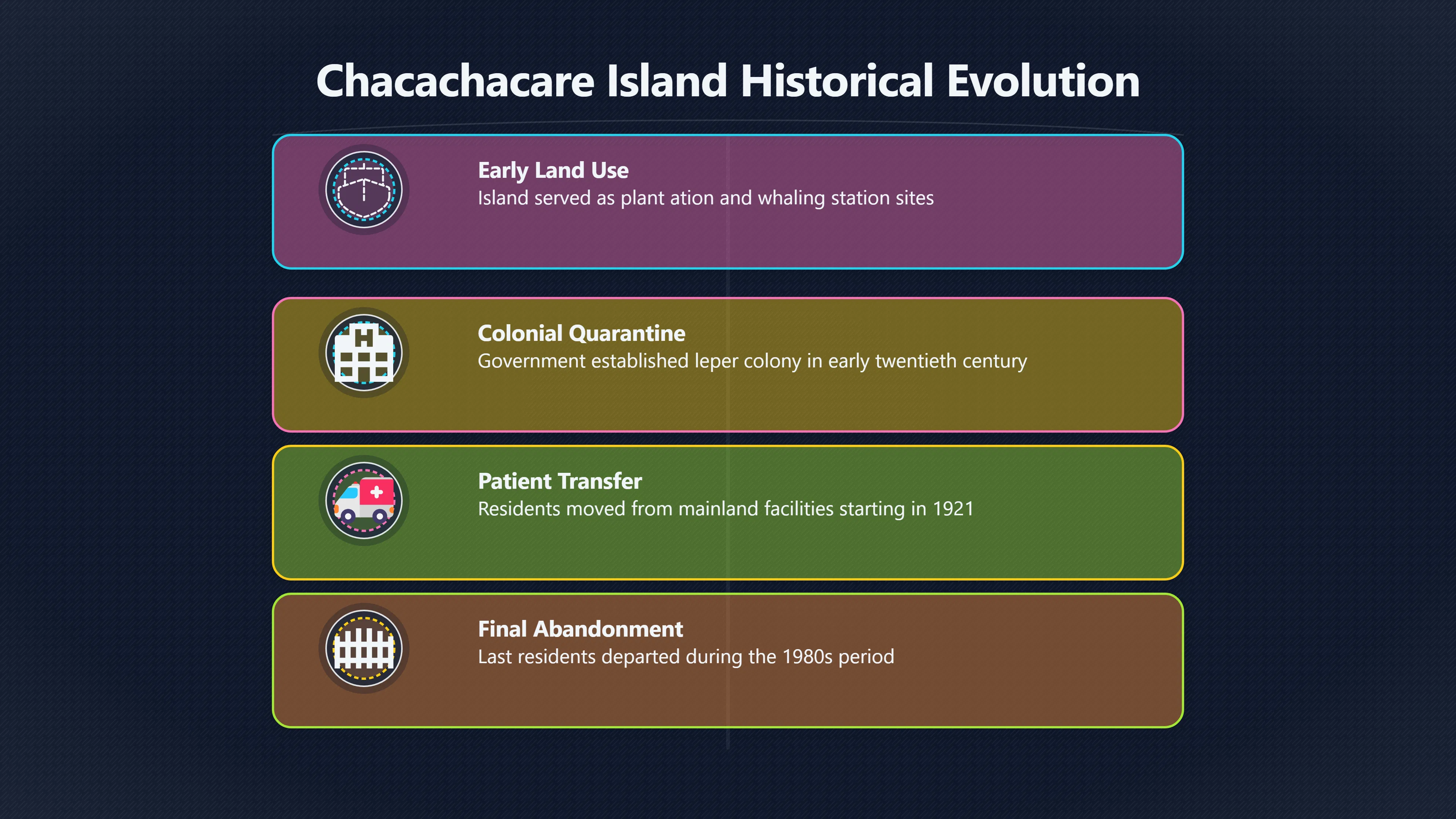
Long before it became associated with hauntings, Chacachacare served several different purposes, including plantations and a whaling station. Its defining chapter began in the early twentieth century when the colonial government established a leper colony there after overcrowding at mainland facilities. Patients were transferred in stages from 1921 onwards, often against the wishes of families, while Dominican sisters and medical staff lived alongside them. The last residents left only in the 1980s, leaving behind an abandoned medical settlement that still dominates the island.[National Trust of Trinidad and Tobago]nationaltrust.ttNational Trust of Trinidad and Tobago Islands of QuarantineNational Trust of Trinidad and TobagoIslands of Quarantine - Part 1 — National Trust of Trinidad and TobagoApril 22, 2020…
This history explains why ghost stories attach so easily to the island. Local tales speak of:
- apparitions around abandoned hospital buildings;
- ghostly nuns walking near the old chapel or cemetery;
- unexplained footsteps or voices in deserted structures;
- an oppressive silence that visitors describe even in daylight.
These accounts remain anecdotal rather than documented paranormal evidence. Many visitors report nothing unusual beyond the emotional effect of exploring an abandoned medical settlement. Nevertheless, the island’s isolation, ruined architecture and knowledge of the suffering once experienced there combine to create an unusually powerful setting for supernatural interpretation.[National Trust of Trinidad and Tobago]nationaltrust.ttNational Trust of Trinidad and Tobago Islands of QuarantineNational Trust of Trinidad and TobagoIslands of Quarantine - Part 1 — National Trust of Trinidad and TobagoApril 22, 2020…
Unlike fictional haunted houses, Chacachacare’s atmosphere grows from verifiable history. The stories therefore function as a way of remembering lives that might otherwise disappear from public memory.
Tobago’s jumbies live in the landscape
In Tobago, ghost traditions are less concentrated on one location than woven through the landscape itself. The word “jumbie” generally refers to the spirit of someone who has died and returned to trouble or frighten the living, although beliefs vary between families and communities. The traditions combine West African beliefs, Christian influences and local Caribbean storytelling that developed after slavery and emancipation.[Visit Tobago]visittobago.gov.ttVisit Tobago Folktales & Superstitions | TobagoVisit Tobago Folktales & Superstitions | Tobago
Rather than appearing anywhere at random, jumbies are commonly associated with places carrying emotional or historical weight.
Silk cotton trees
No feature of the Tobagonian landscape is more closely linked with jumbie belief than the silk cotton tree.
Large silk cotton trees are widely regarded as the dwelling places of spirits. Folklore warns against disturbing them unnecessarily, lingering beneath them after dark or cutting them down. Historian Rita Pemberton notes that these beliefs also preserve memories of slavery because some of these trees stood on plantation estates where resisting enslaved Africans were reportedly executed. The trees therefore became symbols of both supernatural danger and ancestral suffering.[Trinidad and Tobago Newsday]newsday.co.ttTrinidad and Tobago Newsday Ghost lore: The value of Tobago's jumbie storiesTrinidad and Tobago NewsdayGhost lore: The value of Tobago's jumbie stories - Trinidad and Tobago Newsday…
One famous silk cotton tree beside the Northside Road became a landmark because road workers reportedly refused to fell it despite development plans. Whether motivated by genuine belief or respect for tradition, the episode reinforced the tree’s reputation as a place that should not be disturbed.[Trinidad and Tobago Newsday]newsday.co.ttTrinidad and Tobago Newsday Ghost lore: The value of Tobago's jumbie storiesTrinidad and Tobago NewsdayGhost lore: The value of Tobago's jumbie stories - Trinidad and Tobago Newsday…
When another celebrated “Jumbie Tree” at Golden Lane collapsed during severe weather in 2020, many Tobagonians reacted with genuine sadness. The response was notable because discussion focused less on paranormal proof than on the disappearance of a cultural landmark carrying generations of stories.[Trinidad and Tobago Newsday]newsday.co.ttTrinidad and Tobago NewsdayDecember 2, 2020…
Graveyards and old roads
Traditional stories also place jumbies along lonely roads, especially those passing cemeteries or former plantations.
Night workers, fishermen and people returning from social events have long described unsettling encounters after dark. Stories include mysterious figures on roads, inexplicable sounds and sensations of being followed. These experiences usually remain personal testimony rather than claims investigated by researchers, yet they form a recognisable body of local folklore passed between generations.[Trinidad and Tobago Newsday]newsday.co.ttTrinidad and Tobago Newsday Ghost lore: The value of Tobago's jumbie storiesTrinidad and Tobago NewsdayGhost lore: The value of Tobago's jumbie stories - Trinidad and Tobago Newsday…
Gravediggers occupy a particularly important place in these traditions. Folklore holds that certain rituals and respectful behaviour must accompany the reopening of graves. Stories describe misfortune following failures to observe these customs, with offerings such as rum said to calm disturbed spirits. Whether understood literally or symbolically, such beliefs reinforce respect for burial places and those who work within them.[Trinidad and Tobago Newsday]newsday.co.ttTrinidad and Tobago Newsday Ghost lore: The value of Tobago's jumbie storiesTrinidad and Tobago NewsdayGhost lore: The value of Tobago's jumbie stories - Trinidad and Tobago Newsday…
Why these places stay haunted in the public imagination
Many haunted landscapes lose their stories once their original communities disappear. Chacachacare and Tobago are unusual because the folklore continues to evolve alongside historical interpretation.
For Chacachacare, every abandoned building reminds visitors of quarantine, forced isolation and colonial medicine. The island’s ghost stories are therefore inseparable from documented human suffering rather than existing as free-floating legends. Heritage organisations increasingly present the island’s history in this broader context instead of encouraging sensational ghost tourism.[National Trust of Trinidad and Tobago]nationaltrust.ttNational Trust of Trinidad and Tobago Islands of QuarantineNational Trust of Trinidad and TobagoIslands of Quarantine - Part 1 — National Trust of Trinidad and TobagoApril 22, 2020…
In Tobago, jumbie traditions perform a different role. They preserve knowledge about places whose historical importance might otherwise fade. A silk cotton tree becomes not merely an impressive tree but a reminder of slavery, resistance and ancestral memory. A lonely road recalls generations of shared caution. A graveyard becomes a place demanding respect rather than casual curiosity.[Trinidad and Tobago Newsday]newsday.co.ttTrinidad and Tobago Newsday Ghost lore: The value of Tobago's jumbie storiesTrinidad and Tobago NewsdayGhost lore: The value of Tobago's jumbie stories - Trinidad and Tobago Newsday…
From a Fortean perspective, these stories demonstrate how supernatural traditions often survive because they encode social memory. The haunting is less about proving ghosts than ensuring certain places are never regarded as ordinary.
Folklore, belief and sceptical readings
Believers often regard Chacachacare and Tobago’s jumbie landscapes as genuinely active spiritual places, drawing on family experience rather than formal investigation. Personal testimony remains central to the traditions.
More sceptical explanations are equally persuasive in many cases. Abandoned hospitals naturally produce feelings of unease. Dense vegetation, unfamiliar wildlife, changing light and isolation can heighten anxiety and encourage misinterpretation of ordinary sounds or shadows. Cultural expectations also matter: someone arriving at a place already famous for ghosts is more likely to interpret ambiguous experiences as supernatural.
Neither interpretation fully explains why the stories endure. Even visitors who reject paranormal claims frequently describe these locations as emotionally powerful because they embody visible traces of disease, slavery, colonialism and abandonment. The folklore survives not despite the history but because of it.
Within Trinidad and Tobago’s wider strange-history tradition, haunted islands and Tobago’s jumbie landscapes therefore occupy a distinctive place. They show how ghost stories become attached to real geography, allowing landscapes marked by suffering, remembrance and cultural identity to continue speaking long after the people who created those memories have gone.




eBay marketplace picks
Marketplace Samples
Live-tested eBay searches with available results related to this page.



Endnotes
1.
Source: nationaltrust.tt
Title: National Trust of Trinidad and Tobago Islands of Quarantine
Link:https://nationaltrust.tt/home/quarantine-islands-1/
Source snippet
National Trust of Trinidad and TobagoIslands of Quarantine - Part 1 — National Trust of Trinidad and TobagoApril 22, 2020...
Published: April 22, 2020
2.
Source: newsday.co.tt
Title: Trinidad and Tobago Newsday Ghost lore: The value of Tobago’s jumbie stories
Link:https://newsday.co.tt/2020/11/12/ghost-lore-the-value-of-tobagos-jumbie-stories/
Source snippet
Trinidad and Tobago NewsdayGhost lore: The value of Tobago's jumbie stories - Trinidad and Tobago Newsday...
3.
Source: visittobago.gov.tt
Title: Visit Tobago Folktales & Superstitions | Tobago
Link:https://visittobago.gov.tt/go-experience/local-culture-people-heritage/folktales-superstitions
4.
Source: Wikipedia
Link:https://en.wikipedia.org/wiki/Chacachacare
5.
Source: nalis.gov.tt
Link:https://www.nalis.gov.tt/blog/caribbean-folklore-part-2/
Source snippet
Caribbean Folklore (Part 2) – NALIS – National Library and Information System AuthorityNovember 9, 2023 — CARIBBEAN FOLKLORE (PART 2) Nov...
Published: November 9, 2023
6.
Source: library2.nalis.gov.tt
Title: Nalis Library Calendar
Link:https://library2.nalis.gov.tt/gsdl/cgi-bin/library.cgi?a=d&c=NALISCALb&cl=CL2.4&e=d-01000-00—off-0NALISCALb–00-1—-01-10-00—0—0direct-10—-4——-0-1l–11-en-50—20-help—00-3-1-00-00–4–0–0-0-11-10-0utfZz
Source snippet
nalis.gov.ttCalendar| | Folklore (2008) Image | La Diablesse A she-devil whose poise, figure and beautiful dresses hide her cloven hoof...
7.
Source: newsday.co.tt
Link:https://newsday.co.tt/2020/12/02/tobagos-ancient-silk-cotton-tree-falls/
Source snippet
Trinidad and Tobago NewsdayDecember 2, 2020...
Published: December 2, 2020
8.
Source: nalis.gov.tt
Link:https://www.nalis.gov.tt/blog/caribbean-folklore-part-1/
Source snippet
November 9, 2023 — CARIBBEAN FOLKLORE (PART 1) November 9, 2023 Blog, Our Cultural Heritage, Our Heritage Folklore-Caribbean Area, Legend...
Published: November 9, 2023
9.
Source: newsday.co.tt
Title: Silk cotton trees are said to be haunted by jumbies. PHOTO
Link:https://newsday.co.tt/2020/12/10/ancestors-weep-lessons-from-silk-cotton-tree/
Source snippet
Ancestors weep: lessons from silk cotton tree - Trinidad and Tobago NewsdayDecember 10, 2020 — ANCESTORS WEEP: LESSONS FROM SILK COTTON T...
Published: December 10, 2020
10.
Source: visittobago.gov.tt
Link:https://visittobago.gov.tt/local-culture-people-heritage/history-culture/historical-timeline
Source snippet
In 250 BC the First People tribes like the Saladoids entered Trinidad and moved nor...
11.
Source: nalis.gov.tt
Link:https://www.nalis.gov.tt/resources/tt-content-guide/carnival/
Source snippet
Image: Parade participants in orange traditional Dame Lorraine carnival costumes and pink umbrella...
12.
Source: youtube.com
Title: Camping on the haunted Island called chacachacare
Link:https://www.youtube.com/watch?v=cIG3AfnLlP8
Source snippet
Jumbie - Caribbean Malevolent Spirits...
13.
Source: youtube.com
Link:https://www.youtube.com/watch?v=LKrRtjfPXdY
Additional References
14.
Source: citizensforconservationtt.org
Link:https://citizensforconservationtt.org/home/sites/chacachacare/
Source snippet
Chacachacare – Citizens for Conservation Trinidad & TobagoBUILT HERITAGE > COLONIAL CHACACHACARE Image Convent and Chapel, Marine Bay, Ch...
15.
Source: citizensforconservationtt.org
Link:https://citizensforconservationtt.org/home/sites/tobago-folklore/
Source snippet
Tobago Folklore – Citizens for Conservation Trinidad & TobagoTOBAGO FOLKLORE Image Written by Edward Hernandez Characters in Tobago Folkl...
16.
Source: youtube.com
Title: Chacachacare, Trinidad | The Abandoned Leper Colony (Award-Winning Documentary)
Link:https://www.youtube.com/watch?v=qkgzj_PxXUM
Source snippet
Exploring the Haunted Leper Colony on Trinidad's Deserted Island...
17.
Source: reddit.com
Title: What’re some creepy places on the island of Trinidad?
Link:https://www.reddit.com/r/TrinidadandTobago/comments/11x17r2
Source snippet
What're some creepy places on the island of Trinidad?...
18.
Source: youtube.com
Title: Exploring Chacachacare! This Place Seems to Be Haunted?
Link:https://www.youtube.com/watch?v=-k_RCv9020A
Source snippet
Chacachacare, Trinidad | The Abandoned Leper Colony (Award-Winning Documentary)...
19.
Source: youtube.com
Title: Exploring the Haunted Leper Colony on Trinidad’s Deserted Island
Link:https://www.youtube.com/watch?v=VMREJ6QLdNg
Source snippet
Camping on the haunted Island called chacachacare...
Topic Tree