Where Dominican Folklore Meets the Uncanny
The Dominican Republic’s strange-history record is strongest where folklore, landscape and testimony meet: the mountain woman with backward feet, night shapeshifters said to block roads, hidden “wild people” of the Bahoruco range, visionary religion around Papá Liborio, Taíno cave art, fireballs over the Caribbean, and real animals so odd they sound...
Page outline Jump by section
Why Dominican strangeness gathers in mountains, caves and night roads
The Dominican Republic occupies the eastern part of Hispaniola, with the Atlantic to the north, the Caribbean to the south, Haiti to the west, and a landscape that ranges from Caribbean beaches to high mountains and the below-sea-level Enriquillo basin. Official and geographical sources repeatedly stress this dramatic physical variety: the country includes Pico Duarte, the Caribbean’s highest peak, and Lago Enriquillo, the region’s largest lake and lowest elevation.[World Factbook]worldfactbook.coOpen source on worldfactbook.co.
That geography matters because many of the country’s uncanny traditions are not urban drawing-room ghost stories. They are stories of paths, caves, rivers, highland refuges and nocturnal encounters. The Dominican Republic’s official cultural portal describes the Ciguapa as appearing around caverns and rivers, while the Biembienes are tied to the Bahoruco mountains, a region remembered as a refuge for Indigenous people and runaway enslaved people.[Dominicana Online]dominicanaonline.orgOpen source on dominicanaonline.org.
The result is a folklore map with a consistent logic. Remote places are not just empty scenery; they are zones where tracks can be misleading, strangers may not be what they seem, and social order weakens after dark. That does not make the stories literally true. It does explain why they keep returning. Dominican Forteana often begins with the practical unease of moving through difficult country at the wrong hour, then grows teeth, hair, hooves or a whispering voice.
La Ciguapa: the backward-footed woman who refuses to be tracked
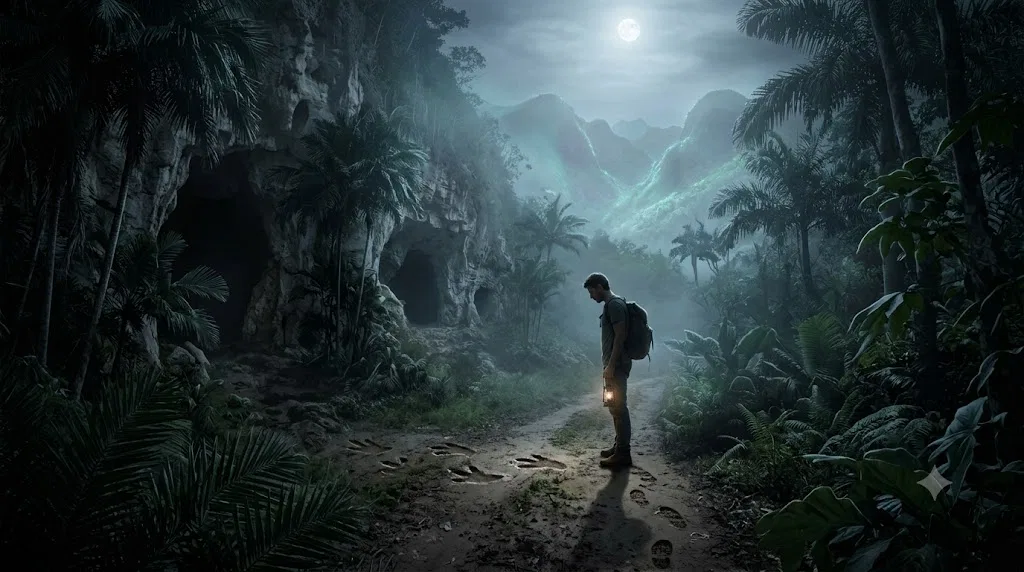
The Ciguapa is probably the Dominican Republic’s most recognisable strange being. She is usually described as a female figure of the mountains, often beautiful or unsettling, with very long hair and feet that face backwards. That last detail is the key to the legend: her footprints mislead anyone trying to follow her, so the tracker becomes the hunted, or at least the confused. The Smithsonian Folklife account calls her the best-known figure in Dominican lore and places her in the rural mountainous heart of the island.[Smithsonian Folklife]folklife.si.edubeautiful monsters elizabeth acevedo poetrybeautiful monsters elizabeth acevedo poetry
Official Dominican cultural material gives a softer but still eerie version: the Ciguapa is a magical creature with inverted feet and long hair, associated with caverns and rivers; in countryside versions, she is a small, beautiful woman who draws men into her nocturnal world.[Dominicana Online]dominicanaonline.orgOpen source on dominicanaonline.org. The same pattern appears in modern retellings, where she functions as seducer, warning, wilderness spirit and national folklore emblem rather than as a single fixed “monster”.
For sceptical readers, the important point is that the Ciguapa is not a zoological claim in any useful sense. There is no credible biological evidence for a backward-footed humanoid living in the Dominican highlands. Her staying power comes from symbolism: she turns pursuit into bewilderment, makes male desire look foolish, and turns the forest into an active character. Scholar Ginetta E. B. Candelario has treated the Ciguapa as a Dominican myth and metaphor, showing how the figure has been used to think about identity, history and contradiction rather than merely to frighten children.[Duke University Press]read.dukeupress.eduLa ciguapa y el ciguapeo Dominican Myth MetaphorLa ciguapa y el ciguapeo Dominican Myth Metaphor
That symbolic flexibility explains why the Ciguapa has travelled well. She appears in literature, art and Dominican diaspora culture, including in the work and public discussion of Dominican-American writer Elizabeth Acevedo. In a Fortean frame, she is less a “case” to be solved than a national image of the uncatchable: the thing that leaves evidence, but evidence pointing the wrong way.
Shapeshifters, pacts and road-haunting creatures
Dominican folklore also has a darker cluster of beings that belong to the night road: the Galipote, the Bacá and related shapeshifting or pact-bound figures. They are less internationally famous than the Ciguapa, but they are central to the country’s weird folklore because they join three recurring fears: dangerous travel, hidden power and wealth acquired by morally suspect means.
The Galipote is usually described as a violent shapeshifter that frightens travellers and can take animal or even inanimate forms. A University of Manchester publication summarises the Dominican Galipote as a magical creature that causes havoc by frightening and stopping people travelling at night, with the ability to transform into animals such as dogs or birds, or into objects such as trees and stones.[Research Explorer]research.manchester.ac.ukResearch Explorer GalipoteResearch Explorer Galipote
The Bacá belongs to the same moral universe but is more strongly linked to the idea of a bargain. It is commonly presented as a demonic or spirit-like familiar, often in animal form, obtained through a pact that grants protection or prosperity at a terrible cost. The available online sources for Bacá traditions are more uneven than for the Ciguapa, but Dominican cultural and folklore summaries consistently place it among the country’s major legendary figures, alongside the Galipote, Ciguapa and other night beings.[Wikipedia]WikipediaFolklore of the Dominican RepublicFolklore of the Dominican Republic
These stories are easy to flatten into “Dominican werewolves” or “Caribbean demons”, but that misses their local function. They often speak to village suspicions about sudden wealth, land control, violence and unexplained misfortune. A road blocked by a monstrous dog is a scary story. A neighbour thought to have a Bacá is a social story: who has power, how did they get it, and what are they prepared to sacrifice to keep it?
Biembienes and the hidden people of Bahoruco
One of the most intriguing Dominican traditions concerns the Biembienes, described in official cultural material as wild beings associated with the Bahoruco mountains. The account links the legend to the region’s history as a refuge for Indigenous people and runaway enslaved people, saying that from these remnants arose stories of hidden clans who moved in groups at night, stole crops, used grunting sounds, and left backward tracks to confuse pursuers.[Dominicana Online]dominicanaonline.orgOpen source on dominicanaonline.org.
This is classic borderland folklore: not a neat ghost story, but a blurred memory of social flight, survival and fear. The Bahoruco mountains were not just dramatic scenery. They were a place where people could withdraw from plantation, colonial and state authority. Over time, real histories of refuge can harden into tales of half-human night beings.
A sceptical reading does not have to mock the tradition. It can ask what the story preserves. The backward tracks echo the Ciguapa motif, but here the figure is not a lone seductive woman. The Biembienes are collective, marginal and evasive. They belong to a landscape where being untraceable may once have been a matter of survival. As Forteana, the story matters because it shows how “mystery people” legends can form where folklore and social history overlap.
Papá Liborio: when prophecy became history
The strangest Dominican material is not always about creatures. The life and afterlife of Olivorio Mateo Ledesma, better known as Papá Liborio, sits at the point where visionary religion, folk healing, anti-occupation resistance and political fear converge. He was a rural Dominican healer and messianic leader from the San Juan region, active in the early twentieth century, and later remembered within a religious and cultural movement known as Liborism.[Wikipedia]WikipediaOlivorio MateoOlivorio Mateo
The legendary version of Liborio’s story says that he disappeared during a 1908 hurricane and reappeared days later with a divine mission as healer, prophet and leader. Accounts describe him curing the sick, preaching peace, attracting followers and becoming a threat first to Dominican authorities and then to the United States occupation forces, which occupied the Dominican Republic from 1916 to 1924.[Wikipedia]WikipediaOlivorio MateoOlivorio Mateo
This is not “paranormal evidence” in the narrow sense. It is more historically serious than that. Liborio’s movement became a vehicle for rural hope and resistance, and his memory endured after he was killed in 1922. The Dominican Embassy in India’s cultural note on the film Liborio describes the film as centred on a social-religious movement in San Juan province during the first quarter of the twentieth century.[DominicanEmbassyIN]dominicanembassy.inOpen source on dominicanembassy.in.
The later Palma Sola tragedy shows how dangerous visionary movements can become when state power interprets them as threats. Sources on Dominican “history from below” describe the Liborista tradition as an Afro-Dominican messianic movement connected to peasant resistance and later repression.[abusablepast.org]abusablepast.orgmicrosyllabus history from below in the dominican republicmicrosyllabus history from below in the dominican republic In Fortean terms, Papá Liborio’s importance is that he cannot be reduced to a ghost, saint, rebel or fraud. He is a case study in how prophecy becomes politics, and how a country remembers a figure who was both spiritually charged and materially dangerous to authority.
Taíno caves and the older sacred landscape
The Dominican Republic’s caves add a much older layer to the country’s strange record. Sites such as Cueva de las Maravillas preserve hundreds of Taíno pictographs and petroglyphs, with official tourism material describing the cave as a major accessible cavern containing well-preserved Indigenous rock art. The cave’s own site says it displays more than 500 pictographs of archaeological and aesthetic value.[Discover Dominican Republic]godominicanrepublic.comOpen source on godominicanrepublic.com.
The point is not that the cave art is “mysterious” because archaeologists know nothing about it. Rather, it belongs to a sacred geography in which caves, spirits, ancestors and ritual experience were deeply connected. Taíno zemís were spiritual forces, deities or ancestral presences as well as objects associated with those powers, according to accessible art-historical explainers.[Smarthistory]smarthistory.orgOpen source on smarthistory.org.
Research on flooded caverns in the Dominican Republic’s East National Park notes that pictographs are often found deeper inside caves and that José María Cave contains more than 1,200 pictographs, making it one of the most notable rock-art caves documented in the Antilles.[Florida Museum]floridamuseum.ufl.eduFlorida Museum Taíno Use of Flooded Caverns in the East National ParkFlorida Museum Taíno Use of Flooded Caverns in the East National Park That matters because modern visitors may experience these places as “eerie” tourist attractions, but their older significance was religious, cosmological and communal.
For a Fortean page, caves are a useful corrective. They remind us that not every uncanny place is a “haunting” in the modern paranormal sense. Some are uncanny because they are old ritual spaces whose meanings are only partly recoverable. The strangeness comes from distance: images underground, made by people whose spiritual world was violently disrupted by colonisation, still facing the visitor in torchlike darkness.
Natural monsters that are real
The Dominican Republic also has animals that sound like folklore even when they are fully biological. The Hispaniolan solenodon is a prime example: a nocturnal, shrew-like mammal found on Hispaniola, famous for its venomous bite, flexible snout and ancient evolutionary lineage. Conservation and science writing often calls attention to how few people know it exists, partly because it is elusive and active at night.[Island Conservation]islandconservation.orgcan rare venomous impossibly resilient island mammal survive anthropocenecan rare venomous impossibly resilient island mammal survive anthropocene
The solenodon is not a cryptid, but it behaves like one in cultural terms. It is rare, odd-looking, nocturnal, poorly known to many locals and startling when encountered. Wired’s science coverage describes solenodons as among the world’s unusual mammals, with grooved lower incisors that deliver venom and a lineage that split from other mammals tens of millions of years ago.[WIRED]wired.comOpen source on wired.com.
Lago Enriquillo offers another almost prehistoric image: American crocodiles living in a hypersaline inland lake below sea level. Conservation material identifies the lake and surrounding ecosystem as part of the Jaragua-Bahoruco-Enriquillo Biosphere Reserve and a Ramsar wetland of international importance, while crocodile research has focused on the lake’s distinctive population.[AVSI]avsi.orgOpen source on avsi.org.
These animals show why “weird history” should leave room for natural history. A traveller hearing of a venomous Caribbean mammal or crocodiles in a salty desert lake might assume exaggeration. In these cases, the marvel is real. The sceptical explanation does not shrink the story; it improves it.
Strange lights over the Dominican sky
Modern Dominican sky strangeness is mostly preserved in sighting databases, social media and regional news rather than in a single canonical case. The National UFO Reporting Center lists Dominican Republic reports from places including Santo Domingo, Río San Juan, Bayahibe and Punta Cana, with witnesses describing discs, lights, unknown shapes and possible rockets.[nuforc.org]nuforc.orgOpen source on nuforc.org.
That does not mean the Dominican Republic is an alien hotspot. It means that the country, like many places with dark skies, tourist cameras and coastal horizons, produces ambiguous observations. Some reports may involve aircraft, drones, planets, satellites, meteors, rocket launches or atmospheric effects. Recent Caribbean “UFO” chatter has often overlapped with SpaceX and Starlink visibility, especially when rocket exhaust or fuel dumps form glowing spirals, plumes or “jellyfish” shapes high in the atmosphere.[The Washington Post]washingtonpost.comOpen source on washingtonpost.com.
Fireballs are a stronger category of evidence because they are familiar astronomical events that can be independently recorded. A paper on meteors and bolides across the Caribbean specifically reviews fireball records for Cuba, Jamaica, Haiti, the Dominican Republic and Puerto Rico, including records not listed in the American Meteor Society database.[ResearchGate]researchgate.netResearch Gate(PDF) Meteors and bolides across the CaribbeanResearch Gate(PDF) Meteors and bolides across the Caribbean The International Meteor Organization and American Meteor Society also maintain public fireball reporting systems that include country-level filters and witness reports.[fireball.imo.net]fireball.imo.netOpen source on imo.net.
For readers, the useful distinction is simple. “Unidentified” means not identified from the available report; it does not mean unidentifiable in principle, and it certainly does not mean extraterrestrial. Dominican sky Forteana is best treated as a mixture of real astronomical events, modern launch effects, ordinary misidentifications and a smaller residue of reports too thinly documented to settle.
What the sceptic and the believer each get right
Believers are right that Dominican strange traditions should not be dismissed as random nonsense. The Ciguapa, Biembienes, Galipote and Bacá have structure. They cluster around meaningful places and anxieties: mountains, night roads, sexuality, wealth, pursuit, hidden communities and spiritual danger. Papá Liborio’s legacy is not a campfire tale but part of a real history of rural religion, occupation and repression.[si.edu]folklife.si.edubeautiful monsters elizabeth acevedo poetrybeautiful monsters elizabeth acevedo poetry
Sceptics are right that evidence has categories. A legendary being, a ritual cave, a venomous mammal, a messianic movement and a rocket-lit sky are not the same kind of claim. Treating them all as “proof of the paranormal” would make the Dominican record less interesting, not more. The strongest approach is to ask what kind of evidence each case could reasonably have, and whether it actually exists.
That gives a practical reading guide:
- Folklore creatures such as the Ciguapa and Galipote are best read through oral tradition, literature, local belief and social meaning.
- Visionary movements such as Liborism need historical context, because their “miracle” claims are tied to real communities and state violence.
- Sky phenomena should be checked against launch schedules, meteor databases, astronomy tools and multiple independent witnesses.
- Natural oddities such as the solenodon and Lago Enriquillo crocodiles should be treated as biology and conservation, not cryptozoology.
This is where Dominican Forteana has its real pull. It is not a museum shelf of “weird facts”. It is a set of border crossings: between animal and monster, saint and rebel, cave art and spirit world, meteor and omen, wilderness and imagination.

Why these stories still matter
The Dominican Republic’s strange record endures because it gives memorable form to things that are otherwise hard to hold in the mind: the danger of the mountains, the secrecy of caves, the unease of sudden wealth, the survival of older spiritual worlds, the violence of occupation, the shock of unexplained lights, and the island’s genuinely startling wildlife. The stories are not all true in the same way, but they are not all false in the same way either.
The Ciguapa is not a documented species, but she is a powerful cultural figure. Papá Liborio’s divine claims cannot be verified as supernatural facts, but his movement and death belong to Dominican history. A UFO report may be a rocket plume, yet the witness’s astonishment is real. A “monster” in the forest may turn out to be a solenodon, which is stranger than many invented beasts.
That is the best reason to take Dominican Forteana seriously without taking it literally. It shows how a country’s weird stories can preserve landscape, fear, humour, resistance, ecology and memory all at once.
Amazon book picks
Further Reading
Books and field guides related to Where Dominican Folklore Meets the Uncanny. Use these as the next step if you want deeper reading beyond the article.
Lonely Planet Dominican Republic
First published 2017. Subjects: Dominican republic, description and travel.
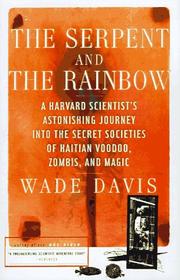
The Serpent and the Rainbow
First published 1985. Subjects: Social life and customs, Description and travel, Zombiism, Bizango (Cult), Religious life and customs.

Why the cocks fight
First published 1999. Subjects: Haiti, Haitians, Relations, International relations, Außenpolitik.
The Dominican Republic Reader
Provides broad context for folklore, religion and national identity.
eBay marketplace picks
Marketplace Samples
Live-tested eBay searches with available results related to this page.



Endnotes
1.
Source: Wikipedia
Title: Folklore of the Dominican Republic
Link:https://en.wikipedia.org/wiki/Folklore_of_the_Dominican_Republic
2.
Source: Wikipedia
Title: Bacá (mythological creature)
Link:https://en.wikipedia.org/wiki/Bac%C3%A1_%28mythological_creature%29
3.
Source: Wikipedia
Title: Olivorio Mateo
Link:https://en.wikipedia.org/wiki/Olivorio_Mateo
4.
Source: dominicanembassy.in
Link:https://www.dominicanembassy.in/blogcult2021/liborio
5.
Source: abusablepast.org
Title: microsyllabus history from below in the dominican republic
Link:https://abusablepast.org/microsyllabus-history-from-below-in-the-dominican-republic/
6.
Source: smarthistory.org
Link:https://smarthistory.org/taino-zemis-and-duhos/
7.
Source: wired.com
Link:https://www.wired.com/2015/03/creature-feature-10-fun-facts-solenodon
8.
Source: wired.com
Link:https://www.wired.com/2016/02/absurd-creature-of-the-week-the-mystery-of-solenodon-the-mammal-that-bites-like-a-snake
9.
Source: avsi.org
Link:https://www.avsi.org/en/news-and-press/news/lago-enriquillo
10.
Source: nuforc.org
Link:https://nuforc.org/subndx/?id=cDominican_Republic
11.
Source: nuforc.org
Link:https://nuforc.org/sighting/?id=188048
12.
Source: nuforc.org
Link:https://nuforc.org/sighting/?id=187853
13.
Source: researchgate.net
Title: Research Gate(PDF) Meteors and bolides across the Caribbean
Link:https://www.researchgate.net/publication/358911696_Meteors_and_bolides_across_the_Caribbean
14.
Source: fireball.imo.net
Link:https://fireball.imo.net/members/imo_view/browse_events
15.
Source: Wikipedia
Title: Dominican Republic
Link:https://en.wikipedia.org/wiki/Dominican_Republic
16.
Source: Wikipedia
Link:https://en.wikipedia.org/wiki/Ciguapa
17.
Source: Wikipedia
Title: 1561 celestial phenomenon over Nuremberg
Link:https://en.wikipedia.org/wiki/1561_celestial_phenomenon_over_Nuremberg
18.
Source: Wikipedia
Title: Galipote (mythological creature)
Link:https://en.wikipedia.org/wiki/Galipote_%28mythological_creature%29
19.
Source: Wikipedia
Title: Ball lightning
Link:https://en.wikipedia.org/wiki/Ball_lightning
20.
Source: Wikipedia
Title: Hispaniolan solenodon
Link:https://en.wikipedia.org/wiki/Hispaniolan_solenodon
21.
Source: Wikipedia
Title: Lake Enriquillo
Link:https://en.wikipedia.org/wiki/Lake_Enriquillo
22.
Source: Wikipedia
Title: American crocodile
Link:https://en.wikipedia.org/wiki/American_crocodile
23.
Source: Wikipedia
Link:https://en.wikipedia.org/wiki/Zemi
24.
Source: Wikipedia
Title: Cueva de las Maravillas National Park
Link:https://en.wikipedia.org/wiki/Cueva_de_las_Maravillas_National_Park
25.
Source: Wikipedia
Title: Twilight phenomenon
Link:https://en.wikipedia.org/wiki/Twilight_phenomenon
26.
Source: Wikipedia
Title: Geography of the Dominican Republic
Link:https://en.wikipedia.org/wiki/Geography_of_the_Dominican_Republic
27.
Source: Wikipedia
Link:https://en.wikipedia.org/wiki/Hispaniola
28.
Source: news.sky.com
Title: nasa confirms meteor after fireball reports 10450845
Link:https://news.sky.com/story/nasa-confirms-meteor-after-fireball-reports-10450845
29.
Source: researchgate.net
Link:https://www.researchgate.net/publication/310779121_La_ciguapa_y_el_ciguapeo_Dominican_Myth_Metaphor_and_Method
30.
Source: researchgate.net
Link:https://www.researchgate.net/figure/Pictographs-in-the-Jose-Maria-Cave_fig1_28322212
31.
Source: history.state.gov
Link:https://history.state.gov/historicaldocuments/frus1977-80v23/d304
32.
Source: worldfactbook.co
Link:https://www.worldfactbook.co/edition.php?country=dominican-republic&year=2024
33.
Source: dominicanaonline.org
Link:https://www.dominicanaonline.org/en/cultura/mitos-creencias/
34.
Source: folklife.si.edu
Title: beautiful monsters elizabeth acevedo poetry
Link:https://folklife.si.edu/magazine/beautiful-monsters-elizabeth-acevedo-poetry
35.
Source: read.dukeupress.edu
Title: [La ciguapa]({{ ‘la-ciguapa/’ | relative_url }}) y el ciguapeo Dominican Myth Metaphor
Link:https://read.dukeupress.edu/small-axe/article-abstract/20/3%20%2851%29/100/33456/La-ciguapa-y-el-ciguapeo-Dominican-Myth-Metaphor
36.
Source: research.manchester.ac.uk
Title: Research Explorer Galipote
Link:https://research.manchester.ac.uk/en/publications/galipote/
37.
Source: godominicanrepublic.com
Link:https://www.godominicanrepublic.com/things-to-do/cueva-de-las-maravillas
38.
Source: floridamuseum.ufl.edu
Title: Florida Museum Taíno Use of Flooded Caverns in the East National Park
Link:https://www.floridamuseum.ufl.edu/wp-content/uploads/sites/44/2017/04/Beekeretal.pdf
39.
Source: islandconservation.org
Title: can rare venomous impossibly resilient island mammal survive anthropocene
Link:https://www.islandconservation.org/can-rare-venomous-impossibly-resilient-island-mammal-survive-anthropocene/
40.
Source: washingtonpost.com
Link:https://www.washingtonpost.com/climate-environment/2025/03/25/spiral-spacex-launch-mystery-blue/
41.
Source: spkofmarvels.wordpress.com
Title: elizabeth acevedo
Link:https://spkofmarvels.wordpress.com/2017/04/04/elizabeth-acevedo/
42.
Source: read.dukeupress.edu
Link:https://read.dukeupress.edu/books/monograph/chapter-pdf/2010335/9780822376521-097.pdf
43.
Source: explorelaromana.com
Link:https://explorelaromana.com/experiences/cultural-experience-1/
44.
Source: worldfactbookarchive.org
Link:https://worldfactbookarchive.org/archive/2010/DO
45.
Source: tripadvisor.com
Title: Cueva de las Maravillas
Link:https://www.tripadvisor.com/Attraction_Review-g10293056-d1985700-Reviews-Cueva_de_las_Maravillas-El_Soco_San_Pedro_de_Macoris_San_Pedro_de_Macoris_Provi.html
46.
Source: godominicanrepublic.com
Title: Dominican Republic Tourism
Link:https://www.godominicanrepublic.com/
47.
Source: ufdcimages.uflib.ufl.edu
Title: Davis Liborio trad transcriptn Engl
Link:https://ufdcimages.uflib.ufl.edu/UF/00/08/74/00/00002/Davis_Liborio_trad%20transcriptn-Engl.pdf
48.
Source: arts.gov
Title: elizabeth acevedo
Link:https://www.arts.gov/stories/podcast/elizabeth-acevedo
49.
Source: global-geography.org
Title: Hispaniola | Pictures | Dominican Republic
Link:https://global-geography.org/af/Geography/America/Dominican_Republic/Pictures/Factbook_Pictures/110dr
50.
Source: en.wikisource.org
Link:https://en.wikisource.org/wiki/CIA_World_Fact_Book%2C_2004/Haiti
51.
Source: ebsco.com
Link:https://www.ebsco.com/research-starters/geography-and-cartography/dominican-republic
52.
Source: wawa.org.uk
Title: hispaniolan solenodon
Link:https://wawa.org.uk/hispaniolan-solenodon/
53.
Source: udc.libguides.com
Link:https://udc.libguides.com/udc-writers/acevedo
54.
Source: monster.fandom.com
Link:https://monster.fandom.com/wiki/Ciguapa
Additional References
55.
Source: youtube.com
Title: The Memphis Tragedy: The Story of a Forgotten Dominican Hero
Link:http://www.youtube.com/watch?v=9bTl_2LyStw
Source snippet
The Dominican Republic's Most Infamous Monster Terrified Me Storied The Dominican Republic's Most Infamous Monster Terrified Me Storied...
56.
Source: youtube.com
Title: Ep 6 Pt 5 Clip || Taino Legend || The Bat-Like Creatures of the Cacibajagua Cave
Link:http://www.youtube.com/watch?v=NkV_S-Hb6xE
Source snippet
The Memphis Tragedy: The Story of a Forgotten Dominican Hero...
57.
Source: youtube.com
Title: URBAN LEGENDS, MYTHS AND FOLKLORE OF THE DOMINICAN REPUBLIC
Link:http://www.youtube.com/watch?v=30KX_R2s2Z8
Source snippet
Ep 6 Pt 5 Clip || Taino Legend || The Bat-Like Creatures of the Cacibajagua Cave...
58.
Source: loc.gov
Link:https://www.loc.gov/everyday-mysteries/browse-all-questions/item/can-it-rain-frogs-fish-and-other-objects/
59.
Source: youtube.com
Title: The Dominican Republic’s Most Infamous Monster Terrified Me
Link:http://www.youtube.com/watch?v=8l3eFQ21vU0
Source snippet
The Taino myth of the cursed creator - Bill Keegan...
60.
Source: youtube.com
Title: The Taino myth of the cursed creator
Link:http://www.youtube.com/watch?v=arlTwhiMxVM
Source snippet
URBAN LEGENDS, MYTHS AND FOLKLORE OF THE DOMINICAN REPUBLIC...
61.
Source: costacruises.com
Link:https://www.costacruises.com/excursions/36/3685.html
62.
Source: pisqueya.com
Link:https://pisqueya.com/blogs/news/4-dominican-urban-legends-of-dark-creatures-that-go-bump-in-the-night?srsltid=AfmBOooKy6VErVNGAMXQD5z_kEc-_HggG_UWKwIYZRFqhvDDQgre_hqO
63.
Source: pisqueya.com
Link:https://pisqueya.com/blogs/news/4-dominican-urban-legends-of-dark-creatures-that-go-bump-in-the-night?srsltid=AfmBOoqVW06WMIiOJcjFi2Yn9of7F917Y2FhzTxF8IGyiTRlD1xerLAV
64.
Source: pisqueya.com
Link:https://pisqueya.com/blogs/news/4-dominican-urban-legends-of-dark-creatures-that-go-bump-in-the-night?srsltid=AfmBOoqh1cNMvTDCNBhutd6SCPAlW4f6D9oTdhFhdaWrceflZhWJlTO6
Topic Tree
Follow this branch
Related pages 192
- Afghan Forteana
- Antigua Uncanny
- Bosnian Mysteries
- Botswana Weird
- Brazil Strange
- +187 more in sidebar