Why Does Namibia Feel So Uncanny?
Namibia is a superb country for strange-but-grounded history because so many of its mysteries begin as visible facts: bare circles in the desert grass, a meteorite too heavy to move, shipwrecks stranded in sand, prehistoric images that once tempted Europeans into wild theories, and lakes whose depth invited rumours of whirlpools, tunnels and lost treasure.
Page outline Jump by section
Introduction
The pattern is clear: many Namibian wonders are genuinely uncanny, but they usually become more interesting when tested rather than merely believed. Fairy circles have ecological explanations in competition; “bottomless” lakes turn out to be karst sinkholes with real hazards and wartime history; sky strangeness sits beside world-class dark-sky astronomy; and old sacred stories are rooted in places where people still passed, hunted, prayed, traded, and remembered.
Why Namibia Feels Built for Weird History
Namibia’s strange reputation begins with scale and emptiness. It has fog deserts, salt pans, dry riverbeds, underground water, exposed rock art, and coastlines where ships have been visibly erased by sand. UNESCO describes the Namib Sand Sea as the only coastal desert in the world with extensive dune fields shaped by fog, with fog acting as a primary water source for specialised desert life. That matters for Forteana because the same environmental conditions that produce real scientific marvels also produce mirage-like stories: disappearing tracks, ghostly coastlines, impossible-looking animal survival, and landscapes that feel deliberately arranged.[UNESCO World Heritage Centre]whc.unesco.orgWorld Heritage Centre Namib Sand SeaWorld Heritage Centre Namib Sand Sea
The country’s weird-history record is therefore unusually physical. A visitor does not need to believe in a haunting to understand why the Skeleton Coast became a place of dread, or why a circular bare patch in grassland would attract stories about gods, dragons, poisonous plants or hidden insects. Namibia’s best anomalies are not weightless rumours. They are often visible, named, mapped and contested.
The caution is that Namibia is also a place where colonial and tourist storytelling has often over-written older local meanings. A European traveller’s “mystery” may be someone else’s sacred site, hunting memory, route marker, warning story or ecological observation. The most useful approach is not to strip the strangeness away, but to ask what kind of strangeness is actually present: folklore, mistaken interpretation, unresolved natural mechanism, heritage myth, or simple human drama under extreme conditions.
Fairy Circles: The Desert’s Best-Known Puzzle
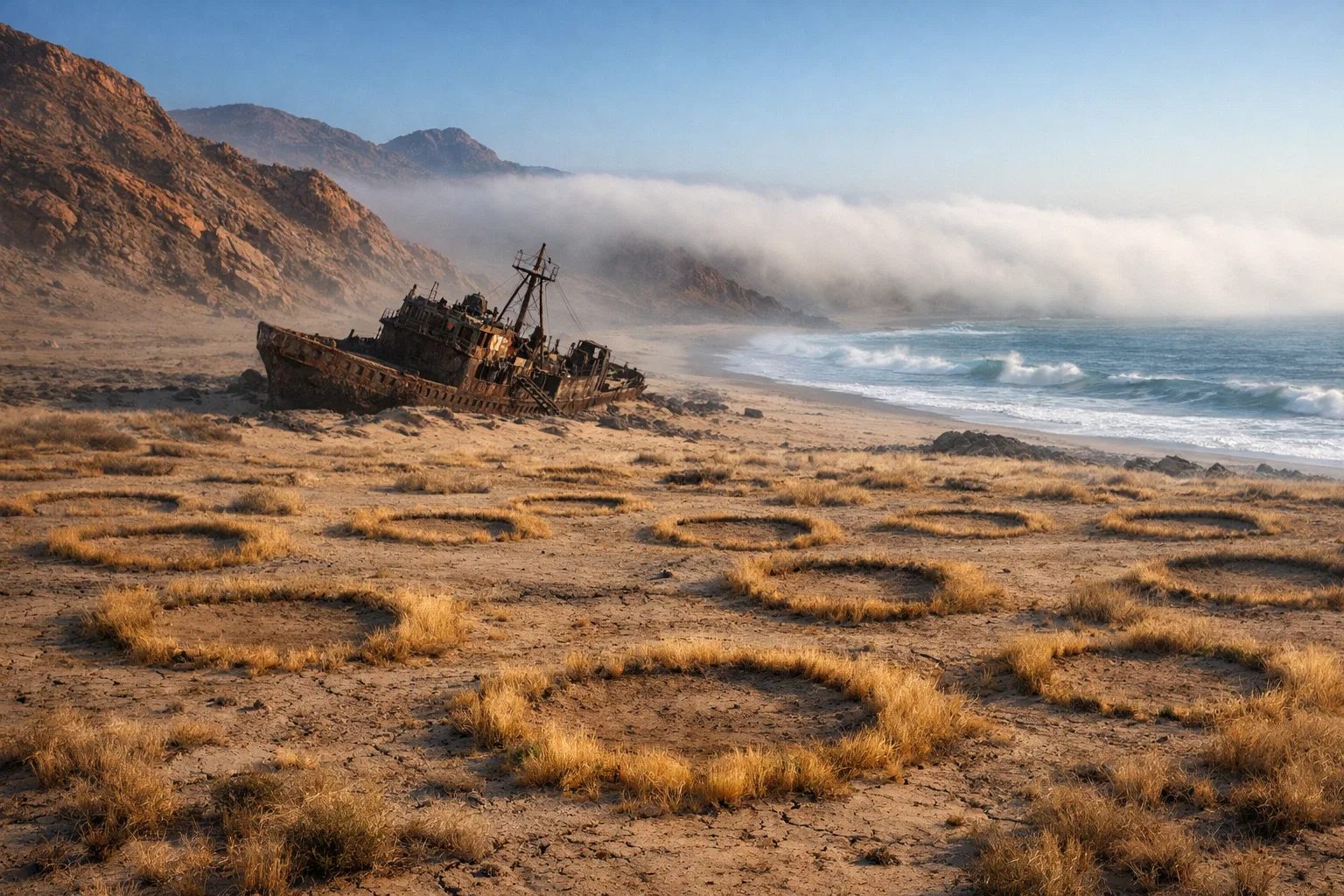
Namibia’s fairy circles are among the world’s most famous natural anomalies: round, bare patches set into dry grassland, often bordered by taller vegetation and arranged so neatly that aerial photographs can look designed. NamibRand Nature Reserve describes them as mysterious bare circles in the sand, especially prominent along the edge of the Namib Desert, and notes that the reserve is one of the best-known places to see them.[Wolwedans]wolwedans.comOpen source on wolwedans.com.
The strange part is not merely that the circles exist, but that they look like a message. Researchers have proposed termites, plant self-organisation, water competition, soil chemistry, poisonous Euphorbia plants and other mechanisms. A Conservation Namibia review of the scientific debate argues against the Euphorbia hypothesis in areas where fairy circles occur without Euphorbia plants, and frames much of the current discussion around field evidence rather than folklore alone.[Conservation Namibia]conservationnamibia.comConservation Namibia Solving the fairy circle mystery using scientific evidenceConservation Namibia Solving the fairy circle mystery using scientific evidence
The most compelling sceptical reading is that fairy circles are ecological patterning in an arid environment. Mathematical and field-based studies have argued that vegetation in dry landscapes can self-organise as plants compete for scarce water, producing stable bare gaps and fringes of stronger grass. Other researchers have continued to defend termite-based explanations, particularly involving sand termites that remove vegetation and alter water availability. The important point is that “explained” does not mean “boring”: the circles remain a live example of how simple ecological pressures can create patterns that look almost intentional.[arXiv]arxiv.orgOpen source on arxiv.org.
For Fortean readers, fairy circles are a model case. They have folklore, tourist magnetism, scientific rivalry and enough visual weirdness to survive debunking. Even if no fairy, dragon or underground intelligence is involved, the landscape still behaves in a way that unsettles the eye.

Stones from the Sky: Hoba, Gibeon and the Ordinary Miracle of Meteorites
Namibia’s meteorites show how a country can have “falls from the sky” that need no exaggeration. The Hoba meteorite, near Grootfontein, is the country’s most spectacular example. Namibia’s National Heritage Council records that it fell to Earth less than 80,000 years ago, was first described by J. H. Brits in 1920, and was declared a national monument in the mid-20th century, with a protected area later proclaimed around it.[NHC]nhc-nam.orgNHCHeritage ObjectsNHCHeritage Objects
Hoba’s Fortean appeal is unusually clean: it is not a rumour of a falling object, but a massive object still lying where it was found. Its lack of a dramatic visible crater has helped make it feel stranger. The likely explanation is atmospheric slowing and a relatively low-energy final impact for such a large iron mass, but the result is still theatrical: a great slab of extraterrestrial metal sitting in a farm landscape, transformed from ploughing obstruction into national heritage.
The Gibeon meteorite field adds another layer. Rather than one iconic mass, it is a prehistoric fall scattered across southern Namibia, with iron fragments historically known and used by local people before scientific classification. Later European collection and analysis folded those “iron stones” into meteoritics, but the deeper story is about two knowledge systems meeting: local practical use and formal scientific identification.[Wikipedia]WikipediaGibeon (meteoriteGibeon (meteorite
Meteorites matter in Namibian Forteana because they are the rare case where the old phrase “something fell from the sky” is literally true. Unlike many alleged sky mysteries, they leave material evidence, chemical signatures and heritage trails. They also help explain why reports of lights, fireballs and strange falls can carry cultural force even when a particular case proves mundane.
Bottomless Lakes and Dragon Breath
| Namibia’s lake legends are strongest where geology naturally invites exaggeration. Lake Otjikoto, also known as Oshikoto, has been associated with stories of being bottomless, linked by a subterranean tunnel to Lake Guinas, and containing a central whirlpool. A local account records the Hai | om belief that anyone who swam in the lake would disappear, while also noting the lake’s role in early copper trade between Hai | om and Aandonga communities.[padlangsnamibia.com]padlangsnamibia.comMysteries and Myths of Lake OshikotoMysteries and Myths of Lake Oshikoto |
The “bottomless” claim is not scientifically necessary to make Otjikoto strange. It is a sinkhole lake formed by collapsed karst, and such lakes can have steep sides, submerged cave passages and misleading depth impressions. The folklore was reinforced by history: in 1915, retreating German forces dumped weapons and ammunition into the lake rather than surrender them to South African troops. Later recovery efforts turned a natural mystery into a war-treasure story, complete with rumours of unrecovered items and lost valuables.[Travel Namibia]travelnam.comOpen source on travelnam.com.
Dragon’s Breath Cave, north of Grootfontein, is even more dramatically named. The cave’s warm, humid air can rise from the entrance and condense into mist, creating the impression of breath from below. Modern accounts describe a narrow, inconspicuous surface opening leading down to a vast flooded cavern roughly 60 metres beneath the surface, with a lake surface of about two hectares. The cave was discovered in 1986 by Roger Ellis and explored by cavers and divers the following year.[Discover Wildlife]discoverwildlife.comOpen source on discoverwildlife.com.
Here again, the explanation improves the story. There is no need to imagine a literal dragon when karst dissolution, hidden water and pressure-driven mist can create a natural effect that looks mythic. Namibia’s underground-water Forteana is powerful because the surface is so dry. A secret lake beneath arid ground feels impossible until geology calmly shows how it happens.
The Skeleton Coast: A Haunted Reputation Made by Fog, Current and Wreckage
The Skeleton Coast is one of Namibia’s most convincing “haunted” landscapes because the fear is historically earned. Namibia’s environment ministry describes Skeleton Coast Park as a great wilderness stretching about 500 kilometres from the Ugab River to the Kunene River, with dense coastal fogs and cold sea breezes caused by the Benguela Current, and beaches littered with shipwrecks, bones and debris.[Ministry of Environment]meft.gov.naMinistry of Environment MEFT NamibiaMinistry of Environment MEFT Namibia
This is not a supernatural case so much as a machine for producing ghost stories. Cold ocean current, fog, heavy surf, remote desert and poor routes inland created a coastline where shipwreck survivors might escape drowning only to face thirst and exposure. The result is a place where wrecks are not just maritime archaeology; they are visual folklore. A stranded hull becomes a warning sign, a memento mori, and eventually a tourist image.
The Eduard Bohlen is the perfect example. Wrecked in fog in 1909, it now lies in desert sand inland from the present shoreline, giving the surreal impression of a ship sailing through dunes or being swallowed by land rather than sea. That image is often treated as eerie fantasy, but it is the product of coastal change, shifting sand and a long record of real wrecks.[Wikipedia]WikipediaEduard BohlenEduard Bohlen
For a Fortean page, the Skeleton Coast is a reminder that “ghostly” does not always mean “ghost”. Sometimes the uncanny is made from weather, distance and time. Namibia’s coast looks haunted because the material evidence of disaster has not been tidied away.
Sacred Cairns, Trickster Figures and Monsters on the Edge of the Path
Namibian folklore is not simply a supply of monsters for modern cryptid lists. Much of it is bound to movement through land: paths, passes, waterholes, hunting grounds and places where travellers left offerings. Sigrid Schmidt’s study of so-called Heitsi-eibeb graves records that early European travellers saw Khoekhoe and San people throwing stones or branches onto certain cairns as they passed, showing reverence to these places. In Namibia, such heaps were known as Heitsi-eibeb graves, though the tradition did not imply a single literal grave in each place.[namibiadigitalrepository.com]namibiadigitalrepository.comOpen source on namibiadigitalrepository.com.
Heitsi-eibib or Haiseb is often described as a powerful, recurring figure in Khoekhoe and related southern African traditions: hunter, trickster, culture hero, and sometimes a being who dies and returns. The “graves” therefore sit in an ambiguous zone between shrine, route marker, memorial, ritual habit and mythic geography. For Forteana, they are valuable because they show how a landscape can be made strange by repeated human action rather than by a single dramatic apparition.
Monster traditions also exist, though they should be handled carefully. The Aigamuxa or Aigamuchab, a man-eating being with eyes on its feet, is usually associated with Khoikhoi folklore of the wider southern African desert region. Modern retellings often turn it into a cryptid, but it reads more convincingly as a cautionary and comic-ogre figure: terrifying, bodily absurd, and adapted to stories about dangerous travel through open country.[Wikipedia]WikipediaOpen source on wikipedia.org.
That distinction matters. A creature with eyes in its feet need not be a zoological claim to be meaningful. It may encode vulnerability, night travel, predator fear, humour, and the trickster logic by which the apparently powerful monster has a built-in weakness. Namibia’s folkloric weirdness is strongest when read as living narrative attached to land, not as a crude hunt for hidden animals.
Rock Art and the Danger of Imported Mysteries
Namibia’s rock art has generated some of the most revealing “mysteries” in the country, especially where outsiders projected their own expectations onto local evidence. Twyfelfontein, or /Ui-//aes, is recognised by UNESCO as a major record of hunter-gatherer ritual practice over at least two millennia, with rock engravings and paintings linked to the sacred value of land near an aquifer. UNESCO also states that the core-area works are authentic San hunter-gatherer creations predating later Damara and European presence.[UNESCO World Heritage Centre]whc.unesco.orgWorld Heritage Centre Twyfelfontein or /Ui-//aesWorld Heritage Centre Twyfelfontein or /Ui-//aes
That context is essential because rock art is often dragged into pseudo-archaeology. Animal-human figures, strange tracks, abstract marks and ritual scenes can look mysterious to modern viewers. But “mysterious” is not a licence to invent lost civilisations, aliens or wandering Mediterranean priests. The better question is what the images meant within hunter-gatherer ritual, trance, landscape knowledge and seasonal survival.
The Brandberg “White Lady” case shows the problem clearly. The famous painted figure was once interpreted by Abbé Henri Breuil as a white female of Mediterranean origin, feeding a diffusionist fantasy of outsiders bringing culture into Africa. Later work, including tracings by Harald Pager discussed by the Bradshaw Foundation, indicates that the figure is not a white lady at all but a male figure within a local ritual scene. The site remains fascinating, but the old mystery says more about European misreading than about the painter’s world.[Bradshaw Foundation]bradshawfoundation.comBradshaw Foundation The White Lady of BrandbergBradshaw Foundation The White Lady of Brandberg
This makes Namibian rock art one of the most important sceptical lessons in the country’s Forteana. Sometimes the anomaly is not in the ancient image. It is in the modern interpreter who cannot recognise African authorship, ritual complexity or symbolic convention without importing a more exotic explanation.
Wild Horses, Desert Survivors and Romantic Uncertainty
The wild horses of the Namib are not paranormal, but they sit comfortably within Namibia’s weird-history record because their survival looks improbable and their origin story has long been debated. They live around Garub on the eastern fringe of the Namib Desert, where the image of horses crossing dry plains has become one of the country’s most romantic natural spectacles. The Namibia Wild Horses Foundation notes that their origins have been described as mysterious, with theories involving diamond prospectors, abandoned mining fields and South African military horses scattered during the First World War.[African Horse Safaris Foundation]africanhorsesafarisfoundation.orgAfrican Horse Safaris Foundation Namibia Wild Horses FoundationAfrican Horse Safaris Foundation Namibia Wild Horses Foundation
A more grounded account points to domestic stock, especially horses connected with the Kubub stud farm, Lüderitz racing and diamond-field transport, later mixed with military animals and protected for decades by the restricted Sperrgebiet diamond zone. Gondwana Collection’s account states that research has linked the core population to Kubub, with horses reaching Garub because a railway borehole provided permanent water.[Gondwana Collection Namibia]gondwana-collection.comGondwana Collection Namibia The Wild Horses of the NamibGondwana Collection Namibia The Wild Horses of the Namib
The Fortean element is not that the horses are unknown animals. It is that a human-made historical accident produced a population that now feels like part of the desert itself. Their story has all the ingredients of legend — war, abandonment, forbidden territory, survival against drought, and periodic threat from predators — while remaining firmly within documented ecology and history.
Strange Lights Under Some of the World’s Darkest Skies
Namibia’s skies deserve a place in any country-level strange-history account, but not because the country has a strong public record of classic UFO cases. The better evidence-supported point is that Namibia is a world-class dark-sky environment, which makes ordinary celestial phenomena unusually vivid. A study on dark-sky tourism notes that Namibia is world-renowned in the astronomy community for exceptionally dark skies and that astronomy is being used for tourism, outreach and capacity-building.[arXiv]arxiv.orgarXiv Dark sky tourism and sustainable development in NamibiaarXiv Dark sky tourism and sustainable development in Namibia
That matters because many “mystery light” reports elsewhere are produced by meteors, satellites, aircraft, planets, military activity, atmospheric effects or unfamiliar viewing conditions. In Namibia, the sheer clarity of the night sky can make these objects more spectacular. A bright meteor over a low-light desert, a satellite train crossing a tourist camp, or gamma-ray observatory beams and equipment glimpsed without context can all become story material.
The country is also home to serious astronomy infrastructure, including the High Energy Stereoscopic System, which has surveyed the Milky Way in very-high-energy gamma rays from Namibia. This creates a pleasing reversal: in some countries, strange lights are pursued mainly by enthusiasts. In Namibia, the dark sky is so good that scientists have built instruments there to study some of the most energetic phenomena in the universe.[arXiv]arxiv.orgarXiv The H.E.S.S. Galactic plane surveyarXiv The H.E.S.S. Galactic plane survey
The sensible Fortean stance is therefore open but restrained. Namibia almost certainly has local stories of odd lights, fireballs and unsettling night experiences; every dark-sky country does. But the country’s best-supported sky strangeness is the grandeur of the real sky itself.
What Believers and Sceptics Each Get Right
Namibia’s strange material rewards both wonder and restraint. Believers are right that some places feel charged because they combine real danger, deep history and striking visual anomalies. The Skeleton Coast is not “just a beach”; Otjikoto is not “just a pond”; fairy circles are not “just patches”; Hoba is not “just a rock”. These things became famous because they genuinely interrupt normal expectations.
Sceptics are right that the interruption usually has better explanations than supernatural claims. Fog and current explain many coastal tragedies. Karst explains hidden lakes. Ecological competition may explain fairy circles. Archaeology explains rock art more responsibly than imported fantasies. Military and mining history explain several “lost” or “abandoned” mysteries. In Namibia, debunking often deepens the story rather than flattening it.
The most useful middle position is evidence-aware curiosity. Ask what was actually reported, who recorded it, what local tradition says, what physical evidence remains, and which explanation requires the fewest inventions. Namibia’s Forteana is strongest when it is allowed to remain a layered record: part folklore, part landscape science, part colonial archive, part tourist myth, and part unresolved human awe.

Why Namibia’s Weird Record Still Has Pull
Namibia’s unusual power lies in how often the uncanny is visible in daylight. The fairy circles can be photographed. Hoba can be touched. The Skeleton Coast wrecks rust in public view. Twyfelfontein’s engravings remain on stone. Otjikoto still looks dark enough to deserve its legends. Dragon’s Breath still exhales mist from below. These are not merely stories told after the fact; they are places where the story seems to have hardened into the landscape.
That is why Namibia belongs naturally in a country-by-country Fortean project. Its weird history is not dominated by a single monster, UFO flap or haunted house. It is a broader pattern of environments that invite wonder, explanations that arrive slowly, and narratives that show how people make sense of extreme places. The best Namibian mysteries are not defeated by facts. They are made sharper by them.
Amazon book picks
Further Reading
Books and field guides related to Why Does Namibia Feel So Uncanny?. Use these as the next step if you want deeper reading beyond the article.



Namibia, 3rd
First published 2007. Subjects: Guidebooks, Namibia, description and travel.
eBay marketplace picks
Marketplace Samples
Live-tested eBay searches with available results related to this page.
Endnotes
1.
Source: whc.unesco.org
Title: World Heritage Centre Namib Sand Sea
Link:https://whc.unesco.org/en/list/1430/
2.
Source: wolwedans.com
Link:https://www.wolwedans.com/namibrand/fairy-circles/
3.
Source: arxiv.org
Link:https://arxiv.org/abs/1306.4848
4.
Source: arxiv.org
Title: arXiv Gradual Regime Shifts in Fairy Circles
Link:https://arxiv.org/abs/1703.00732
5.
Source: nhc-nam.org
Title: NHCHeritage Objects
Link:https://nhc-nam.org/heritage-objects/
6.
Source: Wikipedia
Title: Gibeon (meteorite)
Link:https://en.wikipedia.org/wiki/Gibeon_%28meteorite%29
7.
Source: padlangsnamibia.com
Title: Mysteries and Myths of Lake Oshikoto
Link:https://padlangsnamibia.com/padlangs-namibia/mysteries-and-myths-of-lake-oshikoto
8.
Source: Wikipedia
Title: Otjikoto Lake
Link:https://en.wikipedia.org/wiki/Otjikoto_Lake
9.
Source: Wikipedia
Title: Eduard Bohlen
Link:https://en.wikipedia.org/wiki/Eduard_Bohlen
10.
Source: namibiadigitalrepository.com
Link:https://namibiadigitalrepository.com/items/show/362
11.
Source: Wikipedia
Link:https://en.wikipedia.org/wiki/Aigamuxa
12.
Source: whc.unesco.org
Title: World Heritage Centre Twyfelfontein or /Ui-//aes
Link:https://whc.unesco.org/en/list/1255/
13.
Source: gondwana-collection.com
Title: Gondwana Collection Namibia The Wild Horses of the Namib
Link:https://gondwana-collection.com/blog/wild-horses
14.
Source: arxiv.org
Title: arXiv Dark sky tourism and sustainable development in Namibia
Link:https://arxiv.org/abs/2102.07088
15.
Source: arxiv.org
Title: arXiv The H.E.S.S. Galactic plane survey
Link:https://arxiv.org/abs/1804.02432
16.
Source: Wikipedia
Link:https://en.wikipedia.org/wiki/Namibia
17.
Source: Wikipedia
Title: Heitsi eibib
Link:https://en.wikipedia.org/wiki/Heitsi-eibib
18.
Source: Wikipedia
Title: Hoba meteorite
Link:https://en.wikipedia.org/wiki/Hoba_meteorite
19.
Source: Wikipedia
Title: Namib Desert Horse
Link:https://en.wikipedia.org/wiki/Namib_Desert_Horse
20.
Source: Wikipedia
Title: Dragon’s Breath Cave
Link:https://en.wikipedia.org/wiki/Dragon%27s_Breath_Cave
21.
Source: Wikipedia
Title: Skeleton Coast
Link:https://en.wikipedia.org/wiki/Skeleton_Coast
22.
Source: Wikipedia
Link:https://en.wikipedia.org/wiki/Kolmanskop
23.
Source: Wikipedia
Title: Skeleton Coast National Park
Link:https://en.wikipedia.org/wiki/Skeleton_Coast_National_Park
24.
Source: Wikipedia
Title: The White Lady (Namibia)
Link:https://en.wikipedia.org/wiki/The_White_Lady_%28Namibia%29
25.
Source: Wikipedia
Link:https://en.wikipedia.org/wiki/Twyfelfontein
26.
Source: padlangsnamibia.com
Link:https://padlangsnamibia.com/padlangs-namibia/on-the-road-with-faraway-sandy-trails-the-ghost-tales-of-lake-otjikoto
27.
Source: padlangsnamibia.com
Title: Wild Horses in the Namib Desert
Link:https://padlangsnamibia.com/padlangs-namibia/wild-horses-in-the-namib-desert-8
28.
Source: whc.unesco.org
Link:https://whc.unesco.org/uploads/nominations/1430.pdf
29.
Source: gondwana-collection.com
Link:https://gondwana-collection.com/blog/haitsi-aibeb-namibia
30.
Source: gondwana-collection.com
Title: why the dragons breath cave in namibia is so special
Link:https://gondwana-collection.com/blog/why-the-dragons-breath-cave-in-namibia-is-so-special
31.
Source: fairy-circles.info
Title: Fairy Circles
Link:https://www.fairy-circles.info/
32.
Source: namibrand.com
Link:https://www.namibrand.com/foundation.html
33.
Source: gondwana.travel
Title: 101 reasons to visit namibia ghost riders of the desert
Link:https://gondwana.travel/blog/101-reasons-to-visit-namibia-ghost-riders-of-the-desert
34.
Source: gondwana.travel
Title: born of war raised by wind namibias wild horses
Link:https://gondwana.travel/blog/born-of-war-raised-by-wind-namibias-wild-horses
35.
Source: conservationnamibia.com
Title: Conservation Namibia Solving the fairy circle mystery using scientific evidence
Link:https://conservationnamibia.com/blog/science-of-fairy-circles-2023.php
36.
Source: travelnam.com
Link:https://travelnam.com/namibias-bottomless-lakes-otjikoto-guinas/
37.
Source: discoverwildlife.com
Link:https://www.discoverwildlife.com/environment/dragons-breath-cave
38.
Source: meft.gov.na
Title: Ministry of Environment MEFT Namibia
Link:https://www.meft.gov.na/national-parks/skeleton-coast-park/227/
39.
Source: bradshawfoundation.com
Title: Bradshaw Foundation The White Lady of Brandberg
Link:https://www.bradshawfoundation.com/africa/namibia/white_lady/index.php
40.
Source: africanhorsesafarisfoundation.org
Title: African Horse Safaris Foundation Namibia Wild Horses Foundation
Link:https://www.africanhorsesafarisfoundation.org/who-we-support/namibia-wild-horses-foundation/
41.
Source: nhc-nam.org
Link:https://nhc-nam.org/
42.
Source: nhc-nam.org
Link:https://nhc-nam.org/wp-content/uploads/2024/08/Entrance-Fees-2024-2025.pdf
43.
Source: meft.gov.na
Link:https://www.meft.gov.na/files/files/Horses%20of%20the%20Namib%20Management%20Plan.pdf
44.
Source: bradshawfoundation.com
Link:https://www.bradshawfoundation.com/africa/namibia/twyfelfontein/index.php
45.
Source: cryptidz.fandom.com
Link:https://cryptidz.fandom.com/wiki/Aigamuxa
46.
Source: facebook.com
Link:https://www.facebook.com/gondwana.collection.namibia/posts/discover-the-raw-and-untamed-beauty-of-the-skeleton-coast-a-surreal-landscape-wh/730454292445027/
47.
Source: info-namibia.com
Title: Hoba Meteorite
Link:https://www.info-namibia.com/activities-and-places-of-interest/otavi/hoba-meteorite
48.
Source: info-namibia.com
Link:https://www.info-namibia.com/activities-and-places-of-interest/damaraland/twyfelfontein
49.
Source: hts.org.za
Link:https://hts.org.za/index.php/hts/article/view/9299/26981
50.
Source: iugs-geoheritage.org
Title: Namib Sand Sea
Link:https://iugs-geoheritage.org/geoheritage_sites/namib-sand-sea/
51.
Source: youtube.com
Link:https://www.youtube.com/watch?v=TwyX0h9MKJw
52.
Source: youtube.com
Link:https://www.youtube.com/watch?v=hQKBNoEIqls
53.
Source: travelnam.com
Title: the wild horses of namibia
Link:https://travelnam.com/the-wild-horses-of-namibia/
54.
Source: travelnam.com
Link:https://travelnam.com/shooting-stars-dinosaur-tracks-white-elephants/
55.
Source: travelnam.com
Link:https://travelnam.com/the-spirit-of-the-dragon-and-this-thing-called-life-dragons-breath/
56.
Source: travelnam.com
Link:https://travelnam.com/a-place-of-legends-bones-myths/
57.
Source: travelnam.com
Title: Diamonds in the dust
Link:https://travelnam.com/diamonds-dust-ghost-towns-diamond-era/
58.
Source: travelnam.com
Link:https://travelnam.com/namib-skeleton-coast-national-park-one-of-the-largest-parks-in-the-world/
59.
Source: travelnam.com
Title: The White Lady
Link:https://travelnam.com/the-white-lady-neither-a-lady-nor-white/
60.
Source: embassyofnamibia.fr
Link:https://www.embassyofnamibia.fr/perch/resources/pdf/skeleton-coast-park.pdf
61.
Source: janameerman.com
Link:https://janameerman.com/twyfelfontein/
62.
Source: national-parks.org
Link:https://national-parks.org/namibia/skeleton-coast/
63.
Source: shipwreckworld.com
Title: Eduard Bohlen
Link:https://www.shipwreckworld.com/maps/eduard-bohlen
64.
Source: naturalworldheritagesites.org
Title: Namib Sand Sea
Link:https://www.naturalworldheritagesites.org/sites/namib-sand-sea
65.
Source: tripadvisor.com
Link:https://www.tripadvisor.com/Attraction_Review-g479220-d478966-Reviews-Twyfelfontein-Damaraland.html
66.
Source: clayvermulmfiction.com
Title: The Aigamuxa
Link:https://www.clayvermulmfiction.com/post/cryptid-tidbit-9-the-aigamuxa
67.
Source: bilderreich.de
Title: UNESC O
Link:https://bilderreich.de/1416-7265/image-unesco-rock-engravings-at-twyfelfontein-namibia.html
68.
Source: alamy.com
Title: eduard bohlen
Link:https://www.alamy.com/stock-photo/eduard-bohlen.html
69.
Source: state.gov
Link:https://www.state.gov/countries-areas/namibia
70.
Source: world-heritage-datasheets.unep-wcmc.org
Title: namib sand sea
Link:https://world-heritage-datasheets.unep-wcmc.org/datasheet/output/site/namib-sand-sea
71.
Source: thecommonwealth.org
Link:https://thecommonwealth.org/our-member-countries/namibia
Additional References
72.
Source: youtube.com
Title: Hoba Meteorite: The Biggest Space Rock on Earth That Never Made a Crater
Link:https://www.youtube.com/watch?v=WuWhvRCGRos
Source snippet
3 The Zeila Shipwreck in Namibia | 30 Minutes of the Skeleton Coast's Most Famous Wreck...
73.
Source: youtube.com
Link:https://www.youtube.com/watch?v=SydjFiF2V70
Source snippet
4 Unveiling the Mystery of Namibia's Fairy Circles...
74.
Source: youtube.com
Title: Unveiling the Mystery of Namibia’s Fairy Circles!
Link:https://www.youtube.com/watch?v=k2tXIwyfvgE
Source snippet
5 Earth Untold: Namibia | Hidden Tales from a Land of Extremes | Free Documentary...
75.
Source: youtube.com
Title: Mystery of the Fairy Circles
Link:https://www.youtube.com/watch?v=2VNyo9AoA8I
Source snippet
2 Hoba Meteorite: The Biggest Space Rock on Earth That Never Made a Crater...
76.
Source: researchgate.net
Link:https://www.researchgate.net/publication/380504157_The_interrelatedness_between_the_Nama_Khoikhoi_supreme_being_and_celestial_objects
77.
Source: anywhereweroam.com
Link:https://anywhereweroam.com/driving-the-skeleton-coast/
78.
Source: redsavannah.com
Link:https://www.redsavannah.com/journal/the-silent-beauty-of-namibias-skeleton-coast
79.
Source: buckhambirding.co.za
Link:https://www.buckhambirding.co.za/a-feast-of-reptiles-in-swakopmund/
80.
Source: arideden.org
Link:https://www.arideden.org/funding/adopt-a-fairy-circle
81.
Source: nightbringer.se
Link:https://nightbringer.se/myths-and-legends/mythic-aigamuxa/
Topic Tree
Follow this branch
Related pages 192
- Afghan Forteana
- Antigua Uncanny
- Bosnian Mysteries
- Botswana Weird
- Brazil Strange
- +187 more in sidebar