Within Estonia Strange
Why Estonia's Werewolves Belong With Its Bogs
Estonia's strongest monster material comes from archived werewolf and bog traditions rather than one modern celebrity creature.
On this page
- Werewolf tales in Estonian tradition
- Bogs, ghost lights and hidden treasure
- How archives preserve local monster logic
Page outline Jump by section
Introduction
Estonia does not owe its reputation for strange folklore to a single famous beast lurking in a lake or forest. Instead, its most distinctive monster tradition is a remarkably well-documented body of werewolf stories intertwined with the country’s bogs, marshes and other liminal landscapes. What makes these traditions especially valuable is not simply that people believed them, but that thousands of accounts were carefully collected and preserved, allowing researchers to trace how ideas about shapeshifting, dangerous wetlands, envy and hidden wealth changed across regions and generations. Rather than presenting monsters as isolated curiosities, Estonia’s archives reveal an entire system of local logic in which wolves, bogs and the boundaries between civilisation and wilderness were deeply connected.[researchgate.net]researchgate.netResearch Gate Estonian werewolf legends from SaaremaaEstonia is notorious for its connection with werewolf stories. In 1555. Olaus Magnus wrote…Read more…
Werewolf tales in Estonian tradition
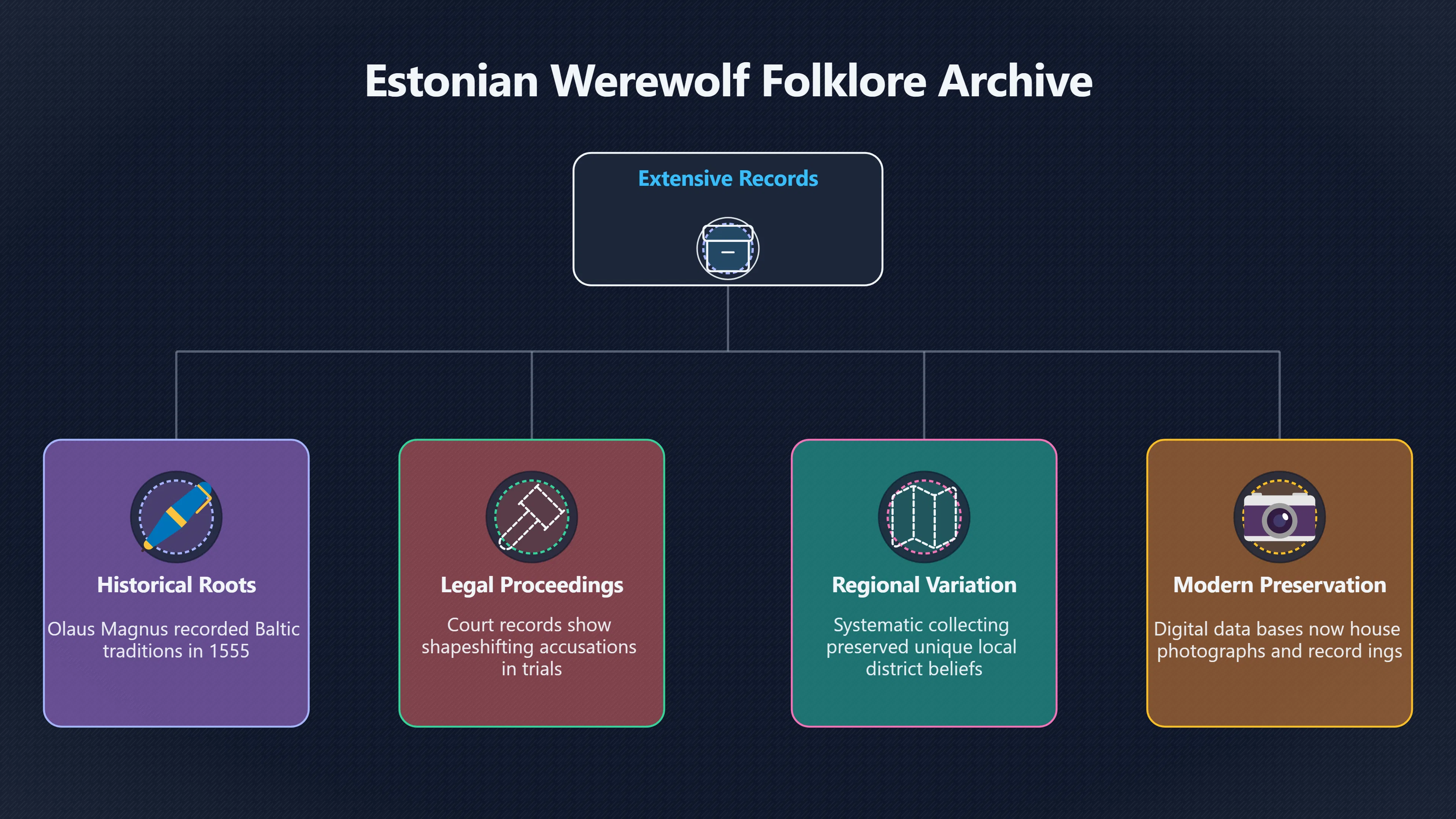
Few European countries possess as extensive a documentary record of werewolf belief as Estonia. During the nineteenth and twentieth centuries, organised folklore collecting created an exceptional archive, and modern researchers estimate that the Estonian Folklore Archives contain roughly 1,400 werewolf texts alongside many related legends about wolves, witchcraft and supernatural transformation. This abundance means scholars can study not merely isolated stories but recurring patterns across the whole country.[ResearchGate]researchgate.netResearch Gate Estonian werewolf legends from SaaremaaEstonia is notorious for its connection with werewolf stories. In 1555. Olaus Magnus wrote…Read more…
Historical references show that Estonia’s reputation for werewolves stretches back centuries. The sixteenth-century writer Olaus Magnus already remarked on Baltic werewolf traditions, while later court records and witchcraft trials demonstrate that accusations of shapeshifting sometimes crossed from folklore into legal proceedings. Yet the archived stories are more varied than the stereotype of the bloodthirsty monster popularised by later horror fiction.[ResearchGate]researchgate.netResearch Gate Estonian werewolf legends from SaaremaaEstonia is notorious for its connection with werewolf stories. In 1555. Olaus Magnus wrote…Read more…
Instead, Estonian werewolves often occupy an uneasy middle ground between victim, outsider and dangerous neighbour. Transformation might occur through:
- a magical wolfskin or belt;
- a curse or spell;
- witchcraft;
- an involuntary fate imposed upon an individual.
Some stories even describe the person’s spirit entering a wolf while the human body remains elsewhere, reflecting older ideas about wandering souls rather than permanent physical transformation.[ResearchGate]researchgate.netResearch Gate Estonian werewolf legends from SaaremaaEstonia is notorious for its connection with werewolf stories. In 1555. Olaus Magnus wrote…Read more…
Why women appear unusually often
One striking feature of Estonian material is the relatively large number of female werewolves. Research on legends from the island of Saaremaa shows that women appear as shapeshifters more frequently there than in many other European traditions, where male werewolves dominate.
Rather than presenting these women as simple villains, many tales explore tensions within village life. Jealousy, disputes between neighbours, broken social expectations and suspicion of people who behaved differently could all lead to accusations that someone secretly became a wolf. The werewolf therefore functioned as a way of explaining social conflict as much as unexplained attacks on livestock.[ResearchGate]researchgate.netResearch Gate Estonian werewolf legends from SaaremaaEstonia is notorious for its connection with werewolf stories. In 1555. Olaus Magnus wrote…Read more…
The wolf itself also occupied an ambiguous position in rural Estonia. It was feared as a predator but respected as an intelligent creature sharing the same forests that supplied timber, hunting and grazing. That ambiguity allowed stories about humans crossing into wolfhood to feel unsettling without requiring entirely supernatural worlds.

Bogs, ghost lights and hidden treasure
If wolves defined the edge of the forest, bogs represented another kind of dangerous boundary. Estonia’s extensive wetlands became natural settings for legends because they were physically hazardous, difficult to navigate and often concealed by mist.
Archived traditions repeatedly associate bogs with mysterious lights, wandering spirits and hidden riches. The lights commonly resemble the will-o’-the-wisp traditions found across northern Europe: glowing flames hovering over marshes that tempt travellers away from safe paths. Modern explanations usually point towards optical effects, atmospheric conditions or the combustion of marsh gases in older interpretations, yet the folklore treated these lights as warnings that the bog itself possessed agency.[Wild and Heritage]wildandheritage.comWild and Heritage Whispers of Water and Time: The Secret Life of Estonia's BogsWild and HeritageWhispers of Water and Time: The Secret Life of Estonia's BogsMarch 19, 2025 — 14 Apr 2025 — In ancient folklore, bogs we…
Treasure legends form another recurring theme. Across approximately 2,000 collected treasure narratives, researchers have found repeated claims that wealth lay buried beneath bogs, marshes or remote landscapes but could rarely be recovered without satisfying supernatural conditions. The treasure often shifted location, vanished when approached incorrectly or demanded ritual behaviour before revealing itself. These stories reflected both hopes of sudden prosperity and moral lessons about greed, patience and respect for forbidden places.[Folklore]folklore.eeHidden treasure lore in Estonian folk traditionIt is based on the collection of 2000 folkloric texts, kept in the Estonian Folklore…Read more…
Rather than existing as separate traditions, bog lights and treasure stories frequently reinforce one another. A mysterious light might indicate buried wealth, but following it recklessly could leave a traveller lost in the marsh. The supernatural explanation therefore mirrored a genuine environmental danger.

How archives preserve local monster logic
The remarkable feature of Estonian folklore is not simply the number of stories but the way systematic collecting preserved regional differences.
Beginning with large-scale collecting campaigns in the nineteenth century and continuing after the establishment of the Estonian Folklore Archives in 1927, thousands of volunteer collectors recorded local beliefs before they disappeared from everyday life. Today these collections contain manuscripts, photographs, sound recordings and searchable databases covering place legends, supernatural traditions and oral history.[Wikipedia]WikipediaEstonian Folklore ArchivesEstonian Folklore Archives
This archive reveals that monsters rarely appear in isolation. A single locality might preserve stories about:
- wolves behaving unnaturally;
- people suspected of becoming wolves;
- ghost lights over nearby marshes;
- treasure hidden beneath the bog;
- dangerous places best avoided after dark.
Seen together, these accounts form what folklorists sometimes describe as a local belief system rather than disconnected ghost stories. The landscape itself becomes the organising principle. Forests, wetlands and isolated farms define where unusual encounters are expected to happen and what kind of supernatural beings belong there.[wikipedia.org]WikipediaEstonian Folklore ArchivesEstonian Folklore Archives
Because the material was collected from many districts over more than a century, researchers can also observe change over time. Some stories become more moralistic under Christian influence, others preserve older ideas about magical transformation, while still others gradually shift towards entertainment rather than expressions of genuine belief.
Why these traditions remain culturally important
Modern Estonia does not promote a single iconic cryptid comparable to Scotland’s Loch Ness Monster or North America’s Bigfoot. Its distinctive contribution to European strange folklore lies instead in the depth of its documentary record.
The werewolf legends show how ordinary communities interpreted fear, conflict and wilderness through stories of human transformation. The bog legends demonstrate how dangerous environments acquired supernatural personalities that warned people away from real hazards while enriching local identity.
From a Fortean perspective, this makes Estonia especially intriguing. The question is not whether werewolves literally roamed the forests or ghost lights truly guarded buried treasure. The fascination comes from having enough archived evidence to reconstruct how entire communities understood monsters, landscapes and uncertainty. Instead of one spectacular mystery, Estonia offers one of Europe’s richest surviving maps of how folklore itself created a world in which wolves, bogs and the supernatural naturally belonged together.
Amazon book picks
Further Reading
Books and field guides related to Why Estonia's Werewolves Belong With Its Bogs. Use these as the next step if you want deeper reading beyond the article.
The werewolf in lore and legend
Directly examines European werewolf traditions relevant to Estonia.
eBay marketplace picks
Marketplace Samples
Live-tested eBay searches with available results related to this page.
Endnotes
1.
Source: researchgate.net
Title: Research Gate Estonian werewolf legends from Saaremaa
Link:https://www.researchgate.net/profile/Merili-Metsvahi/publication/278684764_Estonian_werewolf_legends_collected_from_the_island_of_Saaremaa/links/5583d72b08ae8bf4ba6faf6e/Estonian-werewolf-legends-collected-from-the-island-of-Saaremaa.pdf
Source snippet
Estonia is notorious for its connection with werewolf stories. In 1555. Olaus Magnus wrote...Read more...
2.
Source: Wikipedia
Title: Estonian Folklore Archives
Link:https://en.wikipedia.org/wiki/Estonian_Folklore_Archives
3.
Source: folklore.ee
Title: Hidden treasure lore in Estonian folk tradition
Link:https://www.folklore.ee/pubte/eraamat/eestipoola2/kalda.pdf
Source snippet
It is based on the collection of 2000 folkloric texts, kept in the Estonian Folklore...Read more...
4.
Source: Wikipedia
Title: Kongla Ann
Link:https://en.wikipedia.org/wiki/Kongla_Ann
5.
Source: wildandheritage.com
Title: Wild and Heritage Whispers of Water and Time: The Secret Life of Estonia’s Bogs
Link:https://www.wildandheritage.com/post/wild-heritage-your-gateway-to-unique-estonian-experiences
Source snippet
Wild and HeritageWhispers of Water and Time: The Secret Life of Estonia's BogsMarch 19, 2025 — 14 Apr 2025 — In ancient folklore, bogs we...
Published: March 19, 2025
Additional References
6.
Source: rongabutiik.ee
Link:https://rongabutiik.ee/en/eesti-rahvaparimus-noidus-ja-maagilised-praktikad-taielik-ulevaade/?srsltid=AfmBOor7XwVC-A3Q25ZZ6aO79kRJZYVpUMsRw3_Kh9Z-hs0kkI1DMc-0
7.
Source: scribd.com
Link:https://www.scribd.com/doc/288033361/Estonian-Werewolf-Legends-Collected-From
Source snippet
ed (including quotations from primary and secondary sources) by...Read more...
8.
Source: diva-portal.org
Link:https://www.diva-portal.org/smash/get/diva2%3A1595266/FULLTEXT01.pdf
Source snippet
Werewolves, Warriors and Winter Sacrificesby A Kaliff · 2022 · Cited by 23 — The concept of the werewolf in Western and Northern Europe i...
9.
Source: youtube.com
Title: Exploring Estonia’s Mysterious Werewolf History and Werewolves Culture
Link:https://www.youtube.com/watch?v=KYkVv06tXzY
Source snippet
Witch-hares, Estonian werewolves, and satyr sightings ❧ strange animals leftovers...
10.
Source: youtube.com
Link:https://www.youtube.com/watch?v=7IIhECDpJsA
Source snippet
The Werewolf Who Might Be Your Neighbor — Libahunt Explained...
11.
Source: youtube.com
Title: Legends & Folklore of Tallinn | A Walking Tour of Estonia’s Capital 🇪🇪
Link:https://www.youtube.com/watch?v=LLc8vDphMVo
Source snippet
Estonian werewolf folklore bogs Werewolves in Irish Myth Fortress of Lugh...
12.
Source: beastsoflegend.com
Title: libahunt estonia
Link:https://beastsoflegend.com/bestiary/europe/libahunt-estonia/
Source snippet
Libahunt Werewolf of Estonia12 May 2026 — In tradition, the Libahunt is a human who takes the form of a wolf through a curse, learned mag...
Published: May 2026
13.
Source: youtube.com
Title: Estonian Mythology ~ Kalevipoeg, Linda & Kalev 🇪🇪
Link:https://www.youtube.com/watch?v=1wDl7tuaLZM
Source snippet
Legends & Folklore of Tallinn | A Walking Tour of Estonia's Capital 🇪🇪...
14.
Source: youtube.com
Title: The Werewolf Who Might Be Your Neighbor — Libahunt Explained
Link:https://www.youtube.com/watch?v=U5fM6jIG4Tw
Source snippet
Estonian Mythology ~ Kalevipoeg, Linda & Kalev 🇪🇪...
15.
Source: reddit.com
Title: werewolf in estonian folklore
Link:https://www.reddit.com/r/Eesti/comments/1799gmt/werewolf_in_estonian_folklore/
Topic Tree