Within Uzbekistan Strange
Why Are Uzbekistan's Sacred Springs So Strange?
Uzbekistan's spring legends turn desert water into miracle, memory and folk conservation.
On this page
- Nurata's Chashma spring and meteor legend
- Sacred fish, healing water and taboo
- Chashma Ayub and the folklore of survival
Page outline Jump by section
Introduction
In a dry country where dependable water has always meant survival, it is hardly surprising that some springs are treated as far more than geological features. Uzbekistan’s best-known sacred springs combine religion, folklore, ecology and local custom in ways that can seem distinctly strange to outsiders. Visitors encounter pools whose fish cannot be caught, water believed to ease illness, and stories of prophets or even falling meteorites explaining why life-giving water suddenly emerged from otherwise arid ground.
These places are not compelling because they offer proof of miracles. They are fascinating because they show how practical conservation, pilgrimage and legend became woven together over centuries. The result is a form of living folklore in which unusual natural features are protected not only by law or science but also by belief, custom and social taboo.
Why do sacred springs become centres of legend?
Across Central Asia, springs have long been associated with saints, holy figures and acts of divine intervention. In landscapes where rivers may be seasonal and deserts lie only a short distance away, a constant source of clean water naturally attracts settlement, worship and storytelling.
Many sacred springs therefore share several recurring features:
- Water believed to possess healing or purifying qualities.
- Pilgrimage traditions linked to prayer and blessing.
- Religious buildings constructed beside the source.
- Animals protected because they inhabit sacred water.
- Origin stories involving prophets, saints or extraordinary natural events.
Rather than being isolated curiosities, these traditions illustrate how folklore could reinforce environmental protection. Catching fish, polluting the water or damaging the spring became not merely bad behaviour but a religious offence.
Nurata’s Chashma spring and the meteor legend
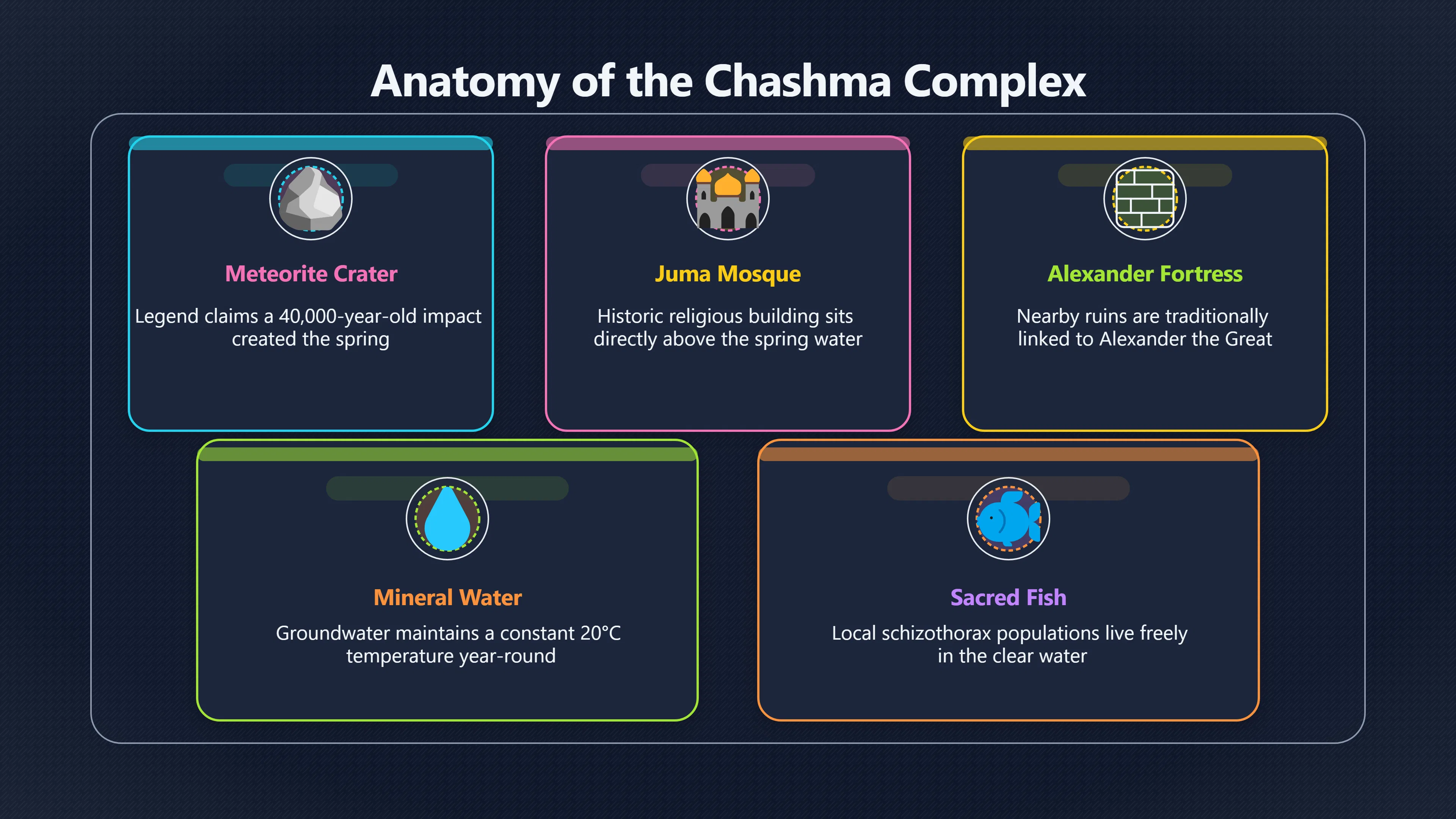
The most famous example is the Chashma complex in the town of Nurata, on the edge of the Kyzylkum Desert. Today it is both a pilgrimage destination and one of Uzbekistan’s best-known religious heritage sites.
According to local tradition, a brilliant meteorite fell here around 40,000 years ago. The impact supposedly created both a crater and the miraculous spring that still flows today. The town’s name is traditionally linked with “light”, reinforcing the image of a heavenly object descending to earth. Although there is no geological evidence supporting a prehistoric meteor impact at the site, the story remains central to the spring’s identity.[Uzbekistan Travel]uzbekistan.travelTravel| Uzbekistan TravelTravel| Uzbekistan Travel
One reason the legend survives is that the spring genuinely appears remarkable. Despite the surrounding dry environment, the water maintains a fairly constant temperature of about 20°C throughout the year. Scientific testing has identified dissolved minerals and trace elements, while pilgrims often attribute the water’s reputation to healing rather than chemistry.[Uzbekistan Travel]uzbekistan.travelTravel| Uzbekistan TravelTravel| Uzbekistan Travel
The spring also lies beneath the historic Juma Mosque, beside the ruins traditionally associated with Alexander the Great’s fortress, creating an unusual landscape where archaeology, religion and folklore overlap in a single location.[Uzbekistan Travel]uzbekistan.travelTravel| Uzbekistan TravelTravel| Uzbekistan Travel
Why are the fish never caught?
Perhaps the most memorable feature of Chashma is its population of fish.
Large shoals swim openly through the clear water, apparently unafraid of people. Visitors quickly discover that local custom strictly forbids catching, eating or even feeding them. The fish are regarded as sacred inhabitants of the spring rather than a food source.[Uzbekistan Travel]uzbekistan.travelTravel| Uzbekistan TravelTravel| Uzbekistan Travel
Several explanations coexist.
Believers often say harming the fish brings misfortune or illness. Some versions of the tradition claim that anyone who eats them will suffer serious consequences, making the taboo both moral and supernatural.[abc-tourism.uz]abc-tourism.uzNURAT A & YURT CAMPNURAT A & YURT CAMP
From a more practical perspective, the custom functions as an effective conservation rule. The protected fish population has survived because generations of pilgrims accepted that disturbing them was forbidden. Long before modern wildlife legislation, religious belief discouraged overfishing and helped preserve the spring’s ecology.
Scientists identify the fish as members of the local schizothorax or marinka group rather than mysterious creatures. Their unusual tameness reflects generations of protection rather than any supernatural quality.[Uzbekistan Travel]uzbekistan.travelTravel| Uzbekistan TravelTravel| Uzbekistan Travel
For Fortean readers, the appeal lies less in the fish themselves than in the remarkable social mechanism: belief has created a sanctuary where wildlife and legend reinforce each other.

Healing water without supernatural proof
Stories about Chashma’s healing properties have circulated for centuries.
Pilgrims drink the water, wash with it or collect small quantities to take home. Some visitors report relief from digestive problems, skin complaints or general ill health. These accounts remain personal testimony rather than medically verified evidence.
Scientific investigation provides a more restrained explanation. Mineral-rich groundwater can taste distinctive and may contain naturally occurring dissolved elements, but there is no accepted clinical evidence that the spring cures disease simply because of its origin.[Uzbekistan Travel]uzbekistan.travelTravel| Uzbekistan TravelTravel| Uzbekistan Travel
The continued popularity of the spring therefore reflects several overlapping factors:
- Faith in the site’s religious importance.
- The psychological value of pilgrimage and ritual.
- The rarity of abundant fresh water in an arid landscape.
- The genuine geological distinctiveness of a stable spring.
Rather than disproving the tradition, these natural explanations help explain why the spring became spiritually significant in the first place.
Chashma-Ayub and the folklore of survival
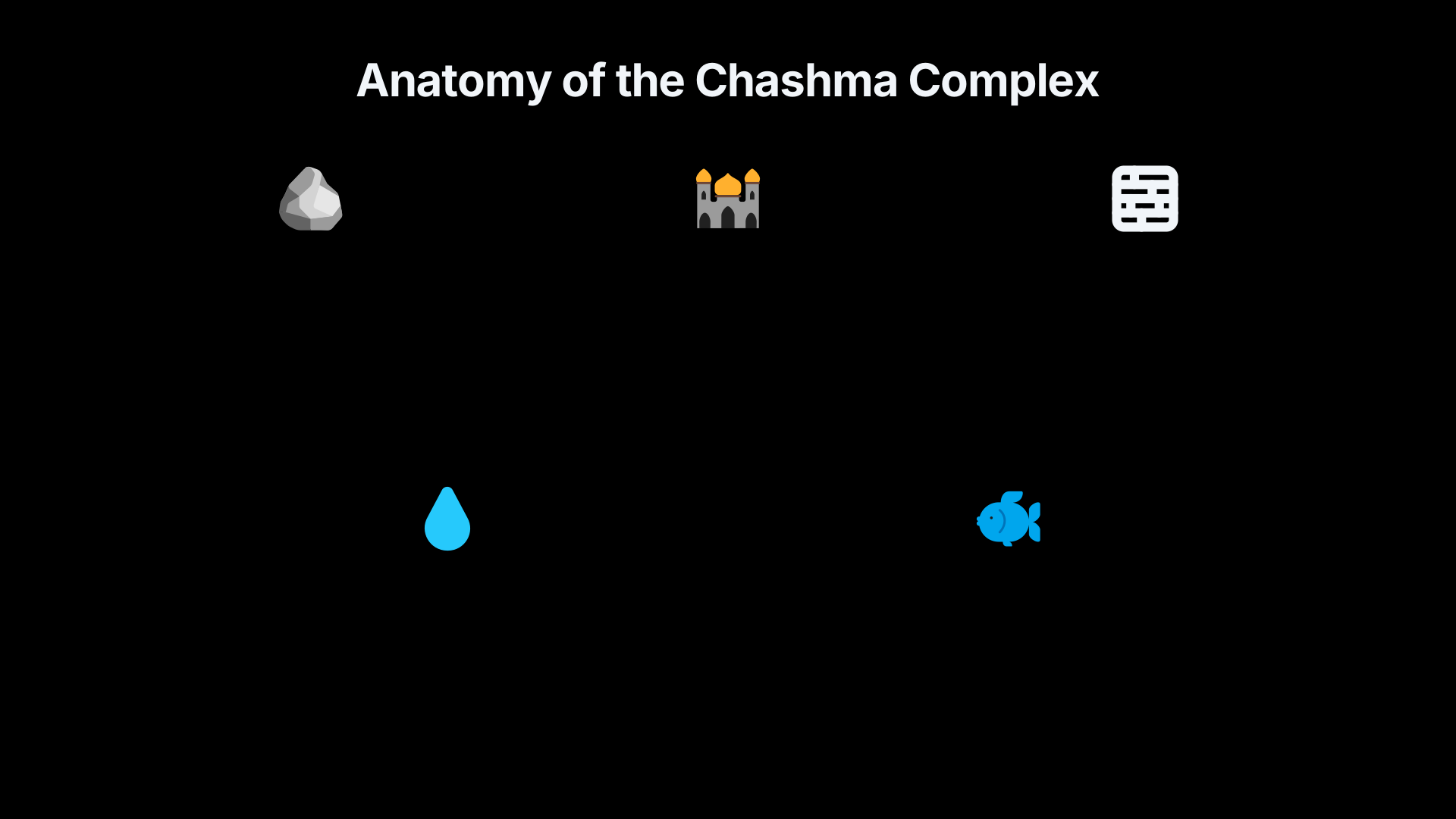
Bukhara preserves a different but equally enduring sacred-water tradition at Chashma-Ayub, meaning “Job’s Spring”.
According to Islamic and Biblical tradition, the prophet Job (Ayub), seeing local people suffering from drought, struck the ground with his staff. A fresh spring immediately appeared, providing water where none had existed before. The well remains at the centre of the monument, and many pilgrims continue to regard its water as unusually pure and beneficial.[Wikipedia]WikipediaChashma-Ayub MausoleumChashma-Ayub Mausoleum
Unlike the meteor legend at Nurata, this story places the miracle firmly within sacred history rather than natural catastrophe. Yet both traditions perform similar cultural work. Each explains an unexpected source of life-giving water through divine intervention while transforming an ordinary spring into a destination for pilgrimage.
The building itself also reflects centuries of changing history. Parts date back to the twelfth century, while Timurid reconstruction introduced the distinctive conical dome that makes the monument immediately recognisable among Bukhara’s monuments.[Wikipedia]WikipediaChashma-Ayub MausoleumChashma-Ayub Mausoleum
Today the complex combines religious devotion, historic architecture and a museum devoted to water management, creating an unusual blend of faith, engineering and folklore that reminds visitors how precious reliable water has always been in Central Asia.[Lonely Planet]lonelyplanet.comLonely Planet Chashma Ayub Mausoleum | Bukhara, Uzbekistan | AttractionsLonely PlanetChashma Ayub Mausoleum | Bukhara, Uzbekistan | Attractions - Lonely Planet…
Why these stories remain part of Uzbekistan’s strange heritage
Unlike tales of ghosts or monsters, Uzbekistan’s sacred springs occupy an intriguing middle ground between observable reality and inherited belief.
The springs unquestionably exist. Their water flows continuously. Their fish genuinely enjoy unusual protection. Pilgrims continue to visit them. What remains uncertain is the supernatural explanation attached to those facts.
For sceptics, the meteor, miraculous healings and divine interventions belong to folklore rather than history. For believers, they explain why these places deserve exceptional respect. Between those positions lies perhaps the most interesting lesson of all: stories can preserve landscapes just as effectively as laws.
That combination of natural curiosity, religious tradition and practical conservation makes Uzbekistan’s sacred springs one of the country’s most distinctive examples of grounded Forteana—places where extraordinary claims persist because the remarkable locations themselves continue to inspire wonder.
Amazon book picks
Further Reading
Books and field guides related to Why Are Uzbekistan's Sacred Springs So Strange?. Use these as the next step if you want deeper reading beyond the article.

The hero with a thousand faces
Useful background on recurring sacred landscape motifs.

Shadow of the Silk Road
Features landscapes where sacred sites remain culturally important.

Lost Enlightenment Central Asias Golden Age From The Arab Con...
First published 2013. Subjects: History, Civilization, Asia, central, history.
eBay marketplace picks
Marketplace Samples
Live-tested eBay searches with available results related to this page.




Endnotes
1.
Source: uzbekistan.travel
Title: Travel| Uzbekistan Travel
Link:https://uzbekistan.travel/en/o/chashma-complex/
2.
Source: abc-tourism.uz
Title: NURAT A & YURT CAMP
Link:https://abc-tourism.uz/why-uzbekistan/nurata-yurt-camp
3.
Source: Wikipedia
Title: Chashma-Ayub Mausoleum
Link:https://en.wikipedia.org/wiki/Chashma-Ayub_Mausoleum
4.
Source: uzbekistan.travel
Link:https://uzbekistan.travel/fr/o/complexe-chashma/
Source snippet
C'est un lieu incroyable qui recèle de nombreuses légendes et contes. Des milliers de personnes vie...
5.
Source: uzbekistan.travel
Link:https://uzbekistan.travel/es/o/complejo-chashma/
Source snippet
Es un lugar increíble que tiene muchas leyendas y leyendas. Miles de personas vienen aquí de todo el mundo...
6.
Source: uzbekistan.travel
Title: kompleks chashma
Link:https://uzbekistan.travel/ru/o/kompleks-chashma/
Source snippet
Это невероятное место, которое имеет множество легенд и сказаний. Тысячи людей приезжают сюда со всего света, ч...
7.
Source: uzbekistan.travel
Link:https://uzbekistan.travel/de/o/chashma-komplex/
Source snippet
Dies ist ein unglaublicher Ort, der viele Legenden und Geschichten hat. Tausende von Menschen aus der ganzen We...
8.
Source: uzbekistan.travel
Link:https://uzbekistan.travel/pt/o/Chashma%20complexo/
Source snippet
Este é um lugar incrível que possui muitas lendas e histórias. Milhares de pessoas vêm aqui de todo o mundo para...
9.
Source: meros.uz
Link:https://meros.uz/en/object/nur-qalasi
Source snippet
May 11, 2015 — NURATA Image Photo: © meros.uz * Location: Navoiy region * Category: Archaeological sites * Location on the map * 11 May...
Published: May 11, 2015
10.
Source: lonelyplanet.com
Title: Lonely Planet Chashma Ayub Mausoleum | Bukhara, Uzbekistan | Attractions
Link:https://www.lonelyplanet.com/points-of-interest/chashma-ayub-mausoleum/443679
Source snippet
Lonely PlanetChashma Ayub Mausoleum | Bukhara, Uzbekistan | Attractions - Lonely Planet...
11.
Source: tripadvisor.co.uk
Title: Tripadvisor gives a Travellers’ Choi
Link:https://www.tripadvisor.co.uk/Attraction_Review-g12879833-d17168629-Reviews-Chashma-Nurota_Navoiy_Province.html
Source snippet
CHASHMA - All You SHOULD Know Before You Go 2026 (w/ Reviews)July 18, 2025 — CHASHMA Save Review See all things to do Chashma 4.6 4.6 (5...
Published: July 18, 2025
12.
Source: meros.uz
Link:https://www.meros.uz/en/object/chashma-ayub-maqbarasi
Source snippet
* Under Unesco: Yes * Location: Buxara region * Category: Architectural structures, Ziyoratgohlar, Diniy obyektlar, Muzeylar...
13.
Source: travellerconcept.uz
Link:https://travellerconcept.uz/en/directions/uzbekistan/nurata/
Source snippet
People wandered for a long time in the desert. They were completely e...
14.
Source: tripadvisor.com
Link:https://www.tripadvisor.com/Attraction_Review-g12879833-d17168629-Reviews-Chashma-Nurota_Navoiy_Province.html
Source snippet
Tripadvisor gives a Travelers’ Choice...
Additional References
15.
Source: eurasia.travel
Link:https://eurasia.travel/uzbekistan/nurata/chashma/
Source snippet
Chashma complex – Tours to Uzbekistan & Central Asia & CaucasusCHASHMA COMPLEX CHASHMA COMPLEX Image: The Chashma sacred complex in the c...
16.
Source: tripadvisor.ie
Title: Attraction Review g12879833 d17168629 Reviews Chashma Nurota Navoiy Province
Link:https://www.tripadvisor.ie/Attraction_Review-g12879833-d17168629-Reviews-Chashma-Nurota_Navoiy_Province.html
Source snippet
CHASHMA: All You SHOULD Know Before Going (2026)CHASHMA Save Review See all things to do Chashma 4.6 4.6 (5 reviews) #1 of 3 things to do...
17.
Source: flickr.com
Title: Chasma Ayub Mausoleum | The Chashma-Ayub mausoleum (Job’s sp… | Flickr
Link:https://www.flickr.com/photos/24183618%40N06/54274974004
Source snippet
January 19, 2025 — Image: Chasma Ayub Mausoleum | by JSAL1957 Image: Chasma Ayub Mausoleum | by JSAL1957 CHASMA AYUB MAUSOLEUM The Chashm...
Published: January 19, 2025
18.
Source: turkestantravel.com
Title: Chashma Ayub mausoleum in Bukhara | Turkestan Travel BUKHARA
Link:https://www.turkestantravel.com/en/sights/chashma-ayub-mausoleum-in-bukhara/
Source snippet
Chashma Ayub mausoleum in Bukhara | Turkestan TravelBUKHARA - MAUSOLEUM CHASHMA AYUB Image THE CHASHMA AYUB MAUSOLEUM IN BUKHARA: A SACRE...
19.
Source: aba.travel
Link:https://aba.travel/uzbekistan/cities/bukhara/activities/chashma-ayub
Source snippet
Chashma-Ayub in Bukhara, UzbekistanCHASHMA-AYUB Chashma-Ayub in Bukhara: sacred spring legend, Timurid-era architecture, and practical ro...
20.
Source: travellerconcept.uz
Title: It is located 55 km to the north of the re
Link:https://travellerconcept.uz/en/blog/nurata_and_the_sacred_spring.htm
Source snippet
Nurata and the sacred spring - TRAVELLER CONCEPTOctober 5, 2018 — Image: Nurata and the sacred spring NURATA AND THE SACRED SPRING 5.10.2...
Published: October 5, 2018
21.
Source: globalconnect.uz
Title: Global Connect Chashma Complex in Nurata
Link:https://globalconnect.uz/uzbekistan/sights/nurata/chashma-complex
Source snippet
Chashma Complex in Nurata - GLOBAL CONNECTHome | Uzbekistan Travel Guide | Sights of Uzbekistan | Sights of Nurata | Chashma Complex CHAS...
22.
Source: visitsilkroad.org
Title: Bukhara Chashamai Ayub Mausoleum
Link:https://visitsilkroad.org/destination/bukhara-chashamai-ayub-mausoleum/
Source snippet
BUKHARA CHASHAMAI AYUB MAUSOLEUM * Bukhara, Uzbekistan * Monuments, Museums Image: pin_uzbekistan VISIT GUIDE TO BUKHARA CHA...
23.
Source: people-travels.com
Title: Chashma Ayub in Bukhara
Link:https://people-travels.com/public/index.php/sights/chashma-ayub
Source snippet
Full information about Chashma Ayub in BukharaCHASHMA AYUB Image: Chashma Ayub Image: Chashma Ayub 1 / 7 Image: Chashma Ayub Image: Chash...
24.
Source: people-travels.com
Title: Chashma Ayub in Bukhara
Link:https://www.people-travels.com/public/sights/chashma-ayub
Source snippet
Full information about Chashma Ayub in BukharaCHASHMA AYUB Image: Chashma Ayub Image: Chashma Ayub 1 / 7 Image: Chashma Ayub Image: Chash...
Topic Tree