Why Does Slovakia Feel So Uncanny?
Slovakia’s strange-history record is not built around one single monster or one world-famous UFO flap.
Page outline Jump by section
Introduction
The result is a country where the uncanny often has a very physical address: the Tribeč Mountains, the Demänovská caves, Čachtice Castle, Bojnice Castle, Živčáková Hill, Mount Zvir, and the skies over Košice. The useful question is not “is Slovakia haunted?” but “why did these particular stories stick?” In most cases, the answer lies in a mix of dramatic landscape, fragmentary evidence, older supernatural vocabulary, and modern retellings that keep inviting fresh belief, doubt and reinterpretation.
Why Slovakia’s weird stories cling to mountains, caves and castles
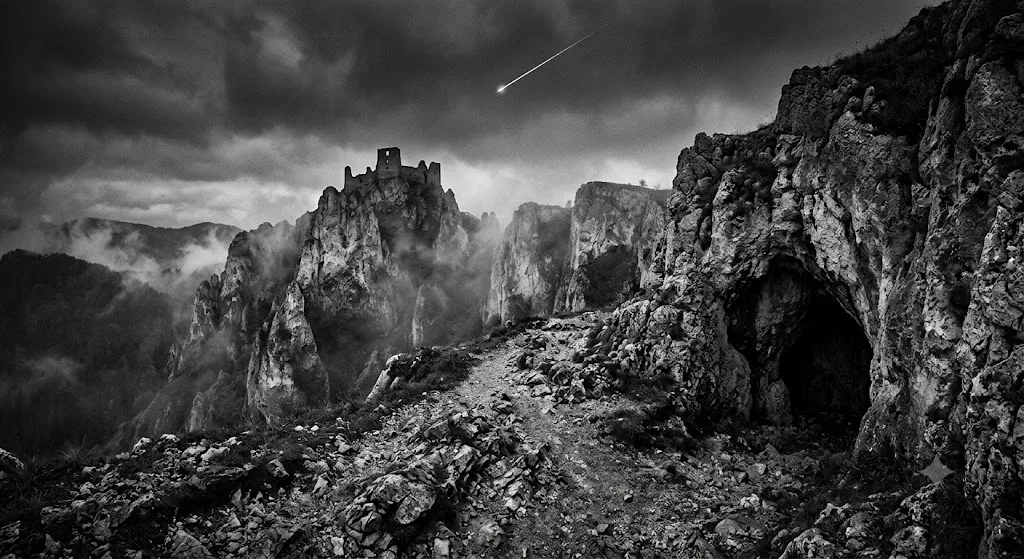
Slovakia’s geography gives its legends excellent scenery. The country sits across the Western Carpathians, with the High Tatras, Low Tatras, limestone karst, volcanic formations, forested ridges and ruined fortresses all packed into a relatively small area. That matters because many Fortean traditions need not only a claim but a stage: a cave no one can fully map, a forest where someone could plausibly get lost, a castle already associated with violence, or a rock so oddly balanced that it looks placed rather than formed.
The official story of the Demänovská caves is already strange without embellishment. The Slovak Caves Administration describes the Demänovské Caves, on the northern side of the Low Tatras, as the longest cave system in Slovakia, with the Demänovská Cave of Liberty among its dominant show caves and the Demänovská Ice Cave noted for permanent ice fill, unusual underground spaces, rare cave fauna and long history. Slovakia’s own tourism material adds the Fortean twist: bones of cave bears found in the Demänovská Ice Cave were once taken for the remains of a “drake”, which is why the cave was also called the Dragon Cave.[ssj.sk]ssj.skOpen source on ssj.sk.
That little episode is a perfect Slovak Fortean pattern. A real thing exists: fossil bones in a cold cave. A pre-scientific explanation follows: dragon remains. Later science gives a better answer, but the older interpretation does not simply vanish. It becomes a cultural layer, helping visitors feel the same old imaginative pressure that made caves frightening and meaningful before geology, palaeontology and conservation signage arrived.
The same pattern appears above ground at Devil’s Rock near Budča. The formation is a geological curiosity: a large andesite boulder balanced on a small contact surface in the Boky nature reserve, produced by differential weathering of volcanic material. Yet its name and local legends turn that precarious-looking rock into a supernatural object: a stone associated with the devil, punishment and failed malice. The natural explanation makes the rock more interesting, not less, because it shows exactly how an uncanny-looking landscape feature becomes a legend-bearing site.[KamNaVylet]kamnavylet.skOpen source on kamnavylet.sk.
The Tribeč Mountains: Slovakia’s modern “Bermuda Triangle”
The most internet-ready Slovak mystery is the Tribeč Mountains, a forested range in western Slovakia near Nitra. Geographically, Tribeč is not an impossible wilderness: its highest point, Veľký Tribeč, is under 830 metres, and the range sits among towns, castles and protected landscape. Yet it has acquired a reputation as a place of disappearances, strange lights, disorientation and ominous forest encounters.[Wikipedia]WikipediaOpen source on wikipedia.org.
The modern fame of the case owes much to Jozef Karika’s thriller Trhlina, published in 2016, and the later screen adaptation. Publishers’ descriptions frame the book around one of Slovakia’s great mysteries: unexplained disappearances in the Tribeč range, while the production company behind the adaptation describes The Rift as a mystery-thriller miniseries about “inexplicable disappearances” there.[Bookbot]bookbot.comOpen source on bookbot.com.
This is where the evidence-aware reader has to slow down. Tribeč’s reputation now comes through a feedback loop: local stories, missing-person motifs, horror fiction, travel writing, social media posts and paranormal summaries have all reinforced one another. Some accounts name alleged missing people and describe the hills as Slovakia’s “Bermuda Triangle”, but much of the easily available material is secondary, promotional, anecdotal or shaped by Karika’s fictionalised treatment.[VaGa Camp]vaga-camp.comVa Ga Camp Slovak Bermuda Triangle: Tríbeč mountainsVa Ga Camp Slovak Bermuda Triangle: Tríbeč mountains
That does not make the Tribeč legend worthless. It makes it a modern folklore case rather than a clean archive of unexplained events. The basic ingredients are familiar in Fortean history:
- Ordinary danger becomes uncanny. Forested hills can genuinely disorient walkers, especially in fog, snow, poor light or away from marked paths.
- Sparse documentation leaves gaps. Missing-person stories become more powerful when official records are not easy for casual readers to verify.
- Fiction gives shape to rumours. A novel can organise scattered fears into a single memorable mystery.
- Tourism repeats the mystery. Once a place is known as eerie, hikers and visitors arrive primed to notice odd sensations, lights, sounds and coincidences.
The sceptical reading is that Tribeč is a classic legend-making environment: a real landscape, real risks, uncertain case details and a compelling media frame. The believer’s reading is that the persistence of the stories points to something stranger than bad luck and poor navigation. The most defensible position is between them: Tribeč is not proven paranormal territory, but it is one of Slovakia’s strongest examples of how contemporary folklore is made.

The Moonshaft: a wartime cave story that refuses to stay buried
If Tribeč is Slovakia’s modern forest mystery, the Moonshaft is its great cave enigma. The core claim comes from Antonín T. Horák, who published “The Moonshaft, Czechoslovakia” in the March 1965 issue of NSS News, the magazine of the National Speleological Society. Library catalogue records identify the piece as appearing in volume 23, issue 3, pages 30–34.[caving-library.org.uk]caving-library.org.ukOpen source on caving-library.org.uk.
Horák’s story, as later retold, says that during the Slovak National Uprising in 1944 he discovered a strange shaft-like structure in a cave somewhere in the Slovak mountains. The alleged object has been described as smooth, dark, large and crescent-like in cross-section. Later writers and mystery hunters have proposed explanations ranging from a geological formation or old mine working to a hoax, underground construction or extraterrestrial artefact.[moonshaft.net]moonshaft.netOpen source on moonshaft.net.
The case has a better paper trail than many cave legends because Horák’s article really is traceable in a caving publication. But that does not solve the main problem: the object itself has never been securely located. Later summaries note repeated search efforts, suspected locations and expeditions, while also acknowledging that researchers remain dependent on Horák’s account, geological comparison and indirect clues.[moonshaft.net]moonshaft.netEvidence & TheoriesEvidence & Theories
The Moonshaft’s pull comes from three overlapping uncertainties. First, the setting is wartime Slovakia, when movement, memory and documentation were all under extreme pressure. Second, the cave location is vague enough to invite treasure-hunt thinking. Third, the described object sounds almost too cinematic: not a simple tunnel, not a normal cave chamber, but an apparently artificial or at least highly unusual structure hidden underground.
A grounded assessment has to separate three questions. Did Horák publish the account? Yes, the bibliographic trace supports that. Did he accurately describe a real place? That remains uncertain. Was the feature alien, ancient or technologically anomalous? No available public evidence proves anything of the kind. The Moonshaft is best treated as an unresolved cave-claim with a real publication history but no confirmed physical target.
Fire from the sky: the Košice meteorite as real-world Forteana
Not every strange fall needs a supernatural explanation. The Košice meteorite fall of 28 February 2010 shows how an event can feel Fortean at street level while being scientifically tractable. A bright bolide lit the sky over central-eastern Slovakia at about 22:25 UTC, during a night when many people were awake watching Olympic ice hockey. The Slovak Academy of Sciences reported that witnesses saw an astonishing celestial spectacle, and later searches recovered meteorite fragments.[SAV]sav.skMeteorite "Kosice", the fall in SlovakiaMeteorite "Kosice", the fall in Slovakia
Scientific work made the case unusually valuable. A 2013 study in Meteoritics & Planetary Science describes the Košice fall as a very bright bolide imaged by security cameras in Hungary, with detailed light curves from the European Fireball Network, sonic-wave records on seismic and infrasonic stations, and an atmospheric dust cloud observed the next morning.[Wiley Online Library]onlinelibrary.wiley.comOpen source on wiley.com.
The Meteoritical Bulletin records that cloudy and rainy weather prevented direct imaging by some networks, but flashes were still recorded at Czech and Austrian fireball stations; sonic booms were recorded at seismic stations in Slovakia, Hungary and Poland. The bulletin gives a maximum brightness of at least magnitude -18, bright enough to explain why witnesses experienced it as a dramatic and alarming sky event.[LPI]lpi.usra.eduOpen source on usra.edu.
Košice matters for a Slovakia Forteana page because it is a useful corrective. Strange lights, thunderous sky-noises and falling stones are among the oldest Fortean motifs. Here, however, the mystery did not remain a rumour. It moved from witness shock to instrument records, meteorite recovery and published analysis. Later research on the fragment distribution analysed 218 fragments with a total mass of 11.285 kg, showing that what begins as “something impossible fell from the sky” can become a rigorous reconstruction of atmospheric fragmentation.[arXiv]arxiv.orgOpen source on arxiv.org.
For readers interested in anomalous falls, Košice is one of Slovakia’s strongest cases precisely because it is not paranormal. It shows what good evidence looks like: time, trajectory, physical specimens, multiple recording systems, and follow-up science. That standard is useful when judging weaker claims about strange lights, mystery objects or sky phenomena elsewhere.
Apparitions and pilgrimage: when visions become public places
Slovakia’s visionary traditions sit at the meeting point of religion, folklore, politics and public memory. They should not be handled as “ghost stories”, because for pilgrims they are devotional realities; nor should they be presented as proven supernatural events. The most useful approach is to ask what was claimed, how communities responded, and what institutional status the sites later gained.
At Živčáková Hill near Turzovka, the tradition centres on a reported 1958 Marian apparition to forest worker Matúš Lašut. Regional tourism sources describe Živčáková as one of Slovakia’s significant Marian pilgrimage sites, visited by thousands of believers seeking prayer, peace and healing from local springs. A Kysuce regional source says the hill was declared an official Marian place of pilgrimage and prayer by decree of the Žilina bishop on 19 October 2008.[Žilinský Turistický Kraj]zilinskyturistickykraj.skOpen source on zilinskyturistickykraj.sk.
That timing matters. The alleged apparition began under communist rule, when religious expression was politically sensitive. A V4 pilgrimage-map entry stresses the harshness of the communist context around Turzovka, including nationalisation and pressure on Christians. Whether or not one accepts the apparition claim, the site’s emotional power is easier to understand against that background: a private vision became a focus for public religious endurance.[europepilgrime.eu]europepilgrime.euOpen source on europepilgrime.eu.
Litmanová, in northern Slovakia, is a more recent and institutionally current case. The local shrine history says the reported apparitions began in 1990, associated with children at Mount Zvir. In July 2025, the Vatican’s Dicastery for the Doctrine of the Faith issued a letter concerning devotion inspired by the alleged apparitions between 1990 and 1995. Vatican News reported that the Vatican granted a “nihil obstat” for Marian devotion at Mount Zvir, while the decision did not amount to a declaration that the apparitions were supernatural in origin.[horazvir.sk]horazvir.skhistory of the holy place litmanovahistory of the holy place litmanova
That distinction is important for Fortean readers. It shows a careful middle category: a place may be approved for devotion because of spiritual fruits, pilgrimage, confession and prayer, while the extraordinary claim itself remains unconfirmed. In other words, the social reality of the apparition tradition can be strong even when the event’s supernatural status is not officially asserted.
Čachtice and Báthory: history, horror and the making of a monster
No Slovak strange-history survey can avoid Čachtice Castle, associated with Elizabeth Báthory. The castle, now a ruin near the village of Čachtice in western Slovakia, was a residence and later prison of the countess, whose legend has made her one of Europe’s most notorious alleged killers.[Wikipedia]WikipediaČachtice CastleČachtice Castle
The familiar story is lurid: Báthory tortured and killed young women, with later folklore adding the claim that she bathed in their blood to preserve youth. National Geographic describes Čachtice Castle as her home after her husband’s death and the place where she was later imprisoned; AP’s 2024 account notes that more than 400 years after her death, her story remains controversial, with claims of hundreds of victims, a royal inquiry, servants executed, and Báthory confined until her death in 1614.[National Geographic]nationalgeographic.comthe bloody legend of hungarys serial killer countessthe bloody legend of hungarys serial killer countess
The Fortean interest lies less in whether Báthory was “really a vampire” — she was not — and more in how legal history becomes Gothic mythology. AP also reports that some researchers question the traditional monster narrative, suggesting that Báthory may have been targeted as a wealthy and powerful woman in a male-dominated political world. That revisionist argument is itself contested, but it is valuable because it reminds readers that the “Blood Countess” image is not a neutral fact. It is a centuries-long construction involving witness testimony, political interests, misogynistic tropes, local memory and later horror culture.[AP News]apnews.comOpen source on apnews.com.
Čachtice is therefore one of Slovakia’s most important weird-history sites, but not because it proves a supernatural legend. It shows how a real noblewoman, real accusations and a real castle ruin can produce a cultural monster more durable than the archive that created her.

Bojnice and the domestication of ghosts
Bojnice Castle offers a gentler, more theatrical version of Slovak haunting. The castle’s museum presents it as one of Slovakia’s oldest and most important monuments, with a first written record dating to 1113 and a natural travertine cave forming part of the castle complex. Slovakia’s tourism portal describes the International Festival of Ghosts and Spooks held there in late April and early May, when the castle becomes a meeting point for ghosts, witches, vampires and other spooky figures.[Bojnice Castle]bojnicecastle.skOpen source on bojnicecastle.sk.
This is not a case where the main value lies in proving a haunting. Bojnice is better understood as the domestication of the uncanny: a medieval and romantic castle, already visually suited to fairy-tale imagination, turns ghostly motifs into public performance. The festival format makes fear safe, repeatable and family-friendly. In Fortean terms, it shows how haunted atmospheres can move from whispered tradition into organised cultural tourism.
That does not make Bojnice fake in a dismissive sense. It means its “ghosts” function differently from the Moonshaft or Tribeč. They are not mainly evidence claims; they are ritualised entertainment built on old architectural atmosphere. The castle’s cave, age, art collections and romantic silhouette do much of the imaginative work before any actor in a sheet appears.
Water, forest and household spirits in Slovak folk imagination
Behind the named modern mysteries lies an older supernatural vocabulary shared with wider Slavic tradition but locally adapted through Slovak storytelling. Water spirits, fairies, witches, wild women, forest presences and household forces appear across Central and Eastern European folklore, often tied to dangerous places or social anxieties: deep pools, mills, childbirth, storms, night travel, mountain paths and the edge of the village.
General Slavic folklore sources identify the Slovak and Czech water spirit as the vodník, a being associated with rivers, lakes and drowning traditions. Such figures are not “cryptids” in the zoological sense; they are moral and environmental beings, explaining why certain places are dangerous and why people should behave carefully around water.[Wikipedia]WikipediaSupernatural beings in Slavic religionSupernatural beings in Slavic religion
This matters when reading Slovak Forteana because many later “mystery” stories still use older structures. A forest that leads travellers astray, a spring with healing power, a cave that hides a dragon, a lake with an uncanny name, a rock thrown by the devil: these are not random motifs. They are inherited ways of making landscape legible. The supernatural being often marks a boundary where human confidence should stop.
The case of Morské oko in eastern Slovakia is a useful non-monster example. The lake’s name means “Eye of the Sea”, and tourism sources present it as one of the country’s striking natural lakes below Sninský kameň in the Vihorlat area. Its formation can be explained through natural processes, including landslide activity connected with the volcanic landscape, but the name alone gives it the feeling of an aperture, a watching place or a hidden connection.[Visit Košice]visitkosice.orgOpen source on visitkosice.org.
UFOs, lights and the problem of weak evidence
Slovakia has UFO and strange-light anecdotes, but the public evidence base is thinner than for Košice, Litmanová, Živčáková, the Moonshaft or the Tribeč legend. Online databases and forums list sightings, and local discussion sometimes links UFO stories to mountains, caves or nuclear sites, but many such claims are difficult to verify from strong primary sources.[usufocenter.com]usufocenter.comOpen source on usufocenter.com.
That does not mean every witness is wrong. It means the evidential category is different. A light in the sky may be an aircraft, satellite, meteor, drone, lantern, astronomical object, atmospheric effect, military activity, camera artefact or something genuinely unidentified. Modern UAP research increasingly stresses the need for multiple sensors, calibrated instruments and environmental context rather than testimony alone. A 2023 scientific paper on multimodal UAP observatories argues for wide-field cameras, narrow-field instruments, radar-related methods, radio receivers, microphones and environmental sensors to distinguish artefacts from true anomalies.[arXiv]arxiv.orgOpen source on arxiv.org.
For Slovakia, the best way to handle UFO material is therefore conservative. Košice shows how a spectacular sky event can be investigated when instruments, timing and physical recovery exist. In contrast, most casual UFO reports remain culturally interesting but evidentially weak. They belong in the country’s weird-history record as testimony and modern folklore unless stronger documentation emerges.
What sceptics and believers usually get right — and wrong
The sceptical reading of Slovak Forteana is strong on mechanisms. Caves generate dragon stories because fossils and darkness invite misinterpretation. Forest disappearances become supernatural because people underestimate terrain, weather and panic. Meteorites become omens until science reconstructs them. Apparition sites become powerful because communities organise around them. Castle horror grows because violence, gender, politics and tourism feed dramatic retellings.
But scepticism can become too flat if it treats every strange tradition as merely an error. People keep these stories because they do useful cultural work. They mark dangerous landscapes, preserve local memory, dramatise injustice, organise pilgrimage, attract visitors, and give communities a way to talk about fear, grief, secrecy and wonder.
Believers, on the other hand, are often right that not every story is fully explained by a neat debunking paragraph. The Moonshaft has a real publication trail but no located object. Tribeč’s legend cannot be reduced only to one novel, even if the novel amplified it. Apparition sites can have deep social effects even when the supernatural claim is not officially confirmed. The mistake is turning unresolved or meaningful into proven paranormal fact.
The most useful middle position is evidence-aware curiosity. Slovakia’s strange material is strongest when treated as a set of layered cases: some explained, some misremembered, some fictionalised, some institutionally recognised as devotional landscapes, and some still unresolved because the evidence is incomplete.

Why Slovakia’s Forteana still has cultural pull
Slovakia’s weird-history record is compelling because it rarely floats free of place. The strangeness is grounded in caves, hills, ruins, pilgrimage paths and night skies. That concreteness gives the stories staying power. A reader can visit Bojnice, walk towards Čachtice, hike in the Tribeč range, enter the Demänovská caves, or stand under the same Central European sky where the Košice bolide turned a winter night into a scientific case study.
The country’s strongest Fortean themes also connect naturally to wider Central European motifs: dragon bones explained by palaeontology, devil rocks explained by geology, Marian visions negotiated by church authority, haunted castles shaped by violent history, and UFO-like lights tested against astronomy and instrumentation. Slovakia is not an outlier so much as a concentrated example of how the strange survives in modern Europe.
The best Slovak cases do not ask readers to abandon judgement. They ask for a more interesting kind of judgement: one that can enjoy a dragon cave while accepting cave bears, recognise the emotional force of an apparition without declaring it proven, admire the Moonshaft as a mystery without inventing evidence, and see in Tribeč not just a spooky forest, but a living demonstration of how folklore is still being made.
Amazon book picks
Further Reading
Books and field guides related to Why Does Slovakia Feel So Uncanny?. Use these as the next step if you want deeper reading beyond the article.
The Encyclopedia of Ghosts and Spirits
Useful background for hauntings, folklore and unexplained reports.

The Penguin Guide to the Superstitions of Britain and Ireland
Offers comparative insight into enduring European supernatural beliefs.
Mysteries of the Unexplained
Introduces many kinds of unexplained phenomena relevant to Slovakia's strange sites.
eBay marketplace picks
Marketplace Samples
Live-tested eBay searches with available results related to this page.
Endnotes
1.
Source: ssj.sk
Link:https://www.ssj.sk/en/jaskyna/4-demanovska-cave-of-liberty
2.
Source: ssj.sk
Link:https://www.ssj.sk/en/jaskyna/5-demanovska-ice-cave
3.
Source: slovakia.travel
Link:https://slovakia.travel/en/things-to-see-and-do/lets-explore-slovakia-online/demaenova-ice-cave
4.
Source: kamnavylet.sk
Link:https://www.kamnavylet.sk/en/attraction/certova-skala-devil-s-rock
5.
Source: Wikipedia
Title: Devil’s Rock, Budča
Link:https://en.wikipedia.org/wiki/Devil%27s_Rock%2C_Bud%C4%8Da
6.
Source: Wikipedia
Link:https://en.wikipedia.org/wiki/Tribe%C4%8D
7.
Source: bookbot.com
Link:https://bookbot.com/g/3696439
8.
Source: vaga-camp.com
Title: Va Ga Camp Slovak Bermuda Triangle: Tríbeč mountains
Link:https://www.vaga-camp.com/en/slovak-bermuda-triangle-tribec-mountains/
9.
Source: forums.forteana.org
Link:https://forums.forteana.org/index.php?threads%2Fthe-tr%C3%ADbe%C4%8D-mountains-slovakias-bermuda-triangle.70997%2F=
10.
Source: caving-library.org.uk
Link:https://caving-library.org.uk/catalogue/BCL/code/php/library.php?action=search&lib=&search=author&search_string=Antonin+T.Horak&type=any
11.
Source: moonshaft.net
Link:https://www.moonshaft.net/
12.
Source: moonshaft.net
Title: Evidence & Theories
Link:https://www.moonshaft.net/evidence
13.
Source: sav.sk
Title: Meteorite “Kosice”, the fall in Slovakia
Link:https://www.sav.sk/index.php?charset=&doc=services-news&lang=en&news_no=3196
14.
Source: sav.sk
Link:https://www.sav.sk/index.php?doc=services-news&lang=en&news_no=3196&source_no=20
15.
Source: onlinelibrary.wiley.com
Link:https://onlinelibrary.wiley.com/doi/full/10.1111/maps.12078
16.
Source: lpi.usra.edu
Link:https://www.lpi.usra.edu/meteor/metbull.php?code=53810
17.
Source: arxiv.org
Link:https://arxiv.org/abs/1403.7109
18.
Source: europepilgrime.eu
Link:https://europepilgrime.eu/en/place/turzovka-vrch-zivcakova-2/
19.
Source: horazvir.sk
Title: history of the holy place litmanova
Link:https://horazvir.sk/en/history-of-the-holy-place-litmanova/
20.
Source: vatican.va
Title: rc ddf doc 20250704 lettera esperienza litmanova en
Link:https://www.vatican.va/roman_curia/congregations/cfaith/documents/rc_ddf_doc_20250704_lettera-esperienza-litmanova_en.html
21.
Source: Wikipedia
Title: Čachtice Castle
Link:https://en.wikipedia.org/wiki/%C4%8Cachtice_Castle
22.
Source: slovakia.travel
Link:https://slovakia.travel/en/bojnice-castle
23.
Source: Wikipedia
Title: Supernatural beings in Slavic religion
Link:https://en.wikipedia.org/wiki/Supernatural_beings_in_Slavic_religion
24.
Source: usufocenter.com
Link:https://www.usufocenter.com/ufo-sighting-reports/worldwide/slovakia-ufo-sightings.html
25.
Source: arxiv.org
Link:https://arxiv.org/abs/2305.18566
26.
Source: Wikipedia
Title: Charles Fort
Link:https://en.wikipedia.org/wiki/Charles_Fort
27.
Source: Wikipedia
Title: List of reported UFO sightings
Link:https://en.wikipedia.org/wiki/List_of_reported_UFO_sightings
28.
Source: Wikipedia
Title: Will o’ the wisp
Link:https://en.wikipedia.org/wiki/Will-o%27-the-wisp
29.
Source: Wikipedia
Title: Elizabeth Báthory
Link:https://en.wikipedia.org/wiki/Elizabeth_B%C3%A1thory
30.
Source: Wikipedia
Title: Morské oko (Slovakia)
Link:https://en.wikipedia.org/wiki/Morsk%C3%A9oko%28Slovakia%29
31.
Source: Wikipedia
Title: Morskie Oko
Link:https://en.wikipedia.org/wiki/Morskie_Oko
32.
Source: Wikipedia
Title: Rain of animals
Link:https://en.wikipedia.org/wiki/Rain_of_animals
33.
Source: forums.forteana.org
Link:https://forums.forteana.org/index.php?threads%2Fshockingly-close-to-charles-fort.21526%2F=
34.
Source: forums.forteana.org
Link:https://forums.forteana.org/index.php?threads%2Ftatra-cave.14670%2F=
35.
Source: slovakia.travel
Link:https://slovakia.travel/en/hidden-treasures-of-slovakia-adventures-in-the-depths-of-the-earth
36.
Source: slovakia.travel
Link:https://slovakia.travel/en/boo-booh-or-the-scariest-slovak-monsters
37.
Source: slovakia.travel
Link:https://slovakia.travel/en/devils-at-the-trencin-castle
38.
Source: moonshaft.net
Link:https://www.moonshaft.net/persons
39.
Source: kamnavylet.sk
Title: Šarkania diera (Dragon Hole) | Hiking Súľov
Link:https://www.kamnavylet.sk/en/attraction/sarkania-diera-dragon-hole
40.
Source: kamnavylet.sk
Link:https://www.kamnavylet.sk/en/attraction/pilgrimage-place-zivcakova
41.
Source: kamnavylet.sk
Link:https://www.kamnavylet.sk/en/attraction/certov-kamen-devil-s-stone
42.
Source: arxiv.org
Link:https://arxiv.org/pdf/1403.7109
43.
Source: onlinelibrary.wiley.com
Link:https://onlinelibrary.wiley.com/doi/abs/10.1111/maps.12078
44.
Source: onlinelibrary.wiley.com
Link:https://onlinelibrary.wiley.com/doi/abs/10.1111/maps.12405
45.
Source: bookbot.com
Link:https://bookbot.com/g/2575/b/22349652
46.
Source: note.com
Link:https://note.com/ready_honest8301/n/n5aaeac0937aa?hl=en
47.
Source: zilinskyturistickykraj.sk
Link:https://www.zilinskyturistickykraj.sk/en/zivcakova-3/
48.
Source: vaticannews.va
Title: ddf vatican nihil obstat marian devotion slovakia mount zvir
Link:https://www.vaticannews.va/en/vatican-city/news/2025-07/ddf-vatican-nihil-obstat-marian-devotion-slovakia-mount-zvir.html
49.
Source: nationalgeographic.com
Title: the bloody legend of hungarys serial killer countess
Link:https://www.nationalgeographic.com/history/article/the-bloody-legend-of-hungarys-serial-killer-countess
50.
Source: apnews.com
Link:https://apnews.com/article/e732847066ffe69f91812b57df61bf43
51.
Source: bojnicecastle.sk
Link:https://bojnicecastle.sk/en/
52.
Source: visitkosice.org
Link:https://visitkosice.org/en/vidiet-a-zazit/morske-oko-lake
53.
Source: reddit.com
Link:https://www.reddit.com/r/horror/comments/b06vs6/trhlina_new_mysterious_thriller_based_on_the_true/
54.
Source: soul-guidance.com
Title: The Moonshaft
Link:https://www.soul-guidance.com/houseofthesun/moonshaft.html
55.
Source: nationalgeographic.com
Title: this slovenian cave is the real house of baby dragons
Link:https://www.nationalgeographic.com/travel/article/this-slovenian-cave-is-the-real-house-of-baby-dragons
56.
Source: tripadvisor.com
Link:https://www.tripadvisor.com/Attraction_Review-g1784976-d24984688-Reviews-Zivcakova_pilgrimage_place-Turzovka_Zilina_Region.html/1000
57.
Source: facebook.com
Title: Bojnice Castle in Slovakia, known as the “
Link:https://www.facebook.com/61561734836380/posts/bojnice-castle-in-slovakia-known-as-the-castle-of-spirits-is-a-stunning-blend-of/122118931028391161/
58.
Source: lpi.usra.edu
Link:https://www.lpi.usra.edu/meetings/acm2012/pdf/6067.pdf
59.
Source: tccweb.org
Link:https://www.tccweb.org/litmanova.htm
60.
Source: tripandtrail.com
Title: Bojnice Castle: Straight out of a fairytale
Link:https://www.tripandtrail.com/bojnice-castle/
61.
Source: en.everybodywiki.com
Link:https://en.everybodywiki.com/Moonshaft
62.
Source: ewtnnews.com
Title: vatican approves marian devotion in slovakia but doesn t recognize apparitions
Link:https://www.ewtnnews.com/vatican/vatican-approves-marian-devotion-in-slovakia-but-doesn-t-recognize-apparitions
63.
Source: libristo.eu
Link:https://www.libristo.eu/en/book/trhlina-2-vydanie_20629451
64.
Source: farawayworlds.com
Title: bojnice castle
Link:https://www.farawayworlds.com/travel/slovakia/bojnice-castle
65.
Source: ndl.ethernet.edu.et
Link:https://ndl.ethernet.edu.et/bitstream/123456789/46979/1/George%20M.%20Eberhart.pdf
66.
Source: readaroundtheworldchallenge.com
Link:https://readaroundtheworldchallenge.com/book/trhlina
Additional References
67.
Source: youtube.com
Title: A Guided Tour of the Most Beautiful Fairy Tale Castle in Slovakia
Link:https://www.youtube.com/watch?v=EiiS2cUadRU
Source snippet
Demänovská Jaskyňa Slobody / Demänova Cave of Liberty...
68.
Source: loc.gov
Link:https://www.loc.gov/everyday-mysteries/browse-all-questions/item/can-it-rain-frogs-fish-and-other-objects/
69.
Source: youtube.com
Title: Elizabeth Bathory
Link:https://www.youtube.com/watch?v=8UqXtGDLiLA
Source snippet
A Guided Tour of the Most Beautiful Fairy Tale Castle in Slovakia...
70.
Source: facebook.com
Link:https://www.facebook.com/13abc/posts/animal-rain-happens-when-small-water-animals-like-fish-frogs-and-crabs-are-swept/10159511629081897/
71.
Source: deezer.com
Link:https://www.deezer.com/en/show/546052
72.
Source: cantab.net
Link:https://www.cantab.net/users/michael.behrend/ebooks/MoreThings/pages/Chapter_01.html
73.
Source: byzcath.org
Link:https://www.byzcath.org/forums/ubbthreads.php/topics/306346/re-decree-on-marian-apparition-in-litmanova
74.
Source: mapy.com
Link:https://mapy.com/en/?id=1067188484&source=osm
75.
Source: visitliptov.sk
Link:https://www.visitliptov.sk/en/interests/demanova-cave-of-freedom/
76.
Source: krastogidas.lt
Link:https://krastogidas.lt/en/objects/devils-stone?route=17564
Topic Tree
Follow this branch
Related pages 192
- Afghan Forteana
- Antigua Uncanny
- Bosnian Mysteries
- Botswana Weird
- Brazil Strange
- +187 more in sidebar