What Makes Sri Lanka's Strange Stories Endure?
Sri Lanka’s strange-history record is unusually rich because it sits where rainforest ecology, Buddhist and Hindu spirit traditions, colonial-era natural history, lively local journalism and modern internet rumour all overlap.
Page outline Jump by section
Red rain, fireballs and the temptation of cosmic explanations
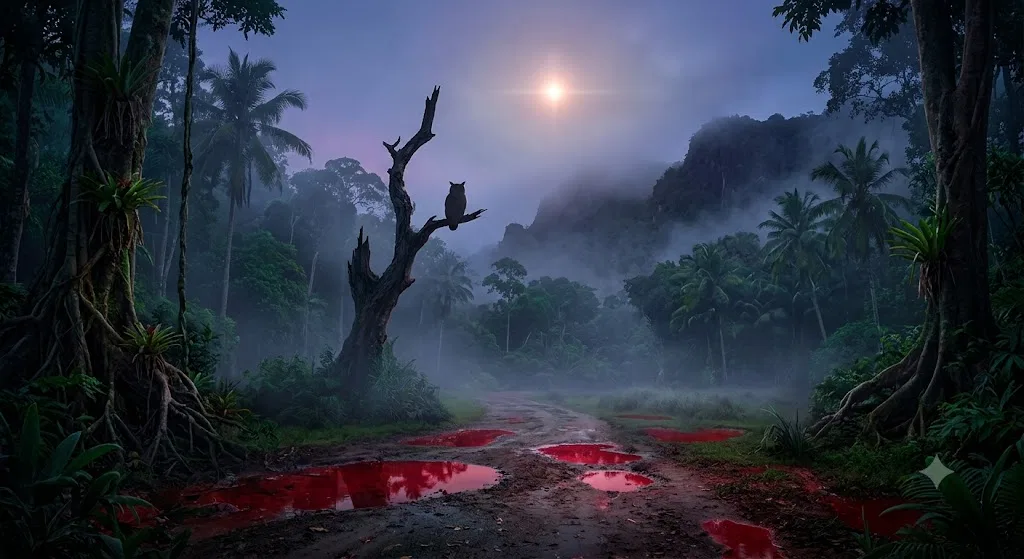
The clearest modern Sri Lankan Fortean episode is the red rain scare of November 2012. Short spells of reddish rain were reported in places including Hingurakgoda, Sevenagala, Manampitiya, Moneragala and Padiyatalawa, alarming residents because the phenomenon looked dramatic and had obvious “blood rain” associations. Sri Lanka’s Medical Research Institute said the colour was linked to a harmless algae-like organism, described in local reporting as belonging to the trachelomonas group; the Health Ministry also said samples had been sent for laboratory work and then to the Sri Lanka Institute of Nanotechnology.[The Sunday Times]sundaytimes.lkOpen source on sundaytimes.lk.
That explanation did not end the story, partly because the timing was so attractive to fringe interpretation. Around the same period, Sri Lanka also had reports of fireballs and a disputed fall of stones near Polonnaruwa. Chandra Wickramasinghe and collaborators argued that the Polonnaruwa material contained biological-looking structures and that this supported cometary panspermia, the idea that life or life-bearing material can arrive from space. Their papers described oxygen-isotope and microscopic findings which they said were inconsistent with a merely terrestrial origin.[arXiv]arxiv.orgOpen source on arxiv.org.
The sceptical reading is simpler and better supported for the rain itself: coloured rains are known in South Asia, and Indian work on similar Kerala events has repeatedly pointed to spores or algae rather than blood, aliens or omens. Sri Lankan officials also treated the 2012 rain as a biological or environmental colouration problem, not as a supernatural fall. The Polonnaruwa “meteorite” claims remain far more controversial than the rain, with the most extraordinary panspermia claims resting on a small circle of researchers and not on a broad scientific consensus. That makes the episode a perfect Fortean case: it began with a real, reported anomaly, acquired a cosmic narrative because of timing and spectacle, and then settled into a split record of official caution, laboratory ambiguity and fringe excitement.[sundaytimes.lk]sundaytimes.lkOpen source on sundaytimes.lk.
The Devil Bird: a monster that may be an owl
Sri Lanka’s Devil Bird is one of the country’s most memorable mystery-animal traditions. The story centres on a terrifying human-like cry heard at night in forested country and treated in folklore as an omen of death. Older accounts from Ceylon framed the sound as so uncanny that listeners struggled to connect it with any ordinary bird. Modern retellings often attach the cry to a tragic legend of a bereaved woman transformed into the bird, giving the sound an emotional explanation as well as a supernatural one.[Popular Mechanics]popularmechanics.comOpen source on popularmechanics.com.
Naturalists have long tried to identify the cry. Candidates include the brown wood owl, the spot-bellied eagle-owl, the Oriental honey buzzard and the changeable hawk-eagle. Recent popular science coverage leans towards the spot-bellied eagle-owl as a strong candidate because it is large, nocturnal, forest-associated and capable of a startling call, though the identification is not universally settled.[Popular Mechanics]popularmechanics.comOpen source on popularmechanics.com.
The Devil Bird matters because it shows how cryptozoology can be culturally meaningful even when the likely answer is zoological. The “mystery” is not simply whether a bird exists. It is how a sound in darkness, heard rarely and described emotionally, becomes a death-omen with a story attached to it. Sri Lanka’s forests contain enough real nocturnal life to generate fear honestly; folklore then gives that fear a memorable shape.

Nittaewo: hairy forest people, lost tribes and weak evidence
The Nittaewo are Sri Lanka’s most discussed hominid-like cryptids: small, hairy, clawed beings said in some traditions to have lived in the eastern or south-eastern forests and to have clashed with the Veddas. Sri Lanka Tourism’s own folklore page presents the tale as one of “hairy bodied, short and dagger clawed people”, while also acknowledging the absence of skeletal remains and the possibility of confusion with monkeys, bears or older stories about “beast-men”.[Sri Lanka Travel]srilanka.travelSri Lanka Travel NittaewoSri Lanka Travel Nittaewo
The tradition became more substantial in writing through Hugh Nevill’s 1886 report, later supported in part by Frederick Lewis’s inquiries in 1914. Those accounts described a remembered extermination story in which the last Nittaewo were driven into a cave and suffocated by fire. Later writers and explorers tried to connect the story to small apes, unknown human groups, sloth bears or even archaic hominins. A 1963 expedition led by Captain A. T. Rambukwella reportedly found animal remains in a cave context, but not the decisive skeletal evidence that would turn the Nittaewo from folklore into anthropology.[Sri Lanka Travel]srilanka.travelSri Lanka Travel NittaewoSri Lanka Travel Nittaewo
The strongest caution here is archaeological. Sri Lanka has an important prehistoric human record, including rainforest cave occupation and microlithic technology at Fa-Hien Lena dating back roughly 48,000–45,000 years, but that evidence concerns anatomically modern humans and their adaptations, not a surviving race of clawed forest hominids.[PMC]pmc.ncbi.nlm.nih.govPMC45-4 ka: New insights from Fa-Hien Lena Cave, Sri LankaPMC45-4 ka: New insights from Fa-Hien Lena Cave, Sri Lanka
The Nittaewo survive because the story sits at a powerful crossroads: indigenous memory, colonial collecting, real deep prehistory, forest fear and the global appeal of “lost people” legends. As evidence for an unknown species, the case is thin. As Sri Lankan Forteana, it is important precisely because it shows how folklore, archaeology and cryptozoology can become entangled without proving the same thing.
Lights in the sky: UFOs, planets and travelling gods
Sri Lanka has a recurring modern UFO tradition, but its better-documented cases are mostly reports of lights rather than close encounters with physical craft. The Sunday Times reported a wave of sightings in the late 1990s and early 2000s, including the 1998 Bandarawela reports and a January 2000 red light near Kandy that witnesses described as hovering, descending and then moving away at remarkable speed. The same article noted that local elders interpreted such lights through older categories such as divine or heroic lights, showing how sky anomalies could be read through both UFO culture and traditional belief.[The Sunday Times]sundaytimes.lkOpen source on sundaytimes.lk.
A second Sunday Times piece summarised earlier Sri Lankan UFO claims, including a reported 1992 episode in which witnesses described multiple bright craft moving over several towns. The article also quoted a sceptical estimate that most UFO sightings are likely delusions, hallucinations, hoaxes or misinterpretations, while still noting the puzzle created when many unrelated witnesses report similar things.[The Sunday Times]sundaytimes.lkOpen source on sundaytimes.lk.
The 2012 sky-light scare shows the modern media version of the same pattern. Residents in several parts of the island reported strange lights; the Sri Lanka Air Force said no unidentified craft had been detected on radar and that there was no clear evidence confirming rumours of alien craft. Reporting also said astronomer Chandana Jayaratne had suggested Mars as an explanation for some of the lights.[Emirates 24|7]emirates247.comOpen source on emirates247.com.
For a Fortean reader, Sri Lanka’s UFO record is interesting less because it contains an undeniable “best case” and more because it shows competing interpretive systems in action. A light can be a planet, aircraft, military flare, camera artefact, rumour, divine sign or extraterrestrial craft depending on who sees it, when it is reported and which cultural vocabulary is already available.

Ghosts, demons and the social life of hauntings
Sri Lankan ghost traditions cannot be separated neatly from Buddhist and Hindu-Buddhist ideas about spirits, demons, attachment, ritual specialists and household disorder. Anthropological work on a Sri Lankan haunting and exorcism case notes an important distinction: demons and deities are named beings with recognised characteristics, while ghosts and malevolent spirits are a broader category. In that study, spirits and ghosts were linked to attachment to the human world, unresolved desires and suffering, rather than simply to “dead people appearing”.[Brunel University Research Archive]bura.brunel.ac.ukBrunel University Research Archive Microsoft WordBrunel University Research Archive Microsoft Word
That matters because it changes how hauntings function. A Western ghost story often asks whether a dead person is still present in a building. In many Sri Lankan contexts, the more urgent question may be what kind of affliction is present, why a household has become vulnerable, and what ritual response might restore order. The same anthropological case describes an exorcism organised around Sinhala Buddhist ideas and a family’s understanding of a cursed or spirit-troubled home.[Brunel University Research Archive]bura.brunel.ac.ukBrunel University Research Archive Microsoft WordBrunel University Research Archive Microsoft Word
This is where Sri Lankan Forteana is at its most culturally dense. A haunted house is not just a spooky location; it can be a way of talking about family tension, moral disorder, illness, misfortune, desire and the boundary between Buddhist order and dangerous attachment. The supernatural claim remains a claim, but the social effect is real: people organise rituals, retell stories and interpret suffering through these categories.
Why Sri Lankan Forteana keeps its pull
Sri Lanka’s strange reports endure because they are rarely just isolated oddities. The red rain story touches weather, microbiology, media panic and astrobiology. The Devil Bird turns an animal cry into an omen. The Nittaewo turn forest memory and prehistory into a lost-race mystery. UFO reports show how modern technology and older sky folklore can occupy the same night. Ghost traditions fold personal distress into ritual and cosmology.
The evidence varies sharply from case to case. Red rain has a plausible natural explanation. The Devil Bird probably has a bird behind it, though the precise species may remain debated. The Nittaewo lack hard physical evidence. UFO lights are usually under-documented and easily misidentified. Ghost and demon cases are best read as lived religious and social experiences rather than laboratory demonstrations of the paranormal.
That unevenness is not a weakness of the subject; it is the subject. Sri Lanka’s weird-history record is valuable because it shows how anomalies become stories, how stories recruit evidence, and how evidence is judged differently by scientists, villagers, journalists, believers, sceptics and tourists. The island’s Forteana is not a single hidden truth waiting to be uncovered, but a set of encounters between real landscapes, real fears, real traditions and uncertain reports.

Amazon book picks
Further Reading
Books and field guides related to What Makes Sri Lanka's Strange Stories Endure?. Use these as the next step if you want deeper reading beyond the article.

The Rough Guide to Unexplained Phenomena 2
Frames Sri Lankan mysteries within global unexplained phenomena.
The World's Greatest Unsolved Mysteries
Appeals to readers exploring famous unexplained cases worldwide.
Mysteries
First published 1978. Subjects: Occultism, Parapsychology, Supernatural, Curiosities and wonders.
The Mammoth Encyclopedia of the Unsolved
Provides context for Fortean stories such as those from Sri Lanka.
eBay marketplace picks
Marketplace Samples
Live-tested eBay searches with available results related to this page.
Endnotes
1.
Source: arxiv.org
Link:https://arxiv.org/abs/1303.1845
2.
Source: arxiv.org
Title: arXiv Fossil diatoms in a new carbonaceous meteorite
Link:https://arxiv.org/abs/1303.2398
3.
Source: emirates247.com
Link:https://www.emirates247.com/news/sri-lankans-panic-over-ufo-sightings-or-lights-from-mars-2012-12-14-1.487163
4.
Source: sri.com
Link:https://www.sri.com/
5.
Source: arxiv.org
Link:https://arxiv.org/pdf/1303.1845
6.
Source: panspermia.org
Link:https://www.panspermia.org/AdAp_100158%20MiltPaper.pdf
7.
Source: archaeology.lk
Link:https://www.archaeology.lk/prehistory-of-sri-lanka-4-the-intermediate-period-of-prehistoric-research-in-sri-lanka/
8.
Source: sundaytimes.lk
Link:https://www.sundaytimes.lk/121118/news/harmless-algae-bearing-red-rain-scares-villagers-21128.html
9.
Source: adaderana.lk
Link:https://adaderana.lk/news/20558
10.
Source: Wikipedia
Title: Chandra Wickramasinghe
Link:https://en.wikipedia.org/wiki/Chandra_Wickramasinghe
11.
Source: popularmechanics.com
Link:https://www.popularmechanics.com/science/animals/a71574470/sri-lanka-devil-bird/
12.
Source: srilanka.travel
Title: Sri Lanka Travel Nittaewo
Link:https://srilanka.travel/nittaewo-in-srilanka
13.
Source: pmc.ncbi.nlm.nih.gov
Title: PMC45-4 ka: New insights from Fa-Hien Lena Cave, Sri Lanka
Link:https://pmc.ncbi.nlm.nih.gov/articles/PMC6774521/
14.
Source: sundaytimes.lk
Link:https://www.sundaytimes.lk/000206/plus5.html
15.
Source: sundaytimes.lk
Link:https://www.sundaytimes.lk/000402/plus5.html
16.
Source: bura.brunel.ac.uk
Title: Brunel University Research Archive Microsoft Word
Link:https://bura.brunel.ac.uk/bitstream/2438/27204/1/FullText.pdf
17.
Source: Wikipedia
Title: Blood rain
Link:https://en.wikipedia.org/wiki/Blood_rain
18.
Source: Wikipedia
Title: Devil Bird
Link:https://en.wikipedia.org/wiki/Devil_Bird
19.
Source: Wikipedia
Link:https://en.wikipedia.org/wiki/Nittaewo
20.
Source: sundaytimes.lk
Link:https://www.sundaytimes.lk/110306/Timestwo/t2_12.html
21.
Source: pmc.ncbi.nlm.nih.gov
Link:https://pmc.ncbi.nlm.nih.gov/articles/PMC9216229/
22.
Source: cryptidarchives.fandom.com
Link:https://cryptidarchives.fandom.com/wiki/Nittaewo
23.
Source: cryptidz.fandom.com
Link:https://cryptidz.fandom.com/wiki/Nittaewo
24.
Source: bloodandporridge.co.uk
Link:https://bloodandporridge.co.uk/wp/tag/nittaewo/
Additional References
25.
Source: youtube.com
Link:https://www.youtube.com/watch?v=dXu2LDP8K_E
Source snippet
This investigative documentary on the Red Rain in Sri Lanka explores the scientific analysis, local panic, and conflicting extraterrestri...
26.
Source: youtube.com
Title: UFO Landing Site in Sri Lanka? The Truth About Danigala Mountain!
Link:https://www.youtube.com/watch?v=EVBoD8HLygg
Source snippet
Danigala The Alien Rock Sri Lanka | History, Wildlife & Hidden Legends | Full Trek Guide...
27.
Source: youtube.com
Title: Voice of the Night: The Devil Bird of Sri Lanka
Link:https://www.youtube.com/watch?v=_HS3E7xJa-0
Source snippet
UFO Landing Site in Sri Lanka? The Truth About Danigala Mountain...
28.
Source: academia.edu
Link:https://www.academia.edu/12416133/An_investigation_into_alleged_hauntings_
29.
Source: researchgate.net
Link:https://www.researchgate.net/publication/365118444_Early_Holocene_Human_Burials_from_Fa_Hien-lena_and_Kuragala_Sri_Lanka
30.
Source: academia.edu
Link:https://www.academia.edu/7498152/Early_Man_and_the_Rise_of_Civilisation_in_Sri_Lanka
31.
Source: researchgate.net
Link:https://www.researchgate.net/publication/235892490_Fossil_diatoms_in_a_new_carbonaceous_meteorite
32.
Source: academia.edu
Link:https://www.academia.edu/8158183/Nittaewo_The_Cursed_Child_of_the_Veddah
33.
Source: researchgate.net
Link:https://www.researchgate.net/publication/235891950_The_Polonnaruwa_meteorite_oxygen_isotope_crystalline_and_biological_composition
34.
Source: spr.ac.uk
Link:https://www.spr.ac.uk/9-hauntings-and-poltergeists
Topic Tree
Follow this branch
Related pages 192
- Afghan Forteana
- Antigua Uncanny
- Bosnian Mysteries
- Botswana Weird
- Brazil Strange
- +187 more in sidebar