Why Algeria's Weird Stories Endure
Algeria’s strange-history record is not a neat cabinet of proven monsters and tidy hauntings.
Page outline Jump by section
Introduction
The most useful way to read Algerian Forteana is not to ask, “Which of these things is supernatural?” but “Why did this country produce such durable strange stories?” Algeria’s answer lies in scale and contrast: Mediterranean cities, Atlas ranges, the vast Sahara, ancient caravan worlds, colonial archives, Islamic and Amazigh oral traditions, and some of the world’s most famous rock art. Algeria is Africa’s largest country by area, and its geography runs from northern mountains to immense Saharan plateaux and desert massifs; that alone gives its oddities room to breathe.[OpenFactBook]openfactbook.orgOpen Fact Book AlgeriaOpen Fact Book Algeria
Why Algeria’s weird record begins in the Sahara
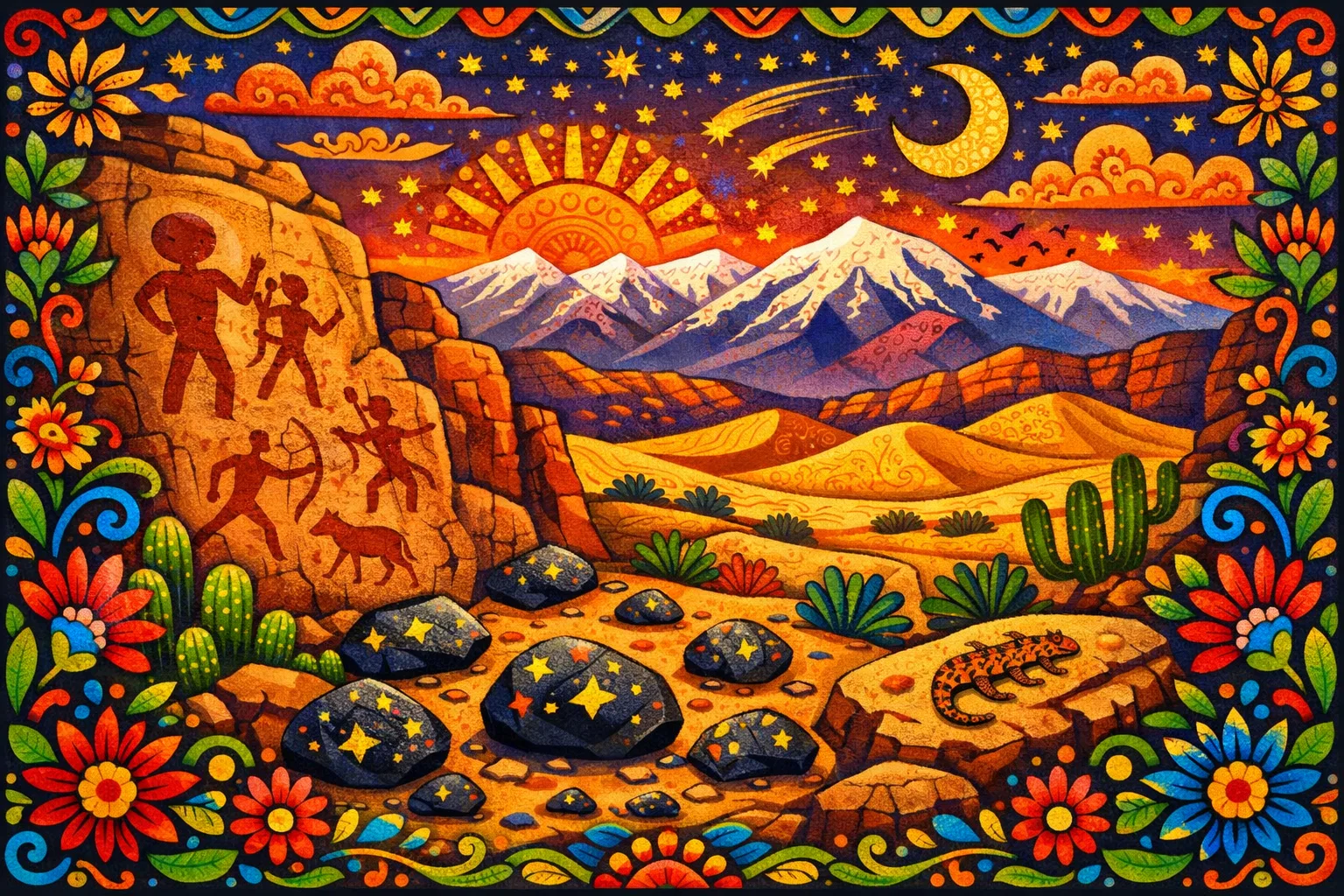
The Sahara is often imagined as empty, but Algeria’s southern deserts are better understood as archives: dry, exposed, slow to erase, and full of stone surfaces that preserve images, tracks, tombs and meteorites. Tassili n’Ajjer, in south-eastern Algeria, is the obvious starting point. UNESCO describes it as a vast plateau of about 72,000 square kilometres near the borders with Libya, Niger and Mali, with more than 15,000 drawings and engravings showing climate change, wildlife migration and human life from roughly 10,000 BC into the first centuries of the common era.[UNESCO World Heritage Centre]whc.unesco.orgOpen source on unesco.org.
For mainstream archaeology, the paintings and engravings are not paranormal evidence. They are evidence of people living through a changing Sahara: one that once supported animals, water and human communities very different from those of the modern hyper-arid desert. Yet the images have become a magnet for fringe interpretation because they are visually startling. Some round-headed figures appear faceless, floating, masked or bulbous. Some scenes seem ritual rather than plainly domestic. To a modern eye trained by science fiction, the temptation to see helmets, spacesuits or alien visitors is strong.
That is why Tassili has become one of the great “ancient astronaut” sites of the internet age. Popular retellings often claim that the paintings show beings from elsewhere, while more careful sources describe the same figures as part of Saharan rock-art traditions whose meanings remain debated. The British Museum’s African Rock Art project notes Algeria’s unusually rich concentrations of rock art, especially in Tassili n’Ajjer, while the Bradshaw Foundation stresses that the art is representational but not simply a literal diary of daily life; symbols, animal-headed humans and geometric forms almost certainly had meanings that are not directly recoverable now.[African Rock Art]africanrockart.britishmuseum.orgAfrican Rock Art AlgeriaAfrican Rock Art Algeria
The Fortean interest here is not that Tassili proves visitors from space. It is that a real archaeological wonder has repeatedly been pulled into modern myth-making. The paintings are strange enough without importing flying saucers. Their power comes from the gap between visible evidence and lost context.
The “ancient astronauts” and mushroom shamans of Tassili
Two modern claims dominate popular strange-history discussions of Tassili. The first is the ancient-astronaut claim: that the “round head” figures are not ritual or symbolic humans but beings in helmets or suits. The second is the psychedelic claim: that some figures show mushroom use in prehistoric ritual.
The ancient-astronaut reading owes much to the look of the paintings and to the language used by early European popularisers. Henri Lhote, who helped bring Tassili to wide public attention in the mid-20th century, used dramatic labels that later writers found irresistible. UNESCO’s own archive notes that a French officer’s discovery in the early 1930s helped publicise the paintings and that scientists later recognised them as among the oldest Saharan pictographic art; later commentary has also pointed out that Lhote’s expedition methods and interpretations have been criticised.[UNESCO]unesco.orgdocument 25 eng 2document 25 eng 2
The mushroom theory is more specific. The ethnomycologist Giorgio Samorini argued that certain Tassili images, including scenes at Tin-Tazarift and Tin-Abouteka, may show mushroom-like forms associated with masked or dancing figures. Later popular writers, including Terence McKenna, folded such images into broader speculation about psychoactive plants and human culture. Samorini’s own published argument describes figures holding mushroom-like objects and proposes a ritual interpretation, but that remains an interpretation of symbolic images rather than proof of drug use.[ResearchGate]researchgate.netResearch Gate New-Data-from-the-Ethnomycology-of-PsychoactiveResearch Gate New-Data-from-the-Ethnomycology-of-Psychoactive
A grounded reading can hold two ideas at once. First, prehistoric Saharan artists were capable of complex symbolic imagery, and ritual readings are not absurd. Secondly, the more confident claims — “these are astronauts”, “this proves psychedelic religion”, “this changes human origins” — run far ahead of the evidence. Optical dating work on deposits associated with Tassili parietal art places parts of the painted tradition within the Holocene, but dating the art is difficult and does not automatically decode what the figures meant.[Academia]academia.eduOpen source on academia.edu.
Tassili’s weirdness is therefore partly archaeological and partly modern. The paintings are ancient; many of the most confident paranormal meanings attached to them are modern projections.

Falling stones, meteorites and the old “thunderstone” problem
Charles Fort loved reports that respectable science struggled to classify: odd falls from the sky, objects in improbable places, and stones that appeared to have dropped from nowhere. Algeria turns up in that older Fortean tradition through a “thunderstone” noted by Fort in The Book of the Damned. Fort cites a report from La Nature in 1892 describing a stone said to have fallen at Ghardaïa, Algeria, and comments on its pear-like shape in contrast to ordinary meteorites.[Internet Sacred Text Archive]sacred-texts.comOpen source on sacred-texts.com.
The term “thunderstone” belongs to a long pre-scientific habit of explaining unusual stones as objects thrown down by storms or lightning. Some were meteorites; many were not. In Algeria’s case, the modern context matters: the Sahara is one of the world’s great meteorite-hunting landscapes because dark fusion-crusted stones can stand out against pale desert surfaces, and aridity helps preserve them. The Meteoritical Society describes the Meteoritical Bulletin as the official source for newly recognised and reclassified meteorites, and its database lists well over 1,600 approved meteorites from Algeria, along with impact-crater entries.[Meteoritical Society]meteoritical.orgOpen source on meteoritical.org.
This does not make every old “fallen stone” story true. It does make Algeria a good example of a classic Fortean theme becoming scientifically normalised. A stone from the sky once sat uneasily between folklore, newspaper curiosity and learned argument. Today, meteorites are still marvellous, but their identification rests on mineralogy, classification and curation rather than awe alone.
The desert also complicates the romance. Many Saharan meteorites are “finds”, not observed “falls”: they were discovered after lying in the landscape for an unknown time. That distinction matters. An observed fall is an event with witnesses and timing; a find is a recovered object with a cosmic origin but no necessarily dramatic local story. Algeria’s meteorite record is therefore genuinely extraordinary, but not in the simple sense of villages watching stones rain down every week.
Snow, red skies and other “impossible” weather
Some Algerian anomalies look supernatural because they violate a mental picture of the Sahara as endless heat. Snow near Aïn Séfra is the most photogenic example. Reuters reported in January 2018 that snow covered Saharan dunes near the Algerian town, allowing residents to slide on the sand; meteorological explainers noted that Aïn Séfra sits around 1,000 metres above sea level and is near the Atlas Mountains, so rare snow is surprising but not impossible.[Reuters]reuters.comSlip-sliding down the Sahara snowSlip-sliding down the Sahara snow
These events become Fortean because photographs flatten geography. A red dune under white snow looks like a broken rule of nature. The better explanation is not that the desert has been enchanted, but that deserts are not climatically uniform. High elevation, winter cold, moisture and local conditions can briefly produce scenes that appear absurd.
The same applies to “blood rain” and red skies linked to Saharan dust. The Fortean bookshelf is full of alarming rains: red rain, black rain, fish rain, dust rain, rains interpreted as omens. In and around Algeria, Saharan dust provides a powerful natural mechanism. Copernicus reported in 2021 that aerosol plumes from sandstorms in north-east Algeria helped produce orange snow and deep-red skies across parts of Europe. Scientific work on European red dust or “blood” rain describes the phenomenon as rainfall mixed with Sahara-derived dust, rather than anything biological or supernatural.[Atmosphere Copernicus]atmosphere.copernicus.eusaharan dust colours skies and snowsaharan dust colours skies and snow
That does not make the experience less eerie. A sky turned copper by desert dust, or snow stained orange in the Alps by particles lifted from North Africa, is exactly the sort of thing that would once have fed omen literature. The modern twist is that satellites and atmospheric modelling can now trace the journey of the “omen”.
Wartime lights and the Bouahmama UFO story
Algeria’s best-known UFO-style case is the alleged March 1958 Bouahmama incident, usually placed during the Algerian War and reported later in UFO literature. The common version says a French Foreign Legion sentry, identified only as “N.G.”, saw an enormous silent object descend near a camp south of Constantine, with green light and a prolonged hover before it departed at high speed. The story is usually traced to Joel Mesnard’s 1973 article “Tranquilizing Visitation at Bouahmama” in Flying Saucer Review, and later summaries repeat the claim with varying dimensions and details.[Think About It Docs]thinkaboutitdocs.com1958 enormous ufo seen during algerian war1958 enormous ufo seen during algerian war
As evidence, it is weak: a single-witness account, published years after the alleged event, in a specialist UFO magazine rather than in a contemporary military file or independent newspaper investigation. As folklore of modern war, however, it is revealing. The setting does much of the work. A sentry at night, an isolated camp, fear, fatigue, conflict, unfamiliar lights, and a sky over the desert: these are ideal conditions for a story to acquire force.
A sceptical reading has several possibilities. The witness may have misperceived an aircraft, flare, astronomical object or atmospheric effect; the account may have been altered in retelling; or an unusual but ordinary military event may have been reframed through the UFO culture of the 1960s and 1970s. A believer’s reading stresses the reported size, silence, hover time and emotional effect on the witness. The problem is that the available public evidence does not let the reader test those details properly.
That makes Bouahmama a classic country-level UFO case: not strong enough to prove anything extraordinary, but culturally memorable because it fuses Algeria’s wartime history with the global flying-saucer era.
Jinn, ogresses and haunted explanations
Algerian supernatural tradition is not limited to imported UFO narratives. Jinn beliefs, saints, healing rituals and oral folktales form a deeper local strangeness. In Islamic and North African contexts, jinn are often understood as invisible beings whose presence may explain misfortune, illness, uncanny sounds, abandoned places or possession-like states. Medical and anthropological literature treats jinn belief not as a laboratory fact but as a culturally important explanatory model that can affect how people interpret distress and seek help.[Enlighten Publications]eprints.gla.ac.ukEnlighten Publications Of Jinn Theories and Germ TheoriesEnlighten Publications Of Jinn Theories and Germ Theories
In Algeria, this overlaps with ritual healing and music. Anthropologist Tamara Turner’s work on Algerian dīwān describes a popular Islamic ritual world in which people may be “haunted” by melodies associated with spirits, saints and historical figures. This is not a ghost story in the Victorian sense; it is a living framework in which sound, memory, affliction and presence are intertwined.[Taylor & Francis Online]tandfonline.comOpen source on tandfonline.com.
Kabyle folklore adds its own monsters. One recurring figure is the ogress, often rendered in European-language scholarship as a terrifying female monster of Kabyle tales. The tale sometimes known as The Son of the Ogress, collected in Kabylia and linked by scholars to the wider “Cupid and Psyche” family of stories, involves a supernatural husband, broken trust and dangerous tasks imposed by an ogress figure. Scholarship on Kabyle monsters treats these beings as part of a rich oral corpus rather than as zoological claims.[Wikipedia]WikipediaThe Son of the OgressThe Son of the Ogress
This matters because “haunting” in Algeria is not one thing. It may mean jinn, saintly presence, family memory, a cautionary tale, a monster from oral tradition, or modern paranormal talk imported through television and the internet. Good Fortean writing should not flatten all of that into “ghosts”.
Tin Hinan: when legend leaves bones behind
Few Algerian traditions better show the productive tension between legend and evidence than Tin Hinan, the ancestral queen associated with the Tuareg of the Ahaggar. The story varies, but she is commonly remembered as a founding matriarch who travelled through the Sahara and became an ancestor figure for Tuareg groups. The strange-history appeal is obvious: a desert queen, a remote tomb, oral tradition, colonial-era excavation, and a historical woman partly visible through archaeology.
The tomb at Abalessa in southern Algeria is real. UNESCO’s tentative listing for Algeria’s ancient royal mausoleums describes the Abalessa-Tin Hinan monument as part of the heritage of the Ahaggar cultural park and dates it between the third and fourth centuries AD. Other summaries of the tomb describe a prestigious female burial with jewellery, funerary material and evidence consistent with a late antique Saharan elite context.[UNESCO World Heritage Centre]whc.unesco.orgOpen source on unesco.org.
The caution is that archaeology does not prove every detail of the legend. A monumental tomb can confirm that an important woman was buried at Abalessa without confirming every oral genealogy or heroic episode later attached to her. That is precisely what makes Tin Hinan interesting. She sits in the middle ground between myth and history: not a mere invented fairy-tale figure, but not a fully documented biography either.
For Algerian Forteana, Tin Hinan is a reminder that “legend” is not a synonym for “false”. Sometimes legend preserves a social memory around a real place, person or burial, while reshaping it into something more meaningful than a museum label.
Phantom lions and the last great animals of the Atlas
Cryptozoology often chases animals that probably never existed. Algeria offers a subtler case: animals that certainly existed, may have survived later than expected, and now haunt the edge of extinction memory. The Barbary lion, or North African lion, once ranged across parts of the Maghreb. Modern reviews of historical records indicate that lions may have survived in Algeria into the mid-20th century, with modelling suggesting possible persistence into the late 1950s or early 1960s.[PMC]pmc.ncbi.nlm.nih.govPMCExamining the Extinction of the Barbary Lion and ItsPMCExamining the Extinction of the Barbary Lion and Its
That kind of uncertainty is fertile ground for “phantom animal” traditions. A lion seen by travellers, hunters or villagers in a remote forested area could be a real late survivor, a misidentification, a rumour, or a memory of an animal already gone. The University of Kent Barbary Lion project notes that small populations seem to have persisted in Algeria and Morocco for years after the last famous kills, with sporadic sightings extending into the 1960s.[Kent Blogs]blogs.kent.ac.ukOpen source on kent.ac.uk.
The Saharan cheetah shows the other side of the same problem: not a vanished beast, but an extremely elusive one. Camera-trap work in the Ahaggar has confirmed the presence of the critically endangered Saharan cheetah, with scientific surveys detecting cheetahs at multiple camera-trap locations. A Wildlife Conservation Society release in 2009 described the first camera-trap photographs of Saharan cheetahs in Algeria, and later research confirmed their continuing rarity in the Ahaggar landscape.[WCS Newsroom]newsroom.wcs.orgCamera Trap Survey Snaps Cheetahs in Algeria.aspxCamera Trap Survey Snaps Cheetahs in Algeria.aspx
This is where cryptid thinking can be both useful and misleading. Local reports of rare animals should not be dismissed simply because scientists have not yet photographed every individual. But rarity is not magic. In Algeria, the most powerful “mystery animal” stories are often about the last traces of real ecological loss.
What Algerian Forteana is really about
Algeria’s strange material is strongest when treated as a layered record rather than a list of wonders. Tassili’s paintings are real, but their astronaut and mushroom meanings are contested. Meteorites are real, but old thunderstone stories need careful sorting. Saharan snow and red rain look uncanny, but meteorology explains them well. Bouahmama is a memorable UFO tale, but the evidence is too thin for strong claims. Jinn and ogresses belong to living and inherited systems of meaning, not to a simple “are they real?” test. Tin Hinan shows how archaeology and oral tradition can illuminate each other without becoming identical. The Barbary lion shows how extinction can turn natural history into ghost story.
The common thread is the Algerian landscape itself. Mountains, deserts, ancient art sites, remote tombs, colonial archives, war zones and oral storytelling all create conditions in which unusual claims can survive. The best sceptical approach is not to drain the stories of wonder, but to separate the kinds of wonder involved: scientific, historical, folkloric, psychological, ecological and genuinely unresolved.
Algeria’s Forteana therefore has a distinctive character. It is less a parade of haunted houses than a conversation between deep time and modern imagination. The desert keeps the traces; people supply the meanings.
Amazon book picks
Further Reading
Books and field guides related to Why Algeria's Weird Stories Endure. Use these as the next step if you want deeper reading beyond the article.
The world's most mysterious places
Covers the style of mysteries and folklore that frame Algeria's unusual traditions.

The Atlas of Atlases
Provides rich context for Algeria's landscapes and historical setting behind many strange stories.
Fingerprints of the gods
Frequently intersects with discussions of ancient mysteries including Saharan archaeology.

Sahara
Explores the Sahara's landscapes, cultures and history central to Algerian lore.
eBay marketplace picks
Marketplace Samples
Live-tested eBay searches with available results related to this page.



Endnotes
1.
Source: openfactbook.org
Title: Open Fact Book Algeria
Link:https://openfactbook.org/countries/algeria/
2.
Source: whc.unesco.org
Link:https://whc.unesco.org/en/list/179/
3.
Source: unesco.org
Title: document 25 eng 2
Link:https://www.unesco.org/archives/multimedia/document-25-eng-2
4.
Source: researchgate.net
Title: Research Gate New-Data-from-the-Ethnomycology-of-Psychoactive
Link:https://www.researchgate.net/profile/Giorgio-Samorini/publication/315395232_New_Data_from_the_Ethnomycology_of_Psychoactive_Mushrooms/links/65ec6977aaf8d548dcbc691d/New-Data-from-the-Ethnomycology-of-Psychoactive-Mushrooms.pdf
5.
Source: academia.edu
Link:https://www.academia.edu/23441910/OSL_dating_of_quaternary_deposits_associated_with_the_parietal_art_of_the_Tassili_n_Ajjer_plateau_Central_Sahara_
6.
Source: meteoritical.org
Link:https://meteoritical.org/publications/meteoritical-bulletin
7.
Source: reuters.com
Title: Slip-sliding down the Sahara snow
Link:https://www.reuters.com/article/world/slip-sliding-down-the-sahara-snow-idUSKBN1EY190/
8.
Source: atmosphere.copernicus.eu
Title: saharan dust colours skies and snow
Link:https://atmosphere.copernicus.eu/saharan-dust-colours-skies-and-snow
9.
Source: archive.org
Link:https://archive.org/stream/dimensionsvallee/dimensions%20vallee_djvu.txt
10.
Source: Wikipedia
Title: The Son of the Ogress
Link:https://en.wikipedia.org/wiki/The_Son_of_the_Ogress
11.
Source: whc.unesco.org
Link:https://whc.unesco.org/en/tentativelists/6832/
12.
Source: Wikipedia
Title: Tin Hinan Tomb
Link:https://en.wikipedia.org/wiki/Tin_Hinan_Tomb
13.
Source: pmc.ncbi.nlm.nih.gov
Title: PMCExamining the Extinction of the Barbary Lion and Its
Link:https://pmc.ncbi.nlm.nih.gov/articles/PMC3616087/
14.
Source: newsroom.wcs.org
Title: Camera Trap Survey Snaps Cheetahs in Algeria.aspx
Link:https://newsroom.wcs.org/News-Releases/articleType/ArticleView/articleId/4828/Camera-Trap-Survey-Snaps-Cheetahs-in-Algeria.aspx
15.
Source: pmc.ncbi.nlm.nih.gov
Title: PMCMonitoring Rarity: The Critically Endangered Saharan
Link:https://pmc.ncbi.nlm.nih.gov/articles/PMC4309643/
16.
Source: Wikipedia
Title: Charles Fort
Link:https://en.wikipedia.org/wiki/Charles_Fort
17.
Source: Wikipedia
Title: UFO sightings in Africa
Link:https://en.wikipedia.org/wiki/UFO_sightings_in_Africa
18.
Source: Wikipedia
Link:https://en.wikipedia.org/wiki/Folklore
19.
Source: Wikipedia
Title: Lluvia de peces
Link:https://en.wikipedia.org/wiki/Lluvia_de_peces
20.
Source: Wikipedia
Title: The Book of the Damned
Link:https://en.wikipedia.org/wiki/The_Book_of_the_Damned
21.
Source: Wikipedia
Link:https://en.wikipedia.org/wiki/Jinn
22.
Source: Wikipedia
Title: Fort Crampel Affair
Link:https://en.wikipedia.org/wiki/Fort_Crampel_Affair
23.
Source: Wikipedia
Title: Tassili n’Ajjer
Link:https://en.wikipedia.org/wiki/Tassili_n%27Ajjer
24.
Source: Wikipedia
Title: Meteorite fall
Link:https://en.wikipedia.org/wiki/Meteorite_fall
25.
Source: Wikipedia
Title: Tassili Mushroom Figure
Link:https://en.wikipedia.org/wiki/Tassili_Mushroom_Figure
26.
Source: Wikipedia
Title: March 1982
Link:https://en.wikipedia.org/wiki/March_1982
Published: March 1982
27.
Source: Wikipedia
Title: Bayyana UFO a Afirka
Link:https://ha.wikipedia.org/wiki/Bayyana_UFO_a_Afirka
28.
Source: Wikipedia
Title: Barbary lion
Link:https://en.wikipedia.org/wiki/Barbary_lion
29.
Source: Wikipedia
Title: Tin Hinan
Link:https://en.wikipedia.org/wiki/Tin_Hinan
30.
Source: researchgate.net
Link:https://www.researchgate.net/publication/389900093_Rock_art_of_Tassili_n%27Ajjer_Towards_a_digital_approach_to_the_preservation_of_cultural_heritage
31.
Source: researchgate.net
Link:https://www.researchgate.net/publication/228929343_The_meteorite_collection_of_the_National_Museum_of_Natural_History_in_Paris_France
32.
Source: researchgate.net
Title: 264390837 The attribution of psychotic symptoms to jinn in Islamic patients
Link:https://www.researchgate.net/publication/264390837_The_attribution_of_psychotic_symptoms_to_jinn_in_Islamic_patients
33.
Source: researchgate.net
Link:https://www.researchgate.net/publication/292945792_Process_of_determining_the_value_of_belief_about_jinn_possession_and_whether_or_not_they_are_a_result_of_mental_illness
34.
Source: researchgate.net
Title: Rock painting from Tin Abouteka Tassili Algeria fig2 315395232
Link:https://www.researchgate.net/figure/Rock-painting-from-Tin-Abouteka-Tassili-Algeria_fig2_315395232
35.
Source: researchgate.net
Link:https://www.researchgate.net/figure/a-Design-from-a-prehistoric-rock-painting-Tin-Tazariff-Tassili-Algeria-b-delail_fig1_315395232
36.
Source: researchgate.net
Link:https://www.researchgate.net/figure/Last-lion-sightings-recorded-in-the-eastern-Maghreb-of-Algeria-1900-1960-Ksour_fig11_236022631
37.
Source: researchgate.net
Link:https://www.researchgate.net/publication/367114771_Monitoring_of_the_Saharan_cheetah_and_large_fauna_in_the_Ahaggar_Cultural_Park_southern_Algeria
38.
Source: space.com
Link:https://www.space.com/space-exploration/search-for-life/were-unexplained-flashes-of-light-in-70-year-old-sky-surveys-caused-by-ufos-or-nuclear-testing-why-not-both-researchers-say
39.
Source: space.com
Title: meteorite found in sahara desert may be 1st evidence of lost solar system world
Link:https://www.space.com/astronomy/solar-system/meteorite-found-in-sahara-desert-may-be-1st-evidence-of-lost-solar-system-world
40.
Source: samorini.it
Link:https://www.samorini.it/doc1/sam/samorini%20tracia.pdf
41.
Source: samorini.it
Link:https://www.samorini.it/doc1/sam/samorini-mushroom-effigies-archaeology.pdf
42.
Source: academia.edu
Link:https://www.academia.edu/105253516/The_oldest_representations_of_hallucinogenic_mushrooms_in_the_world_Sahara_desert_90007000_B_P
43.
Source: cheetah.org
Title: sahelo saharan interest group wildlife surveys central ahaggar mountains
Link:https://cheetah.org/wp-content/uploads/2019/05/sahelo-saharan-interest-group-wildlife-surveys-central-ahaggar-mountains.pdf
44.
Source: archive.org
Title: The Complete Books of Charles Fort
Link:https://archive.org/download/biological-mysteries/The%20Complete%20Works%20of%20Charles%20Fort.pdf
45.
Source: archive.org
Link:https://archive.org/stream/jacques-f.-vallee-the-invisible-college-what-a-group-of-scientists-has-discovere/Jacques%20F.%20Vall%C3%A9e%20-%20The%20Invisible%20College_%20What%20a%20Group%20of%20Scientists%20Has%20Discovered%20About%20UFO%20Influence%20on%20the%20Human%20Race%20%282014%2C%20Anomalist%20Books%29%20-%20libgen.lc_djvu.txt
46.
Source: algeria.com
Link:https://www.algeria.com/blog/tin-hinan-festival-a-tribute-to-the-legendary-taureg-queen/
47.
Source: meteoritical.org
Link:https://meteoritical.org/society/leadership/nomenclature-committee
48.
Source: africanrockart.britishmuseum.org
Title: African Rock Art Algeria
Link:https://africanrockart.britishmuseum.org/country/algeria/
49.
Source: sacred-texts.com
Link:https://sacred-texts.com/fort/damn/damn08.htm
50.
Source: thinkaboutitdocs.com
Title: 1958 enormous ufo seen during algerian war
Link:https://thinkaboutitdocs.com/1958-enormous-ufo-seen-during-algerian-war/
51.
Source: eprints.gla.ac.uk
Title: Enlighten Publications Of Jinn Theories and Germ Theories
Link:https://eprints.gla.ac.uk/207828/8/207828.pdf
52.
Source: tandfonline.com
Link:https://www.tandfonline.com/doi/full/10.1080/14735784.2020.1856700
53.
Source: blogs.kent.ac.uk
Title: Kent Blogs Algeria | Barbary Lion
Link:https://blogs.kent.ac.uk/barbarylion/tag/algeria/
54.
Source: blogs.kent.ac.uk
Link:https://blogs.kent.ac.uk/barbarylion/
55.
Source: facebook.com
Link:https://www.facebook.com/groups/215323841852332/posts/1875740162477350/
56.
Source: facebook.com
Link:https://www.facebook.com/groups/1775722152816977/posts/3138229603232885/
57.
Source: facebook.com
Link:https://www.facebook.com/groups/970702203406344/posts/2343361452807072/
58.
Source: facebook.com
Link:https://www.facebook.com/groups/1213814356197501/posts/1419748572270744/
59.
Source: facebook.com
Link:https://www.facebook.com/groups/478956409706716/posts/1742459156689762/
60.
Source: blogs.kent.ac.uk
Link:https://blogs.kent.ac.uk/barbarylion/category/history/page/3/
61.
Source: lpi.usra.edu
Link:https://www.lpi.usra.edu/meteor/
62.
Source: lpi.usra.edu
Link:https://www.lpi.usra.edu/meteor/?ants=&browse=&categ=All&country=Algeria&dr=&falls=&lrec=200&map=ge&mblist=All&page=3&phot=&pnt=Normal+table&rect=&sea=&sfor=names&snew=0&srt=name&stype=contains&valids=
63.
Source: ebsco.com
Link:https://www.ebsco.com/research-starters/geography-and-cartography/algeria
64.
Source: pmc.ncbi.nlm.nih.gov
Link:https://pmc.ncbi.nlm.nih.gov/articles/PMC11738708/
65.
Source: pmc.ncbi.nlm.nih.gov
Link:https://pmc.ncbi.nlm.nih.gov/articles/PMC4379907/
66.
Source: geofactbook.com
Link:https://geofactbook.com/countries/algeria
67.
Source: britannica11.org
Title: atlas mountains
Link:https://britannica11.org/article/02-0906-s3/atlas_mountains
68.
Source: cgsanfrancisco.mfa.gov.dz
Link:https://cgsanfrancisco.mfa.gov.dz/en/discover-algeria-1/tourism
69.
Source: insu.hal.science
Link:https://insu.hal.science/insu-04241898/document
70.
Source: insu.hal.science
Link:https://insu.hal.science/insu-03863070v1/document
71.
Source: eprints.gla.ac.uk
Link:https://eprints.gla.ac.uk/207828/
72.
Source: tandfonline.com
Link:https://www.tandfonline.com/doi/abs/10.1080/14735784.2020.1856700
73.
Source: animals.fandom.com
Title: Barbary Lion
Link:https://animals.fandom.com/wiki/Barbary_Lion
74.
Source: metoffice.gov.uk
Title: what is blood rain and will we see it this week
Link:https://www.metoffice.gov.uk/blog/2026/what-is-blood-rain-and-will-we-see-it-this-week
75.
Source: thinkaboutitdocs.com
Link:https://thinkaboutitdocs.com/sighting-by-location-african-ufo-alien-sightings/
Additional References
76.
Source: youtube.com
Title: The Whisper of the Desert Djinn | Algerian Folktale | The Griot
Link:https://www.youtube.com/watch?v=KQUq1qFbc0k
Source snippet
The Ancient Petroglyphs of Tassili n'Ajjer: A Journey Through Prehistoric Art...
77.
Source: msa.maryland.gov
Link:https://msa.maryland.gov/megafile/msa/speccol/sc4800/sc4872/001284/pdf/m1284-1552.pdf
78.
Source: youtube.com
Title: Tassili n’Ajjer: Ancient Mysteries Unveiled
Link:https://www.youtube.com/watch?v=Io3ocsfz_O8
Source snippet
Tassili n'Ajjer Algeria's Ancient Rock Art Wonderland in the Sahara...
79.
Source: 4point2.org
Link:https://www.4point2.org/hist-84.htm
80.
Source: reddit.com
Link:https://www.reddit.com/r/interestingasfuck/comments/1cjwavn/a_fish_rain_took_place_in_iran_when_tornados_pass/
81.
Source: facebook.com
Link:https://www.facebook.com/meteoredofficial/posts/a-major-snowfall-%EF%B8%8F-has-left-siberian-like-landscapes-in-algeria-in-north-africa-/1306041024897547/
82.
Source: facebook.com
Link:https://www.facebook.com/fromquarktoquasars/posts/a-rock-found-in-the-sahara-desert-have-have-come-from-a-lost-worldresearchers-st/1568756761528917/
83.
Source: instagram.com
Link:https://www.instagram.com/reel/DGvJg9YRyhs/
84.
Source: medomed.org
Link:https://medomed.org/featured_item/great-western-sand-sea-oases-4-a-haggar-massif-its-gueltas-and-oases-algeria/
85.
Source: pinkjinn.com
Link:https://www.pinkjinn.com/tag/algeria/
Topic Tree
Follow this branch
Related pages 192
- Afghan Forteana
- Antigua Uncanny
- Bosnian Mysteries
- Botswana Weird
- Brazil Strange
- +187 more in sidebar