Why Jordan Makes the Uncanny Feel Ancient
Jordan’s Fortean record is not a neat parade of flying saucers and lake monsters.
Page outline Jump by section
Why Jordan’s strange history feels ancient rather than tabloid
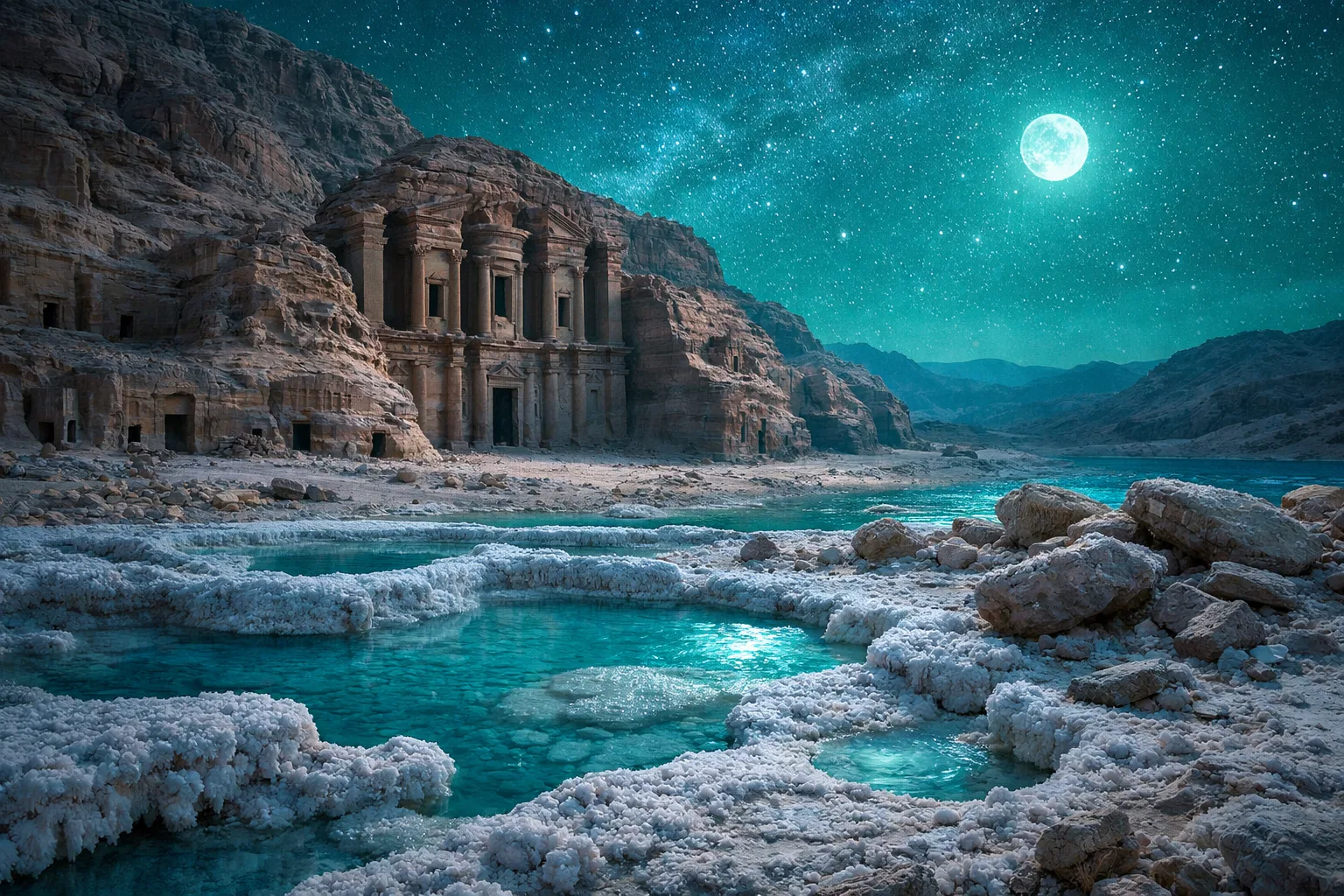
Jordan sits at a meeting point of desert routes, biblical geography, Nabataean architecture, Bedouin oral tradition and Dead Sea geology. That means many of its “mysteries” are attached to places already thick with meaning: Petra, Wadi Rum, the Dead Sea, the Jordan Valley and the eastern desert. The result is a country where the Fortean question is often not “did a monster appear?” but “why did this place keep attracting stories of spirits, fire from heaven, impossible ruins and signs in the landscape?”
That matters because Jordan’s best strange material has a strong sense of place. UNESCO’s listing for the cultural space of the Bedu in Petra and Wadi Rum stresses oral knowledge, poetry, songs and folktales tied to particular landscapes, rather than folklore floating free of geography. In Fortean terms, that is exactly where the interesting tension begins: a canyon, ruin, cave or salt plain can be a tourist site, a sacred memory, a geological formation and a stage for uncanny storytelling all at once.[UNESCO ICH]ich.unesco.orgOpen source on unesco.org.
The cautious reading is that Jordan has fewer well-documented modern “paranormal cases” than countries with large newspaper archives and organised UFO societies. The richer seam is stranger but less sensational: traditions and claims that have been repeatedly attached to real physical places, then reinterpreted by archaeologists, travellers, journalists, believers and debunkers.
Did a cosmic blast create Jordan’s Sodom story?
The most famous recent Jordanian anomaly is the claim that Tall el-Hammam, a Bronze Age city site in the southern Jordan Valley north-east of the Dead Sea, was destroyed around 1650 BCE by a Tunguska-sized airburst. The 2021 Scientific Reports paper argued that a high-temperature cosmic event produced melted materials, shocked quartz, spherules, salt contamination and a regional abandonment pattern; it also suggested the event may have fed into the later biblical story of Sodom.[Nature]nature.comOpen source on nature.com.
For a while, this was almost too perfect as Forteana: fire from the sky, a real archaeological mound, the Dead Sea basin, and a scientific paper linking catastrophe to scripture. But the case has since become a warning about how dramatic anomaly claims can outrun their evidence. Scientific Reports marked the paper as retracted on 24 April 2025, and contemporary reporting noted that the journal’s editors found clear errors and concluded the data no longer supported the original conclusions.[Nature]nature.comOpen source on nature.com.[EL PAÍS English]english.elpais.comOpen source on elpais.com.
That does not make Tall el-Hammam uninteresting. Quite the opposite: it is now a textbook Jordanian Fortean case because it shows every layer of the process. There is a real ancient site, a real destruction horizon, a powerful religious narrative, a dramatic scientific hypothesis, global media amplification, expert criticism, and then formal retraction. The “mystery” is no longer best framed as “was Sodom destroyed by an asteroid?” but as “how did an uncertain archaeological interpretation become a world headline?”
Jordan’s official tourism material still presents Lot’s Cave near the Dead Sea as a place believed to be connected with Lot’s escape after the story of Sodom and Gomorrah, noting the later church and mosaic remains at the site. That is a different kind of evidence: not proof of the biblical event, but evidence that the landscape has long been organised around remembered sacred geography.[Visit Jordan]international.visitjordan.comthe dead seathe dead sea

The Dead Sea: a natural engine for weird stories
The Dead Sea is one of Jordan’s great generators of strange-but-real phenomena. Its density lets people float in a way that feels faintly impossible, its salt and mud have long been folded into healing claims, and its shores preserve names and traditions linked with Lot, Sodom and ancient catastrophe. Older classical and historical traditions also associated the lake with bitumen or asphalt, which helped give it names such as Asphaltites in ancient writing.[Geoscience World]pubs.geoscienceworld.orgDead Sea Asphalts Historical Aspects1Dead Sea Asphalts Historical Aspects1[Wikisource]en.wikisource.orgDead SeaDead Sea
The modern Fortean twist is the sinkhole landscape. Around Ghor al-Haditha on the Jordanian side of the Dead Sea, ground collapse has produced holes that residents have reportedly called “star holes” because they looked like craters from something that fell out of the sky. The scientific explanation is earthly but still dramatic: studies of the Dead Sea region connect many sinkholes with subsurface dissolution, erosion and changes linked to the falling level of the Dead Sea.[MERIP]merip.orgTerra Infirma – Dead Sea Sinkholes – A Photo EssayTerra Infirma – Dead Sea Sinkholes – A Photo Essay[SE]se.copernicus.orgOpen source on copernicus.org.
This is a good example of how Fortean interpretation works at its best. A hole in the ground may invite a sky-fall story; geology then supplies a mechanism; the local name preserves the first emotional response. Nobody needs to pretend the sinkholes are meteor strikes for them to belong in Jordan’s weird-history record. Their uncanniness comes from a real hazard that looks, at first glance, like an impact field.
Petra, Wadi Rum and the jinn-haunted landscape
Petra and Wadi Rum are not “haunted attractions” in the cheap sense. Their strange power comes from scale, silence, ruins and oral tradition. UNESCO’s description of the Bedu cultural space emphasises transmitted knowledge of the environment, traditional medicine, camel husbandry, tent-making, poetry, songs and folktales tied to Petra and Wadi Rum. That makes the region a living folklore landscape rather than merely a backdrop for tourist ghost stories.[UNESCO ICH]ich.unesco.orgOpen source on unesco.org.
Jinn traditions sit naturally in this setting. In Jordanian and wider Arabic folklore, jinn and ghouls often work as narrative figures through which fear, caution, moral behaviour and dangerous places can be discussed. A recent study of Jordanian oral folktales describes supernatural beings such as ghouls and jinn as devices that help transmit values and preserve collective memory.[jcasc.com]jcasc.comOpen source on jcasc.com.
The believer’s reading treats these places as inhabited by unseen beings. The sceptical reading sees the stories as culturally meaningful ways to map risk: deserts, caves, ruins, night travel, strangers, predators, thirst and disorientation. The more interesting middle ground is that folklore does not have to be “literally true” to be locally true. It can encode the feeling of a place and the behaviour needed to survive it.
Petra also has a sky-mystery that belongs more to archaeoastronomy than the paranormal. Research on Nabataean monuments argues that some sacred structures were deliberately oriented with celestial events in mind. At Ad Deir, the Monastery, the winter solstice sun creates striking light-and-shadow effects, while the Urn Tomb has been linked with solstitial and equinoctial alignments.[Springer]link.springer.comOpen source on springer.com.
This is not evidence of lost super-science. It is more interesting than that. It suggests that the Nabataeans may have used architecture, landscape and sunlight to create ritual effects that later visitors experience as uncanny. A beam of light hitting a sacred place at the right time of year can look like a sign, even when the mechanism is geometry, observation and design.
Desert kites: the “mystery structures” that became hunting machines
Some of Jordan’s strangest archaeology is easiest to see from above. “Desert kites” are huge stone-built structures in arid landscapes, with long guiding walls that converge towards enclosures and pits. Early pilots noticed such forms across the region in the twentieth century, and their kite-like shape gave them the name. For decades they carried a mystery aura because they were often too large to understand properly from ground level.
Recent research has moved the question away from vague speculation. The Globalkites project describes desert kites as massive hunting traps across the Near and Middle East, mapped through high-resolution satellite imagery and studied for their distribution, form and environmental setting.[Journal of Open Archaeology Data]openarchaeologydata.metajnl.comOpen source on metajnl.com.
Jordan is central to that story. A 2026 open-access study of Jibal al-Khashabiyeh in south-eastern Jordan reported direct and robust evidence for Late Pre-Pottery Neolithic B kite construction and use, in the second half of the eighth millennium BCE. The excavations found deep pit-traps around kite enclosures and argued that these structures were built by highly organised hunter-forager groups with detailed local knowledge.[Springer]link.springer.comOpen source on springer.com.
For a Fortean page, the key point is not that the kites remain unexplained. It is that they show how “mystery archaeology” can mature. What first appears as an enigmatic desert drawing becomes, through aerial survey, excavation and dating, evidence for large-scale prehistoric planning. The wonder survives the explanation: Jordan’s desert contains enormous animal traps older than many famous monuments, built so cleverly into the terrain that modern people needed aircraft and satellites to appreciate them.
Real fire from the sky: Jebel Waqf as Suwwan
Jordan does have a confirmed cosmic scar: Jebel Waqf as Suwwan, a roughly 6 km-wide impact crater in the central eastern border area. Researchers at the University of Freiburg describe it as a meteorite impact structure, with shatter cones and shocked quartz providing diagnostic evidence of impact.[Kenkmann]kenkmann.uni-freiburg.deKenkmann Impact Crater Jebel Waqf as Suwwan — Professor Thomas KenkmannKenkmann Impact Crater Jebel Waqf as Suwwan — Professor Thomas Kenkmann
This matters because it separates two very different types of “fire from heaven” claim. At Tall el-Hammam, the proposed cosmic airburst became controversial and was retracted. At Jebel Waqf as Suwwan, the evidence is geological and impact-diagnostic. One case shows how a dramatic story can fail under scrutiny; the other shows that extraterrestrial impacts are real natural events, just not automatically the explanation for every ancient destruction story.
The crater also gives Jordan’s Forteana a useful grounding point. A meteorite impact does not need aliens, omens or prophecy to be strange. It is a reminder that the sky has genuinely altered the country’s deep-time landscape, even if most human-era catastrophe stories need more cautious handling.

Jordan’s UFO record: more hoax than classic casebook
Jordan does not have a major, well-documented public UFO tradition comparable with the United States, Britain, France or Brazil. The best-known modern Jordanian UFO story is instead a media prank. In 2010, Al Ghad published an April Fool’s front-page report claiming that UFOs had landed near the desert town of Jafr, lighting up the area, interrupting communications and frightening residents. According to CBS News, the mayor took the story seriously enough to send security authorities to look for aliens.[CBS News]cbsnews.comNewspaper's UFO Prank Causes Mayhem in Jordan - CBS News…
As a UFO case, it is solved: it was a hoax. As Jordanian Forteana, it is still valuable. It shows how quickly a flying-saucer story can move from joke to civic disruption when it borrows the right scenery: a remote desert town, lights in the night, communications trouble and official response. Those are classic UFO ingredients, and the prank worked because the script was already familiar to readers.
There are scattered social-media videos and informal claims of strange lights over Jordan, but they rarely come with the evidential ingredients needed for a strong case: multiple independent witnesses, precise time and location, original unedited footage, radar or flight data, and serious investigation. The evidence-aware conclusion is that Jordan’s UFO material is culturally interesting but thin as a record of unexplained aerial events.
How to read Jordan’s strange reports without flattening them
Jordan rewards a particular kind of scepticism: not the joyless kind that wants every legend to disappear, but the useful kind that asks what kind of claim is being made.
A few distinctions help:
A sacred tradition is not the same as an archaeological proof. Lot’s Cave, Sodom traditions and Dead Sea place-memory matter because people have attached meaning to them for centuries. That does not mean every associated event can be verified historically.
A natural explanation does not cancel the uncanny. Dead Sea sinkholes are not star impacts, but their sudden appearance and crater-like form explain why people might speak of them in sky-fall language.
A debunked claim can still be historically important. The Tall el-Hammam airburst claim is weaker after retraction, not stronger. Yet the episode remains important as a modern case study in how spectacular anomaly claims travel through science, media and religion.
Folklore can encode practical knowledge. Jinn and ghoul stories may warn about dangerous places, night travel, ruins, isolation or social boundaries. Treating them only as “false beliefs” misses their cultural work.
Some mysteries become better after explanation. Desert kites are less mysterious than they once were, but far more impressive: they reveal sophisticated prehistoric engineering, not vague ancient magic.
Jordan’s place in country-level Forteana
Jordan’s weird-history profile is distinctive because it is not dominated by monsters, poltergeists or famous UFO flaps. Its strongest material comes from the friction between landscape and interpretation. The country’s deserts, ruins, caves, salt shores and ancient road systems invite stories; modern archaeology and geology then explain some, complicate others and occasionally expose a hoax.
The enduring pull is easy to understand. At Petra, sunlight can seem staged by the gods. In Wadi Rum, silence and stone make jinn stories feel at home. Beside the Dead Sea, biblical memory, bitumen, salt and collapse turn geology into theatre. In the eastern desert, prehistoric hunters left vast stone machines that only modern aerial vision made legible. And at Jebel Waqf as Suwwan, the sky really did leave a wound in the land.
Jordan’s Forteana is therefore best read as strange-but-grounded: a record of claims, traditions, misreadings, discoveries and real natural marvels, all sharpened by one of the most symbolically loaded landscapes on Earth.
Amazon book picks
Further Reading
Books and field guides related to Why Jordan Makes the Uncanny Feel Ancient. Use these as the next step if you want deeper reading beyond the article.

The Bible unearthed
Explores the historical background to biblical locations and traditions.
Lost Cities of the Ancient World
Places Petra and other ancient landscapes into wider context.
The Holy Land: An Oxford Archaeological Guide
Provides archaeological context for many Jordanian mystery sites.
The World of the Nabataeans
Supports understanding of Petra and Jordan's ancient landscapes.
eBay marketplace picks
Marketplace Samples
Live-tested eBay searches with available results related to this page.


Endnotes
1.
Source: ich.unesco.org
Link:https://ich.unesco.org/en/RL/cultural-space-of-the-bedu-in-petra-and-wadi-rum-00122
2.
Source: nature.com
Link:https://www.nature.com/articles/s41598-021-97778-3
3.
Source: en.wikisource.org
Title: Dead Sea
Link:https://en.wikisource.org/wiki/1911_Encyclop%C3%A6dia_Britannica/Dead_Sea
4.
Source: merip.org
Title: Terra Infirma – Dead Sea Sinkholes – A Photo Essay
Link:https://www.merip.org/2020/10/terra-infirma-dead-sea-sinkholes-a-photo-essay/
5.
Source: jcasc.com
Link:https://jcasc.com/index.php/jcasc/article/view/2703
6.
Source: link.springer.com
Link:https://link.springer.com/article/10.1007/s00004
7.
Source: link.springer.com
Link:https://link.springer.com/article/10.1007/s12520-026-02409-5
8.
Source: cbsnews.com
Title: CBS News
Link:https://www.cbsnews.com/news/newspapers-ufo-prank-causes-mayhem-in-jordan/
Source snippet
Newspaper's UFO Prank Causes Mayhem in Jordan - CBS News...
9.
Source: link.springer.com
Link:https://link.springer.com/rwe/10.1007/978
10.
Source: link.springer.com
Link:https://link.springer.com/content/pdf/10.1007/s00004-013-0164-6.pdf
11.
Source: link.springer.com
Link:https://link.springer.com/article/10.1007/s12665
12.
Source: jcasc.com
Link:https://jcasc.com/index.php/jcasc/article/download/2703/807
13.
Source: unesco.org
Title: document 2272
Link:https://www.unesco.org/archives/multimedia/document-2272
14.
Source: archives.gov
Link:https://www.archives.gov/research/topics/uaps/photographs
15.
Source: globalkites.fr
Link:https://www.globalkites.fr/
16.
Source: space.com
Title: 25318 ancient petra monastery tracks sun
Link:https://www.space.com/25318-ancient-petra-monastery-tracks-sun.html
17.
Source: english.elpais.com
Link:https://english.elpais.com/science-tech/2025-04-24/sodom-and-gomorrah-were-not-destroyed-by-the-impact-of-an-extraterrestrial-object.html
18.
Source: international.visitjordan.com
Title: the dead sea
Link:https://international.visitjordan.com/wheretogo/the-dead-sea/
19.
Source: pubs.geoscienceworld.org
Title: Dead Sea Asphalts Historical Aspects1
Link:https://pubs.geoscienceworld.org/aapg/aapgbull/article/62/5/837/37124/Dead-Sea-Asphalts-Historical-Aspects1
20.
Source: se.copernicus.org
Link:https://se.copernicus.org/articles/9/1079/2018/se-9-1079-2018-relations.html
21.
Source: openarchaeologydata.metajnl.com
Link:https://openarchaeologydata.metajnl.com/articles/10.5334/joad.150
22.
Source: kenkmann.uni-freiburg.de
Title: Kenkmann Impact Crater Jebel Waqf as Suwwan — Professor Thomas Kenkmann
Link:https://www.kenkmann.uni-freiburg.de/projekte-en/completed/impaktkrater-jebel-waqf-as-suwwan
23.
Source: Wikipedia
Link:https://en.wikipedia.org/wiki/Petra
24.
Source: Wikipedia
Title: Dead Sea
Link:https://en.wikipedia.org/wiki/Dead_Sea
25.
Source: Wikipedia
Link:https://en.wikipedia.org/wiki/Jinn
26.
Source: international.visitjordan.com
Link:https://international.visitjordan.com/
27.
Source: thehistoryblog.com
Link:https://www.thehistoryblog.com/archives/12840
28.
Source: thehistoryblog.com
Link:https://www.thehistoryblog.com/archives/63426
29.
Source: se.copernicus.org
Link:https://se.copernicus.org/preprints/se-2019-97/se-2019-97.pdf
30.
Source: freidok.uni-freiburg.de
Link:https://freidok.uni-freiburg.de/files/278076/iIRg_jI8MwqQHShN/s12520-026-02409-5.pdf
31.
Source: journals.akademicka.pl
Link:https://journals.akademicka.pl/saac/article/view/605
32.
Source: degruyterbrill.com
Link:https://www.degruyterbrill.com/document/doi/10.1515/sem-2024-0162/html?srsltid=AfmBOooDc-9OWGuCNf5RX4ll3RPUHRnd4ngpG_OpXkfoCh8q1P4tdirY
Additional References
33.
Source: youtube.com
Title: Melted Brick, Airborne Pottery, Bones Burned
Link:https://www.youtube.com/watch?v=7iELovzH-Sw
Source snippet
2 Did They Find Sodom? | Archaeological Evidence Examined (Dr. Steven Collins)...
34.
Source: youtube.com
Title: Did They Find Sodom? | Archaeological Evidence Examined (Dr. Steven Collins)
Link:https://www.youtube.com/watch?v=7h5kcChC1PA
Source snippet
3 The LARGEST Prehistoric Man-Made Structures: Desert Kite Animal Traps...
35.
Source: youtube.com
Title: The LARGEST Prehistoric Man-Made Structures: Desert Kite Animal Traps
Link:https://www.youtube.com/watch?v=Vzm0HbSCsxU
Source snippet
4 Desert Kites: Giant Archaeological Traps of Ancient Arabia | Dr. Rémy Crassard...
36.
Source: youtube.com
Title: Desert Kites: Giant Archaeological Traps of Ancient Arabia | Dr. Rémy Crassard
Link:https://www.youtube.com/watch?v=BIxS5ounVVI
Source snippet
5 Jordan's Tunnel of Light: Unveiling the Ancient Wonder...
37.
Source: loc.gov
Link:https://www.loc.gov/everyday-mysteries/browse-all-questions/item/can-it-rain-frogs-fish-and-other-objects/
38.
Source: researchgate.net
Link:https://www.researchgate.net/publication/392032355_A_Tunguska_Sized_Airburst_Destroyed_Tall_el-Hammam_a_Middle_Bronze_Age_City_in_the_Jordan_Valley_Near_the_Dead_Sea_Expanded
39.
Source: researchgate.net
Link:https://www.researchgate.net/publication/256374946_Dead_sea_asphalt_in_ancient_egyptian_mummies-why
40.
Source: researchgate.net
Link:https://www.researchgate.net/publication/356798317_Discovery_and_excavation_of_desert_kites_in_the_south-eastern_Badia_of_Jordan
41.
Source: academia.edu
Link:https://www.academia.edu/72572563/Discovery_and_excavation_of_desert_kites_in_the_south_eastern_Badia_of_Jordan
42.
Source: researchgate.net
Link:https://www.researchgate.net/publication/272138882Jebel_Wagf_as_Suwwan_Jordan_a_possible_impact_crater-a_first_approach_Jebel_Wagf_as_Suwwan_Jordanien_ein_moglicher_Impaktkrater-_eine_erste_Annaherung
Topic Tree
Follow this branch
Related pages 192
- Afghan Forteana
- Antigua Uncanny
- Bosnian Mysteries
- Botswana Weird
- Brazil Strange
- +187 more in sidebar