Within Turkmenistan
Were Turkmenistan's Giant Footprints Sacred Elephants?
The Koytendag dinosaur tracks show how fossil evidence can preserve older legends about sacred elephants and impossible footprints.
On this page
- The Dinosaur Plateau and its fossil tracks
- Holy elephants, Alexander stories and local memory
- Why solved mysteries still belong in weird history
Page outline Jump by section
Introduction
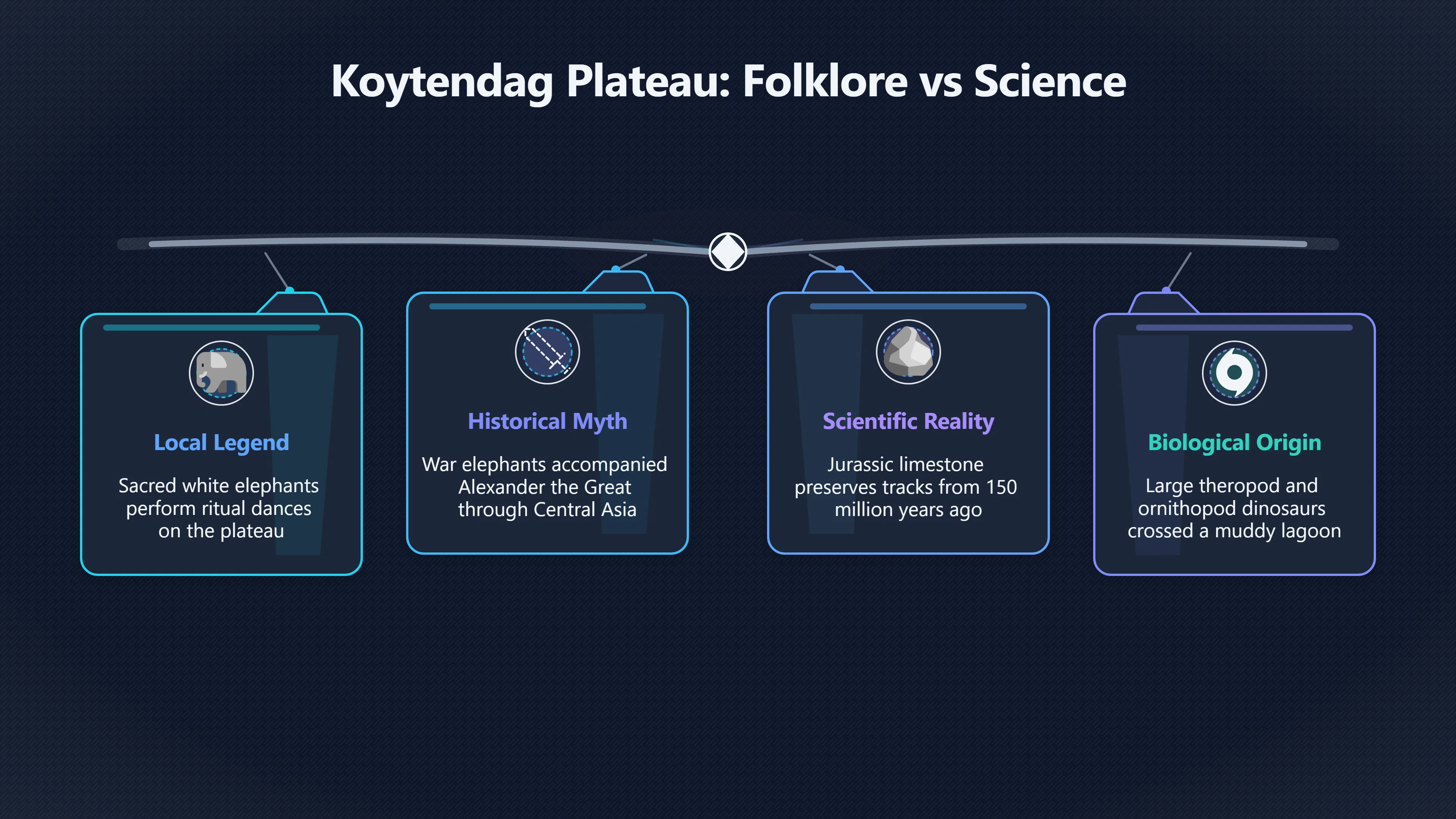
The giant footprints on the Koytendag Dinosaur Plateau are one of Turkmenistan’s most intriguing meetings of science and folklore. Today they are recognised as fossil dinosaur trackways preserved in Jurassic limestone around 150 million years ago. For centuries, however, local people explained the enormous impressions in a very different way. They were said to be the tracks of sacred white elephants or the war elephants of Alexander the Great, leaving behind a legend so enduring that the nearby village became known as Hojapil, commonly interpreted as meaning “holy” or “sacred elephants”. Rather than being an example of supernatural belief disproved by science, Koytendag shows how striking natural evidence can generate memorable traditions that survive until geology finally offers another explanation. It is exactly the sort of solved mystery that still belongs in Turkmenistan’s strange historical landscape.
The Dinosaur Plateau and its fossil tracks
High in the Koytendag Mountains of eastern Turkmenistan lies one of the world’s most remarkable dinosaur footprint sites. The inclined limestone slab preserves around 2,500 footprints arranged into more than thirty trackways, making it one of the largest concentrations of dinosaur tracks found in a single locality. The animals crossed a muddy lagoon during the Late Jurassic before their footprints hardened, were buried by later sediments, and eventually reappeared after millions of years of uplift and erosion. Scientists have identified tracks left by several kinds of large theropod and ornithopod dinosaurs, with some trackways extending for more than 300 metres.[Wikipedia]WikipediaDinosaur PlateauDinosaur Plateau
The site is unusual because the tracks are not scattered randomly. Long, parallel pathways create the impression that enormous animals marched across the landscape in an orderly procession. To anyone encountering them without modern palaeontology, they look less like isolated fossils than the preserved route of gigantic beasts.
That visual impact explains why the plateau has fascinated local communities for generations. The tracks were known long before geologists formally described them in the twentieth century, and local guides reportedly directed early Turkmen researchers to the site after preserving its location through oral tradition. Soviet geological investigations during the 1950s and 1980s transformed the plateau from a regional curiosity into an internationally recognised palaeontological site, while Turkmenistan later proposed the wider Koytendag landscape for UNESCO World Heritage recognition.[Wikipedia]WikipediaDinosaur PlateauDinosaur Plateau
Holy elephants, Alexander stories and local memory
Long before anyone suggested dinosaurs, the footprints already had an explanation rooted in local history and imagination.
The best-known tradition says the tracks belonged to sacred white elephants that gathered annually on the plateau to perform ritual dances. Another version identifies them as the war elephants accompanying Alexander the Great during his campaigns through Central Asia. Although Alexander almost certainly never marched elephants across this particular mountain plateau, his legendary eastern expeditions became attached to many impressive landscapes throughout the region, making the explanation feel plausible within local storytelling.[advantour.com]advantour.comDinosaur Plateau, MagdanlyAlong with a scientific version of the plateau phenomenon, there are also two legends on the origin of…
The village name reinforces the legend. Hojapil (also written Khodjapil or Khojapil) is widely interpreted as meaning “holy elephants” or “sacred elephants”. Whether the place-name inspired the legend or the legend explained the place-name is impossible to establish, but together they show that the mysterious footprints had entered cultural memory centuries before scientific investigation.[Turkmenportal.com]turkmenportal.comThe plateau of dinosaurs in Turkmenistanelephants”. An ancient local legend considered the footprints of dinosaur limbs traces of the elephants of troops of the legendary ancien…
From a historical perspective, these traditions make good sense. People naturally interpret unfamiliar marks through the largest animals they know. Central Asia had no living dinosaurs to compare with, but stories of elephants travelled widely through trade, conquest and religious literature. An enormous rounded footprint therefore became easier to understand as an elephant’s track than as evidence of an extinct animal unknown to human experience.

Why the legend is still worth remembering
The discovery that the impressions are dinosaur tracks did not erase the older stories. Instead, it revealed something equally interesting about how people interpret extraordinary landscapes.
Many legendary “giant footprints” around the world are carved into rock or attributed to saints, heroes or mythical creatures. Koytendag differs because the impressions are genuine trace fossils. The folklore developed around a real geological phenomenon rather than an invented landmark. The scientific explanation therefore does not replace an imaginary story with reality so much as explain why the story arose in the first place.
This makes Koytendag an unusually valuable example for historians of folklore. The legends preserve evidence that local communities noticed and discussed the tracks long before professional scientists documented them. Oral tradition effectively acted as a record of an important natural feature, even though its interpretation was mistaken.[Wikipedia]WikipediaDinosaur PlateauDinosaur Plateau
Why solved mysteries still belong in weird history
For readers interested in Fortean subjects, Koytendag demonstrates that not every strange story ends with disappointment once science arrives.
The mystery was genuine. People encountered hundreds of enormous footprints on a mountainside with no obvious explanation. Their solution—sacred elephants, perhaps linked with Alexander’s legendary armies—was culturally meaningful and survived for generations. Modern geology and palaeontology eventually showed that the tracks were around 150 million years old and belonged to dinosaurs, but that answer does not diminish the fascination of the earlier belief.[Wikipedia]WikipediaDinosaur PlateauDinosaur Plateau
Instead, the site illustrates one of the recurring themes in Turkmenistan’s strange history: spectacular natural places acquire memorable legends because they genuinely demand explanation. Like the country’s burning gas crater or its sacred caves, the Dinosaur Plateau occupies the fertile ground where extraordinary landscapes encourage extraordinary stories. The supernatural claim may have vanished, but the journey from sacred elephants to Jurassic dinosaurs remains one of Central Asia’s most compelling examples of folklore preserving the memory of a real natural wonder.
Amazon book picks
Further Reading
Books and field guides related to Were Turkmenistan's Giant Footprints Sacred Elephants?. Use these as the next step if you want deeper reading beyond the article.



The Princeton field guide to dinosaurs
Provides scientific background for Jurassic track makers.

eBay marketplace picks
Marketplace Samples
Live-tested eBay searches with available results related to this page.




Endnotes
1.
Source: Wikipedia
Title: Dinosaur Plateau
Link:https://en.wikipedia.org/wiki/Dinosaur_Plateau
2.
Source: Wikipedia
Title: Kurek Formation
Link:https://en.wikipedia.org/wiki/Kurek_Formation
3.
Source: whc.unesco.org
Link:https://whc.unesco.org/en/tentativelists/5434/
Source snippet
UNESCO World Heritage CentreDinosaurs and Caves of KoytendagKoytendag is famous for its unique caves and other geological features (marbl...
4.
Source: advantour.com
Link:https://www.advantour.com/turkmenistan/magdanly/dinosaur-plateau.htm
Source snippet
Dinosaur Plateau, MagdanlyAlong with a scientific version of the plateau phenomenon, there are also two legends on the origin of...
5.
Source: turkmenportal.com
Title: The plateau of dinosaurs in Turkmenistan
Link:https://turkmenportal.com/en/articles/72
Source snippet
elephants”. An ancient local legend considered the footprints of dinosaur limbs traces of the elephants of troops of the legendary ancien...
6.
Source: tourstoturkmenistan.com
Title: Tours to Turkmenistan Dinosaur Plateau
Link:https://tourstoturkmenistan.com/en/blog/archeological-monuments/dinosaur-plateau.html
Source snippet
Dinosaur Plateau - Turkmenistan2 Apr 2019 — Because for centuries, the indigenous people believed that the giant footprints left deep on...
Additional References
7.
Source: darvazatravel.com
Link:https://darvazatravel.com/the-secrets-of-turkmenistans-dinosaur-plateau-footprints-science-and-legends/
Source snippet
The Secrets Of Turkmenistan's Dinosaur PlateauThe Koytendag Dinosaur Plateau contains over 2,500 authentic Megalosaurus and Iguanodon foo...
8.
Source: silkadv.com
Link:https://silkadv.com/en/content/dinosaur-plateau-kugitang
9.
Source: youngpioneertours.com
Title: Dinosaur Plateau and Kugitang Mountains
Link:https://www.youngpioneertours.com/dinosaur-plateau-kugitang-turkmenistan/
Source snippet
how you can...Visit one of the most interesting places in Turkmenistan nestled far away from the likes of Ashgabat - visit real dinosaur...
10.
Source: ramaarya.blog
Title: turkmenistan lebap dinosaur plateau
Link:https://ramaarya.blog/2024/02/12/turkmenistan-lebap-dinosaur-plateau/
Source snippet
time-travel and dinosaur plateaus in remote north-east...12 Feb 2024 — Filled with moonscapes, a dinosaur plateau scalloped with around...
11.
Source: blog.everythingdinosaur.com
Title: turkmenistans jurassic park
Link:https://blog.everythingdinosaur.com/blog/_archives/2014/05/05/turkmenistans-jurassic-park.html
Source snippet
Tracks at Turkmenistan's "Jurassic Park"5 May 2014 — A remote plateau in eastern Turkmenistan famed for its thousands of dinosaur tras mi...
Published: May 2014
12.
Source: centralasia-adventures.com
Title: Plateau of Dinosaurs
Link:https://centralasia-adventures.com/en/turkmenistan/nature-of-turkmenistan/plateau_of_dinosaur.html
Source snippet
Turkmenistan... Kugitang plateau is the world's largest repository of dinosaur... Another legend says that these footprints were left by...
13.
Source: facebook.com
Link:https://www.facebook.com/groups/seyahatbloglari/posts/709606189224757/
Source snippet
30 and 1 reason to visit Turkmenistan. Reason #916 Jul 2017 — Local citizens noticed the mysterious dinosaur footprints in Turkmenistan l...
14.
Source: turkmenistan.gov.tm
Title: koytendag a journey to the realm of gorges and underground labyrinths
Link:https://turkmenistan.gov.tm/index.php/en/post/15727/koytendag-a-journey-to-the-realm-of-gorges-and-underground-labyrinths
Source snippet
Many of them are...Read more...
15.
Source: youtube.com
Title: TURKMENISTAN: What the Desert Kingdom Still Hides | 4K Travel Documentary
Link:https://www.youtube.com/watch?v=OzduOJE5Pm0
Source snippet
[Kyrk Gyz]({{ 'kyrk-gyz/' | relative_url }}) gorge Kugitag Turkmenistan...
16.
Source: youtube.com
Title: Kyrk Gyz gorge Kugitag Turkmenistan
Link:https://www.youtube.com/watch?v=OdFE56IuU8M
Source snippet
Koytengganu Part 4 (final)...
Topic Tree