Within Uzbekistan Strange
Did Opening Timur's Tomb Unleash a Curse?
The opening of Timur's tomb became Uzbekistan's most famous curse story because it collided with the Nazi invasion of the USSR.
On this page
- The June 1941 Samarkand excavation
- Warnings, inscriptions and later retellings
- Coincidence, propaganda and why the story lasted
Page outline Jump by section
Introduction
Did opening Timur’s tomb unleash a curse? The short answer is no compelling evidence says it did, but the coincidence that followed has become one of Uzbekistan’s most enduring strange-history stories. In June 1941, a Soviet scientific expedition opened the tomb of the conqueror Timur in Samarkand’s Gur-e-Amir mausoleum. Two days later, Nazi Germany launched Operation Barbarossa, the largest invasion in military history. That remarkable timing transformed a routine archaeological investigation into a legend about forbidden graves, ancient warnings and fate. More than eighty years later, the story remains fascinating not because it proves the supernatural, but because it sits at the intersection of documented history, oral tradition, wartime myth-making and humanity’s habit of finding meaning in extraordinary coincidences.[Wikipedia]WikipediaCurse of TimurCurse of Timur
The June 1941 Samarkand excavation
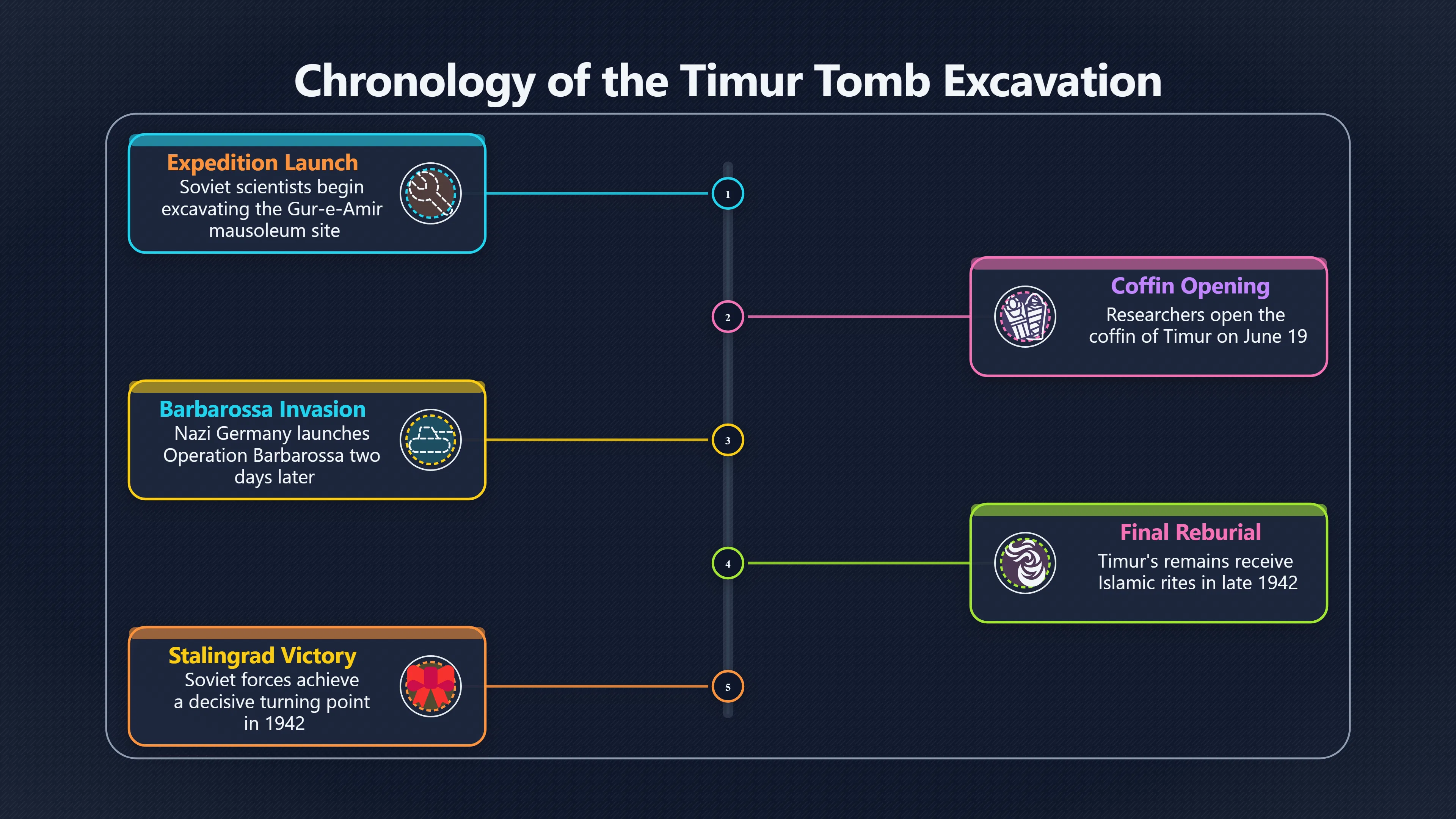
The events at the heart of the legend are well documented. In June 1941, a Soviet expedition excavated the Timurid royal mausoleum at Gur-e-Amir in Samarkand. The project was overseen by Uzbek scholar Tashmuhammed Kari-Niyazov and included the celebrated forensic anthropologist Mikhail Gerasimov, whose speciality was reconstructing historical faces from skulls. One purpose of the expedition was to study Timur’s remains scientifically and produce a facial reconstruction.[Wikipedia]WikipediaMikhail Gerasimov (archaeologistMikhail Gerasimov (archaeologist
Excavation began in mid-June, while Timur’s coffin itself was opened around 19–20 June 1941. Different sources give slightly different dates because the work unfolded over several days and reporting varied between Samarkand and Moscow. What is not disputed is that the opening occurred immediately before Germany attacked the Soviet Union on 22 June 1941.[Wikipedia]WikipediaCurse of TimurCurse of Timur
The scientific work itself produced tangible historical results. Gerasimov reconstructed Timur’s appearance from his skull and confirmed physical evidence consistent with the ruler’s famous limp, reinforcing historical descriptions that had earned him the epithet “Timur the Lame”. Those achievements, however, have long been overshadowed by the much more dramatic curse story.[Wikipedia]WikipediaOpen source on wikipedia.org.
Warnings, inscriptions and later retellings
The legend became richer as it was retold.
According to popular versions, local elders and religious figures warned the Soviet expedition not to disturb Timur’s grave. Some accounts claim they quoted an ancient prophecy that opening the tomb would bring disaster. Others say the researchers discovered a hidden inscription inside the coffin reading words to the effect of: “Whoever opens my tomb shall unleash an invader more terrible than I.”[Wikipedia]WikipediaCurse of TimurCurse of Timur
These details are much harder to verify than the excavation itself.
Historians have pointed out that contemporary expedition records do not clearly record the famous “invader” inscription, and photographs of the tomb do not show such wording. Researchers examining the expedition’s documentation have argued that the dramatic quotation appears to have emerged only in later retellings rather than in the original archaeological record.[Reddit]reddit.comOne of the more lurid tales of WW2 is that the Soviet Union opened the Tomb of Timur and found an inscription promising disaster to…
Another frequently repeated detail concerns the smell reportedly released when the tomb was opened. Rather than suggesting anything supernatural, this is readily explained by the aromatic substances historically used during elite burials, including resins, camphor and incense, which can remain detectable in enclosed tombs for centuries.[Atlas Obscura]atlasobscura.comAtlas ObscuraFacial Reconstruction, Nazis, and Siberia: The story of Mikhail GerasimovJanuary 25, 2011…
As with many famous curse stories, the most memorable elements are also the least securely documented.

Why the Barbarossa coincidence became so powerful
The timing alone would probably have been enough to create a legend.
Operation Barbarossa had been planned for months before the Samarkand excavation. Hitler’s decision to invade the Soviet Union was a strategic and military one, entirely unrelated to archaeological work in Uzbekistan. From a historical standpoint, the invasion cannot plausibly have been caused by events at Timur’s tomb.[Wikipedia]WikipediaCurse of TimurCurse of Timur
Yet coincidences become especially compelling when they connect events of enormous emotional significance. Here, an ancient conqueror’s grave was opened, and within forty-eight hours another vast invasion began. To people living through the catastrophe of 1941, the sequence naturally invited symbolic interpretation.
The story acquired an even neater ending in later versions. Timur’s remains were reburied with Islamic rites in late 1942, and soon afterwards the Soviet victory at Stalingrad marked a decisive turning point on the Eastern Front. Popular retellings often compress the chronology to imply an immediate cause-and-effect relationship, although in reality several weeks separated the reburial from the Soviet victory, and the military situation had already begun changing through strategic decisions and enormous material commitments rather than supernatural intervention.[Wikipedia]WikipediaCurse of TimurCurse of Timur
Coincidence, propaganda and why the story lasted
The endurance of Timur’s curse owes less to evidence than to storytelling.[Wikipedia]WikipediaCurse of TimurCurse of Timur
The Soviet Union officially promoted scientific archaeology rather than belief in supernatural curses. Nevertheless, dramatic wartime narratives could serve political as well as cultural purposes. Linking Timur’s reburial with eventual victory over Nazi Germany created an emotionally satisfying story in which respect for a great historical figure appeared to restore order after catastrophe. Whether Soviet authorities actively encouraged every version is debated, but the legend undoubtedly flourished in books, documentaries and popular history after the war.[Wikipedia]WikipediaCurse of TimurCurse of Timur
Modern tourism has also helped preserve the tale. Visitors to Samarkand frequently hear some version of the curse alongside the genuine history of the Gur-e-Amir mausoleum. The story works because it combines several ingredients that make historical legends memorable:
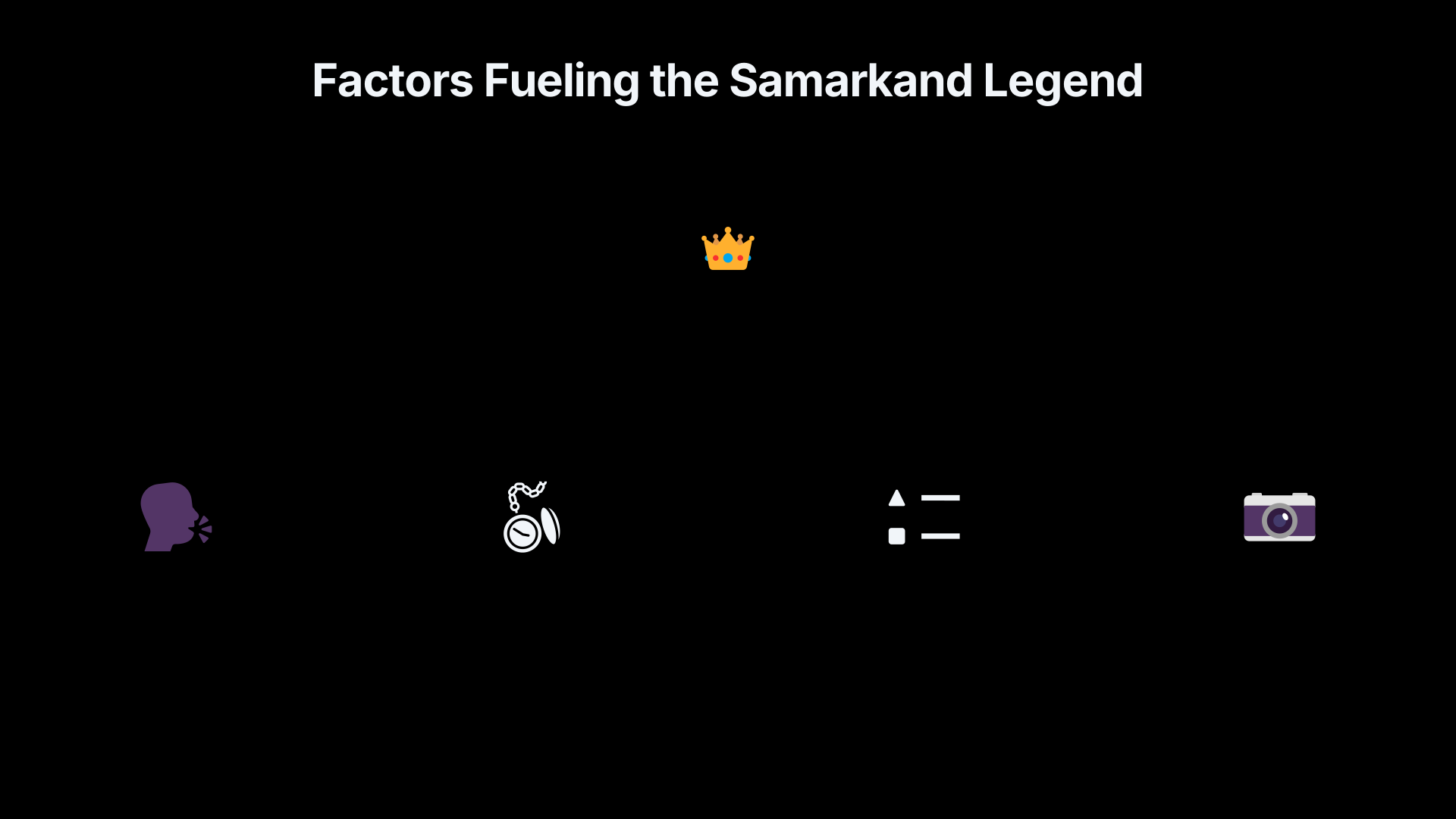
- a real archaeological expedition;
- an internationally famous conqueror;
- documented local traditions about disturbing graves;
- an astonishing chronological coincidence;
- and a satisfying narrative arc ending with reburial and apparent redemption.
None of these elements requires belief in the paranormal, yet together they create a story that feels uncannily complete.
How historians assess the curse today
From an evidence-based perspective, the strongest conclusions are straightforward.
The excavation unquestionably happened. Operation Barbarossa unquestionably began two days later. Timur’s remains were later reburied with Islamic rites, and Gerasimov’s scientific examination genuinely contributed to historical knowledge about Timur himself.[Wikipedia]WikipediaMikhail Gerasimov (archaeologistMikhail Gerasimov (archaeologist
The weaker parts of the story involve the alleged curse inscription, the exact wording of prophetic warnings and claims that Soviet leaders changed military or political decisions because they feared supernatural consequences. These claims rest largely on later recollections and popular retellings rather than contemporary documentary evidence.[Reddit]reddit.comOne of the more lurid tales of WW2 is that the Soviet Union opened the Tomb of Timur and found an inscription promising disaster to…
That distinction is precisely why the episode remains one of Uzbekistan’s finest examples of grounded Forteana. It is not a case in which the supernatural has been demonstrated. Instead, it shows how a genuine historical event acquired legendary meaning because it coincided with one of the most consequential moments of the twentieth century. The power of the story lies not in proving a curse, but in revealing how history, memory and coincidence can combine to create a legend that continues to outlive the people who first told it.
Amazon book picks
Further Reading
Books and field guides related to Did Opening Timur's Tomb Unleash a Curse?. Use these as the next step if you want deeper reading beyond the article.



Genghis Khan and the Making of the Modern World
Appeals to readers interested in steppe conquerors and their legacy.

Lost Enlightenment Central Asias Golden Age From The Arab Con...
First published 2013. Subjects: History, Civilization, Asia, central, history.
eBay marketplace picks
Marketplace Samples
Live-tested eBay searches with available results related to this page.



Endnotes
1.
Source: Wikipedia
Title: Curse of Timur
Link:https://en.wikipedia.org/wiki/Curse_of_Timur
2.
Source: Wikipedia
Title: Mikhail Gerasimov (archaeologist)
Link:https://en.wikipedia.org/wiki/Mikhail_Gerasimov_%28archaeologist%29
3.
Source: Wikipedia
Link:https://en.wikipedia.org/wiki/Timur
4.
Source: Wikipedia
Link:https://en.wikipedia.org/wiki/Gur-e-Amir
5.
Source: reddit.com
Link:https://www.reddit.com/r/AskHistorians/comments/gpqbp3
Source snippet
One of the more lurid tales of WW2 is that the Soviet Union opened the Tomb of Timur and found an inscription promising disaster to...
6.
Source: everything.explained.today
Link:https://everything.explained.today/Tamurlane/
Source snippet
HISTORICAL SOURCES The earliest known history of his reign was Nizam al-Din Shami's Zafarnama, which was written during Timur's...
7.
Source: everything.explained.today
Link:https://everything.explained.today/Timur/
Source snippet
EUROPEAN VIEWS Timur arguably had a significant impact on the Renaissance culture and early modern Europe.^{[111]} European view...
8.
Source: atlasobscura.com
Link:https://www.atlasobscura.com/articles/facial-reconstruction-nazis-and-siberia-the-story-of-mikhail-gerasimov
Source snippet
Atlas ObscuraFacial Reconstruction, Nazis, and Siberia: The story of Mikhail GerasimovJanuary 25, 2011...
Published: January 25, 2011
9.
Source: history.stackexchange.com
Title: comsoviet union
Link:https://history.stackexchange.com/questions/20747/tamerlane-and-operation-barbarossa
Source snippet
union - Tamerlane and Operation Barbarossa - History Stack ExchangeMarch 6, 2015 — TAMERLANE AND OPERATION BARBAROSSA Ask Question Asked...
Published: March 6, 2015
10.
Source: military-history.fandom.com
Link:https://military-history.fandom.com/wiki/Timur
Source snippet
Gerasimov (1941). Timur's body was exhumed from his tomb in 1941 by the Soviet anthropologist Mikhail M...
11.
Source: newworldencyclopedia.org
Link:https://www.newworldencyclopedia.org/entry/Tamerlane
Source snippet
Gerasimov. He found that Timur's facial characteristics conformed to that of Mongoloid features, whi...
12.
Source: en.dharmapedia.net
Link:https://en.dharmapedia.net/wiki/Timur
Source snippet
Dharmapedia WikiMALFUZAT-I TIMURI The Malfuzat-i Timurī and the appended Tuzūk-i Tīmūrī, supposedly Timur's own autobiography, are almost...
13.
Source: lonelyplanet.com
Title: Gur-e-Amir Mausoleum | Samarkand, Uzbekistan | Attractions
Link:https://www.lonelyplanet.com/points-of-interest/gur-e-amir-mausoleum/1384275
Source snippet
Lonely PlanetGUR-E-AMIR MAUSOLEUM ©NICOLA MESSANA PHOTOS/Shutterstock Image: SAMARKAND, UZBEKISTAN - AUGUST 28, 2016: Gur-E Amir Mausoleu...
Published: August 28, 2016
Additional References
14.
Source: encycloreader.org
Link:https://encycloreader.org/r/view.php?p=wikipedia&t=Timur
Source snippet
EXHUMATION AND ALLEGED CURSE [edit] Main article: Curse of Timur ImageTomb of Timur in Gur-e-Amir, Samarkand Timur's body wa...
15.
Source: artikeldigital.com
Link:https://artikeldigital.com/en/Timur
Source snippet
TimurEUROPEAN VIEWS Timur arguably had a significant impact on the Renaissance culture and early modern Europe.^{[150]} European views of...
16.
Source: dlab.epfl.ch
Link:https://dlab.epfl.ch/wikispeedia/wpcd/wp/t/Timur.htm
Source snippet
TO THE ARTS Timur became widely known as a patron to the arts. Much of the architecture he commissioned still stands in Samarqand, now in...
17.
Source: silkadv.com
Link:https://silkadv.com/ru/node/12672
Source snippet
Portrait of Tamerlane.January 1, 1947 — In May and June 1941, excavations were conducted at the Gur-Emir mausoleum, the burial place of t...
Published: January 1, 1947
18.
Source: facts.museum
Title: Как связано нападение Германии на СССР с раскопками могилы Тамерлана?
Link:https://facts.museum/2919
Source snippet
Музей фактовКАК СВЯЗАНО НАПАДЕНИЕ ГЕРМАНИИ НА СССР С РАСКОПКАМИ МОГИЛЫ ТАМЕРЛАНА? Image: Как связано нападение Германии на СССР с раско...
19.
Source: livescience.com
Title: Live Science Real or Not? 6 Famous Historical Curses | Live Science
Link:https://www.livescience.com/38670-famous-historical-curses.html
Source snippet
6 Famous Historical Curses | Live ScienceAugust 6, 2013 — THE CURSE OF TIMUR'S TOMB Image: tamir The Gur Emir mausoleum, site of the tomb...
Published: August 6, 2013
20.
Source: gettyimages.dk
Title: The Gur Emir is the resting place of Tamerlane in Samarkand and is
Link:https://www.gettyimages.dk/detail/news-photo/the-gur-emir-is-the-resting-place-of-tamerlane-in-samarkand-news-photo/1297220587
Source snippet
News Photo - Getty ImagesOctober 20, 1998 — INSIDE THE GUR EMIR AT SAMARKAND The Gur Emir is the resting place of Tamerlane in Samarkand...
Published: October 20, 1998
21.
Source: advantour.com
Link:https://www.advantour.com/uzbekistan/legends/tamerlane-curse.htm
Source snippet
The news passed from mouth to mouth: "The Russian expedition is going to open the tomb of Tamerla...
22.
Source: wikihandbk.com
Title: Английская Википедия:Curse of Timur / Онлайн справочник
Link:https://wikihandbk.com/wiki/%D0%90%D0%BD%D0%B3%D0%BB%D0%B8%D0%B9%D1%81%D0%BA%D0%B0%D1%8F_%D0%92%D0%B8%D0%BA%D0%B8%D0%BF%D0%B5%D0%B4%D0%B8%D1%8F%3ACurse_of_Timur
Source snippet
АНГЛИЙСКАЯ ВИКИПЕДИЯ:CURSE OF TIMUR Материал из Онлайн справочника The Curse of Timur or the Curse of Tamerlane (Russian: П...
23.
Source: military-history.fandom.com
Title: Local leaders attempted to warn the excava
Link:https://military-history.fandom.com/wiki/Gur-e-Amir
Source snippet
fandom.comGur-e-Amir | Military Wiki | FandomCURSE OF TIMUR When Soviet scientists wanted to open Tamerlane's tomb, rumors went around...
Topic Tree