What Makes Nepal's Strange History So Enduring?
Nepal’s strange-history record is dominated by one famous creature, the Yeti, but the country’s Fortean landscape is broader and more interesting than a single snowman-shaped silhouette.
Page outline Jump by section
Why Nepal Became Yeti Country
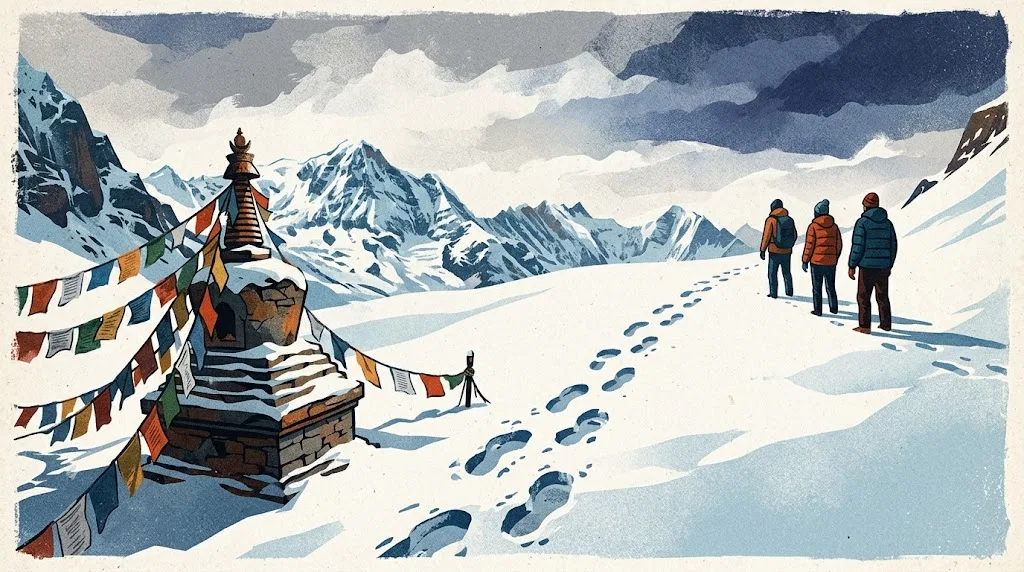
The Yeti is the best-known Nepalese anomaly because it entered global popular culture through mountaineering. Western climbers did not invent Himalayan wild-man traditions, but Everest exploration gave them photographs, expedition reports and newspaper oxygen. The most famous case came in 1951, when Eric Shipton’s Everest reconnaissance party encountered tracks near the Menlung glacier. Michael Ward later described finding a line of prints at about 15,000–16,000 feet, one print roughly 12–13 inches long, nearly twice as broad as his boot, with a prominent big-toe impression and possible claw marks where a crevasse had been crossed. Shipton photographed the print with an ice axe for scale, creating one of the most reproduced images in cryptozoology.[alpinejournal.org.uk]alpinejournal.org.ukAJ 1999 81 87 Ward FootprintsAJ 1999 81 87 Ward Footprints
What made the photograph powerful was also what made it slippery. It was a single striking image from harsh terrain, taken by respected mountaineers but not collected with modern biological controls. Snow enlarges, melts, refreezes and distorts tracks. Bears, goats, humans and overlapping prints can become theatrical under Himalayan conditions. For believers, the Shipton print remains the cleanest visual emblem of a large unknown primate. For sceptics, it is a classic example of how a real trace can become mysterious once weather, altitude, cultural expectation and limited documentation do their work.
The Yeti story also became tied to relics in monasteries. Pangboche Monastery, near the Everest route, was associated with a mummified hand said to be from a Yeti; the case later became less a monster hunt than an object-trafficking story. A finger was removed in 1958 and smuggled out with help from actor James Stewart, while the complete hand was reportedly stolen in the early 1990s. Later DNA testing of a rediscovered finger fragment found it to be human, not evidence of an unknown creature.[traffickingculture.org]traffickingculture.orgPangboche Hand « Trafficking CulturePangboche Hand « Trafficking Culture
Khumjung’s famous “Yeti scalp” had a similar double life as sacred object and scientific specimen. In 1960, Edmund Hillary took the scalp from a Sherpa village for examination, with the village headman accompanying it and the relic to be returned within a month. Hillary publicly said he did not believe in an “abominable snowman”, although he admitted the scalp was the one item for which his party had not yet found a rational explanation at that moment.[Stars and Stripes]stripes.comStars and Stripes'Yeti scalp' fails to convince Hillary | Stars and StripesStars and Stripes'Yeti scalp' fails to convince Hillary | Stars and Stripes
Modern genetics has shifted the balance strongly towards bears. A 2017 Proceedings of the Royal Society B study analysed samples said to be from Yetis, including bone, skin, hair and faecal material from the Himalayas and Tibetan Plateau; the researchers concluded they belonged to local black and brown bears, while also clarifying the evolutionary history of Himalayan and Tibetan bears. Charlotte Lindqvist, one of the researchers, summarised the result bluntly: the biological basis of the legend is likely local brown and black bears, not a mythical creature or unknown hominid.[Royal Society]royalsociety.orgRoyal Society Mysteries of the yeti | Royal SocietyRoyal Society Mysteries of the yeti | Royal Society
That does not make the Yeti culturally empty. In Nepal, the creature survives because it is not just a zoological claim. It is a mountain warning, a story of dangerous terrain, a tourist symbol, a Sherpa and expedition motif, and a reminder that Himalayan animals can look uncanny when glimpsed in snow, cloud and fear. The Yeti is weaker as cryptid evidence than as folklore with ecological teeth.

Living Goddesses, Omens and the Edge of the Miraculous
Nepal’s Kumari tradition is not a “paranormal case” in the usual sense, but it belongs in any grounded account of Nepalese strangeness because it publicly treats a living child as a divine embodiment. The Nepal Tourism Board describes the Kumari as representing Taleju Bhawani, with a legend that the goddess disappeared after conflict with King Jayaprakash Malla and later instructed him in a dream to choose a young girl for her to possess. Candidates are selected from a Buddhist Shakya family; once chosen, the Kumari is revered by both Hindus and Buddhists, appears at festivals, and loses divine status at puberty.[Nepal Tourism Board]ntb.gov.npNepal Tourism Board LIVING GODDESS KUMARINepal Tourism Board LIVING GODDESS KUMARI
For outsiders, the uncanny part is often the collision between ordinary childhood and public divinity. The Kumari lives in a palace-temple setting, appears ritually, and carries symbolic authority. In September 2025, AP reported that Trishna Shakya, then 11, had served as Kumari since the age of three and was carried out for the Indra Jatra festival, where tens of thousands gathered as her chariot was pulled through Kathmandu. AP also noted that Kumaris rarely leave the palace and that their feet are not supposed to touch the outside ground during ritual appearances.[AP News]apnews.comOpen source on apnews.com.
Later that month, Aryatara Shakya, aged two years and eight months, was chosen as the new Kumari. AP reported that Kumaris are selected from Shakya clans of the Newar community, revered by both Hindus and Buddhists, and traditionally serve until puberty. The report also noted that candidates are expected to have unblemished features and not fear the dark.[AP News]apnews.comAP News Nepal selects 2-year-old girl as new living goddess | AP NewsAP News Nepal selects 2-year-old girl as new living goddess | AP News
The Fortean interest here is not whether the child is “really” divine, which is a theological rather than evidential question. It is how a living tradition turns signs, dreams, bodily purity, fearlessness and royal-political symbolism into an institution that still operates in public. In older monarchic Nepal, blessings from the Kumari were linked to sovereignty; in republican Nepal, the ritual continues as heritage, devotion and spectacle. It is a rare case where prophecy, embodiment and state history remain visible in daylight rather than hidden in ghost stories.
Serpent Lakes and Water That Remembers
Nepal’s lake legends often involve serpents, rain and the idea that water is inhabited by powers with moods. These are not lake monsters in the Loch Ness sense; they are sacred water beings, closer to guardian spirits than zoological puzzles. That distinction matters. The claim is rarely “there is an unknown animal in the lake”; it is more often “this water belongs to beings who must be respected”.
The Nepal Tourism Board’s account of Nag Panchami says Nepali people worship snake gods, or Nagas, and links the festival to a story in which the Nagas once stopped rain from falling over Nepal until a Tantric king compelled and honoured them. On the festival, pictures of Nagas are placed above doorways, offerings are made, and Naga temples at Nagpokhari, Taudaha and Nagdaha draw devotees.[Nepal Tourism Board]ntb.gov.npNepal Tourism Board Nag Panchami | Festivals in Nepal | Nepal Tourism BoardNepal Tourism Board Nag Panchami | Festivals in Nepal | Nepal Tourism Board
Taudaha, on the outskirts of Kathmandu, is one of the most vivid examples. The lake’s name is commonly explained from words meaning “snake” and “lake”, and it is associated with the legend that Kathmandu Valley was once a great lake drained through the Chobar Gorge. In the folklore, displaced Nagas were angered when the valley dried, so an underwater palace was made for the serpent king, who then protected people living nearby so long as the lake’s tranquillity was respected.[Wikipedia]WikipediaTaudaha LakeTaudaha Lake
Pokhara’s Phewa Lake offers a different sacred-water texture. Tal Barahi Temple sits on an island in the lake and is dedicated to the goddess Barahi; visitors reach it by boat, and it is one of Pokhara’s most important religious sites.[Wikipedia]WikipediaTal Barahi TempleTal Barahi Temple Unlike Taudaha’s serpent-king tradition, Tal Barahi is not a monster story, but it shows the same Nepalese pattern: water is not merely scenery, it is ritually charged space.
For a Fortean reader, these lake traditions are valuable because they resist the easy “cryptid checklist” approach. The strangeness is not a blurry animal photograph. It is a social rule: do not disturb the lake; honour the serpent powers; remember that water, fertility and rainfall belong to a moral landscape. That is why these stories still matter even when no one is presenting them as zoological evidence.
Ghosts, Shamans and Witchcraft Claims
Nepal has a rich vocabulary of spirits, possession and ritual healing, but the subject needs care because not every uncanny belief is harmless folklore. In some contexts, spirit diagnosis is part of healing, identity and community ritual. In others, accusations of witchcraft have led to violence against real people.
Ethnographic writing on Nepalese shamanism records practitioners who shake or tremble as spirits enter the body and who describe seeing spirit forms invisible to others. One account notes that shamans may encounter witch-spirit forms described as glowing lights or human-like shadows, and that the ritual stare into darkness becomes part of the shaman’s ability to see and combat them.[Cultural Survival]culturalsurvival.orgOpen source on culturalsurvival.org.
This is classic Fortean territory: lights, shadows, possession, diagnosis and performance overlapping in a setting where witnesses are not necessarily “lying” or “deluded”, but interpreting experience through a ritual system. A sceptical reading may look to trance, expectation, social authority, illness and the sensory drama of firelit performance. A believer’s reading may see genuine spirit contact. The important point is that the experience is culturally organised; it is not a random ghost anecdote floating free of social meaning.
Witchcraft accusations are different because they have documented victims. A UNFPA Nepal report explains that belief in witchcraft crosses religion and faith, but witchcraft accusation and persecution refers to the human-rights abuses caused by those beliefs. Men can be accused, but most accused persons are women; local healers may play a role because they are believed to identify witches and perform healing rituals. The report states that accusations can be used to rationalise misfortune, illness, social problems or natural events, and that accused people may face severe physical and psychosocial violence.[UNFPA Nepal]nepal.unfpa.orgOpen source on unfpa.org.
Nepal has legally recognised this harm. A Government of Nepal national review says the Witchcraft-related Accusation (Crime and Punishment) Act, 2015 criminalises accusing someone of practising witchcraft and subjecting the accused to cruel, inhuman or degrading treatment; it also provides for punishment and compensation to victims.[UN Women]unwomen.orgUN Women A UNFPA literature review adds that prevalence data are limited, but records include reported cases, extra-judicial responses and killings linked to witchcraft accusations, with women, Dalits, widows, single women and other excluded groups identified as especially vulnerable.[UNFPA Nepal]nepal.unfpa.orgOpen source on unfpa.org.
That gives Nepalese witchcraft material a hard evidential edge. The supernatural claim may be unproven, but the social consequences are real. A responsible strange-history page should therefore treat such material not as spooky entertainment, but as the dangerous end of the same human impulse that turns misfortune into a story with an accused agent.
Lights in the Sky: Meteors, Earthquakes and Misread Wonders
Nepal’s high skies and mountainous horizons make unusual lights especially memorable. Some are ordinary astronomy misread through local expectation. A paper on visual meteor observation in Nepal notes that the Nepal Astronomical Society began public meteor outreach in 2007 and that many people still had superstitious beliefs about meteors; the author observed that people often recognised sky flashes as “fireworks” and that public education helped explain meteor showers without telescopes.[Astrophysics Data System]adsabs.harvard.eduAstrophysics Data Systembhattarai_offprint.dviAstrophysics Data Systembhattarai_offprint.dvi
That does not drain the wonder from the sky. It simply changes the question from “Was it a sign?” to “What did people think a sign looked like before scientific explanation reached them?” In 2017, The Kathmandu Post reported Nepal Astronomical Society guidance for viewing the Lyrid and Eta Aquarid meteor showers, including expected dates, viewing windows and likely numbers of meteors visible from Nepal.[Kathmandu Post]kathmandupost.comKathmandu Post Meteor shower to illuminate Nepal sky in BaisakhKathmandu Post Meteor shower to illuminate Nepal sky in Baisakh The same event that might once have been read as an omen can become a public science night.
Earthquakes add a more ambiguous category. The 2015 Nepal earthquake was a real national disaster: a 7.8 magnitude quake struck on 25 April at 11:56 local time, with its epicentre northwest of Kathmandu, causing large-scale damage, landslides, avalanches and aftershocks.[UNDP]undp.orgUN Nepal Earthquake Flash Appeal | United Nations Development ProgrammeUN Nepal Earthquake Flash Appeal | United Nations Development Programme Around major earthquakes worldwide, people sometimes report strange lights. The European Geosciences Union’s seismology blog notes that earthquake lights remain poorly understood, while experiments suggest shifting layers of powder can generate high-voltage signals and potentially electrical discharge during large slip events such as landslides or earthquakes.[EGU Blogs]blogs.egu.euBlogs Seismology | Earthquake lights (2Blogs Seismology | Earthquake lights (2
Claims about pre-earthquake atmospheric or ionospheric signals around Nepal’s 2015 events should be treated cautiously. One arXiv paper reported correlations between the Nepal earthquakes and anomalies in outgoing radiation, GPS/TEC electron-density data and lower-atmosphere temperature patterns, calling the findings preliminary.[arXiv]arxiv.orgOpen source on arxiv.org. That is not the same as reliable earthquake prediction, nor does it prove luminous phenomena were seen in Nepal. It does show why Nepal’s seismic setting naturally attracts borderland claims: in a country where the ground can suddenly move, people are alert to signs in the sky, the air and animal behaviour.
Lightning is another source of uncanny reports. Nepal’s varied terrain shapes lightning risk and observation; a study of lightning activity across ecological zones found large regional differences, with lower tropical zones receiving more lightning density than trans-Himalayan zones.[arXiv]arxiv.orgarXiv A Study of Lightning Activity over Different Ecological Zones of NepalarXiv A Study of Lightning Activity over Different Ecological Zones of Nepal In folklore, a sudden light may become a spirit; in meteorology, it may be lightning, a meteor, satellite re-entry or atmospheric electricity. The Fortean lesson is not that every light is mundane, but that Nepal offers many natural ways to make the sky look briefly supernatural.

What Sceptics and Believers Are Really Arguing About
Nepal’s strange record is not one debate. It is several debates wearing the same cloak.
For the Yeti, the argument is evidential: do footprints, relics and testimony point to an unknown animal, or to bears, distorted tracks, ritual objects and expedition romance? Modern DNA strongly favours the bear explanation, but the Yeti’s cultural life survives because legends do not need to pass a zoology exam to remain meaningful.[Royal Society]royalsociety.orgRoyal Society Mysteries of the yeti | Royal SocietyRoyal Society Mysteries of the yeti | Royal Society
For the Kumari, the argument is interpretive: is this divine embodiment, heritage, gendered restriction, living ritual, or all of those at once? The tradition is observable and current, but its supernatural claim belongs to faith and symbolism rather than laboratory testing.[Nepal Tourism Board]ntb.gov.npNepal Tourism Board LIVING GODDESS KUMARINepal Tourism Board LIVING GODDESS KUMARI
For serpent lakes, the question is ecological and ritual: do Naga stories preserve respect for water sources, encode old valley-formation myths, or express living devotion to serpent powers? A sceptic may see environmental taboo and social memory; a believer may see actual guardianship. Either way, the stories shape behaviour around water.[Nepal Tourism Board]ntb.gov.npNepal Tourism Board Nag Panchami | Festivals in Nepal | Nepal Tourism BoardNepal Tourism Board Nag Panchami | Festivals in Nepal | Nepal Tourism Board
For witchcraft, the debate must stop being playful. The supernatural claim is unverified, but the violence has been documented, and Nepal’s legal framework recognises accusation and abuse as crimes.[UNFPA Nepal]nepal.unfpa.orgOpen source on unfpa.org. Here scepticism is not just an intellectual posture; it can be a safeguard against harm.
Why Nepal’s Weird History Still Has Pull
Nepal’s Forteana lasts because it is attached to places people can still visit and practices people still see: monasteries on Everest routes, Kathmandu’s Kumari Ghar, serpent lakes in the valley, meteor showers above dark ridges, and healing rituals in communities where illness and misfortune are not always explained in biomedical terms. The stories are not sealed in old books. They live in tourism, law, festivals, family memory and scientific rebuttal.
The country’s strongest strange-history material also has unusually good contrasts. The Yeti gives us a clean cryptozoological arc: sighting, footprint, relic, expedition, DNA test, cultural afterlife. The Kumari gives us a living case of sacred embodiment rather than a dead legend. Naga lakes show how “monster” categories can fail when applied outside Western lake-beast folklore. Witchcraft accusations show the ethical danger of treating all supernatural claims as harmless curiosities. Meteors and earthquake lights show how natural phenomena can still feel uncanny before they are named.
Nepal, then, is not merely “the country of the Yeti”. It is a place where the strange often appears at thresholds: snowline and village, lake and city, child and goddess, healer and patient, sky sign and science, folklore and law. Its weird-history record is strongest when read with both wonder and restraint: enough wonder to understand why the stories endure, and enough restraint not to mistake every powerful story for proof.

eBay marketplace picks
Marketplace Samples
Live-tested eBay searches with available results related to this page.
Endnotes
1.
Source: alpinejournal.org.uk
Title: AJ 1999 81 87 Ward Footprints
Link:https://www.alpinejournal.org.uk/Contents/Contents_1999_files/AJ%201999%2081-87%20Ward%20Footprints.pdf
2.
Source: traffickingculture.org
Title: Pangboche Hand « Trafficking Culture
Link:https://traffickingculture.org/encyclopedia/case-studies/pangboche-hand/
3.
Source: stripes.com
Title: Stars and Stripes’Yeti scalp’ fails to convince Hillary | Stars and Stripes
Link:https://www.stripes.com/theaters/asia_pacific/1960-12-11/%27yeti-scalp%27-fails-to-convince-hillary-1844281.html
4.
Source: Wikipedia
Title: Taudaha Lake
Link:https://en.wikipedia.org/wiki/Taudaha_Lake
5.
Source: Wikipedia
Title: Tal Barahi Temple
Link:https://en.wikipedia.org/wiki/Tal_Barahi_Temple
6.
Source: nepal.unfpa.org
Link:https://nepal.unfpa.org/sites/default/files/pub-pdf/Harmful%20Practices%20Perception%20Survey.pdf
7.
Source: unwomen.org
Title: UN Women
Link:https://www.unwomen.org/sites/default/files/Headquarters/Attachments/Sections/CSW/64/National-reviews/Nepal.pdf
8.
Source: nepal.unfpa.org
Link:https://nepal.unfpa.org/sites/default/files/pub-pdf/Literature%20Review%20on%20Harmful%20Practices%20in%20Nepal.pdf
9.
Source: undp.org
Title: UN Nepal Earthquake Flash Appeal | United Nations Development Programme
Link:https://www.undp.org/publications/un-nepal-earthquake-flash-appeal
10.
Source: blogs.egu.eu
Title: Blogs Seismology | Earthquake lights (2)
Link:https://blogs.egu.eu/divisions/sm/2014/03/07/earthquake-lights-2/
11.
Source: arxiv.org
Link:https://arxiv.org/abs/1508.01805
12.
Source: arxiv.org
Title: arXiv A Study of Lightning Activity over Different Ecological Zones of Nepal
Link:https://arxiv.org/abs/2112.03569
13.
Source: Wikipedia
Title: List of reported UFO sightings
Link:https://en.wikipedia.org/wiki/List_of_reported_UFO_sightings
14.
Source: Wikipedia
Title: Lake monster
Link:https://en.wikipedia.org/wiki/Lake_monster
15.
Source: Wikipedia
Title: Pangboche Hand
Link:https://en.wikipedia.org/wiki/Pangboche_Hand
16.
Source: Wikipedia
Link:https://en.wikipedia.org/wiki/Yeti
17.
Source: Wikipedia
Title: Earthquake light
Link:https://en.wikipedia.org/wiki/Earthquake_light
18.
Source: Wikipedia
Title: Witch hunts in Nepal
Link:https://en.wikipedia.org/wiki/Witch_hunts_in_Nepal
19.
Source: Wikipedia
Link:https://en.wikipedia.org/wiki/Boksi
20.
Source: Wikipedia
Link:https://en.wikipedia.org/wiki/N%C4%81ga
21.
Source: Wikipedia
Title: List of lake monsters
Link:https://en.wikipedia.org/wiki/List_of_lake_monsters
22.
Source: Wikipedia
Title: Eglė the Queen of Serpents
Link:https://en.wikipedia.org/wiki/Egl%C4%97_the_Queen_of_Serpents
23.
Source: Wikipedia
Title: Monster of Lake Tota
Link:https://en.wikipedia.org/wiki/Monster_of_Lake_Tota
24.
Source: Wikipedia
Title: Blood rain
Link:https://en.wikipedia.org/wiki/Blood_rain
25.
Source: Wikipedia
Title: Rain of animals
Link:https://en.wikipedia.org/wiki/Rain_of_animals
26.
Source: Wikipedia
Title: Red rain in Kerala
Link:https://en.wikipedia.org/wiki/Red_rain_in_Kerala
27.
Source: time.com
Title: animals have actually rained from the sky
Link:https://time.com/28894/animals-have-actually-rained-from-the-sky/
28.
Source: royalsociety.org
Title: Royal Society Mysteries of the yeti | Royal Society
Link:https://royalsociety.org/blog/2017/11/mysteries-of-the-yeti/
29.
Source: ntb.gov.np
Title: Nepal Tourism Board LIVING GODDESS KUMARI
Link:https://ntb.gov.np/living-goddess-kumari
30.
Source: apnews.com
Link:https://apnews.com/article/2c38435573fb934dc10c5a9d1f4b6e99
31.
Source: apnews.com
Title: AP News Nepal selects 2-year-old girl as new living goddess | AP News
Link:https://apnews.com/article/0cd93fa79e3446ffdf995210f44b8f99
32.
Source: ntb.gov.np
Title: Nepal Tourism Board Nag Panchami | Festivals in Nepal | Nepal Tourism Board
Link:https://ntb.gov.np/nag-panchami
33.
Source: culturalsurvival.org
Link:https://www.culturalsurvival.org/pt-br/publications/cultural-survival-quarterly/among-spirits-and-dietiesdiverse-shamanisms-nepal
34.
Source: adsabs.harvard.edu
Title: Astrophysics Data Systembhattarai_offprint.dvi
Link:https://adsabs.harvard.edu/pdf/2011pimo.conf…20B
35.
Source: kathmandupost.com
Title: Kathmandu Post Meteor shower to illuminate Nepal sky in Baisakh
Link:https://kathmandupost.com/national/2017/04/19/meteor-shower-to-illuminate-nepal-sky-in-baisakh
36.
Source: royalsocietypublishing.org
Link:https://royalsocietypublishing.org/rspb/article/284/1868/20171804/78775/Evolutionary-history-of-enigmatic-bears-in-the
37.
Source: trade.ntb.gov.np
Link:https://trade.ntb.gov.np/tourist-destination/pilgrimage-sites-2/
38.
Source: ntb.gov.np
Link:https://ntb.gov.np/en/naag-panchami
39.
Source: trade.ntb.gov.np
Link:https://trade.ntb.gov.np/wp-content/uploads/2023/04/natural-treasures-of-nepal-insides.pdf
40.
Source: ntb.gov.np
Link:https://ntb.gov.np/kathmandu-durbar-square
41.
Source: trade.ntb.gov.np
Title: ntb.gov.np JANAKPURDHA M
Link:https://trade.ntb.gov.np/wp-content/uploads/2023/04/janakpur-booklet-2020.pdf
42.
Source: trade.ntb.gov.np
Link:https://trade.ntb.gov.np/wp-content/uploads/2023/04/rural-tourism.pdf
43.
Source: ntb.gov.np
Link:https://ntb.gov.np/fr/living-goddess-kumari
44.
Source: ntb.gov.np
Link:https://ntb.gov.np/indra-jatra
45.
Source: ntb.gov.np
Link:https://ntb.gov.np/en/latest-stories/kathmandu-for-spiritual-rejuvenation
46.
Source: trade.ntb.gov.np
Link:https://trade.ntb.gov.np/know-nepal/culture/
47.
Source: trade.ntb.gov.np
Link:https://trade.ntb.gov.np/wp-content/uploads/2023/04/cultural-treasures-of-nepal-inside.pdf
48.
Source: ntb.gov.np
Link:https://ntb.gov.np/plan-your-trip/about-nepal/culture
49.
Source: trade.ntb.gov.np
Link:https://trade.ntb.gov.np/tourist-destination/around-kathmandu/
50.
Source: trade.ntb.gov.np
Title: nepal destination promotion program held in osaka japan
Link:https://trade.ntb.gov.np/nepal-destination-promotion-program-held-in-osaka-japan/
51.
Source: nationalgeographic.com
Title: earthquake lights
Link:https://www.nationalgeographic.com/environment/article/earthquake-lights
52.
Source: ui.adsabs.harvard.edu
Link:https://ui.adsabs.harvard.edu/abs/2021AMS…10179275S/abstract
53.
Source: ui.adsabs.harvard.edu
Link:https://ui.adsabs.harvard.edu/abs/2006Ap%26SS.302..175L
54.
Source: kathmandupost.com
Title: bill mooted to adjudicate witchcraft related crimes
Link:https://kathmandupost.com/miscellaneous/2014/07/30/bill-mooted-to-adjudicate-witchcraft-related-crimes
55.
Source: elibrary.tucl.edu.np
Link:https://elibrary.tucl.edu.np/bitstreams/111882ca-131d-4dc6-a041-2f617ee960ce/download
56.
Source: weather.metoffice.gov.uk
Link:https://weather.metoffice.gov.uk/learn-about/weather/types-of-weather/rain/blood-rain
57.
Source: zenodo.org
Link:https://zenodo.org/records/18892307
58.
Source: ares.jsc.nasa.gov
Link:https://ares.jsc.nasa.gov/meteorite-falls/events/
59.
Source: cryptidz.fandom.com
Title: Lake Monsters
Link:https://cryptidz.fandom.com/wiki/Lake_Monsters
Additional References
60.
Source: loc.gov
Link:https://www.loc.gov/everyday-mysteries/browse-all-questions/item/can-it-rain-frogs-fish-and-other-objects/
61.
Source: policehumanrightsresources.org
Link:https://policehumanrightsresources.org/content/uploads/2016/07/The-Witchcraft-Act.pdf?x36399=
62.
Source: researchgate.net
Link:https://www.researchgate.net/publication/321361263_Evolutionary_history_of_enigmatic_bears_in_the_Tibetan_Plateau-Himalaya_region_and_the_identity_of_the_yeti
63.
Source: researchgate.net
Link:https://www.researchgate.net/publication/353038547_Witchcraft_allegations_and_untouchability_as_forms_of_violence_upon_women_in_Nepal_A_7-year_study
64.
Source: researchgate.net
Link:https://www.researchgate.net/publication/376891986_A_global_picture_of_unidentified_anomalous_phenomena_Towards_a_cross-cultural_understanding_of_a_potentially_universal_issue
65.
Source: medium.com
Link:https://medium.com/%40soniamehra9560/5-haunted-places-in-nepal-a-glimpse-of-the-blood-curdling-side-of-the-country-145379b0b03a
66.
Source: facebook.com
Link:https://www.facebook.com/nonextquestion/posts/a-mysterious-bright-object-with-a-long-glowing-tail-was-seen-in-the-sky-across-s/913087574969414/
67.
Source: facebook.com
Link:https://www.facebook.com/13abc/posts/animal-rain-happens-when-small-water-animals-like-fish-frogs-and-crabs-are-swept/10159511629081897/
68.
Source: facebook.com
Link:https://www.facebook.com/officialroutineofnepalbanda/posts/meteor-shower-view-from-dhampus-nepal-astrophoto-of-the-fireball-from-the-gemini/4468619523170806/
69.
Source: reddit.com
Link:https://www.reddit.com/r/Cryptozoology/comments/1b2ydz9/could_this_really_be_yetis_footprints_famous/
Topic Tree
Follow this branch
Related pages 192
- Afghan Forteana
- Antigua Uncanny
- Bosnian Mysteries
- Botswana Weird
- Brazil Strange
- +187 more in sidebar