Within Nicaragua Weird
Was Lake Nicaragua's Monster A Shark?
Lake Nicaragua's shark stories show how a monster-like claim can become stranger, not weaker, when biology explains it.
On this page
- Why a freshwater shark sounded impossible
- Bull sharks, river movement and scientific correction
- Decline, conservation and the fading monster
Page outline Jump by section
Introduction
Lake Nicaragua has one of the world’s strangest wildlife stories because it sounds like a classic monster legend but turned out to be a genuine biological surprise. For centuries, travellers and local communities reported large sharks living in a freshwater lake hundreds of kilometres from the open sea. Many naturalists assumed the reports were exaggerated, while others believed the lake contained a unique species trapped since prehistoric times. The real explanation proved even more remarkable. The animals were not mythical lake monsters at all, but bull sharks capable of moving between the Caribbean Sea and Lake Nicaragua through the San Juan River. Scientific research transformed what looked like folklore into one of the best-known examples of nature being stranger than fiction.[DigitalCommons]digitalcommons.unl.eduDigitalCommons"Movement of Bull Sharks, Carcharhinus Leucas, Between…by TB Thorson · 1976 · Cited by 141 — The shark that occurs in th…
Why a freshwater shark sounded impossible
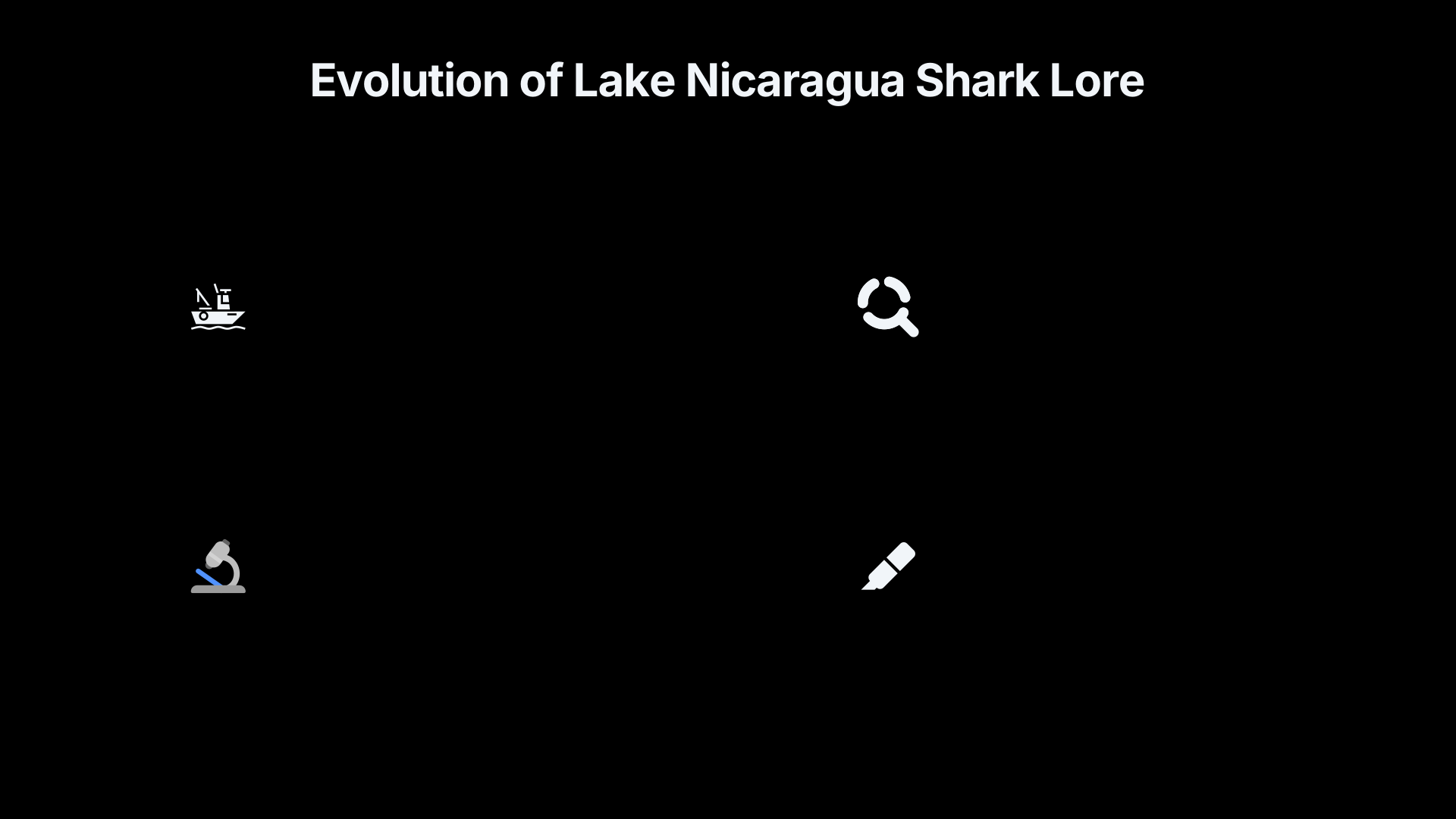
For most of recorded history, the idea of sharks living permanently in freshwater seemed absurd. Sharks were regarded as marine animals, and Lake Nicaragua lies well inland despite its enormous size. Reports of dangerous fish attacking livestock, damaging nets and occasionally threatening people therefore acquired an almost legendary quality.
Early explorers, missionaries and scientists accepted that large sharks were present but struggled to explain how they had arrived. By the late nineteenth century, the animals were even described as a distinct species, often called the Lake Nicaragua shark (Carcharhinus nicaraguensis). The prevailing theory suggested they had become trapped when geological changes isolated the lake from an ancient marine bay, leaving a population to evolve in freshwater over thousands of years. That explanation appeared sensible because the lake also contains other species usually associated with the sea, including tarpon and sawfish.[DigitalCommons]digitalcommons.unl.eduDigitalCommons"Movement of Bull Sharks, Carcharhinus Leucas, Between…by TB Thorson · 1976 · Cited by 141 — The shark that occurs in th…
The result was an unusual kind of “monster” story. Unlike many lake-monster traditions, witnesses were not describing a mysterious shape glimpsed through mist. They were describing recognisable sharks in a place where sharks supposedly could not exist.
Bull sharks rewrote the mystery
The breakthrough came during the 1960s and 1970s through the work of zoologist Thomas B. Thorson and colleagues. Careful comparisons of specimens showed that the supposed Lake Nicaragua shark was not a unique species at all but the widespread bull shark (Carcharhinus leucas), one of the few sharks able to tolerate both saltwater and freshwater.[DigitalCommons]digitalcommons.unl.eduDigitalCommons"Movement of Bull Sharks, Carcharhinus Leucas, Between…by TB Thorson · 1976 · Cited by 141 — The shark that occurs in th…
Even that discovery left an obvious question unanswered. If these were ordinary bull sharks, how were they reaching an inland lake?
Researchers answered it with tagging studies. Sharks marked inside Lake Nicaragua were later recovered in the Caribbean, while sharks tagged in marine waters appeared in the lake. The animals were travelling through the San Juan River, negotiating rapids once thought impassable. Some completed the journey in little more than a week, proving the population was not isolated at all.[DigitalCommons]digitalcommons.unl.eduDigitalCommons"Movement of Bull Sharks, Carcharhinus Leucas, Between…by TB Thorson · 1976 · Cited by 141 — The shark that occurs in th…
This finding overturned decades of scientific thinking. Instead of representing a prehistoric relic, the lake population formed part of a mobile system linking freshwater and the sea.
How bull sharks manage the journey
Bull sharks possess an exceptional ability called osmoregulation. Most sharks rely on seawater chemistry, but bull sharks can adjust the concentration of salts and other compounds within their bodies, allowing them to survive in environments ranging from the ocean to rivers and lakes.
Young bull sharks often benefit from freshwater because it contains fewer large marine predators, while adults can move back to coastal waters to feed or reproduce. Lake Nicaragua therefore became one of the classic examples demonstrating that some sharks are far more adaptable than once believed. Similar behaviour has since been documented in river systems elsewhere in the world, including the Amazon and major rivers in Africa, Asia and Australia, but Lake Nicaragua remains the case that changed scientific understanding.[Wikipedia]WikipediaBull sharkBull shark
Why the scientific answer is more extraordinary than the legend
The Lake Nicaragua story is unusual within Fortean history because scientific investigation did not remove the sense of wonder. Instead, it replaced an incorrect explanation with one that was arguably even more astonishing.
Several features keep the story alive in popular imagination:
- The setting appears impossible. A vast freshwater lake feels like the last place anyone expects to encounter sharks.
- The original theory sounded convincing. An isolated “lake shark” species fitted nineteenth-century ideas about evolution and geology.
- The real mechanism is genuinely rare. Few shark species can tolerate freshwater, and fewer still undertake such extensive river migrations.
- The evidence is unusually strong. Tagged animals physically demonstrated movement between the lake and the Caribbean, leaving little doubt about the mechanism.[DigitalCommons]digitalcommons.unl.eduDigitalCommons"Movement of Bull Sharks, Carcharhinus Leucas, Between…by TB Thorson · 1976 · Cited by 141 — The shark that occurs in th…
For readers interested in Forteana, this makes the case particularly satisfying. It illustrates that extraordinary reports deserve investigation rather than automatic dismissal. Sometimes the mystery disappears; sometimes it changes into something equally surprising but firmly grounded in evidence.
Decline, conservation and the fading monster
Ironically, the better scientists came to understand Lake Nicaragua’s sharks, the less frequently people encountered them. Commercial fishing, targeted harvesting and broader environmental pressures reduced numbers during the twentieth century. Freshwater populations of both bull sharks and sawfish declined significantly, prompting conservation measures and fishing restrictions.[Wikipedia]WikipediaFauna of NicaraguaFauna of Nicaragua
This decline has subtly altered the folklore. Earlier generations could plausibly tell stories of sharks appearing near boats or shorelines because such encounters genuinely occurred. Today, the animals are far less commonly seen, making the old tales sound increasingly mythical despite their factual basis.
The result is a curious reversal. Many famous lake monsters have faded because evidence failed to appear. Lake Nicaragua’s “monster” has faded because the evidence was so convincing that biology solved the mystery, while the sharks themselves became rarer.
What the Lake Nicaragua sharks tell us about Fortean history
Lake Nicaragua demonstrates that the boundary between folklore and science is not always a battle between belief and scepticism. Reports that initially seemed impossible preserved an important observation about the natural world. Witnesses were right that large sharks inhabited the lake. Scientists were wrong about why—until decades of research revealed an even more remarkable explanation.
Among Nicaragua’s strange stories, this is one of the strongest examples of reality overtaking legend. The monster never vanished; it simply acquired a scientific name and an extraordinary life history that proved every bit as memorable as the myth it replaced.
Amazon book picks
Further Reading
Books and field guides related to Was Lake Nicaragua's Monster A Shark?. Use these as the next step if you want deeper reading beyond the article.


The Hidden Life of Trees
A general nature-mystery crossover option when readers enjoy surprising biology.

The Book of Yōkai
Useful comparative folklore reading for understanding how cultures transform fears and places into stories.
eBay marketplace picks
Marketplace Samples
Live-tested eBay searches with available results related to this page.




Endnotes
1.
Source: Wikipedia
Title: Lake Nicaragua
Link:https://en.wikipedia.org/wiki/Lake_Nicaragua
Source snippet
Lake Nicaragua... San Juan River — which connects Lake Nicaragua with the Caribbean Sea — almost like salmon. As evidence of these mov...
2.
Source: Wikipedia
Title: Bull shark
Link:https://en.wikipedia.org/wiki/Bull_shark
3.
Source: Wikipedia
Title: Fauna of Nicaragua
Link:https://en.wikipedia.org/wiki/Fauna_of_Nicaragua
4.
Source: Wikipedia
Link:https://en.wikipedia.org/wiki/Lake
Source snippet
LakeA lake is often a naturally occurring, relatively large and fixed body of water on or near the Earth's surface...
5.
Source: nicaragua.com
Link:https://www.nicaragua.com/blog/the-bull-sharks-of-lake-nicaragua/
Source snippet
The Bull Sharks of Lake NicaraguaUnlike most marine sharks, bull sharks can tolerate and adapt to fresh water, although they are not true...
6.
Source: youtube.com
Title: Freshwater Predators: The Sharks of Nicaragua
Link:https://www.youtube.com/watch?v=umLLrCvp80w
Source snippet
Lake Nicaragua Sharks...
7.
Source: youtube.com
Title: Lake Nicaragua Sharks
Link:https://www.youtube.com/watch?v=MgVkVuYAOAI
Source snippet
Lake Nicaragua 101 - How Big Is Lake Nicaragua Actually?...
8.
Source: digitalcommons.unl.edu
Link:https://digitalcommons.unl.edu/ichthynicar/38/
Source snippet
DigitalCommons"Movement of Bull Sharks, Carcharhinus Leucas, Between...by TB Thorson · 1976 · Cited by 141 — The shark that occurs in th...
9.
Source: lamar.edu
Title: bull shark
Link:https://www.lamar.edu/arts-sciences/biology/study-abroad-belize/marine-critters/marine-critters-2/bull-shark.html
Source snippet
11 Aug 2025 — Bull sharks are known for their “bull-headed” look and territorial behaviors. The snout is very short; its mouth is wider t...
Additional References
10.
Source: ranchosantana.com
Link:https://ranchosantana.com/blog/sharks-of-lake-nicaragua/
11.
Source: upi.com
Title: From the depths of Lake Nicaragua comes a fish
Link:https://www.upi.com/Archives/1992/10/19/From-the-depths-of-Lake-Nicaragua-comes-a-fish/6851719467200/
Source snippet
19 Oct 1992 — Thorson determined that bull sharks in search of food make their way into the lake through the San Juan river, which con...
12.
Source: reddit.com
Link:https://www.reddit.com/r/todayilearned/comments/db49w0/til_it_was_first_assumed_that_the_sharks_in_the/
Source snippet
miles up and down the San Juan River like salmon...
13.
Source: youtube.com
Title: Bull Sharks Are Dangerous Predator In Freshwater River | SHARK WEEK
Link:https://www.youtube.com/watch?v=clH9LbM4P54
Source snippet
Lake Nicaragua sharks Lake Nicaragua — The Most Dangerous Lake in Central America?...
14.
Source: facebook.com
Link:https://www.facebook.com/groups/1019544238110437/posts/24845501691754691/
Source snippet
Update: Sounds like Bull sharks might not be in the lake...Bull sharks can tolerate freshwater and are known to swim up the San Juan Riv...
15.
Source: americansurfmagazine.com
Title: nicaragua shark attacks
Link:https://www.americansurfmagazine.com/article/nicaragua-shark-attacks
Source snippet
There have been a total of six reported attacks and three of which happened in the freshwater of Lake Nicaragua.Read more...
16.
Source: pmc.ncbi.nlm.nih.gov
Link:https://pmc.ncbi.nlm.nih.gov/articles/PMC12928108/
Source snippet
by GA Castellanos‐Galindo · 2026 — In several areas of Central America this species is known to migrate upstream in rivers and is comm...
17.
Source: scribd.com
Link:https://www.scribd.com/doc/149163379/Lake-Nicaragua-Sharks-Copy
Source snippet
for as long as people can remember...
18.
Source: youtube.com
Title: Lake Nicaragua 101
Link:https://www.youtube.com/watch?v=YOMfNTedMRU
Source snippet
Bull Sharks Are Dangerous Predator In Freshwater River | SHARK WEEK...
19.
Source: onlinelibrary.wiley.com
Link:https://onlinelibrary.wiley.com/doi/10.1002/ece3.73114
Source snippet
Confirmed Record of a Bull Shark in Lake Gatun, the...Feb 23, 2026 — After establishing that Bull Sharks can navigate the ~200 km of the...
Topic Tree