Within Madagascar Weird
Did Madagascar's Lost Giants Become Legends?
Madagascar's extinct megafauna make some monster-bird and giant-primate traditions feel unusually close to real science.
On this page
- Elephant birds in fact and story
- Giant lemurs in memory and speculation
- Where folklore meets palaeontology
Page outline Jump by section
Introduction
Madagascar’s extinct giant animals occupy a rare place where archaeology, palaeontology and folklore overlap. Elephant birds and giant lemurs were real creatures that survived long enough to live alongside people, making it plausible that memories of them lingered in stories after the animals themselves disappeared. That possibility has made them a recurring feature of the island’s strange-history tradition. Unlike many legendary monsters, these “lost giants” begin with genuine fossil evidence. The mystery lies not in whether they existed, but in whether fragments of Malagasy oral tradition, early traveller accounts and later folklore preserve echoes of encounters with animals that vanished within the last 1,500 years. The evidence is intriguing but incomplete, encouraging curiosity while resisting simple conclusions.[Wikipedia]WikipediaElephant birdElephant bird

Elephant birds in fact and story
Elephant birds were among the largest birds ever to walk the Earth, reaching around three metres in height and laying eggs vastly larger than those of an ostrich. Their enormous eggs and scattered bones fascinated European visitors from the nineteenth century onwards, but Malagasy people had long been familiar with these remarkable remains. Whole eggs were sometimes preserved, while fragments entered local collections and trade.[National Museum of Ireland]museum.ieThe elephant birdNational Museum of IrelandElephant Bird Egg from MadagascarThe elephant bird is an extinct species of large flightless bird, which once i…
The strange element enters through history rather than fantasy. French governor Étienne de Flacourt, writing in the seventeenth century, described an enormous ostrich-like bird called the “Vouron patra” that supposedly lived in remote marshes and avoided humans. Historians disagree over whether he was recording genuine local knowledge of elephant birds, repeating an already ancient tradition, or describing a bird that had recently disappeared. The account is too vague to settle the question, but it remains one of the strongest historical reasons for wondering whether memories of elephant birds survived into the colonial era.[Wikipedia]WikipediaElephant birdElephant bird
Later writers linked elephant birds with the legendary Roc of medieval travel literature. The comparison is appealing because Marco Polo described an immense bird capable of astonishing feats, and elephant bird eggs certainly impressed early explorers. However, most historians regard this connection as speculative rather than demonstrated. The Roc almost certainly drew on several traditions from around the Indian Ocean rather than a single Malagasy source.[National Museum of Ireland]museum.ieThe elephant birdNational Museum of IrelandElephant Bird Egg from MadagascarThe elephant bird is an extinct species of large flightless bird, which once i…
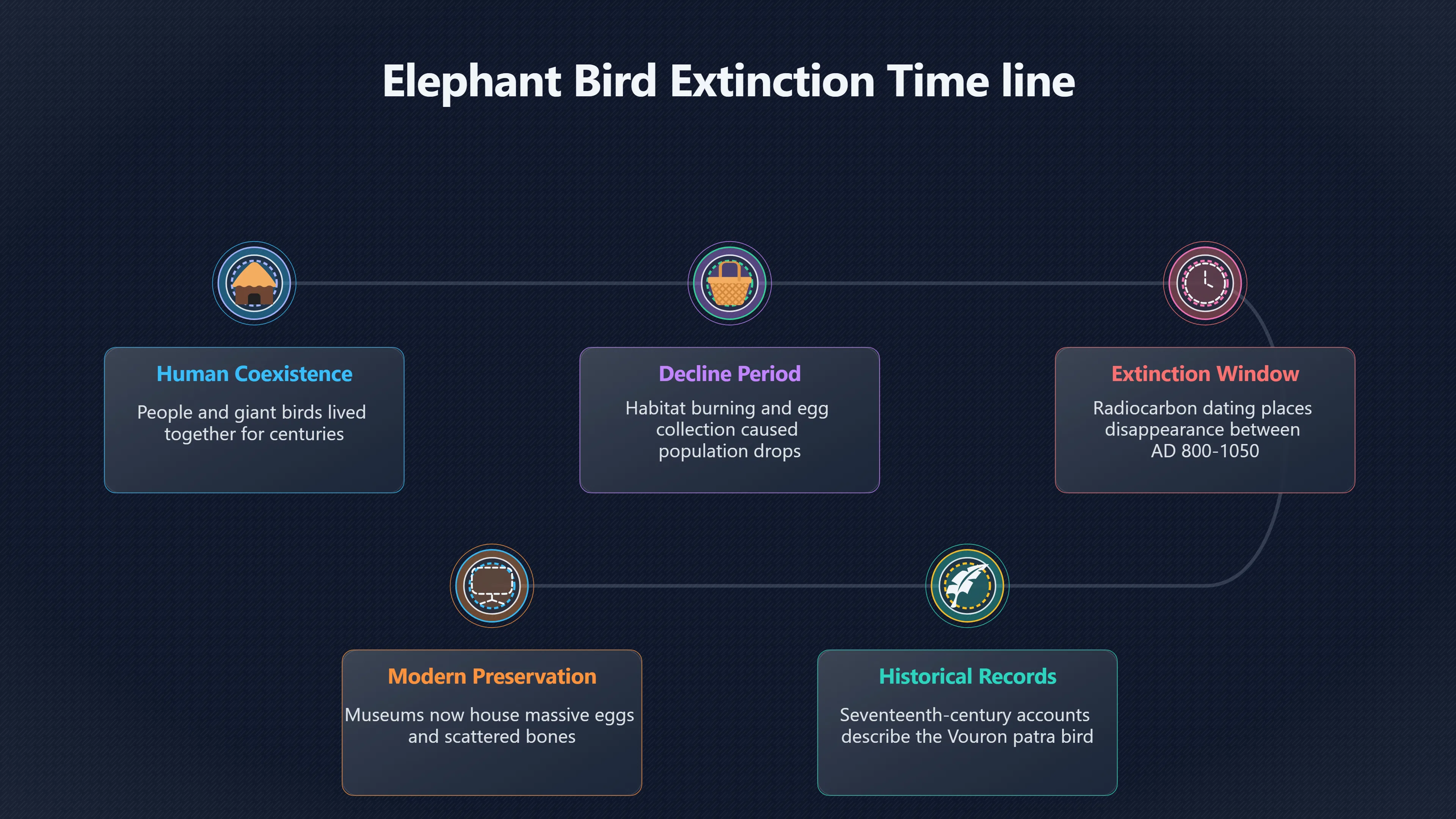
Scientific work has narrowed the likely extinction window. Radiocarbon dating increasingly suggests that elephant birds disappeared roughly between AD 800 and 1050, after centuries of coexistence with humans. Habitat burning, forest clearance, egg collection and wider environmental change appear to have combined in their decline. That relatively recent extinction makes surviving cultural memories conceivable, even if they cannot be proved.[wikipedia.org]WikipediaElephant birdElephant bird
Giant lemurs in memory and speculation
Madagascar was also home to several giant lemur species, some approaching or exceeding the size of modern gorillas. They looked nothing like living lemurs familiar to visitors today. Some climbed slowly through forests, while others probably spent much of their time on the ground. Their disappearance transformed Madagascar’s wildlife into something very different from the landscape encountered by the island’s first settlers.[UMass Amherst]umass.eduUMass AmherstVentura Pérez and the case of the elephant birdIt has been understood that the arrival of humans on Madagascar drove megafau…
Because giant lemurs survived into the late Holocene, researchers have occasionally asked whether stories about unusual forest beings preserve distant memories of these animals. Suggestions have centred on traditions describing shy, human-like creatures inhabiting remote forests. Such comparisons are necessarily cautious. Folklore changes over generations, incorporates symbolic meanings and often blends human, animal and spiritual qualities. There is no direct evidence that any surviving Malagasy legend is a straightforward description of an extinct lemur.
Nevertheless, the idea remains attractive because the chronology allows it. If giant lemurs survived until people were well established across Madagascar, children could have heard stories from grandparents whose own ancestors remembered encountering unfamiliar animals. Even after the creatures vanished, distinctive behaviour or appearance might have remained embedded within local storytelling while gradually acquiring supernatural elements. This is a possibility rather than a demonstrated historical process.[UMass Amherst]umass.eduUMass AmherstVentura Pérez and the case of the elephant birdIt has been understood that the arrival of humans on Madagascar drove megafau…

Where folklore meets palaeontology
One reason these stories continue to fascinate is that Madagascar provides unusually fertile ground for “extinction memories”—the idea that oral traditions can preserve information about vanished species over surprisingly long periods.
Researchers studying oral history elsewhere have shown that some traditions appear to preserve memories of volcanic eruptions, tsunamis or changing coastlines over many generations. Whether the same can happen with extinct animals remains much harder to test. Animal stories evolve rapidly because they are retold for entertainment, moral instruction and spiritual purposes as well as historical remembrance.
Madagascar presents several factors that make the question especially interesting:
- People and megafauna almost certainly overlapped for centuries.
- Giant eggs, bones and other remains remained visible in the landscape after extinction.
- The island’s oral traditions place considerable importance on ancestors, place and remembered landscapes.
- Later European writers sometimes misunderstood or exaggerated Malagasy accounts, making it difficult to separate original traditions from colonial reinterpretation.[nih.gov]pmc.ncbi.nlm.nih.govEarly Holocene human presence in Madagascar evidenced…by J Hansford · 2018 · Cited by 148 — We report >10,500-year-old human-modifi…
These factors create fertile conditions for genuine cultural memories while also making over-interpretation a constant risk.
Why the mystery still matters
For readers interested in Fortean history, elephant birds and giant lemurs illustrate a valuable lesson: not every extraordinary story needs a supernatural explanation to remain genuinely mysterious.
The central puzzle is not whether these giant animals existed—they unquestionably did—but how long knowledge of them survived in human memory. Archaeology confirms that humans encountered Madagascar’s megafauna. Historical records hint that knowledge of giant birds may have lingered. Folklore preserves stories about unusual beings inhabiting forests and marshes. Yet none of these strands can be joined together with certainty.
That uncertainty is precisely what gives the subject its enduring appeal. Madagascar’s lost giants occupy the narrow space where fossil evidence, historical testimony and traditional storytelling briefly overlap. They remind us that legends are sometimes built around impossible creatures, but sometimes they may also contain faint echoes of animals that really walked the same landscapes only a few dozen generations ago.

Amazon book picks
Further Reading
Books and field guides related to Did Madagascar's Lost Giants Become Legends?. Use these as the next step if you want deeper reading beyond the article.
The Sixth Extinction
Places Madagascar's vanished giants into the wider extinction story.

Wonderful Life the Burgess
First published 1988. Subjects: Life, British Columbia, Invertebrate fossils, Paleontology, Burgess Shale.
eBay marketplace picks
Marketplace Samples
Live-tested eBay searches with available results related to this page.



Endnotes
1.
Source: Wikipedia
Title: Elephant bird
Link:https://en.wikipedia.org/wiki/Elephant_bird
2.
Source: csiro.au
Title: elephant birds
Link:https://www.csiro.au/en/news/all/articles/2023/march/elephant-birds
Source snippet
At up to three metres tall and some weighing over 500 kilograms, they were the...Read more...
3.
Source: museum.ie
Title: The elephant bird
Link:https://www.museum.ie/en-IE/Collections-Research/Collection/Documentation-Discoveries/Artefact/An-Elephant-Bird-Egg-from-Madagascar/63324e2f-f7f8-46ac-aa72-a3a930113dd3
Source snippet
National Museum of IrelandElephant Bird Egg from MadagascarThe elephant bird is an extinct species of large flightless bird, which once i...
4.
Source: umass.edu
Link:https://www.umass.edu/magazine/ventura-perez-elephant-bird
Source snippet
UMass AmherstVentura Pérez and the case of the elephant birdIt has been understood that the arrival of humans on Madagascar drove megafau...
5.
Source: pmc.ncbi.nlm.nih.gov
Link:https://pmc.ncbi.nlm.nih.gov/articles/PMC6135541/
Source snippet
Early Holocene human presence in Madagascar evidenced...by J Hansford · 2018 · Cited by 148 — We report >10,500-year-old human-modifi...
Additional References
6.
Source: youtube.com
Link:https://www.youtube.com/watch?v=P6ltr2o-hYM
Source snippet
The Tale of the Elephant Bird: The Biggest Bird EverWhere do you think it came from?” I happily answered, “The elephant bird!” I had no i...
7.
Source: artensterben.de
Link:https://www.artensterben.de/en/elephant-bird-aepyornis-maximus/
Source snippet
Elephant bird Aepyornis maximus – When did it go extinct?3 Feb 2026 — Aepyornis maximus, the largest elephant bird, lived on Madagascar...
8.
Source: peckperk.com
Title: elephant bird madagascar s lost giant and its secrets
Link:https://peckperk.com/blog/elephant-bird-madagascar-s-lost-giant-and-its-secrets?srsltid=AfmBOopT_h-wOwbuRSkbB0q2Jng8rtUEXxdzgMOVtcZmgcrRMC0zSsHF
Source snippet
Elephant Bird: Madagascar's Lost Giant and Its Secrets2 Sept 2025 — Explore Madagascar's elephant bird, a colossal flightless giant, its...
9.
Source: reddit.com
Title: The Elephant Bird of Madagascar
Link:https://www.reddit.com/r/natureismetal/comments/g3afda/the_elephant_bird_of_madagascar_went_extinct/
Source snippet
went extinct circa 1000...TIL that elephant birds laid the largest eggs of any animal ever—including all dinosaurs. They went extinct in...
10.
Source: youtube.com
Title: Prehistoric Madagascar Was Pure Nightmare Fuel
Link:https://www.youtube.com/watch?v=hDOS5RLcm5c
Source snippet
Extinct giant lemur Madagascar elephant bird Extinct Giant "Spotted": The 10-Foot Elephant Bird of Madagascar! | Prehistoric Documentary...
11.
Source: youtube.com
Link:https://www.youtube.com/watch?v=KWw3d5EABkM
Source snippet
The Massive Elephant Bird Egg | Zoo Quest to Madagascar | BBC Earth...
12.
Source: amusingplanet.com
Title: the elephant bird
Link:https://www.amusingplanet.com/2019/12/the-elephant-bird.html
Source snippet
17 Dec 2019 — The Elephant bird has been extinct since at least the early 17th century. There are evidences that humans hunted the bird f...
13.
Source: youtube.com
Title: The Massive Elephant Bird Egg | Zoo Quest to Madagascar | BBC Earth
Link:https://www.youtube.com/watch?v=ASJvktzfQ4g
Source snippet
Prehistoric Madagascar Was Pure Nightmare Fuel...
14.
Source: timesofindia.indiatimes.com
Link:https://timesofindia.indiatimes.com/etimes/animals/elephant-bird-madagascars-giant-flightless-bird-that-laid-the-largest-eggs-in-earths-history/articleshow/132211979.cms
Source snippet
indiatimes.comMadagascar's giant flightless bird that laid the largest eggs...1 day ago — As reported by the BBC, elephant birds may hav...
15.
Source: youtube.com
Title: When Giant Lemurs Ruled Madagascar
Link:https://www.youtube.com/watch?v=1hTJh8W0khU
Source snippet
Extinct Giant "Spotted": The 10-Foot Elephant Bird of Madagascar! | Prehistoric Documentary...
Topic Tree