Why Malta Feels So Uncannily Alive
Malta’s strange-history record is not built around one famous monster or a single national UFO flap.
Page outline Jump by section
Introduction
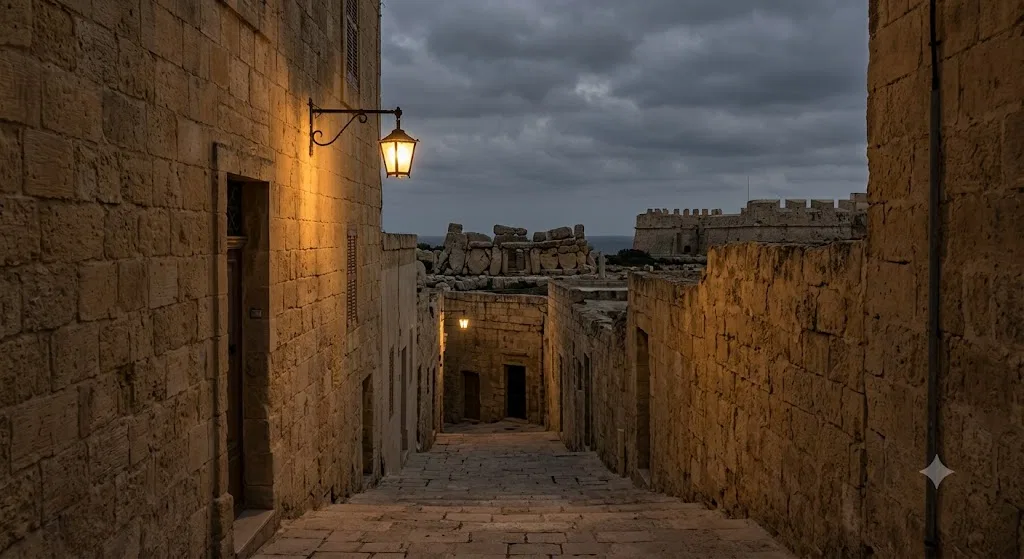
The useful way to read Malta’s weird material is not to ask whether it “proves” the paranormal. It does not. The better question is why a small Mediterranean country with such visible layers of ancient, medieval and wartime history keeps producing stories in which the past seems almost physically alive: beneath streets, in chapels, inside forts, above harbours and out at sea. That is where Malta’s Fortean character begins.
Why Malta’s Ancient Sites Attract Modern Mysteries
The Ħal Saflieni Hypogeum in Paola is the obvious starting point, because it is genuinely extraordinary before any legend is added. Heritage Malta describes it as an underground burial complex used between about 4000 BC and 1500 BC, discovered accidentally in 1902 and later inscribed on the UNESCO World Heritage List. UNESCO identifies it as an underground cemetery that originally contained the remains of about 7,000 people, cut into three levels of limestone chambers and decorated in places with red ochre designs.[Heritage Malta]heritagemalta.mtHeritage MaltaĦal Saflieni HypogeumHeritage MaltaĦal Saflieni Hypogeum
That combination — underground space, ancient burials, damaged early excavations and restricted modern access — is perfect fuel for mystery. The most famous Hypogeum legend claims that schoolchildren and teachers entered an underground chamber and disappeared. Heritage Malta’s own debunking page traces the story’s international fame to a 1940 National Geographic report, but notes that the claim is not supported by local newspaper reports, resident accounts or signs of a collapse inside the site. The same official explanation suggests the legend may have functioned as a warning to children about dangerous underground places.[Heritage Malta]heritagemalta.mtHeritage Malta Debunking Urban Legends -The Hypogeum Myths- Heritage MaltaHeritage Malta Debunking Urban Legends -The Hypogeum Myths- Heritage Malta
The Hypogeum also has one of Malta’s more genuinely intriguing “strange but grounded” features: sound. UNESCO notes that one decorated chamber contains a niche that echoes when someone speaks into it, and says the effect may have been used in ritual even if it was not necessarily created deliberately. A 2015 archaeoacoustic study reported strong resonance effects in the chamber often called the Oracle Room, especially at 70 Hz and 114 Hz, while arguing that chanting or percussion could have made the space feel more powerful to participants. That does not require lost super-science; it is enough to imagine low voices, darkness, bones, ochre and reverberation doing what human ritual spaces have always done.[unesco.org]whc.unesco.orgWorld Heritage CentreĦal Saflieni HypogeumWorld Heritage CentreĦal Saflieni Hypogeum
Gozo’s Ġgantija temples add a different sort of mystery: the folk explanation for enormous stones. UNESCO describes the Megalithic Temples of Malta as seven prehistoric temple sites, with the two Ġgantija temples on Gozo notable for their gigantic structures. Heritage Malta also preserves the nearby Sansuna’s Rock, an irregular four-metre limestone slab associated locally with the giantess Sansuna, while cautioning that its interpretation as part of a Bronze Age dolmen has not been proven by archaeological investigation.[UNESCO World Heritage Centre]whc.unesco.orgWorld Heritage Centre Megalithic Temples of MaltaWorld Heritage Centre Megalithic Temples of Malta
The giantess story matters because it shows how Maltese folklore turns difficult engineering into memorable narrative. Later generations often explained megalithic building through giants, not because the builders were literally giants, but because the stones seem to demand a larger-than-human cause. In Malta, the archaeological fact and the legend now coexist: one belongs to Neolithic engineering, the other to the island’s way of making ancient ruins emotionally legible.

The Hypogeum Children, “Alien Skulls” and the Problem of Thin Evidence
The lost-children story is Malta’s classic modern urban legend because it has the right ingredients: a real underground labyrinth, a respectable-sounding magazine citation, missing bodies, grieving mothers and inaccessible tunnels. It is also a good example of how Fortean stories grow when a vivid claim outruns local documentation. Heritage Malta’s debunking is careful rather than dismissive: it does not deny that the story has cultural force, but it points out the absence of corroborating Maltese reports and physical evidence.[Heritage Malta]heritagemalta.mtHeritage Malta Debunking Urban Legends -The Hypogeum Myths- Heritage MaltaHeritage Malta Debunking Urban Legends -The Hypogeum Myths- Heritage Malta
The “alien skulls” branch of the Hypogeum myth works in a similar way. The real site did contain thousands of human remains, and UNESCO confirms that human bones formed part of the archaeological material. But the leap from ancient burials to non-human beings depends on speculation rather than secure evidence. The Fortean lesson is simple: Malta’s underground archaeology is mysterious enough without treating every damaged excavation record or unusual skull claim as proof of extraterrestrial visitors.[UNESCO World Heritage Centre]whc.unesco.orgWorld Heritage CentreĦal Saflieni HypogeumWorld Heritage CentreĦal Saflieni Hypogeum
The more interesting question is why these stories stick. In Malta, deep time is not abstract. Prehistoric chambers sit under modern streets; temples stand near villages; Christian shrines occupy a landscape already dense with older sacred places. The result is a country where the ground itself feels narratively unstable. That feeling is not evidence for hidden races or vanished school parties, but it helps explain why those tales keep finding new readers.
Fort Ghosts: Knights, Mistresses and War-Damaged Stone
Malta’s ghost traditions often attach themselves to military architecture, especially the stonework of the Knights and the British period. Fort Manoel’s Black Knight is one of the best-known examples. A Times of Malta account places the apparition in the years after the First World War, when Maltese and English workers were restoring Manoel Island. The figure was said to appear in full armour and regalia of the Order of St John, watching over work near the chapel, and was compared with portraits of Grand Master Manoel de Vilhena.[Times of Malta]timesofmalta.comTimes of Malta Malta’s most hauntedTimes of Malta Malta’s most haunted
The story’s power lies in its moral neatness. In one version, the chapel crypt had been vandalised and the knight’s appearances were linked to disorder among the dead. Once bones and sacred space were put right, the haunting quietened. Whether or not anyone saw anything supernatural, the tale behaves like a conservation fable: neglected heritage summons the past; respectful restoration appeases it. That makes it especially Maltese, because so much of the island’s public memory is held in fortifications, chapels and wartime scars.
Fort St Angelo has its own major apparition, the Grey Lady. TVM, reporting around Heritage Malta’s Fort St Angelo storytelling tours, summarised the legend as the ghost of a Castellan’s mistress, allegedly murdered and buried within the fort after threatening to expose the affair. The report also notes the curator’s caution that the story was never proved, while preserving the tradition that three skeletons — two male and one female — helped feed the legend, and that prayers or exorcism rites were later said to have ended the apparitions.[TVMnews.mt]tvmnews.mtThe Grey Lady who lived at Fort St AngeloThe Grey Lady who lived at Fort St Angelo
These stories should not be treated as court records. They are better read as social memory. The Black Knight speaks to violated tombs and the dignity of the Order; the Grey Lady speaks to hidden violence, gendered vulnerability and the secrets of elite households. Both are attached to real places that tourists can visit and locals recognise, which gives the legends staying power even when the evidence remains anecdotal.
The Blue Lady and Malta’s Haunted Palaces
Verdala Palace supplies Malta’s most romantic palace ghost: the Blue Lady. Modern retellings usually describe her as a young noblewoman forced into an unwanted marriage, confined in the palace and said to have died after falling or jumping from a balcony. MaltaToday’s Halloween feature presents the Blue Lady as one of Malta’s best-known ghost stories and places the legend at Verdala Palace, tied to Grand Master de Rohan’s circle and an imposed marriage.[MaltaToday.com.mt]maltatoday.com.mtOpen source on com.mt.
As with many European “lady in a colour” ghosts, the details shift. Some versions make her dress white, others blue; some emphasise suicide, others confinement or family cruelty. The unstable details do not make the story worthless. They show how a ghost legend adapts to the needs of each retelling: doomed romance for visitors, family warning tale for locals, gothic atmosphere for the palace, and a neat human story for a building otherwise associated with power.
Malta’s palace and fort ghosts also show why “haunted tourism” can be both shallow and useful. It can flatten complex history into spooky entertainment, but it also keeps people asking why particular rooms, chapels and courtyards acquired reputations. The best reading is neither gullible nor sneering: the ghost may be unproven, but the anxieties it carries are real.
The Christmas Ogre and Older Folk Belief
Not all Maltese strangeness belongs to castles. One of the more distinctive folk beliefs concerns the Gawgaw, a ghostly or monstrous Christmas Eve figure. A University of Malta repository record for Samia Al-Azharia Jahn’s 1978 article summarises Joseph Cassar-Pullicino’s earlier account: people born on Christmas Eve were believed to be doomed to transform once a year, while asleep, into a ghost called Gawgaw, wandering and frightening people with groans. The same abstract notes possible parallels with Sicilian and Chios traditions, and Malta’s historic cultural ties with the Arab world.[L-Università ta' Malta]um.edu.mtOpen source on edu.mt.
This is classic folklore rather than a “case”. It does not ask to be investigated like a police report. Its value is in what it reveals about older ideas of dangerous dates, birth, punishment and liminality — the unsettling state of being between categories. Christmas Eve is holy, but also a charged night; a person born then becomes narratively marked, and the household must manage the danger through ritualised behaviour.
For a modern reader, the Gawgaw is a reminder that Maltese Forteana is not just imported UFO language or ghost-tour packaging. It includes older folk structures: warnings, remedies, inherited motifs and explanations for why some nights feel different from others.
Visionary Malta: Ta’ Pinu and the Public Life of Miracle Claims
Malta’s Catholic visionary tradition deserves a different treatment from ghost stories. Ta’ Pinu, in Gozo, is not a fringe curiosity but a major national shrine. The shrine’s own account says that in June 1883 Karmni Grima, a forty-five-year-old woman from Għarb, heard a voice calling her near the chapel and urging her to come. Visit Malta likewise presents Ta’ Pinu’s modern story as beginning in 1883, when a peasant working in the fields heard the voice of Our Lady calling to her.[tapinu.org]tapinu.orgCome, comeCome, come
For believers, Ta’ Pinu belongs to Marian devotion and answered prayer. For a Fortean country page, its importance is slightly different: it shows how visionary claims can move from private experience to shared pilgrimage, architecture and national identity. A voice in a rural place becomes a shrine; a shrine becomes a destination; votive offerings and repeated testimony keep the original event socially alive.
An evidence-aware account should not present the apparition as proven in a scientific sense, nor should it treat it as merely “just a story”. It is a living religious tradition with institutional weight and public meaning. That places it in the same broad Maltese landscape as ghost legends and ancient mysteries, but with a different evidential and cultural frame.
UFOs, Harbour Lights and Modern Misreadings
Malta has its share of UFO reports, but the pattern is scattered rather than a single great national wave. The University of Malta’s repository includes C. O. Stopler’s 1991 article “Various ways of seeing an UFO”, whose abstract discusses a Times photograph from 27 October 1989 of an alleged UFO over Xernxija Bay; the photographer reportedly noticed something flashing in the viewfinder at the moment the picture was taken.[L-Università ta' Malta]um.edu.mtL-Università ta' Malta OAR@UM: Various ways of seeing an UFOL-Università ta' Malta OAR@UM: Various ways of seeing an UFO
Later Maltese media reports show the same modern rhythm: a photograph or video appears, it is framed as “unidentified”, and the story travels because the image is suggestive but inconclusive. Times of Malta reported a claimed mobile-phone photograph of a UFO at Marsaxlokk in March 2013, while MaltaToday covered amateur footage said to show two UFOs near the airport at Gudja in 2012. Neither report, as presented, establishes anything beyond unidentified or alleged aerial objects.[Times of Malta]timesofmalta.comTimes of Malta‘UFO’ in MarsaxlokkTimes of Malta‘UFO’ in Marsaxlokk
The local setting matters. Malta has busy skies, harbours, aircraft, ships, bright planets, drones, fireworks, military history and intense coastal lighting. A photometric study of the Maltese night sky found that most of the islands are heavily light-polluted, with the Milky Way visible from only a small fraction of the area under the study’s threshold. That does not “debunk” every sighting, but it does show how modern light conditions complicate skywatching and can make ordinary lights harder to interpret.[arXiv]arxiv.orgarXiv A photometric mapping of the night sky brightness of the Maltese islandsarXiv A photometric mapping of the night sky brightness of the Maltese islands
The fairest conclusion is modest: Malta’s UFO material is culturally interesting but evidentially weak. It belongs less to proof of alien craft and more to the history of how people interpret sudden lights and ambiguous images in a densely used Mediterranean sky.
When It Really Did “Rain Fish”
Malta’s best recent anomalous-fall story is also one of the cleanest examples of how a bizarre headline can have a mundane cause. In February 2019, Euronews reported that a storm hit Malta’s north-eastern coast with winds around 100 km/h. At Xemxija, high waves flooded beaches and streets, leaving fish on the ground; local headlines called it “raining fish”, but the report explained that the fish came from a fish farm in the bay and were thrown ashore by the storm and waves.[euronews]euronews.comIt's 'raining fish' in Malta after storm brings high waves | EuronewsIt's 'raining fish' in Malta after storm brings high waves | Euronews
This is almost a perfect Fortean teaching case. It looked biblical, sounded like a classic “fall from the sky”, and spread well because people enjoy impossible weather. Yet the mechanism was local, physical and visible: sea, storm, fish farm, wave energy. The story still belongs in Malta’s strange record because it shows how quickly an anomalous report can form around a real event once the phrasing becomes memorable.
It also helps distinguish two types of strangeness. Some claims are strange because the evidence is missing or contradictory. Others are strange because the event really happened, but the first description was playful or misleading. Malta’s fish-fall belongs to the second category.
How to Read Malta’s Weird Record Without Flattening It
Malta’s Forteana works best when sorted by evidence type. The Hypogeum is a real archaeological site surrounded by some debunked or speculative legends. Ġgantija is real prehistoric architecture with giant folklore attached. Ta’ Pinu is a living religious tradition based on visionary testimony. Fort ghosts are place-legends tied to military and domestic memory. UFO reports are mostly ambiguous media items. The Xemxija fish-fall was a dramatic but explained weather incident.
That sorting matters because it prevents two common mistakes. The first is credulity: treating every old building story or odd photograph as paranormal evidence. The second is overcorrection: dismissing the whole field as nonsense and missing what the stories reveal about Maltese history, fear, humour, faith and landscape. The strongest approach is to ask what kind of claim is being made, what records support it, what simpler explanations exist, and why people keep repeating it.
Malta’s small size intensifies this process. A fort is not an anonymous ruin; it is part of a visible harbour. A shrine is not just a private belief; it is a destination. A prehistoric chamber is not a remote abstraction; it sits beneath a lived-in town. The result is a country where strange stories remain unusually place-specific.
Why Malta’s Strange Stories Still Have Pull
The enduring appeal of Maltese Forteana comes from compression. Few countries pack so many historical layers into such a small area: Neolithic ritual spaces, Phoenician and Roman traces, Catholic devotion, Knights-era fortifications, British military infrastructure, wartime destruction, tourism and modern media. Each layer supplies its own kind of haunting.
The best Maltese weird stories are therefore not random oddities. They are arguments about memory. The Black Knight asks whether the dead have been respected. The Grey Lady asks what violence a fortress has hidden. The Hypogeum children ask what lies under the streets and what happens when archaeology becomes inaccessible. The Gawgaw asks why a holy night might also be dangerous. Ta’ Pinu asks how a private voice becomes public devotion. The fish at Xemxija ask how fast the marvellous can form from wind, water and a good headline.
Taken together, these stories make Malta a particularly rich country-level Fortean subject: not because its anomalies are proven, but because its legends, reports and explanations are so tightly bound to real places. The strangeness is not floating free. It is built into stone, shoreline, chapel, chamber and harbour light.
Amazon book picks
Further Reading
Books and field guides related to Why Malta Feels So Uncannily Alive. Use these as the next step if you want deeper reading beyond the article.
eBay marketplace picks
Marketplace Samples
Live-tested eBay searches with available results related to this page.


Endnotes
1.
Source: whc.unesco.org
Title: World Heritage CentreĦal Saflieni Hypogeum
Link:https://whc.unesco.org/en/list/130/
2.
Source: whc.unesco.org
Title: World Heritage Centre Megalithic Temples of Malta
Link:https://whc.unesco.org/en/list/132/
3.
Source: tvmnews.mt
Title: The Grey Lady who lived at Fort St Angelo
Link:https://tvmnews.mt/en/news/the-grey-lady-who-lived-at-fort-st-angelo-exorcism-of-building-was-carried-out/
4.
Source: maltatoday.com.mt
Link:https://www.maltatoday.com.mt/arts/entertainment/132051/the_blue_lady_a_headless_bride_and_the_vanishing_cat_maltese_ghostly_folklore_for_halloween_night
5.
Source: tapinu.org
Title: Come, come
Link:https://www.tapinu.org/index.php/sanctuary/come-come
6.
Source: maltatoday.com.mt
Title: Malta Today.com.mt Amateur footage of ‘UFO’ over Gudja
Link:https://www.maltatoday.com.mt/news/national/17381/amateur-footage-of-ufo-over-gudja-20120411
7.
Source: arxiv.org
Title: arXiv A photometric mapping of the night sky brightness of the Maltese islands
Link:https://arxiv.org/abs/2002.04435
8.
Source: euronews.com
Title: It’s ‘raining fish’ in Malta after storm brings high waves | Euronews
Link:https://www.euronews.com/2019/02/25/it-s-raining-fish-in-malta-after-storm-brings-high-waves
9.
Source: tapinu.org
Link:https://www.tapinu.org/
10.
Source: forums.forteana.org
Link:https://forums.forteana.org/index.php?threads%2Fhypogeum-of-hal-saflienti-malta-mia-kids-tale-elongated-skulls-etc.8319%2F=
11.
Source: heritagemalta.mt
Title: Heritage MaltaĦal Saflieni Hypogeum
Link:https://heritagemalta.mt/explore/hal-saflieni-hypogeum/
12.
Source: heritagemalta.mt
Title: Heritage Malta Debunking Urban Legends -The Hypogeum Myths- Heritage Malta
Link:https://heritagemalta.mt/news/debunking-urban-legends-the-hypogeum-myths/
13.
Source: um.edu.mt
Title: L-Università ta’ Malta Microsoft Word
Link:https://www.um.edu.mt/library/oar/bitstream/123456789/16630/1/OA%20Archaeoacoustic%20Analysis%20of%20the%20%C4%A6al%20Saflieni%20Hypogeum%20in%20Malta.pdf
14.
Source: heritagemalta.mt
Link:https://heritagemalta.mt/explore/hagra-ta-sansuna/
15.
Source: timesofmalta.com
Title: Times of Malta Malta’s most haunted
Link:https://timesofmalta.com/article/malta-s-most-haunted.248980
16.
Source: um.edu.mt
Link:https://www.um.edu.mt/library/oar/handle/123456789/27623
17.
Source: um.edu.mt
Title: L-Università ta’ Malta OAR@UM: Various ways of seeing an UFO
Link:https://www.um.edu.mt/library/oar/handle/123456789/25155
18.
Source: timesofmalta.com
Title: Times of Malta‘UFO’ in Marsaxlokk
Link:https://timesofmalta.com/article/-UFO-in-Marsaxlokk.462864
19.
Source: um.edu.mt
Link:https://www.um.edu.mt/library/oar/bitstream/123456789/27623/1/REFLECTIONS%20ABOUT%20THE%20OLD%20MALTESE%20FOLK%20BELIEFIN%20THE%20TRANSFORING%20OF%20A%20PERSO%20INTO%20GAWGAW%20GHOST%20O%20CHRISTAS%20EVE.pdf
20.
Source: um.edu.mt
Title: The Field of Maltese Folklore
Link:https://www.um.edu.mt/library/oar/bitstream/123456789/24200/1/The%20Field%20of%20Maltese%20Folklore.pdf
21.
Source: um.edu.mt
Title: Maltese folklore review volume 1 issue 1
Link:https://www.um.edu.mt/library/oar/bitstream/123456789/123773/1/Maltese_folklore_review_volume_1_issue_1.pdf
22.
Source: um.edu.mt
Link:https://www.um.edu.mt/library/oar/bitstream/123456789/42419/1/Chest-piece%2C_1%284%29_-_A3.pdf
23.
Source: um.edu.mt
Link:https://www.um.edu.mt/library/oar/bitstream/123456789/107533/1/Cassar%20Pullicino%20J._Traditions%20and%20folklore%20in%20Birgu_Birgu%20-%20a%20Maltese%20maritime%20city_1993.pdf
24.
Source: um.edu.mt
Title: Maltese folklore review volume 1 issue 4
Link:https://www.um.edu.mt/library/oar/bitstream/123456789/124282/1/Maltese_folklore_review_volume_1_issue_4.pdf
25.
Source: um.edu.mt
Link:https://www.um.edu.mt/library/oar/bitstream/123456789/107534/1/Cassar-Pullicino%20J._Some%20parallels%20between%20Maltese%20and%20Arabic%20folklore_Acta%20Ethnographica%20Acad.Sci.Hung.%2034%281-4%29_1988.pdf
26.
Source: um.edu.mt
Title: Maltese folklore review volume 1 issue 2
Link:https://www.um.edu.mt/library/oar/bitstream/123456789/123939/1/Maltese_folklore_review_volume_1_issue_2.pdf
27.
Source: um.edu.mt
Link:https://www.um.edu.mt/library/oar/bitstream/123456789/9233/1/Malta%20-%20an%20island%20of%20prehistoric%20sacredplaces%20viewed%20as%20site%20significant%20spatial%20systems.pdf
28.
Source: um.edu.mt
Title: Book Reviews. Journal of Maltese Studies. 10(1975)(134 140)
Link:https://www.um.edu.mt/library/oar/bitstream/123456789/26807/1/Book%20Reviews.%20Journal%20of%20Maltese%20Studies.%2010%281975%29%28134-140%29.pdf
29.
Source: heritagemalta.mt
Title: Ġgantija Archaeological Park
Link:https://heritagemalta.mt/explore/ggantija-archaeological-park/
30.
Source: heritagemalta.mt
Link:https://heritagemalta.mt/news/a-giant-anniversary-for-unesco-listed-temples/
31.
Source: timesofmalta.com
Title: in malta countryside group meditates make contact aliens.1112641
Link:https://timesofmalta.com/article/in-malta-countryside-group-meditates-make-contact-aliens.1112641
32.
Source: timesofmalta.com
Title: Explaining the unexplained.428492
Link:https://timesofmalta.com/article/Explaining-the-unexplained.428492
33.
Source: timesofmalta.com
Title: The Blue lady.654131
Link:https://timesofmalta.com/article/The-Blue-lady.654131
34.
Source: timesofmalta.com
Title: hypogeum missing children alien skulls and 7000 skeletons.644151
Link:https://timesofmalta.com/article/hypogeum-missing-children-alien-skulls-and-7000-skeletons.644151
35.
Source: timesofmalta.com
Title: sitemap articles 2010 3.xml
Link:https://timesofmalta.com/sitemap_articles-2010-3.xml
36.
Source: timesofmalta.com
Title: sitemap articles 2016 3.xml
Link:https://timesofmalta.com/sitemap_articles-2016-3.xml
37.
Source: timesofmalta.com
Title: sitemap articles 2013 8.xml
Link:https://timesofmalta.com/sitemap_articles-2013-8.xml
38.
Source: timesofmalta.com
Title: sitemap articles 2017 3.xml
Link:https://timesofmalta.com/sitemap_articles-2017-3.xml
39.
Source: timesofmalta.com
Title: dark tales at fort st angelo.691363
Link:https://timesofmalta.com/article/dark-tales-at-fort-st-angelo.691363
40.
Source: timesofmalta.com
Title: marking 143rd anniversary lady ta pinu manifestation.1130259
Link:https://timesofmalta.com/article/marking-143rd-anniversary-lady-ta-pinu-manifestation.1130259
41.
Source: Wikipedia
Title: Verdala Palace
Link:https://en.wikipedia.org/wiki/Verdala_Palace
42.
Source: Wikipedia
Title: Fort Manoel
Link:https://en.wikipedia.org/wiki/Fort_Manoel
43.
Source: Wikipedia
Title: Ta’ Pinu
Link:https://en.wikipedia.org/wiki/Ta%27_Pinu
44.
Source: tuljak.com
Title: megalithic temples of malta
Link:https://www.tuljak.com/blog/megalithic-temples-of-malta
Additional References
45.
Source: youtube.com
Title: The Secrets of the Hypogeum: Malta’s Hidden Subterranean Mystery
Link:https://www.youtube.com/watch?v=lvRqtzJTsGY
Source snippet
Malta's Hidden Side | Secrets You Were Never Told About This Island 4K...
46.
Source: youtube.com
Title: Malta’s Hidden Side | Secrets You Were Never Told About This Island 4K
Link:https://www.youtube.com/watch?v=z0Fim3INzGY
Source snippet
The Mystery of Malta's Ġgantija & the Giantess Sansuna...
47.
Source: loc.gov
Link:https://www.loc.gov/everyday-mysteries/browse-all-questions/item/can-it-rain-frogs-fish-and-other-objects/
48.
Source: youtube.com
Title: The Mystery Of Malta’s Underground Temple: The Hypogeum
Link:https://www.youtube.com/watch?v=2wTcz-9qzIQ
Source snippet
The Secrets of the Hypogeum: Malta's Hidden Subterranean Mystery...
49.
Source: youtube.com
Title: The Mystery of Malta’s Ġgantija & the Giantess Sansuna
Link:https://www.youtube.com/watch?v=kIfJyaIsyAU
Source snippet
Most Mysterious Mythical Creatures Of Malta Explained...
50.
Source: history.co.uk
Link:https://www.history.co.uk/articles/strangest-things-to-rain-from-the-sky
51.
Source: axhotelsmalta.com
Link:https://axhotelsmalta.com/discover-activities-in-malta/history-culture/ggantija-gozo/
52.
Source: facebook.com
Link:https://www.facebook.com/radio105malta/posts/a-quiet-night-in-senglea-a-balcony-and-a-woman-who-waited-every-evening-for-a-hu/122218126040302000/
53.
Source: instagram.com
Link:https://www.instagram.com/reel/DD7gHdfpVOl/
54.
Source: facebook.com
Link:https://www.facebook.com/darkmaltatours/videos/according-to-maltese-legend-people-born-on-christmas-eve-turn-into-a-ghost-on-th/1319272622295030/
Topic Tree
Follow this branch
Related pages 192
- Afghan Forteana
- Antigua Uncanny
- Bosnian Mysteries
- Botswana Weird
- Brazil Strange
- +187 more in sidebar