What Makes Singapore's Strange History So Persistent?
Singapore’s strange-history record is not a wilderness of grand unsolved monsters or famous UFO dossiers. It is something more compact and, in some ways, more revealing: a city-state where old island legends, colonial newspaper oddities, war-haunted buildings, tropical weather, cinema ghosts and misidentified wildlife sit unusually close together.
Page outline Jump by section
The fish rain of 1861: Singapore’s best Fortean weather case
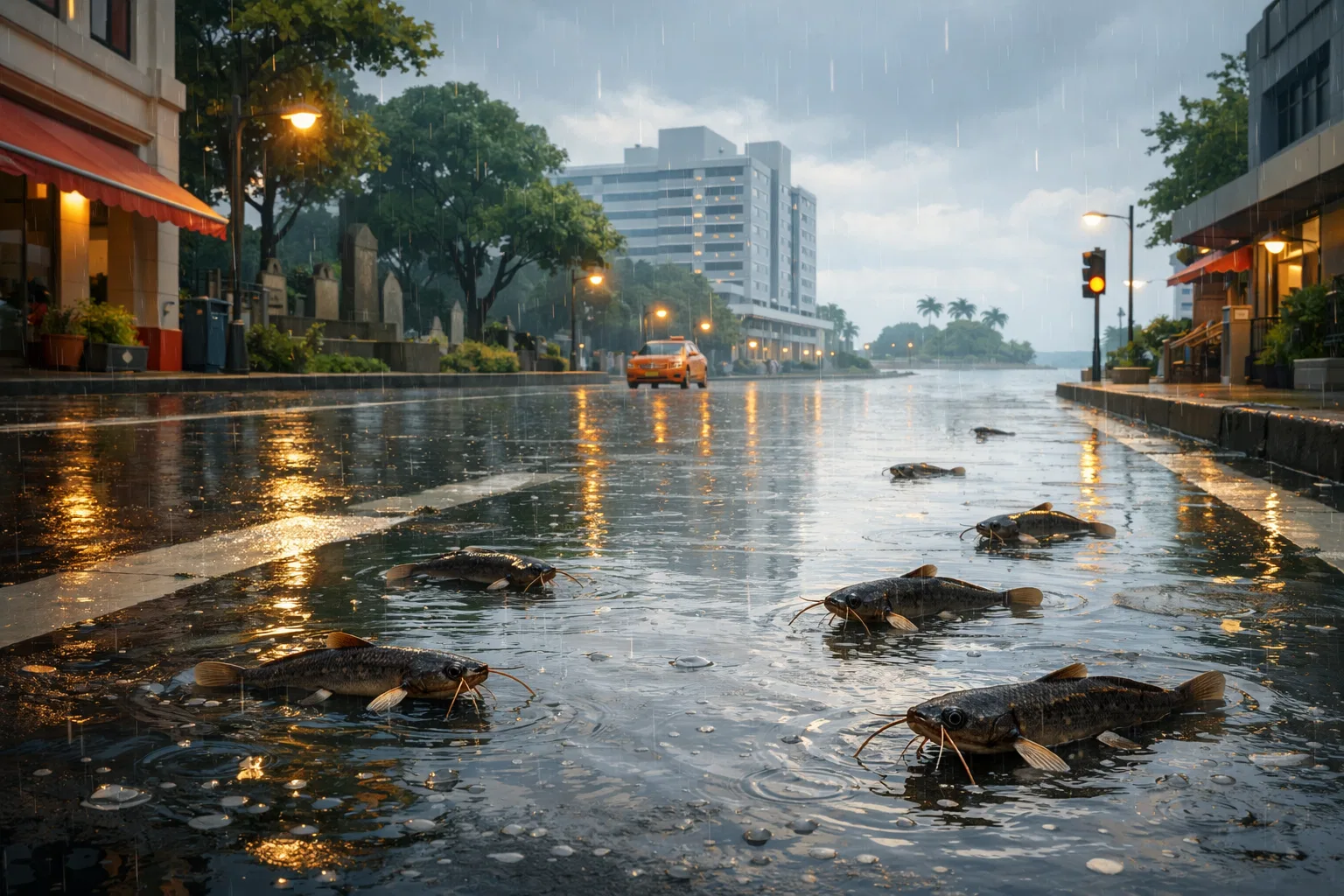
The most classic Charles Fort-style Singapore case is the reported fall of fish in February 1861. The account is usually traced to Francis de Castelnau, a French naturalist and diplomat then in the region. According to a later translation discussed in Natural History Magazine, Singapore experienced an earthquake followed by heavy rain on 20, 21 and 26 February 1861. When the rain stopped, Castelnau reported seeing Malay and Chinese residents collecting fish from pools, while people told him the fish had “fallen from heaven”. He identified them as Clarias batrachus, the walking catfish, a species capable of surviving out of water for some time.[naturalhistorymag.com]naturalhistorymag.comRains of Fishes | Natural History MagazineRains of Fishes | Natural History Magazine
The case has staying power because Castelnau did not merely repeat a tavern tale. He claimed that fish were also found in his own walled courtyard, where he thought they could not easily have been washed in by a flood. He estimated the affected area at about fifty acres and noted that the fish were lively and healthy. His own suggested explanation was cautious rather than mystical: perhaps a waterspout over a river in Sumatra had lifted fish and carried them to Singapore.[naturalhistorymag.com]naturalhistorymag.comRains of Fishes | Natural History MagazineRains of Fishes | Natural History Magazine
That explanation is still the standard naturalistic answer for many “animal rain” reports, though it is not always a neat fit. Atmospheric scientists generally treat fish and frog rains as unusual but not impossible: a waterspout or tornado may pick up small animals from a water body and later drop them, while odd-coloured rain can come from dust, ash or other particles washed out by precipitation. Smithsonian’s science coverage notes that such reports are ancient, widespread and often debated, with waterspouts and tornadoes among the likeliest mechanisms for fish or frog falls.[Smithsonian Magazine]smithsonianmag.comOpen source on smithsonianmag.com.
For Singapore Forteana, the case matters because it is both strange and unusually documentable. It is not a ghost seen by one frightened witness at midnight, but a 19th-century naturalist’s report involving named species, weather conditions, a proposed mechanism and later scientific discussion. Sceptics need not accept that fish literally fell from the clouds; walking catfish moving across wet ground after flooding remains a serious competing explanation. But the event is exactly the sort of half-natural, half-baffling incident that keeps anomalous falls in the Fortean canon.
Haunted Singapore: where ghost stories attach to real places
Singapore’s ghost geography is rooted less in remote ruins than in public memory: hospitals, cemeteries, wartime sites, schools, amusement parks and housing estates. The stories often become powerful not because the evidence is strong, but because the locations already carry emotional weight.
Old Changi Hospital is the clearest example. The surviving buildings began as part of a British military base in the 1930s, were turned into a prison-camp site during the Japanese Occupation, later returned to medical use, and were vacated in 1997 when Changi Hospital merged with Toa Payoh Hospital to form Changi General Hospital. The National Heritage Board’s Roots.sg notes plainly that after the buildings were vacated, the site became popular for filming and gained a reputation for being haunted, attracting people interested in the paranormal.[Roots]roots.gov.sgRoots Old Changi Hospital (24, 37, 161 Halton RoadRoots Old Changi Hospital (24, 37, 161 Halton Road
That reputation is easy to understand. Empty hospital corridors, wartime associations and restricted access are almost a ready-made ghost-story machine. Yet the responsible reading is not that the building is “proved haunted”; it is that the place gathers overlapping anxieties about illness, military occupation, abandonment and urban change. The historical record gives the site gravity. The ghost stories dramatise that gravity.
Bukit Brown Cemetery has a different kind of pull. It is not simply a spooky setting but a major heritage landscape, associated with Chinese burial rites, ancestry, redevelopment debates and civil-society activism. Roots.sg records that the government’s 2011 development plans for Bukit Brown were met by heritage and nature groups’ preservation efforts, and that the National Heritage Board documented rites practised there during Qing Ming, the Seventh Month Ghost Festival and the Winter Clothing Festival.[Roots]roots.gov.sgRoots Bukit Brown CemeteryRoots Bukit Brown Cemetery
In that context, ghostly talk around cemeteries should not be flattened into “scary stories”. In Singapore, cemeteries are also places where family memory, ritual duty and land scarcity meet. The uncanny atmosphere comes from a real social tension: the dead remain present, but the city keeps moving.
Pontianaks, oily men and the making of Singapore horror
Singapore’s supernatural imagination has also been shaped by mass entertainment. The National Library Board’s BiblioAsia traces Singapore horror through amusement parks, literature and film, noting that early 20th-century venues such as New World and Great World featured ghost-train attractions, while Haw Par Villa’s Ten Courts of Hell, built in 1937, remains a vivid artefact of Chinese afterlife imagery in Pasir Panjang.[BiblioAsia]biblioasia.nlb.gov.sgBiblio Asia A History of Singapore Horror | Biblio AsiaBiblio Asia A History of Singapore Horror | Biblio Asia
The major turning point came in 1957, when Cathay-Keris premiered Pontianak. The film drew on the Malay figure of the pontianak, traditionally described as the vengeful spirit of a woman who died in childbirth, but adapted the figure for cinema. BiblioAsia describes the film as a major success that screened for almost two months, unusually long for a local production of the period, and notes that it was a multiethnic collaboration released in Malay and Mandarin and later dubbed into other languages.[BiblioAsia]biblioasia.nlb.gov.sgBiblio Asia A History of Singapore Horror | Biblio AsiaBiblio Asia A History of Singapore Horror | Biblio Asia
That matters because the pontianak did not remain only a village or kampong tale. It became shared popular culture. Sequels and rival productions followed, while other Malay supernatural figures appeared on screen: skeletal ghosts, the oily man and the toyol, a child-sized spirit used by a shaman.[BiblioAsia]biblioasia.nlb.gov.sgBiblio Asia A History of Singapore Horror | Biblio AsiaBiblio Asia A History of Singapore Horror | Biblio Asia
The Fortean interest here is cultural rather than evidential. These films do not prove that such beings exist; they show how oral supernatural material became modern, urban, commercial and cross-ethnic. Singapore horror is therefore not an imported afterthought. It grew out of regional folklore, local media networks, post-war entertainment and the changing language politics of Singapore and Malaya.
Haw Par Villa: moral horror in broad daylight
Haw Par Villa is one of Singapore’s strangest public places because it turns the supernatural into civic instruction. Its Ten Courts of Hell are not a hidden occult tradition but a public display of judgement, punishment and rebirth drawn from Chinese religious and moral imagery. Roots.sg collection entries describe the courts as scenes in which souls are judged for past deeds before their next reincarnation is determined.[Roots]roots.gov.sgOpen source on roots.gov.sg.
The official Haw Par Villa site now presents Hell’s Museum as a museum about death and the afterlife, with the Ten Courts of Hell as its central draw. The museum frames the graphic punishments not merely as shock material but as a way to understand how ideas about sin, karma and afterlife punishment developed across cultures.[Haw Par Villa]hawparvilla.sgOpen source on hawparvilla.sg.
For readers of strange history, Haw Par Villa is valuable because it complicates the line between folklore and institution. It is grotesque, funny, moralising, theatrical and educational all at once. In many countries, underworld imagery lives mainly in churches, temples or folk tales; in Singapore, one of its most famous versions became a family outing.
Kusu Island and miracle geography
Not all Singapore strangeness is frightening. Kusu Island, south-west of the main island, is tied to pilgrimage, seafaring protection and miracle legends. Roots.sg records that the island is the site of an annual pilgrimage by Chinese and Malay devotees, with a Chinese temple and three Malay shrines. Devotees mainly visit during the ninth month of the Chinese lunar calendar.[Roots]roots.gov.sgRoots Pilgrimage to Kusu IslandRoots Pilgrimage to Kusu Island
The island’s legends vary, but several share the same structure: danger at sea, miraculous rescue and the creation or sanctification of the island. One version tells of a Malay and a Chinese fisherman saved from drowning by a turtle that brought them ashore. Another says a great turtle turned itself into an island to save sailors. A third links the island to two holy men, one Arab and one Chinese, whose story became associated with the temple and shrine traditions.[Roots]roots.gov.sgRoots Pilgrimage to Kusu IslandRoots Pilgrimage to Kusu Island
These are not “mysteries” in the evidential sense. Their importance lies in how they make geography meaningful. Kusu Island becomes more than land and ferry timetable: it becomes a place where sea danger, inter-communal harmony, gratitude and sacred protection are remembered together.
The Bukit Timah Monkey Man: Singapore’s pocket cryptid
The Bukit Timah Monkey Man is the closest Singapore comes to a popular home-grown cryptid. The claim, in its modern form, describes a large bipedal ape-like or monkey-like figure said to inhabit the Bukit Timah area. Local coverage treats the creature as urban legend and cryptozoology rather than established zoology. A 2020 Mothership report on a claimed night-trek sighting described the creature as supposedly one to two metres tall and noted that the alleged sighting details were vague, with the existence of the creature remaining unverified.[Mothership]mothership.sgS'pore night trekker claims he saw Bukit Timah Monkey ManS'pore night trekker claims he saw Bukit Timah Monkey Man
The obvious sceptical explanation is misidentification. Singapore has real macaques, and NParks lists the long-tailed macaque, also called the crab-eating macaque, as a native and common species found in forests, parks, urban areas and nature reserves including Bukit Timah. It is active by day and night, feeds on plants and animals, forages on the ground as well as in trees, and may appear around urban buildings.[Gov]nparks.gov.sgOpen source on nparks.gov.sg.
A macaque is not a two-metre forest hominid, but night, fear, expectation and fleeting glimpses can inflate animals. The Monkey Man remains interesting precisely because Singapore seems an unlikely place for a Bigfoot-style legend: small, surveilled, urbanised and scientifically well mapped. That mismatch is the story’s charm. The cryptid survives as a joke, a thrill, a local legend and a reminder that even a city-state can keep a dark patch of forest in its imagination.
Tigers, crocodiles and the thin line between monster and wildlife
Some Singapore “monster” material becomes less mysterious when placed beside the country’s ecological history. Tigers once lived in Singapore, and their attacks were not folklore. The National Library Board’s article on tigers in Singapore records that by the mid-19th century tiger attacks were rumoured to claim one life a day, while Governor William Butterworth reportedly gave a lower but still alarming estimate of about 200 deaths a year in a population of around 50,000. In 1859, one village near Bukit Timah was abandoned because of tiger attacks.[National Library Board]nlb.gov.sgarticle detailarticle detail
That history matters because it shows how quickly a real animal can become legendary. A tiger in the forest is not paranormal, but for plantation workers, villagers and officials in 19th-century Singapore it was a source of dread, rumour, bounty hunting and frontier storytelling. Modern Singapore’s ghostly or cryptid forest tales sit in the shadow of a time when the forest really did contain large predators.
Crocodile sightings play a similar role today, though in a more controlled and publicly managed setting. Sungei Buloh Wetland Reserve is officially promoted by NParks as a biodiverse mangrove and wetland site and Singapore’s first ASEAN Heritage Park. Recent press reports show NParks still responding to crocodile sightings near the reserve, urging caution and searching when animals appear near public areas.[Gov]nparks.gov.sgOpen source on nparks.gov.sg.
For Fortean purposes, these cases are useful guardrails. Not every startling animal report is a cryptid. Sometimes the “monster” is a real species in an unexpected place, seen briefly by people who are startled, excited or afraid.
Swordfish, Redhill and legendary attacks from the sea
One of Singapore’s most memorable old legends is the attack of the swordfish, often linked to the origin story of Redhill. The National Library Board’s summary of The Redhill: A Singapore Folktale gives the core plot: Singapore is attacked by swordfish; the king’s attempt to stop them by ordering men into the water leads to deaths; a clever boy suggests using banana stems; the plan works, but the king later has the boy killed because he fears the child’s intelligence.[National Library Board]nlb.gov.sgOpen source on nlb.gov.sg.
The National Heritage Board also retells the story for children as “Attack of the Swordfish”, showing how the legend remains part of Singapore’s public heritage and educational storytelling.[Roots]roots.gov.sgOpen source on roots.gov.sg.
This is not a zoological report in the same category as the 1861 fish rain. It is a moral and political tale. The strange attack from the sea creates the crisis, but the real horror is human: a ruler who destroys the person who saved his people. In country-level Forteana, that distinction matters. The story belongs not because anyone should expect a literal swordfish siege, but because it is one of Singapore’s classic examples of folklore using an impossible or exaggerated natural event to say something durable about power, cleverness and fear.
Flying saucers, green streaks and explainable sky scares
Singapore has had UFO-style moments, but they tend to be small, brief and quickly explained. A 1954 Straits Times item preserved in NewspaperSG reported a white round object over Geylang Serai that started a flying-saucer scare; RAF observation posts identified it as a meteorological balloon from Paya Lebar.[E-Resources]eresources.nlb.gov.sgstraitstimes19541027 1straitstimes19541027 1
A much later example came in January 2007, when Today reported intermittent green streaks across Singapore’s skies that prompted talk of UFO sightings and expert debate over whether the flashes were meteors, green flashes or perceptual effects.[E-Resources]eresources.nlb.gov.sgtoday20070109 1today20070109 1
These cases are worth including because they show Singapore participating in global UFO culture without producing a major national UFO mythology. The pattern is familiar: something appears in the sky; witnesses reach for the language of flying saucers or UFOs; journalists report the excitement; specialists suggest balloons, meteors, aircraft or optical effects. The interest lies less in aliens than in the speed with which modern skies become screens for anxiety and imagination.
Why Singapore’s strange record feels different
Singapore’s Forteana is shaped by density. There are few empty hinterlands in which a lake monster or mountain phantom can grow unchecked. Instead, the uncanny attaches to compressed spaces: a vacant hospital beside a modern healthcare system, an old cemetery beside redevelopment plans, a moral underworld inside a public attraction, a forest cryptid within a nature reserve, a miracle island reachable by ferry.
The best Singapore cases also tend to be hybrid. The fish rain sits between meteorology and witness testimony. Old Changi Hospital sits between war history and ghost tourism. The pontianak sits between Malay folklore and multiethnic cinema. Kusu Island sits between legend and living pilgrimage. The Monkey Man sits between cryptid entertainment and macaque misidentification. UFO scares sit between public wonder and ordinary aerial objects.
That makes Singapore a strong example of grounded strange history. Its weird record does not require belief in ghosts, monsters or alien craft. It asks a better question: how do unusual reports survive in a place famous for order, planning and modernity? The answer is that strangeness does not need wilderness. It only needs memory, weather, darkness, animals, old stories and the human habit of turning uncertainty into narrative.

Amazon book picks
Further Reading
Books and field guides related to What Makes Singapore's Strange History So Persistent?. Use these as the next step if you want deeper reading beyond the article.

The Penguin Book of Ghost Stories
Useful companion for readers interested in ghost traditions.

Singapore: A Biography
Excellent background for the country's strange historical traditions.

eBay marketplace picks
Marketplace Samples
Live-tested eBay searches with available results related to this page.

Endnotes
1.
Source: naturalhistorymag.com
Title: Rains of Fishes | Natural History Magazine
Link:https://www.naturalhistorymag.com/picks-from-the-past/271577/rains-of-fishes?page=6
2.
Source: mothership.sg
Title: S’pore night trekker claims he saw Bukit Timah Monkey Man
Link:https://mothership.sg/2020/12/btmm-2020/
3.
Source: mothership.sg
Title: raining fish in singapore
Link:https://mothership.sg/2018/01/raining-fish-in-singapore/
4.
Source: mothership.sg
Title: bukit timah monkey man
Link:https://mothership.sg/2018/02/bukit-timah-monkey-man/
5.
Source: roots.gov.sg
Title: Roots Old Changi Hospital (24, 37, 161 Halton Road)
Link:https://www.roots.gov.sg/places/places-landing/Places/surveyed-sites/Old-Changi-Hospital-24-37-161-Halton-Road
6.
Source: biblioasia.nlb.gov.sg
Title: Biblio Asia A History of Singapore Horror | Biblio Asia
Link:https://biblioasia.nlb.gov.sg/all-sections/vol-13-issue-2-jul-sep-2017-history-of-singaporean-horror/
7.
Source: roots.gov.sg
Title: Roots Pilgrimage to Kusu Island
Link:https://www.roots.gov.sg/ich-landing/ich/pilgrimage-to-kusu-island
8.
Source: smithsonianmag.com
Link:https://www.smithsonianmag.com/science-nature/strange-rain-why-fish-frogs-and-golf-balls-fall-skies-180956527/
9.
Source: roots.gov.sg
Title: Roots Bukit Brown Cemetery
Link:https://www.roots.gov.sg/en/resources-landing/online-exhibitions/bukit-brown-cemetery
10.
Source: roots.gov.sg
Link:https://www.roots.gov.sg/collection-landing/listing/1110979
11.
Source: hawparvilla.sg
Link:https://www.hawparvilla.sg/
12.
Source: hawparvilla.sg
Link:https://www.hawparvilla.sg/hells-museum/
13.
Source: nparks.gov.sg
Link:https://www.nparks.gov.sg/florafaunaweb/fauna/4/7/475
14.
Source: nlb.gov.sg
Title: article detail
Link:https://www.nlb.gov.sg/main/article-detail?cmsuuid=baa5413b-941d-4540-8640-d8606b539b04
15.
Source: nparks.gov.sg
Link:https://www.nparks.gov.sg/visit/parks/park-detail/sungei-buloh-wetland-reserve
16.
Source: nlb.gov.sg
Link:https://www.nlb.gov.sg/main/book-detail?cmsuuid=057c03bd-634c-4e6c-922e-e9b057c665e9
17.
Source: roots.gov.sg
Link:https://www.roots.gov.sg/stories-landing/stories/attack-of-the-swordfish/story
18.
Source: eresources.nlb.gov.sg
Title: straitstimes19541027 1
Link:https://eresources.nlb.gov.sg/newspapers/digitised/issue/straitstimes19541027-1
19.
Source: eresources.nlb.gov.sg
Title: today20070109 1
Link:https://eresources.nlb.gov.sg/newspapers/digitised/issue/today20070109-1
20.
Source: roots.gov.sg
Title: Changi Heritage Trail
Link:https://www.roots.gov.sg/places/places-landing/trails/changi-heritage-trail—war-and-peace
21.
Source: roots.gov.sg
Link:https://www.roots.gov.sg/api/media/83dca40b-bb9f-473c-9345-f38298bf8de3/MUSE%20162%20Interactive%2013%20Sep.pdf
22.
Source: roots.gov.sg
Link:https://www.roots.gov.sg/collection-landing/listing/1131888
23.
Source: roots.gov.sg
Link:https://www.roots.gov.sg/api/media/73e9ecae-71e6-43af-b1cc-d2de3e91432b/Changi%20Heritage%20Trail%20Companion%20Guide.pdf
24.
Source: roots.gov.sg
Title: Documenting Chinese Death Beliefs in Singapore
Link:https://www.roots.gov.sg/MUSE/articles/Documenting-Chinese-Death-Beliefs-in-Singapore
25.
Source: roots.gov.sg
Title: haw par villa
Link:https://www.roots.gov.sg/places/places-landing/places/surveyed-sites/haw-par-villa
26.
Source: roots.gov.sg
Link:https://www.roots.gov.sg/places/places-landing/trails/Changi-Heritage-Trail
27.
Source: roots.gov.sg
Title: for seniors
Link:https://www.roots.gov.sg/api/media/92077a63-ac2f-44d1-8376-7493fa03e5b7/CSK_4_Rituals%20and%20Celebrations_English.pdf
28.
Source: roots.gov.sg
Link:https://www.roots.gov.sg/collection-landing/listing/1083637
29.
Source: roots.gov.sg
Link:https://www.roots.gov.sg/api/media/669a5ab4-faca-408f-ab93-2e9cef26418a/world-war-2-trail-booklet.pdf
30.
Source: roots.gov.sg
Title: pulau ubin
Link:https://www.roots.gov.sg/resources-landing/online-exhibitions/pulau-ubin
31.
Source: roots.gov.sg
Link:https://www.roots.gov.sg/collection-landing/listing/1110309
32.
Source: roots.gov.sg
Title: Changi Heritage Trail Map
Link:https://www.roots.gov.sg/api/media/12f9136b-61fe-4497-8176-3633dfe1add3/Changi%20Heritage%20Trail%20Map.pdf
33.
Source: roots.gov.sg
Title: goh chor tua pek kong temple
Link:https://www.roots.gov.sg/places/places-landing/places/landmarks/balestier-heritage-trail-faith-film-and-food/goh-chor-tua-pek-kong-temple
34.
Source: roots.gov.sg
Link:https://www.roots.gov.sg/collection-landing/listing/1039738
35.
Source: roots.gov.sg
Link:https://www.roots.gov.sg/places/places-landing/places/national-monuments/bowyer-block
36.
Source: roots.gov.sg
Link:https://www.roots.gov.sg/api/media/974e8dbc-40e8-462c-b2ca-9daf4c66835b/muse-magazine_aprjune2016-fa_lores.pdf
37.
Source: roots.gov.sg
Link:https://www.roots.gov.sg/collection-landing/listing/1129389
38.
Source: roots.gov.sg
Link:https://www.roots.gov.sg/collection-landing/listing/1210912
39.
Source: roots.gov.sg
Title: Toa Payoh Heritage Trail Booklet
Link:https://www.roots.gov.sg/api/media/43621854-4ea8-4cfb-bf7d-de4ed8d0b114/Toa%20Payoh%20Heritage%20Trail_Booklet.pdf
40.
Source: roots.gov.sg
Link:https://www.roots.gov.sg/collection-landing/listing/1113689
41.
Source: roots.gov.sg
Link:https://www.roots.gov.sg/collection-landing/listing/1443684
42.
Source: roots.gov.sg
Link:https://www.roots.gov.sg/api/media/ad65559f-46c2-43b4-b811-a33813425ab5/NHB22_Woodlands_Trail%20Booklet_web.pdf
43.
Source: roots.gov.sg
Link:https://www.roots.gov.sg/collection-landing/listing/1130801
44.
Source: roots.gov.sg
Link:https://www.roots.gov.sg/stories-landing/stories/world-war-ii/story
45.
Source: roots.gov.sg
Link:https://www.roots.gov.sg/api/media/3b79eb82-ff33-41c8-901f-08bce85d959c/nhb_tampines_trail-booklet.pdf
46.
Source: roots.gov.sg
Link:https://www.roots.gov.sg/collection-landing/listing/1134530
47.
Source: roots.gov.sg
Link:https://www.roots.gov.sg/api/media/e3c9ec7e-571f-4c2d-add6-ad69f33abc31/tales-from-our-shores-sec.pdf
48.
Source: roots.gov.sg
Title: Muse Magazine Vol132Highrescompressed
Link:https://www.roots.gov.sg/-/media/Roots/Files/muse/Muse-MagazineVol132Highrescompressed.pdf
49.
Source: roots.gov.sg
Link:https://www.roots.gov.sg/collection-landing/listing/1109915
50.
Source: roots.gov.sg
Link:https://www.roots.gov.sg/collection-landing/listing/1182306
51.
Source: roots.gov.sg
Link:https://www.roots.gov.sg/collection-landing/listing/1130636
52.
Source: roots.gov.sg
Link:https://www.roots.gov.sg/collection-landing/listing/1133218
53.
Source: eresources.nlb.gov.sg
Title: maltribune19330715 1
Link:https://eresources.nlb.gov.sg/newspapers/digitised/issue/maltribune19330715-1
54.
Source: eresources.nlb.gov.sg
Title: nlb.gov.sg Newspaper S G
Link:https://eresources.nlb.gov.sg/newspapers/digitised/issue/singstandard19550517-1
55.
Source: eresources.nlb.gov.sg
Title: nlb.gov.sg Newspaper S G
Link:https://eresources.nlb.gov.sg/newspapers/digitised/issue/straitstimes20200310-1
56.
Source: eresources.nlb.gov.sg
Title: straitstimes19501126 1
Link:https://eresources.nlb.gov.sg/newspapers/digitised/issue/straitstimes19501126-1
57.
Source: eresources.nlb.gov.sg
Title: nlb.gov.sg Newspaper S G
Link:https://eresources.nlb.gov.sg/newspapers/digitised/issue/singstandard19541004-1
58.
Source: eresources.nlb.gov.sg
Title: straitstimes19521220 1
Link:https://eresources.nlb.gov.sg/newspapers/digitised/issue/straitstimes19521220-1
59.
Source: eresources.nlb.gov.sg
Title: nlb.gov.sg Newspaper S G
Link:https://eresources.nlb.gov.sg/newspapers/digitised/issue/singstandard19550721-1
60.
Source: eresources.nlb.gov.sg
Title: nlb.gov.sg Newspaper S G
Link:https://eresources.nlb.gov.sg/newspapers/digitised/issue/freepress19500816-1
61.
Source: eresources.nlb.gov.sg
Title: nlb.gov.sg Newspaper S G
Link:https://eresources.nlb.gov.sg/newspapers/digitised/issue/freepress19540703-1
62.
Source: eresources.nlb.gov.sg
Title: easternsun19681021 1
Link:https://eresources.nlb.gov.sg/newspapers/digitised/issue/easternsun19681021-1
63.
Source: nlb.gov.sg
Link:https://www.nlb.gov.sg/main/book-detail?cmsuuid=925e462f-2cc2-4063-8dbc-a861948072ca
64.
Source: nlb.gov.sg
Title: Kusu Island
Link:https://www.nlb.gov.sg/main/article-detail?cmsuuid=88b893d8-6da3-45a9-ab08-c2b795c989cc
65.
Source: biblioasia.nlb.gov.sg
Title: vol 13 issue 4 jan mar 2018 when tigers used to roam
Link:https://biblioasia.nlb.gov.sg/all-sections/vol-13-issue-4-jan-mar-2018-when-tigers-used-to-roam/
66.
Source: eresources.nlb.gov.sg
Title: nlb.gov.sg Newspaper S G
Link:https://eresources.nlb.gov.sg/newspapers/digitised/issue/freepress19600516-1
67.
Source: eresources.nlb.gov.sg
Title: straitstimes19800303 1
Link:https://eresources.nlb.gov.sg/newspapers/digitised/issue/straitstimes19800303-1
68.
Source: eresources.nlb.gov.sg
Title: nlb.gov.sg Newspaper S G
Link:https://eresources.nlb.gov.sg/newspapers/digitised/issue/singstandard19560116-1
69.
Source: eresources.nlb.gov.sg
Title: nlb.gov.sg Newspaper S G
Link:https://eresources.nlb.gov.sg/newspapers/digitised/issue/freepress19470607-1
70.
Source: eresources.nlb.gov.sg
Title: nlb.gov.sg Newspaper S G
Link:https://eresources.nlb.gov.sg/newspapers/digitised/issue/freepress19590608-1
71.
Source: eresources.nlb.gov.sg
Title: nlb.gov.sg Newspaper S G
Link:https://eresources.nlb.gov.sg/newspapers/digitised/issue/straitstimes19980405-1
72.
Source: eresources.nlb.gov.sg
Title: straitstimes19520720 1
Link:https://eresources.nlb.gov.sg/newspapers/digitised/issue/straitstimes19520720-1
73.
Source: eresources.nlb.gov.sg
Title: straitstimes19531120 1
Link:https://eresources.nlb.gov.sg/newspapers/digitised/issue/straitstimes19531120-1
74.
Source: eresources.nlb.gov.sg
Title: straitstimes19520504 1
Link:https://eresources.nlb.gov.sg/newspapers/digitised/issue/straitstimes19520504-1
75.
Source: nlb.gov.sg
Title: Haw Par Villa (Tiger Balm Gardens)
Link:https://www.nlb.gov.sg/main/article-detail?cmsuuid=7809f4c9-d067-455c-8dbb-a511073e4d31
76.
Source: nparks.gov.sg
Link:https://www.nparks.gov.sg/visit/parks/bukit-timah-nature-reserve/activities/birdwatching
77.
Source: nparks.gov.sg
Link:https://www.nparks.gov.sg/docs/default-source/resources/2020/mammals-native-singapore.pdf
78.
Source: nparks.gov.sg
Title: introducing our elusive wild neighbours
Link:https://www.nparks.gov.sg/publications-resources/articles/introducing-our-elusive-wild-neighbours
79.
Source: nparks.gov.sg
Link:https://www.nparks.gov.sg/docs/default-source/resources/2022/nparks-wildlife–booklet.pdf
80.
Source: biodiversitysg.nparks.gov.sg
Link:https://biodiversitysg.nparks.gov.sg/our-ecosystems/terrestrial-and-freshwater-habitats/primary-forests-in-singapore/
81.
Source: nparks.gov.sg
Link:https://www.nparks.gov.sg/docs/default-source/parks-docs/bukit-timah-nature-reserve/bukit-timah-nature-reserve-trail-guide.pdf?sfvrsn=86d801ab_1
82.
Source: nparks.gov.sg
Link:https://www.nparks.gov.sg/docs/default-source/resources/2023/handbook-habitat-restoration-chapter8.pdf
83.
Source: nparks.gov.sg
Title: In the Lonely ‘Owl’
Link:https://www.nparks.gov.sg/publications-resources/articles/in-the-lonely–owl
84.
Source: nparks.gov.sg
Title: Bukit Timah Nature Reserve
Link:https://www.nparks.gov.sg/sbg/research/publications/gardens%27-bulletin-singapore/-/media/sbg/gardens-bulletin/supplementary_old/suppl_03%2847%29_y1995_rainforest-in-the-city_bukit-timah-nature-reserve.ashx
85.
Source: nparks.gov.sg
Link:https://www.nparks.gov.sg/sbg/research/publications/gardens-bulletin-singapore/-/media/sbg/gardens-bulletin/supplementary_old/suppl_03%2847%29_y1995_rainforest-in-the-city_bukit-timah-nature-reserve.pdf
86.
Source: nparks.gov.sg
Title: Rifle Range Nature Park
Link:https://www.nparks.gov.sg/visit/parks/park-detail/rifle-range-nature-park
87.
Source: nparks.gov.sg
Title: 71 s1 05 y2019 v71s1 gbs pg145
Link:https://www.nparks.gov.sg/sbg/research/publications/the-gardens%27-bulletin-singapore/-/media/sbg/gardens-bulletin/gbs_71_s1_y2019_v71_s1/71_s1_05_y2019_v71s1_gbs_pg145.pdf
88.
Source: nparks.gov.sg
Link:https://www.nparks.gov.sg/visit/parks/park-detail/upper-peirce-reservoir-park
89.
Source: Wikipedia
Link:https://en.wikipedia.org/wiki/Singapore
90.
Source: Wikipedia
Title: Bukit Timah Monkey Man
Link:https://en.wikipedia.org/wiki/Bukit_Timah_Monkey_Man
91.
Source: Wikipedia
Title: Haw Par Villa
Link:https://en.wikipedia.org/wiki/Haw_Par_Villa
92.
Source: hawparvilla.sg
Link:https://www.hawparvilla.sg/exhibitions/
93.
Source: sla.gov.sg
Title: kusu island
Link:https://www.sla.gov.sg/articles/kusu-island/
94.
Source: nlb.libcal.com
Link:https://nlb.libcal.com/event/5868870
95.
Source: nlb.libcal.com
Link:https://nlb.libcal.com/event/5856658
96.
Source: instagram.com
Link:https://www.instagram.com/reel/DUMzMaPD2Gm/?hl=en
97.
Source: bloodandporridge.co.uk
Title: bukit timah monkey man
Link:https://bloodandporridge.co.uk/wp/tag/bukit-timah-monkey-man/
98.
Source: passionsandplaces.com
Title: haw par villa singapore
Link:https://passionsandplaces.com/haw-par-villa-singapore/
99.
Source: asiamediacentre.org.nz
Title: haw par villa an asian version of alice in wonderland
Link:https://www.asiamediacentre.org.nz/features/haw-par-villa-an-asian-version-of-alice-in-wonderland
100.
Source: itsmth.fandom.com
Title: Bukit Timah Monkey Man
Link:https://itsmth.fandom.com/wiki/Bukit_Timah_Monkey_Man
101.
Source: cryptidz.fandom.com
Title: Bukit Timah Monkey Man
Link:https://cryptidz.fandom.com/wiki/Bukit_Timah_Monkey_Man
102.
Source: thesmartlocal.com
Title: old changi hospital
Link:https://thesmartlocal.com/read/old-changi-hospital/
103.
Source: isomer-user-content.by.gov.sg
Link:https://isomer-user-content.by.gov.sg/339/76dec0a9-74b5-4b44-bb39-df934d958d43/biblioAsia_Jan_Mar2024_lowres_5mb.pdf
104.
Source: gov.sg
Link:https://www.gov.sg/
105.
Source: stb.gov.sg
Link:https://www.stb.gov.sg/
Additional References
106.
Source: youtube.com
Title: The Vengeful Mother: A Deep Dive into the Pontianak Legend
Link:http://www.youtube.com/watch?v=yoSkVgtnyk0
Source snippet
Singapore strange history unexplained ghost stories Changi Hospital Bukit Brown Most Haunted Place in Singapore 👹 Syncy...
107.
Source: youtube.com
Link:http://www.youtube.com/watch?v=nsLRvFjc-EA
Source snippet
The Vengeful Mother: A Deep Dive into the Pontianak Legend...
108.
Source: youtube.com
Title: 10 Most [Haunted Places]({{ ‘haunted-places-799f43/’ | relative_url }}) in Singapore | Terrifying Horror Stories & Dark Legends
Link:http://www.youtube.com/watch?v=aof5jGY1j5k
Source snippet
HAUNTED Amber Beacon Tower, Singapore | PARANORMAL Investigation...
109.
Source: youtube.com
Title: Bukit Brown Cemetery Revisited
Link:http://www.youtube.com/watch?v=eBe19mxegs4
Source snippet
What I Found At Old Changi Hospital During Hungry Ghost Festival | Hidden Hustles Ep 49...
110.
Source: instagram.com
Link:https://www.instagram.com/p/COK6IH6DxlB/
111.
Source: academia.edu
Link:https://www.academia.edu/35143543/Reel_Life_Singapore_The_Films_of_Clyde_E_Elliott
112.
Source: medium.com
Link:https://medium.com/%40stevechoo888/the-fisherman-and-the-swordfish-a-maritime-battle-in-ancient-singapore-795f77838b76
113.
Source: pinterest.com
Link:https://www.pinterest.com/pin/denmark-singapore-australia-and-china-have-famously-once-a-century-rained-fish-the-nearby-and-mass-populations-of-eggs-in-the–128774870565301546/
114.
Source: researchgate.net
Link:https://www.researchgate.net/publication/388971690_An_alien_among_aliens_Translating_multicultural_identities_in_Singapore%27s_contemporary_theatre
115.
Source: api.sg
Link:https://api.sg/api-describes-5-most-haunted-spots-in-singapore-2/
Topic Tree
Follow this branch
Related pages 192
- Afghan Forteana
- Antigua Uncanny
- Bosnian Mysteries
- Botswana Weird
- Brazil Strange
- +187 more in sidebar