Within Maldives Weird
Was Rannamaari a Monster or a Memory?
Rannamaari is the Maldives' great sea-demon story, linking fear of the ocean with conversion, power and memory.
On this page
- The sacrifice story and the conversion of Malé
- Ibn Battuta, local chronicles and competing saviours
- Sea lights, ritual fear and sceptical readings
Page outline Jump by section
Introduction
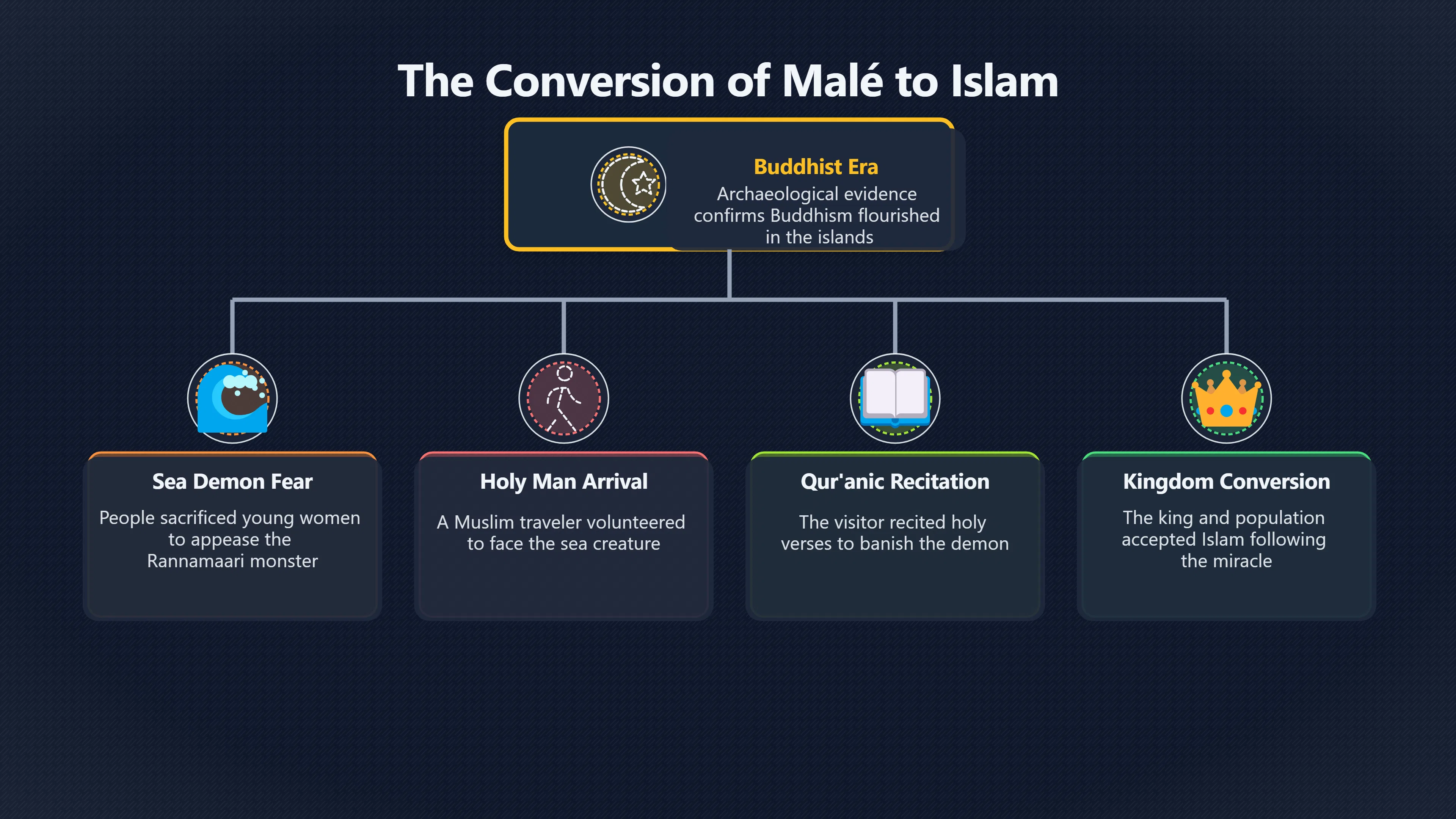
The legend of Rannamaari is the best-known piece of strange folklore in the Maldives and one of the country’s defining origin stories. It tells of a terrifying sea demon that demanded the regular sacrifice of a young woman from the people of Malé until a visiting Muslim holy man confronted the creature by reciting the Qur’an. The demon vanished, the king converted to Islam, and the islands followed. Whether read as history, religious memory, political myth or folklore, the story occupies a unique place in Maldivian culture because it links fear of the sea, the end of Buddhism, and the beginning of the Islamic era in a single dramatic narrative. Modern historians generally accept the conversion to Islam as historical while treating the monster story as a legendary explanation rather than a literal record.[Wikipedia]WikipediaOpen source on wikipedia.org.

Was Rannamaari a Monster or a Memory?
Unlike many legendary monsters, Rannamaari is inseparable from a specific historical event. The tale is not simply about a frightening creature but about the transformation of an entire kingdom.
In the most familiar version, the people of Malé believed that a dreadful being emerged periodically from the sea. To prevent disaster, they selected a young virgin by lot, dressed her as a bride, and left her alone overnight in a temple beside the shore. By morning she was dead. This sacrifice supposedly continued for years because no one dared challenge the creature.[Wikipedia]WikipediaOpen source on wikipedia.org.
Everything changed when a Muslim traveller arrived on the islands. Rather than allowing another young woman to die, he volunteered to spend the night in the temple himself. Instead of performing any magical ritual, he continuously recited passages from the Qur’an. When dawn came he was unharmed, while Rannamaari had fled forever. Witnessing this miracle, the king accepted Islam, and the population followed his example. The story places this turning point in the twelfth century, corresponding with the historically recognised conversion of the Maldives to Islam.[Resortlife Maldives]resortlife.travelconversion 1153Resortlife MaldivesThe Night the Demon Fled — Conversion of the Maldives, 1153A scrollytelling deep dive into the legendary conversion of…
For believers, the narrative demonstrates divine protection and the triumph of Islam over fear and superstition. For historians, it illustrates how societies often compress complex political and religious change into a memorable miracle story.
The sacrifice story and the conversion of Malé
The legend is striking because nearly every element reflects life on small coral islands surrounded by the Indian Ocean.
The monster is never simply described as an inland beast lurking in a forest. It belongs to the sea itself, the source of both prosperity and danger for Maldivians. Depending on the version, Rannamaari either emerged from the ocean or appeared as a mysterious illuminated object approaching the island. Some traditional descriptions portray it less as an animal than as something resembling a ship covered in lamps or lights, making it one of the more unusual “monster” traditions in world folklore.[Wikipedia]WikipediaOpen source on wikipedia.org.
The monthly sacrifice likewise reflects communal rather than individual fear. Every family faced the possibility that its daughter might be chosen, turning the entire community into unwilling participants in the ritual. The visiting holy man’s willingness to replace the victim transforms him into both religious teacher and heroic protector.
The conversion itself is supported by historical evidence, although not the supernatural elements. Copperplate inscriptions known as the Loamaafaanu documents record royal actions associated with the early Islamic kingdom, while archaeological evidence confirms that Buddhism had previously flourished in the islands. The miraculous confrontation with Rannamaari belongs to later narrative tradition rather than documentary history.[Resortlife Maldives]resortlife.travelconversion 1153Resortlife MaldivesThe Night the Demon Fled — Conversion of the Maldives, 1153A scrollytelling deep dive into the legendary conversion of…
Ibn Battuta, local chronicles and competing saviours
One reason the legend remains fascinating is that even the identity of its hero is disputed.
The earliest surviving written version comes from the fourteenth-century Moroccan traveller Ibn Battuta, who spent several months in the Maldives as a judge. He recorded that the islands had been converted by Abu al-Barakat Yusuf al-Barbari, whom he regarded as a fellow North African. According to Ibn Battuta, this was the man who defeated the sea demon through Qur’anic recitation.[Yabiladi]en.yabiladi.comwhen moroccan merchant al barakat yusufWhen Moroccan merchant Abu al-Barakat Yusuf al-Barbari…20 Jun 2018 — For Moroccan traveler Ibn Battuta, Maldivians were conver…
Later Maldivian historical chronicles tell a different story. Works such as the Raadavalhi and Taarikh identify the religious figure not as a Berber from North Africa but as Yusuf Shamsuddin of Tabriz in Persia. Some historians suggest Ibn Battuta may have misread an Arabic inscription because medieval Arabic script could make the names “al-Barbari” and “al-Tabrizi” appear remarkably similar. Others argue that different traditions emerged because several regions wished to associate themselves with such an important conversion narrative.[Wikipedia]WikipediaOpen source on wikipedia.org.
A further debate concerns the meaning of “al-Barbari”. While Ibn Battuta understood it to refer to a Berber from the Maghreb, some later scholars have suggested it could instead refer to the East African port of Berbera, producing yet another possible origin for the mysterious preacher. None of these competing identifications changes the central structure of the legend, but they show how stories evolve as they pass through different cultures and historical traditions.[Wikipedia]WikipediaIslam in the MaldivesFebruary 27, 2026 — The person traditionally deemed responsible for this conversion was a Sunni Muslim visitor named Abu al-Barakat Yusuf…
Sea lights, ritual fear and sceptical readings
Modern interpretations rarely treat Rannamaari as evidence for a real sea monster. Instead, scholars ask what the legend may preserve beneath its supernatural surface.
One explanation is that the tale represents the memory of older religious practices during the final Buddhist period. Archaeologist Egil Mikkelsen has suggested that elements of the story may preserve distorted memories of tantric Buddhist rituals, later reinterpreted after Islam became established. In this reading, the terrifying demon is not a literal creature but a symbolic way of describing religious practices that later generations regarded as alien or dangerous.[Wikipedia]WikipediaOpen source on wikipedia.org.
Folklorist Xavier Romero-Frias has pointed out that the name Rannamaari may itself have connections with a South Indian goddess and notes that Maldivian folklore contains many stories involving dangerous female spirits. He also observes parallels between the overall plot and older South Asian narrative traditions, suggesting that the legend combines local beliefs with wider Indian Ocean folklore.[Wikipedia]WikipediaOpen source on wikipedia.org.
Another possibility is that the creature’s reported appearance as something like a brightly illuminated vessel reflects unfamiliar ships approaching the islands at night. Before modern navigation, strange lights offshore could easily become woven into supernatural explanations, particularly in isolated island communities where the sea already represented both livelihood and mortal danger. While there is no evidence that this was the legend’s original inspiration, it illustrates how natural observations can acquire mythical meaning over generations.

Why Rannamaari still matters
Rannamaari survives because it operates on several levels at once.
It is a monster story, a religious conversion narrative, a foundation myth, and a cultural memory about overcoming fear. Schoolchildren learn it, tourist guides recount it, dramatists perform it, and historians continue to debate its historical foundations. The reputed tomb of Abu al-Barakat opposite Malé’s historic Friday Mosque further anchors the tradition in a real landscape, even while the monster itself remains firmly within folklore.[Resortlife Maldives]resortlife.travelconversion 1153Resortlife MaldivesThe Night the Demon Fled — Conversion of the Maldives, 1153A scrollytelling deep dive into the legendary conversion of…
For students of Fortean traditions, the legend is especially revealing because it demonstrates how extraordinary stories need not depend on claims of literal monsters to remain culturally powerful. Whether Rannamaari ever represented a genuine belief in a sea demon, a misunderstood ritual, a symbolic memory of religious change, or a blend of several traditions, the tale continues to explain one of the most significant moments in Maldivian history through an unforgettable encounter between the supernatural and the sea.
Amazon book picks
Further Reading
Books and field guides related to Was Rannamaari a Monster or a Memory?. Use these as the next step if you want deeper reading beyond the article.


The world's most mysterious places
Provides context for legendary locations and unexplained traditions.

The Penguin Book of Dragons
Explores historical monster traditions relevant to sea-demon folklore.
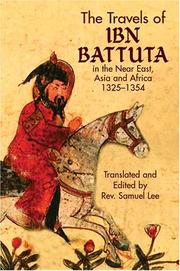
The Travels of Ibn Battuta
First published 2004. Subjects: Ibn batuta, 1304-1377, Asia, description and travel, Early works to 1800, Description and travel, Voyages...
eBay marketplace picks
Marketplace Samples
Live-tested eBay searches with available results related to this page.




Endnotes
1.
Source: Wikipedia
Link:https://en.wikipedia.org/wiki/Rannamaari
2.
Source: Wikipedia
Title: History of the Maldives
Link:https://en.wikipedia.org/wiki/History_of_the_Maldives
3.
Source: resortlife.travel
Title: conversion 1153
Link:https://resortlife.travel/history-of-maldives/deep-dives/conversion-1153
Source snippet
Resortlife MaldivesThe Night the Demon Fled — Conversion of the Maldives, 1153A scrollytelling deep dive into the legendary conversion of...
4.
Source: en.yabiladi.com
Title: when moroccan merchant al barakat yusuf
Link:https://en.yabiladi.com/articles/details/66201/when-moroccan-merchant-al-barakat-yusuf
Source snippet
When Moroccan merchant Abu al-Barakat Yusuf al-Barbari...20 Jun 2018 — For Moroccan traveler Ibn Battuta, Maldivians were conver...
5.
Source: Wikipedia
Title: Ibn Battuta
Link:https://en.wikipedia.org/wiki/Ibn_Battuta
6.
Source: Wikipedia
Link:https://en.wikipedia.org/wiki/Maldives
7.
Source: Wikipedia
Title: Islam in the Maldives
Link:https://en.wikipedia.org/wiki/Islam_in_the_Maldives
Source snippet
February 27, 2026 — The person traditionally deemed responsible for this conversion was a Sunni Muslim visitor named Abu al-Barakat Yusuf...
Published: February 27, 2026
Additional References
8.
Source: kids.kiddle.co
Link:https://kids.kiddle.co/Islam_in_Maldives
Source snippet
in Maldives Facts for KidsThe person usually given credit for bringing Islam to the Maldives is a Sunni Muslim visitor named Abu al-Barak...
9.
Source: humanities.uct.ac.za
Link:https://humanities.uct.ac.za/media/540373
Source snippet
uct.ac.zaSufis, Sea Monsters, and Miraculous CircumcisionsIn the Maldives today, Ibn Battuta's version remains popular and serves as the...
10.
Source: community.somaliforum.com
Title: somalilands historic connection with the island state of maldives
Link:https://community.somaliforum.com/t/somalilands-historic-connection-with-the-island-state-of-maldives/1105
Source snippet
somaliforum.comSomaliland's historic connection with the Island State of...29 Nov 2021 — Somali Muslim Abu al-Barakat Yusuf al-Barbari...
11.
Source: maldivestravel.fyi
Title: maldives embraced islam holiday history
Link:https://maldivestravel.fyi/maldives-embraced-islam-holiday-history/
Source snippet
The Day the Maldives Embraced Islam: History, Holiday...11-06-2026 — The scholar credited with converting the Maldives is known by sever...
12.
Source: facebook.com
Title: Story of how Islam reached Maldives
Link:https://www.facebook.com/DigitalLifeA/videos/maldives-the-demon-and-the-sheikh-ibn-battutas-real-story/5176401049107511/
Source snippet
The Demon and the...Ranamari is a Maldives method legend which chronicles the Maldives people's conversion from Buddhism to Islam. Ranam...
13.
Source: reddit.com
Link:https://www.reddit.com/r/maldives/comments/1iuuwcp/the_rannamaari_legend_a_myth_or_a_royal_coverup/
Source snippet
e of a young virgin girl. Each month, a girl was left...
14.
Source: facebook.com
Link:https://www.facebook.com/groups/Maldivespast/posts/1866710903558958/
Source snippet
ni Berber-Muslim visitor named Abu al Barakat...
15.
Source: youtube.com
Title: She Was Left for the Sea Demon…
Link:https://www.youtube.com/watch?v=dKGdrE0nl_0
Source snippet
Rannamaari Maldives conversion legend Islam Rannamaari: Maldives Journey to Islam DepartmentofMediaandCommunicationStudies UM...
16.
Source: factsanddetails.com
Title: entry 8033
Link:https://factsanddetails.com/south-asia/Maldives/History_Maldives/entry-8033.html
Source snippet
MUSLIM PERIOD OF THE MALDIVES (1153 to 1968)One such story states that the Maldivians were haunted by a sea demon named Rannamaari.... I...
17.
Source: x.com
Link:https://x.com/aaolomi/status/1486419333278765056
Source snippet
Ibn Battuta records the legend of Rannamaari, a Maldivian...26 Jan 2022 — Ibn Battuta records the legend of Rannamaari, a Maldivian sea...
Topic Tree