Within Nepal Uncanny
Why Are Nepal's Lakes Full of Serpent Powers?
Nepal's serpent-lake traditions frame water as inhabited, morally charged space rather than simple lake-monster territory.
On this page
- Nag Panchami and Rain Bringing Serpents
- Taudaha Lake and the Drained Valley Legend
- Sacred Water Without a Lake Monster
Page outline Jump by section
Introduction
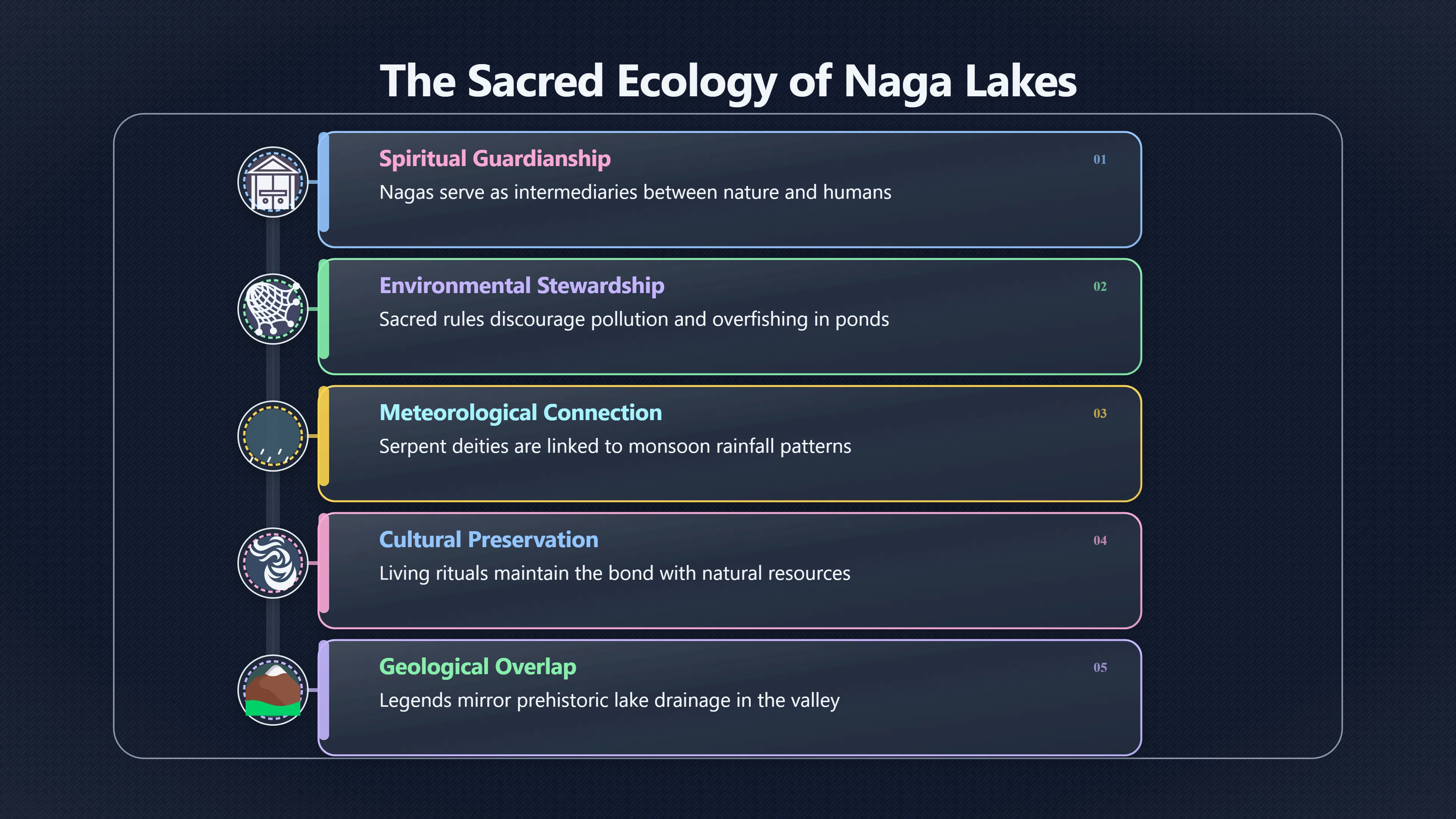
Nepal’s stories about sacred lakes are not really stories about lake monsters. They are stories about relationships: between people and water, between rainfall and survival, and between the visible landscape and unseen powers believed to inhabit it. Across the Kathmandu Valley and beyond, serpent deities known as Nagas are remembered as guardians of springs, ponds and lakes whose favour brings rain, fertility and prosperity, while disrespect risks drought or misfortune. Rather than encouraging monster hunts, these traditions establish moral rules about how water should be treated, turning real lakes into places of restraint, ritual and ecological respect. That combination of folklore, religion and landscape has made Nepal’s Naga lakes one of the country’s most distinctive pieces of living Fortean heritage.[Nepal Tourism Board]ntb.gov.npNepal Tourism BoardNag Panchami | Festivals in NepalNepali people worship snake gods, also called the Nagas during Nag Panchami. In the a…

Why are Nepal’s lakes linked with serpent powers?
In Nepalese tradition, Nagas are supernatural serpents associated with water rather than purely terrestrial snakes. They inhabit lakes, ponds, springs and underground waters, acting as intermediaries between the natural world and human society. Rainfall, successful harvests and the health of the landscape are frequently attributed to their goodwill, while drought is often explained as a sign that the balance between humans and these water guardians has been disturbed.[Nepal Tourism Board]ntb.gov.npNepal Tourism BoardNag Panchami | Festivals in NepalNepali people worship snake gods, also called the Nagas during Nag Panchami. In the a…
This differs from many Western tales of mysterious lake creatures. The question is rarely whether a giant serpent physically exists beneath the water. Instead, the lake itself is understood as inhabited by sacred presence. The mystery lies in respecting invisible boundaries rather than proving an unknown animal.
These beliefs also reflect Nepal’s dependence on seasonal monsoon rains. In a landscape where agriculture historically relied upon predictable rainfall, connecting serpents with clouds, rivers and springs provided a religious language for understanding an unpredictable environment. Modern observers may interpret the stories symbolically, but their practical effect was to encourage careful treatment of water sources that communities depended upon.[Nepal Tourism Board]ntb.gov.npNepal Tourism BoardNag Panchami | Festivals in NepalNepali people worship snake gods, also called the Nagas during Nag Panchami. In the a…
Nag Panchami and the rain-bringing serpents
The annual festival of Nag Panchami illustrates this relationship most clearly. During the festival, households honour serpent deities with prayers, offerings and images placed above doorways, asking for protection from snakebite, plentiful rain and general wellbeing. The festival is observed by both Hindu and Buddhist communities in Nepal, reflecting how deeply the serpent tradition is woven into the country’s religious life.[ntb.gov.np]ntb.gov.npNepal Tourism BoardNag Panchami | Festivals in NepalNepali people worship snake gods, also called the Nagas during Nag Panchami. In the a…
One Nepalese tradition explains the festival through a legend that the Nagas once withheld rain from the country until a powerful king persuaded them to release it. Rather than celebrating military victory, the story celebrates restored harmony between humanity and the forces governing water. The festival therefore becomes a yearly renewal of that agreement.[Nepal Tourism Board]ntb.gov.npNepal Tourism BoardNag Panchami | Festivals in NepalNepali people worship snake gods, also called the Nagas during Nag Panchami. In the a…
From a Fortean perspective, these traditions are intriguing because they attribute weather to intelligent supernatural beings while remaining embedded in everyday religious practice rather than extraordinary miracle claims. They occupy the borderland between mythology, environmental memory and living ritual.
Taudaha Lake and the drained valley legend
The best-known Naga lake in Nepal is Taudaha, on the south-western edge of Kathmandu.[Wikipedia]WikipediaTaudaha LakeTaudaha Lake
According to one of the Kathmandu Valley’s foundation legends, the valley was once a vast lake. The Buddhist figure Manjushree cut open the hills at Chobar, allowing the water to drain away and making the valley habitable. Most of the water disappeared, but one remaining pool became Taudaha, where the serpent king Karkotaka and other Nagas found refuge after losing their ancient home.[Wikipedia]WikipediaTaudaha LakeTaudaha Lake
The legend carries an important condition. Karkotaka agrees to protect nearby communities provided the peace of the lake is not disturbed. Local tradition therefore discourages swimming, fishing and other disruptive behaviour. The prohibition is not presented as wildlife conservation in modern scientific language, yet it functions much the same way by limiting disturbance to a natural site regarded as sacred.[Wikipedia]WikipediaTaudaha LakeTaudaha Lake
The story has an unusual relationship with geology. Scientists recognise that the Kathmandu Valley really was occupied by an ancient lake in prehistoric times before geological processes allowed it to drain naturally. That scientific reconstruction does not confirm the existence of serpent kings, but it does mean the legendary setting begins with a genuine feature of the valley’s distant past. The myth and the geological record therefore overlap in an unexpectedly suggestive way, even though they explain the landscape very differently.[insidehimalayas.com]insidehimalayas.comThe Origins and Legends of the Naga Serpents and Nag…31 Jul 2024 — These serpents were likely revered as deities, and offerings of val…
Why sacred water comes with rules
Across Nepal, lakes and ponds associated with Nagas are often surrounded by customs that regulate behaviour rather than encourage supernatural encounters.
Common themes include:
- avoiding unnecessary disturbance of sacred waters;
- making offerings before drawing water or visiting important sites;
- respecting seasonal rituals connected with rainfall;
- treating ponds and springs as places deserving reverence rather than recreation;
- recognising certain water bodies as homes of unseen guardians rather than ordinary landscape features.[ntb.gov.np]ntb.gov.npNepal Tourism BoardNag Panchami | Festivals in NepalNepali people worship snake gods, also called the Nagas during Nag Panchami. In the a…
Anthropologists and folklorists frequently note that such customs can have practical effects. Sacred restrictions discourage pollution, overfishing and careless use of vital water sources. Whether or not anyone believes literal serpent beings inhabit the lakes, the traditions reinforce long-term stewardship of environments on which communities depended.
Why there is no Nepalese “lake monster”
Readers approaching these traditions through Forteana sometimes expect a Himalayan equivalent of the Loch Ness Monster. Nepal’s Naga lakes rarely fit that pattern.
Reports focus far less on sightings of unknown creatures than on the sacred status of the water itself. The serpent is usually understood as a divine or mythological being rather than an undiscovered species. Stories emphasise blessings, rainfall, protection and taboo instead of eyewitness descriptions, physical evidence or searches for hidden animals.
This distinction matters because it changes how the traditions should be interpreted. They belong more naturally alongside sacred geography, religious folklore and environmental belief than alongside cryptozoological investigations.
Belief, scepticism and enduring cultural appeal
Believers may regard the Nagas as genuine spiritual guardians whose influence continues through ritual and respect for sacred places. For them, festivals such as Nag Panchami are not symbolic performances but meaningful acts that sustain the relationship between humanity and the natural world.[Nepal Tourism Board]ntb.gov.npNepal Tourism BoardNag Panchami | Festivals in NepalNepali people worship snake gods, also called the Nagas during Nag Panchami. In the a…
Sceptics generally interpret the stories differently. They see serpent kings as mythic figures explaining rainfall, dangerous waters and the prehistoric memory of an ancient lake, while viewing the associated customs as cultural mechanisms for protecting valuable water resources and strengthening community identity.
Both readings help explain why the traditions have endured. Unlike many Fortean legends that depend on elusive evidence or dramatic eyewitness reports, Nepal’s Naga lakes remain woven into living religious practice. The stories continue because they are enacted every year through festivals, rituals and respectful behaviour at real lakes whose mystery lies less in hidden monsters than in the enduring belief that water itself deserves reverence.
Amazon book picks
Further Reading
Books and field guides related to Why Are Nepal's Lakes Full of Serpent Powers?. Use these as the next step if you want deeper reading beyond the article.

The hero with a thousand faces
Useful for understanding sacred serpent motifs across cultures.



Myths and Symbols in Indian Art and Civilization (Works by He...
First published 2017. Subjects: Symbolism in art, Art, indic.
eBay marketplace picks
Marketplace Samples
Live-tested eBay searches with available results related to this page.



Endnotes
1.
Source: Wikipedia
Title: Naga Panchami
Link:https://en.wikipedia.org/wiki/Naga_Panchami
Source snippet
Naga PanchamiNaga Panchami; Religious, India and Nepal · Honors the divine serpent deities (Nagas), symbolizing protection, strength...
2.
Source: Wikipedia
Title: Taudaha Lake
Link:https://en.wikipedia.org/wiki/Taudaha_Lake
3.
Source: insidehimalayas.com
Link:https://www.insidehimalayas.com/the-origins-and-legends-of-the-naga-serpents-and-nag-panchami/
Source snippet
The Origins and Legends of the Naga Serpents and Nag...31 Jul 2024 — These serpents were likely revered as deities, and offerings of val...
4.
Source: youtube.com
Title: Taudaha | Lake of Snakes | Lakes around Kathmandu
Link:https://www.youtube.com/watch?v=XN2N0QThGrM
Source snippet
Snakes Fishes Birds of Taudaha Lake...
5.
Source: ntb.gov.np
Link:https://ntb.gov.np/nag-panchami
Source snippet
Nepal Tourism BoardNag Panchami | Festivals in NepalNepali people worship snake gods, also called the Nagas during Nag Panchami. In the a...
Additional References
6.
Source: facebook.com
Link:https://www.facebook.com/raffleseducare/posts/-nag-panchami-is-not-just-a-festivalits-a-deep-rooted-belief-in-the-power-of-nat/1164327059054623/
Source snippet
A sacred day of nature worship and spiritual reflection. Naag Panchami reminds us to honor and protect all living beings...Read more...
7.
Source: researchgate.net
Title: 382996124 Nag Panchami A ritual and realistic view
Link:https://www.researchgate.net/publication/382996124_Nag_Panchami_A_ritual_and_realistic_view
Source snippet
(PDF) Nag Panchami: A ritual and realistic view10 Aug 2024 — Nag Panchami is a traditional Sanatan festival in Nepal that venerates snake...
8.
Source: facebook.com
Link:https://www.facebook.com/groups/174566046959088/posts/950146876067664/
Source snippet
is followers after Manjushree drained the primordial waters...Read more...
9.
Source: nepalconnect.world
Link:https://nepalconnect.world/the-serpents-story-between-myth-fear-and-nature/
Source snippet
The Serpent's Story: Between Myth, Fear, and Nature28 Nov 2025 — According to folklore, these nagas bring prosperity and rainfall...
10.
Source: facebook.com
Link:https://www.facebook.com/groups/lovenepaltravelnepal/posts/1902128713578669/
Source snippet
Once upon a time, Kathmandu was not a valley, but a giant...According to Buddhist legend, a single perfect lotus grew in the center of t...
11.
Source: instagram.com
Link:https://www.instagram.com/reel/DBfSzzuSo9L/?hl=en
Source snippet
snake' and 'Daha' translates to 'lake', the lake of snakes, and the...
12.
Source: instagram.com
Link:https://www.instagram.com/p/DMrafdPvIRc/
Source snippet
with rituals rooted in ancient Himalayan belief.Read more...
13.
Source: acethehimalaya.com
Link:https://www.acethehimalaya.com/nag-panchami-hindu-festival-snake/
Source snippet
It is celebrated mainly in India and Nepal.Read more...
14.
Source: english.nepalnews.com
Link:https://english.nepalnews.com/s/feature/nag-panchami-the-festival-that-connects-us-to-nature-and-tradition/
Source snippet
Nepal NewsNag Panchami: The Festival That Connects Us to Nature and...29 Jul 2025 — The Nagas or serpent gods are believed to control th...
15.
Source: facebook.com
Title: 🌸✨ Today is Naag Panchami!
Link:https://www.facebook.com/nepaltourismboard/posts/-today-is-naag-panchami-on-this-day-we-offer-rituals-to-invoke-spirit-of-naag-or/1168516265308521/
Source snippet
🐍 On this day we offer rituals...Very Merry Nag Panchami! Its the day Hindus & Buddhists in Nepal & India worship snakes as protectors o...
Topic Tree