Why Sweden's Weird Stories Keep Returning
Sweden’s strange-history record is unusually rich because its oddities sit at the meeting point of landscape, archives and modern scepticism.
Page outline Jump by section
Why Sweden is fertile ground for strange reports
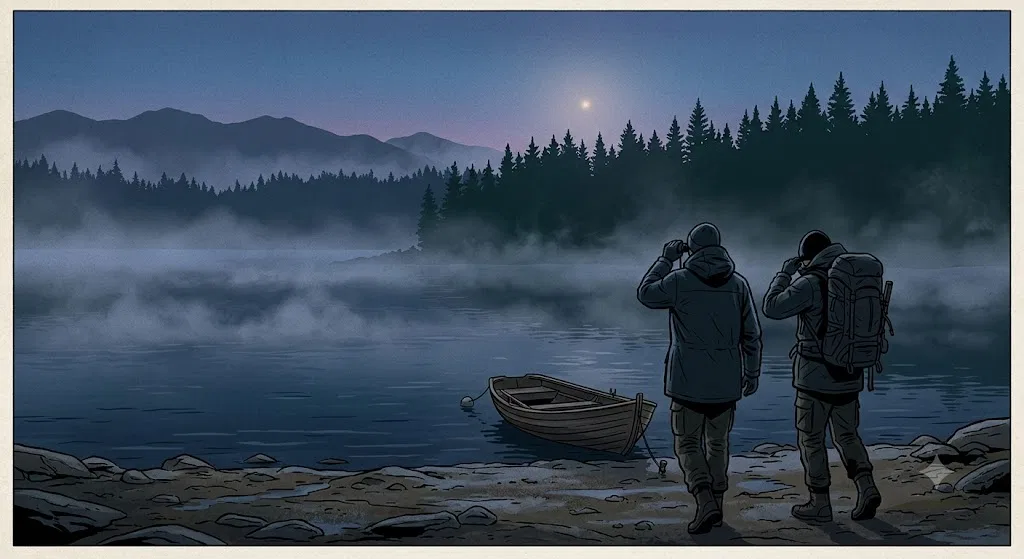
Swedish Forteana is not just a grab-bag of monsters and lights. It is shaped by geography. Forests, lakes, mountains, long winters, dark rural roads and northern skies give the country a natural stage for ambiguous experiences: lights on water, sounds in woods, animals glimpsed at distance, aurorae, meteors, fog, echoes and isolation. The official tourism site Visit Sweden frames much of the country’s folklore as landscape-based, noting that traditional beings are tied to forests, mountains, lakes and meadows, and that these stories are part of a cultural identity built around closeness to nature.[Visit Sweden]visitsweden.comOpen source on visitsweden.com.
That matters because many Swedish legends are not set in a vague fairy-tale elsewhere. They are often attached to recognisable places: a lake, a vicarage, a mountain, a metro station, a stone, a forest road. The Institute for Language and Folklore’s Map of Nordic Legends makes this clear. It includes 10,000 archive records from Sweden, Norway and Swedish-speaking Finland, covering giants’ throws, witches, water spirits, gnomes, werewolves and the Devil, and defines legends as short narratives often told as if they happened in the real world.[Institute for Language and Folklore]isof.seOpen source on isof.se.
This place-based quality is what keeps Swedish strange material alive. A lake monster can be watched for. A haunted house can be slept in. A ghost train can be imagined on a real platform. A “ghost rocket” can be plotted, dived for, and filed away in a military archive. Sweden’s weird history is therefore less about one grand national myth than about recurring collisions between everyday settings and stubbornly odd claims.
Lake Storsjön and Sweden’s best-known monster
The most famous Swedish cryptid is Storsjöodjuret, the Great Lake Monster of Lake Storsjön in Jämtland. The creature is usually described in modern retellings as serpent-like, though the details vary: humps, a long body, a head sometimes compared to a dog or cat, and appearances on or just below the water. Its appeal is easy to understand. Storsjön is a large northern lake, Östersund gives the story a civic centre, and the monster has the right blend of antiquity, local pride and teasing uncertainty.
The tradition is old enough to be more than a modern tourist invention. A 2024 Lund University doctoral thesis describes Storsjöodjuret as an “elusive phenomenon” in Lake Storsjön and studies it as a Swedish cryptid shaped by social, cultural, historical and local forces. The thesis is especially useful because it treats the monster not as a zoological fact, but as a “borderland between the real and the imagined” that changes meaning over time.[Lund University]portal.research.lu.send UniversityThe Great Lake Monster in a Kaleidoscope: Human Ecological Perspectives on a Swedish Cryptid - Lund University…
Several details make the case culturally distinctive. Storsjöodjuret is linked in tradition to the Frösö Runestone and to older stories of a serpent bound in the lake. It also became a public joke with a bureaucratic afterlife: in 1986, the monster and its offspring were placed under a county protection order, a fact now used in official Swedish promotional material. That protection was later revoked, but the story survived the debunking of its own legal seriousness.[Sharing Sweden]sharingsweden.seSharing Sweden Storsjöodjuret – Sweden’s own lake monsterSharing Sweden Storsjöodjuret – Sweden’s own lake monster
Sceptically, the lake-monster evidence is weak. Sightings vary, photographs and films have not established a biological animal, and many reports can be read through the usual lake-monster explanations: waves, logs, swimming animals, birds, low light, expectation and local narrative. Yet dismissing the whole thing as “just a monster story” misses the interesting part. Storsjöodjuret matters because it is a Swedish example of how a cryptid can become a landscape symbol: part folklore, part local identity, part tourism, part unresolved personal testimony.

The 1946 ghost rockets: Cold War fear before flying saucers
Sweden’s strongest claim to classic UFO history is the ghost rocket wave of 1946. These reports came before the modern “flying saucer” era began in the United States in 1947, and they were taken seriously because they sounded less like fantasy craft and more like possible secret weapons. Witnesses described fast, rocket-like or missile-like objects, sometimes silent, sometimes glowing, sometimes apparently falling into lakes or the sea. Sweden’s neutral position, proximity to the Soviet sphere, and fresh memories of German V-weapons made the reports politically sensitive.
The episode produced a large official and archival footprint. The CIA’s declassified material on “Ghost Rockets” over Scandinavia shows that American intelligence was receiving and discussing information on the reports in August 1946.[CIA]cia.govOpen source on cia.gov. The Archives for the Unexplained in Norrköping says its UFO-Sweden/AFU report archives include copies of Swedish defence material covering the 1933–34 ghost flier wave, the 1936–37 wave, the 1946 ghost rockets and later UFO reports; it also notes that combined defence files were digitised by the Swedish Defence Research Agency and the Military Archives of Sweden.[AFU]afu.seUFO report filesUFO report files
The most famous Swedish “impact” story involved Lake Kölmjärv in July 1946, where witnesses reportedly saw a grey, winged, rocket-like object crash into the water. A military search found disturbed lakebed material but no conclusive wreckage. The absence of recovered hardware is crucial. Believers can argue that witnesses and investigators were not simply imagining everything; sceptics can reply that without debris, instrument records and consistent physical evidence, the case cannot carry the weight later UFO lore places on it.
Natural explanations remain plausible for many sightings. Meteors, especially during periods of meteor activity, can produce spectacular fast-moving lights and sonic reports; aircraft, rockets, rumours, wartime nerves and press amplification could also have shaped the wave. But the ghost rockets remain important because they show Sweden treating anomalous sky reports as an intelligence problem before UFO culture hardened into its later forms. They are less a clean mystery than a historical tangle of observation, military caution, Cold War speculation and incomplete evidence.
UFO Sweden and the archive that keeps the oddities organised
Sweden is unusual not just for what has been reported there, but for how much has been collected. The Archives for the Unexplained, formerly the Archives for UFO Research, is based in Norrköping and describes its mission as preserving paper archives, book libraries, recordings, digital files, objects and other material related to unexplained phenomena. It says its facilities have more than two kilometres of shelf capacity and that its library includes more than 20,000 titles or editions on anomalistic subjects.[AFU]afu.seOpen source on afu.se.
Its report files give Sweden’s UFO history a stronger documentary base than many countries can claim. AFU states that UFO-Sweden reports arrive at a rate of roughly 300 to 500 Swedish reports per year, that the Swedish report archive contains more than 20,000 cases, and that about 17,000 are in its ScanCat database.[AFU]afu.seUFO report filesUFO report files This does not make the reports true in the extraordinary sense. It makes them available for comparison, classification and historical study.
That distinction is important. A serious archive can preserve poor reports, misidentifications and hoaxes alongside stronger testimony. Its value lies in pattern-finding and accountability: dates, locations, witness descriptions, follow-up notes, mundane explanations, and changes in belief over time. In a country-level Fortean context, AFU is one of Sweden’s most significant contributions. It turns the unexplained from campfire material into a researchable cultural record.
Forest beings, water spirits and the logic of older fear
Swedish folklore is full of beings who are not “cryptids” in the modern biological sense. They are better understood as moral, ecological and social figures: the seductive forest spirit, the dangerous water musician, the troll, the household guardian, the displaced dead. Visit Sweden’s overview presents these beings as tied to particular habitats and as figures that may reward respect for nature or punish carelessness.[Visit Sweden]visitsweden.comOpen source on visitsweden.com.
The water spirit is especially relevant to Sweden’s strange geography. Stories of a musician-like being by lakes or streams can be read as supernatural warning tales about drowning, thin ice, dangerous currents and the lure of beauty in unsafe places. Forest spirits do similar work in wooded landscapes: they personify disorientation, sexual danger, hunting luck, charcoal burning, loneliness and the risks of crossing boundaries between cultivated and wild space.
The Map of Nordic Legends helps explain why such stories should not be treated simply as “old beliefs people used to have”. It stresses that legends often describe singular events in the real world and may include self-experienced encounters with the supernatural. It also cautions that folklore archives are samples shaped by who collected stories, who was interviewed, and what late nineteenth- and early twentieth-century collectors thought was old or disappearing.[Institute for Language and Folklore]isof.seOpen source on isof.se.
That caveat is useful for modern readers. Swedish folklore is not a transparent window into a timeless national mind. It is a set of recorded, retold and curated stories. Its Fortean value lies in showing how earlier communities explained danger, difference, illness, landscape features and uncanny experience before modern categories such as psychology, meteorology, wildlife biology and urban legend took over much of the work.
Haunted Sweden: from rural vicarages to the Stockholm Metro
Sweden’s ghost traditions range from rural hauntings to modern urban legends. Borgvattnet Vicarage in Jämtland is the best-known haunted-house example. Visit Sweden describes it as a nineteenth-century vicarage, now offering accommodation and guided tours, and says it is known as one of Sweden’s most haunted houses. It also summarises the standard claims: unexplained footsteps, moving furniture and shadowy figures.[Visit Sweden]visitsweden.comVisit Sweden9 haunted houses in Sweden you can actually stay in | Visit SwedenVisit Sweden9 haunted houses in Sweden you can actually stay in | Visit Sweden
The evidence for such hauntings is mostly testimonial and experiential. People hear sounds, feel presences, report figures, or interpret old buildings through stories they already know. Old timber, plumbing, animals, sleep disruption, expectation and group suggestion are all mundane possibilities. Yet haunted accommodation keeps working because it offers controlled fear: visitors can enter the legend, test themselves against it, and leave with a story.
A more modern Swedish ghost is Silverpilen, the Silver Arrow, Stockholm’s legendary ghost train. The tale grew around a real oddity: unpainted aluminium metro cars that looked unlike the usual trains and were reportedly seen rarely enough to feel uncanny. Later versions linked the train to Kymlinge, an unfinished station on the Stockholm Metro, producing the memorable idea that “only the dead get off” there. In Fortean terms, Silverpilen is a neat urban-legend machine: a real object, a strange appearance, a liminal transport space, and a city rumour that turns infrastructure into haunting.
These stories show the range of Swedish ghost lore. Borgvattnet belongs to the older haunted-house economy of place, memory and atmosphere. Silverpilen belongs to the late-modern world of metros, prototypes, unfinished stations and commuter anxiety. Both depend less on proof than on repeatability: people keep telling the stories because the settings still exist.

The Baltic Sea anomaly and the internet age of Swedish weirdness
The Baltic Sea anomaly is a useful cautionary case. In 2011, the Swedish Ocean X team recorded an indistinct sonar image while treasure hunting in the Baltic Sea. The image was widely circulated as a possible crashed UFO, ancient structure or artificial object. The case had all the ingredients of modern internet Forteana: a grainy image, expert uncertainty, dramatic scale, underwater inaccessibility and visual resemblance to science-fiction shapes.
The sober explanation is much less exotic. HowStuffWorks notes that the team found unusual formations on the Baltic seafloor, but also that scientists were sceptical of the sonar resolution and equipment reliability. It reports that Stockholm University geologist Volker Brüchert described the samples brought up as mostly granites, gneisses and sandstones, consistent with ordinary rocks in a glacially shaped Baltic basin, and that most experts regard the structure as likely natural, such as a glacial deposit or rock outcrop.[HowStuffWorks]science.howstuffworks.comHow Stuff Works What Is the Baltic Sea Anomaly? | How Stuff WorksHow Stuff Works What Is the Baltic Sea Anomaly? | How Stuff Works
That does not make the anomaly worthless as a Fortean story. It is valuable precisely because it shows how quickly a Swedish-adjacent maritime find can become a global mystery once images detach from context. It also shows a common pattern in fringe claims: the mystery is strongest when the data are weakest. A low-quality sonar image invites imagination; better geological context reduces the need for extraordinary explanations.
Strange falls, lights and the problem of ordinary explanations
Classic Forteana often includes falls from the sky: fish, frogs, coloured rain, stones, ice or organic matter. Sweden does not have one dominant globally famous “rain of animals” case in the way it has the ghost rockets or Storsjöodjuret, but the motif belongs naturally in the Swedish record because northern weather, lakes, birds and storms can produce odd reports. More broadly, such reports are a reminder that “unexplained” does not always mean “inexplicable”.
The Library of Congress gives the standard cautious explanation for animal rains: frogs and fish do not rain in the meteorological sense, but strong winds, tornadoes or waterspouts can lift small animals and deposit them elsewhere.[The Library of Congress]loc.govOpen source on loc.gov. Sceptical investigator Sharon A. Hill has also argued in a modern fish-fall case outside Sweden that birds vomiting recently eaten fish may explain some alleged “rains” without needing waterspouts at all.[Sharon A. Hill]sharonahill.comSharon A. Hill Texarkana Fish Rain Mystery Solved | Sharon A. HillSharon A. Hill Texarkana Fish Rain Mystery Solved | Sharon A. Hill
The same logic applies to mystery lights. Sweden’s skies can produce aurorae, meteors, satellites, aircraft, military activity, drones, reflections and atmospheric effects. The 2023 fireball over northern Sweden, analysed by researchers using an auroral imaging system, is a good example of how a spectacular sky event can move from awe to measurement when instruments are available: the study reconstructed its trajectory, orbit and likely strewn field.[arXiv]arxiv.orgOpen source on arxiv.org.
This is not a killjoy point. It is what makes good Fortean reading better. The strongest strange-history pages do not merely say “people saw something weird”. They ask what ordinary processes can look weird under the right conditions, and which cases still resist easy sorting after those processes are considered.
Swedenborg: the visionary Swede who blurred science and spirits
No account of Sweden’s strange intellectual history is complete without Emanuel Swedenborg. He was not a lake-monster witness or UFO investigator, but he is central to the country’s visionary tradition: a Swedish scientist, engineer and mining official who became one of Europe’s most influential mystical writers.
Swedenborg’s life is Fortean because it unsettles easy categories. He was not simply an uneducated prophet on the margins. He moved in learned circles, wrote on scientific and technical subjects, and then, in the 1740s, began recording intense dreams and visions. Biographical accounts describe a turning point in 1745, when he believed the spiritual world had opened to him and that he had been commissioned to reveal the inner meaning of scripture.[Swedenborg Foundation]swedenborg.comFoundation Swedenborg's LifeFoundation Swedenborg's Life
His claims about spirits, angels, heaven and hell influenced later religious and esoteric movements and attracted criticism from Enlightenment thinkers, including Immanuel Kant. For Swedish Forteana, Swedenborg provides a bridge between respectable learning and visionary experience. He reminds readers that “the weird” is not always a rural survival or a tabloid invention. Sometimes it appears inside the study of a highly educated civil servant trying to map reality more widely than his contemporaries thought safe.
What sceptics and believers are really arguing about
Swedish Forteana often turns on a simple disagreement: what kind of evidence should count? Believers tend to emphasise sincerity, recurrence, official attention and the emotional force of testimony. Sceptics tend to ask for physical traces, independent records, controlled observation and explanations that do not multiply mysteries.
The ghost rockets show the tension well. They were numerous, investigated and historically important, but the missing wreckage limits extraordinary conclusions. Storsjöodjuret has longevity and local meaning, but not decisive zoological evidence. Borgvattnet has atmosphere and visitor testimony, but ordinary building noises and expectation remain strong alternatives. The Baltic Sea anomaly looked dramatic in circulation, but geology and sonar limitations make a natural explanation far more likely.
The most interesting Swedish cases therefore sit between mockery and belief. They are not proven paranormal facts, but neither are they culturally empty. They reveal how people respond when experience, landscape and evidence do not line up neatly. Sweden’s record is especially good for this because it contains both old oral tradition and modern collecting institutions.
Why Sweden’s weird history still has cultural pull
Sweden’s strange stories endure because they do several jobs at once. They make landscapes memorable. They give local identity a touch of danger or humour. They preserve older ways of thinking about water, forest, weather and death. They turn Cold War uncertainty into narrative. They also let modern, secular readers play with belief without fully surrendering to it.
The 2024 Uppsala University findings are revealing here. The study did not portray paranormal belief as confined to a tiny fringe; it reported belief across social groups and noted the paradox that many people who believe in not-yet-scientifically-recognised phenomena still regard science as the most reliable source of knowledge.[Mynewsdesk]mynewsdesk.comFour out of ten Swedes believe in supernatural phenomena | Uppsala UniversityFour out of ten Swedes believe in supernatural phenomena | Uppsala University That paradox may be the key to Swedish Forteana. The appeal is not necessarily anti-scientific. Often it is a curiosity about the border: between folklore and ecology, witness and instrument, archive and rumour, lake monster and local mascot.
Sweden’s strongest strange-history material is therefore not a claim that the country is uniquely supernatural. It is a record of how a modern Nordic society keeps negotiating with the uncanny. A serpent in a lake can become a thesis topic. A Cold War sky scare can become an archive category. A metro prototype can become a ghost train. A blurry sonar scan can become an internet UFO. The mystery is rarely simple, but the cultural pattern is clear: Sweden is very good at giving the unexplained somewhere to live.
Amazon book picks
Further Reading
Books and field guides related to Why Sweden's Weird Stories Keep Returning. Use these as the next step if you want deeper reading beyond the article.

The Element Encyclopedia of Magical Creatures
Covers Scandinavian legendary beings alongside wider folklore.

Passport to Magonia: from folklore to flying saucers
Links folklore and anomalous aerial reports.
The Oxford companion to world mythology
Places Swedish traditions within global mythology.
eBay marketplace picks
Marketplace Samples
Live-tested eBay searches with available results related to this page.


Endnotes
1.
Source: mynewsdesk.com
Title: Four out of ten Swedes believe in supernatural phenomena | Uppsala University
Link:https://www.mynewsdesk.com/uu/pressreleases/four-out-of-ten-swedes-believe-in-supernatural-phenomena-3307584
2.
Source: portal.research.lu.se
Title: nd University
Link:https://portal.research.lu.se/en/publications/storsj%C3%B6odjuret-i-ett-kalejdoskop-humanekologiska-perspektiv-p%C3%A5-en/
Source snippet
The Great Lake Monster in a Kaleidoscope: Human Ecological Perspectives on a Swedish Cryptid - Lund University...
3.
Source: cia.gov
Link:https://www.cia.gov/readingroom/docs/1946-08-23.pdf
4.
Source: afu.se
Title: UFO report files
Link:https://www.afu.se/collections/report-files/
5.
Source: afu.se
Link:https://www.afu.se/afu2/
6.
Source: science.howstuffworks.com
Title: How Stuff Works What Is the Baltic Sea Anomaly? | How Stuff Works
Link:https://science.howstuffworks.com/environmental/earth/oceanography/baltic-sea-anomaly.htm
7.
Source: arxiv.org
Link:https://arxiv.org/abs/2605.08834
8.
Source: swedenborg.com
Title: Foundation Swedenborg’s Life
Link:https://swedenborg.com/emanuel-swedenborg/about-life/
9.
Source: afu.se
Link:https://www.afu.se/
10.
Source: swedenborg.com
Link:https://swedenborg.com/wp-content/uploads/2015/08/SF_ScientistExploresSpirit.pdf
11.
Source: swedenborg.com
Link:https://swedenborg.com/
12.
Source: visitsweden.com
Link:https://visitsweden.com/what-to-do/culture-history-and-art/culture/mythological-creatures/
13.
Source: isof.se
Link:https://www.isof.se/other-languages/english/the-map-of-nordic-legends
14.
Source: sharingsweden.se
Title: Sharing Sweden Storsjöodjuret – Sweden’s own lake monster
Link:https://sharingsweden.se/materials/storsjoodjuret-swedens-own-lake-monster/
15.
Source: visitsweden.com
Title: Visit Sweden9 haunted houses in Sweden you can actually stay in | Visit Sweden
Link:https://visitsweden.com/where-to-stay/castles-and-manor-houses/haunted-houses/
16.
Source: loc.gov
Link:https://www.loc.gov/everyday-mysteries/browse-all-questions/item/can-it-rain-frogs-fish-and-other-objects/
17.
Source: sharonahill.com
Title: Sharon A. Hill Texarkana Fish Rain Mystery Solved | Sharon A. Hill
Link:https://sharonahill.com/texarkana-fish-rain-mystery-solved/
18.
Source: Wikipedia
Link:https://en.wikipedia.org/wiki/Storsj%C3%B6odjuret
19.
Source: Wikipedia
Title: Ghost rockets
Link:https://en.wikipedia.org/wiki/Ghost_rockets
20.
Source: Wikipedia
Title: Archives for the Unexplained
Link:https://en.wikipedia.org/wiki/Archives_for_the_Unexplained
21.
Source: Wikipedia
Title: Rain of animals
Link:https://en.wikipedia.org/wiki/Rain_of_animals
22.
Source: Wikipedia
Title: Emanuel Swedenborg
Link:https://en.wikipedia.org/wiki/Emanuel_Swedenborg
23.
Source: Wikipedia
Title: Baltic Sea anomaly
Link:https://en.wikipedia.org/wiki/Baltic_Sea_anomaly
24.
Source: adventuresweden.com
Link:https://adventuresweden.com/storsjoodjuret-the-great-lake-monster/
25.
Source: reddit.com
Title: Baltic Sea Anomaly
Link:https://www.reddit.com/r/submechanophobia/comments/ady21y/baltic_sea_anomaly_sonar_image_peter_lindberg/
26.
Source: reddit.com
Title: Baltic Sea Anomaly
Link:https://www.reddit.com/r/UrbanMyths/comments/1n6nvao/baltic_sea_anomaly_since_the_discovery_of_a/
27.
Source: cryptidz.fandom.com
Link:https://cryptidz.fandom.com/wiki/Storsj%C3%B6odjuret
28.
Source: warriorsofmyth.fandom.com
Title: Ghost Train
Link:https://warriorsofmyth.fandom.com/wiki/Ghost_Train
29.
Source: atlasobscura.com
Title: borgvattnet vicarage
Link:https://www.atlasobscura.com/places/borgvattnet-vicarage
30.
Source: trinkelbonker.wordpress.com
Title: the great lake monster
Link:https://trinkelbonker.wordpress.com/2012/08/24/the-great-lake-monster/
Additional References
31.
Source: youtube.com
Title: How to Understand: The Skogsrå, the Seductive Forest Ruler of Nordic Folklore!
Link:https://www.youtube.com/watch?v=_x4OOw38Pmw
Source snippet
Massive 'Rocket' Hits Lake But Leaves No Debris | Close Encounters...
32.
Source: youtube.com
Title: Sightings of Storsie The Lake Monster of Sweden
Link:https://www.youtube.com/watch?v=jxS4Yng6log
Source snippet
How to Understand: The Skogsrå, the Seductive Forest Ruler of Nordic Folklore...
33.
Source: reddit.com
Link:https://www.reddit.com/r/UFOs/comments/1o5ttgu/50100_unidentified_lights_over_ocean_off_the/
34.
Source: facebook.com
Link:https://www.facebook.com/groups/3238587069499399/posts/9443339509024093/
35.
Source: instagram.com
Link:https://www.instagram.com/reel/DVB8WJdj1Tu/
36.
Source: instagram.com
Link:https://www.instagram.com/reel/DQbh6QrDJOo/?hl=en
37.
Source: facebook.com
Link:https://www.facebook.com/swedense/videos/storsj%C3%B6odjuret-the-scary-lake-legend-of-sweden/808702665261285/
38.
Source: facebook.com
Link:https://www.facebook.com/amlibraries/photos/the-real-x-files-archiving-the-unexplainedmarchapril-2016on-a-residential-street/1090992457589725/?locale=it_IT
39.
Source: naturvardsverket.se
Link:https://www.naturvardsverket.se/en/about-us/about-the-swedish-environmental-protection-agency/
40.
Source: instagram.com
Link:https://www.instagram.com/archivesfortheunexplained/
Topic Tree
Follow this branch
Related pages 192
- Afghan Forteana
- Antigua Uncanny
- Bosnian Mysteries
- Botswana Weird
- Brazil Strange
- +187 more in sidebar