Within Guinea Bissau Strange
Do Spirit Forests Still Guard the Land?
Guinea-Bissau's sacred forests show how spirit taboos can protect land while keeping older claims of invisible guardians alive.
On this page
- What people say lives in the forest
- Taboo, medicine and access rules
- Sceptical and believer readings
Page outline Jump by section
Introduction
Sacred forests are among the most distinctive pieces of Guinea-Bissau’s living Fortean landscape. Unlike classic ghost stories or monster legends, these traditions centre on places rather than creatures. Across parts of the country, patches of woodland have long been regarded as the homes of invisible guardians, ancestral powers or local deities. The claims are not usually presented as entertainment. Instead, they help determine who may enter a forest, which trees can be cut, where medicines may be gathered and what happens when people ignore long-established rules. At the same time, modern conservationists have become interested in these beliefs because they have often protected biodiversity more effectively than formal regulations alone. The result is a fascinating meeting point between folklore, ecology and questions about whether unseen guardians are spiritual realities, cultural traditions or practical conservation tools.[Cambridge University Press & Assessment]cambridge.orgThese were widely…Read more…
What people say lives in the forest
Traditional beliefs vary between Guinea-Bissau’s many ethnic communities, so there is no single catalogue of forest spirits. Instead, individual forests may be associated with particular guardian beings or local deities whose identities are known within nearby communities rather than across the country.
The shared idea is that certain forests are inhabited by powerful invisible presences. These guardians are believed to watch over both the woodland itself and the people who interact with it. Entering carelessly, removing plants without permission or disrespecting ritual obligations is sometimes said to invite illness, accidents or other forms of misfortune. Such consequences are usually understood as the work of the guardian rather than random bad luck.[Cambridge University Press & Assessment]cambridge.orgThese were widely…Read more…
Accounts from the Boé region in south-eastern Guinea-Bissau provide one of the clearest examples. Local traditions describe sacred forests whose spiritual owners must be respected before anyone collects medicinal plants or other forest resources. Access is not entirely forbidden, but it is regulated through ritual permission, often mediated by recognised community custodians who understand the appropriate customs.[Chimbo]chimbo.orgTaboo based governance of sacred forests in the Boé, Guinea…Chimbo an environmental NGO based in the Netherlands along with its…
For Fortean readers, the striking feature is that the “guardian” is rarely described in detailed physical terms. Unlike folklore about dragons or lake monsters, these beings are usually invisible. Their presence is inferred through inherited stories, ritual experience and the consequences of breaking taboos rather than through eyewitness descriptions of visible apparitions.
Taboo, medicine and access rules
The sacred forests function through systems of taboo rather than permanent exclusion. People often continue to hunt nearby, farm surrounding land or gather useful plants, but only under conditions regarded as spiritually acceptable.
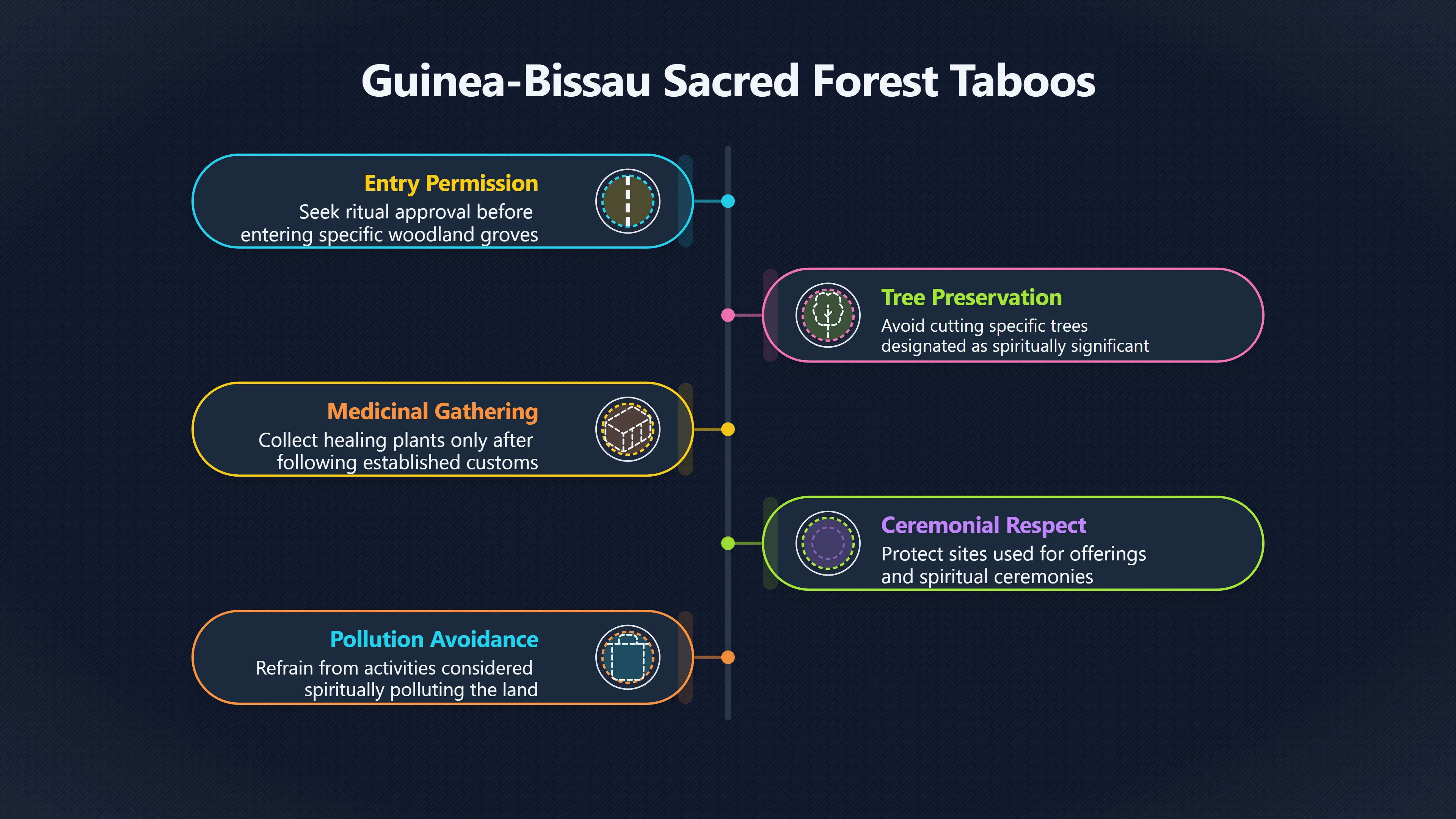
Typical restrictions include:
- seeking permission before entering particular groves;
- avoiding the cutting of certain trees;
- collecting medicinal plants only after following established customs;
- respecting places used for ceremonies or offerings;
- refraining from activities considered spiritually polluting.
These rules mean that sacred forests often survive as islands of relatively undisturbed vegetation within landscapes that have otherwise been heavily used. Researchers studying Guinea-Bissau have noted that forests protected through religious custom are found across different ethnic regions, demonstrating that this is not an isolated tradition but a widespread historical pattern.[Cambridge University Press & Assessment]cambridge.orgThese were widely…Read more…
Medicinal plants occupy a particularly interesting place in these beliefs. The forest is not viewed simply as a forbidden zone but as a source of healing whose benefits depend upon maintaining a respectful relationship with its spiritual guardians. The effectiveness of remedies may therefore be linked, in traditional understanding, not only to the properties of the plants themselves but also to the proper observance of ritual practice.
Why these forests matter beyond folklore
One reason sacred forests attract attention outside anthropology is that they have measurable environmental effects.
Researchers have found that many sacred groves preserve older forest structure, provide habitat for wildlife and protect plant diversity because customary law limits exploitation. In Guinea-Bissau, recent conservation research argues that these traditional systems have historically made a substantial contribution to forest protection, even though they were never designed as environmental policy in the modern sense.[Cambridge University Press & Assessment]cambridge.orgThese were widely…Read more…
This creates an unusual overlap between supernatural belief and practical conservation. Whether or not a visitor believes in invisible guardians, the behavioural effect is real: fewer trees are felled, fewer plants are removed and certain habitats remain relatively intact.
Modern conservation programmes therefore face a delicate question. If younger generations move away from traditional religious beliefs, can community-based management replace the protective power once supplied by sacred taboos? Researchers studying Guinea-Bissau suggest this is one of the country’s major conservation challenges, as the decline of sacred status may weaken long-established informal protections.[Cambridge University Press & Assessment]cambridge.orgThese were widely…Read more…
Why stories of punishment endure
Many traditions include warnings about what happens when sacred rules are ignored. These accounts typically involve unexplained illness, persistent bad fortune or accidents affecting those who entered forbidden places improperly.
From a Fortean perspective, these narratives resemble many other traditions around the world in which supernatural sanctions reinforce community rules. The emphasis is not usually on spectacular miracles but on a chain of events interpreted as meaningful because they follow an act of disrespect.
The stories also serve practical purposes. They discourage over-harvesting, reinforce respect for elders who oversee sacred places and remind younger generations that forests possess both ecological and spiritual value. Because these tales are transmitted orally, individual details often differ from village to village while preserving the same underlying message.
Sceptical and believer readings
Believers generally understand sacred forests literally. For them, invisible guardians are active beings whose continued presence explains why particular places deserve respect. Ritual observance is therefore not symbolic but necessary for maintaining a proper relationship between people, ancestors, nature and the spiritual world.
A sceptical interpretation reaches a different conclusion without dismissing the traditions entirely. Anthropologists and conservation researchers often argue that belief in spirit guardians operates as an effective social institution. Fear of supernatural consequences encourages behaviour that protects woodland, conserves medicinal species and regulates access without requiring permanent policing. Under this interpretation, the guardians need not exist objectively for the traditions to produce genuine environmental benefits.[Cambridge University Press & Assessment]cambridge.orgThese were widely…Read more…
A third perspective attempts to bridge the two. Some scholars suggest that asking whether the spirits are “real” may miss the point. The traditions matter because they organise social behaviour, shape relationships with landscapes and preserve knowledge about particular forests, regardless of how outsiders interpret their supernatural claims.

Why sacred forests remain part of Guinea-Bissau’s Fortean landscape
Sacred forests occupy a distinctive place within Guinea-Bissau’s strange traditions because they blur familiar categories. They are simultaneously religious sites, ecological refuges, historical institutions and sources of enduring supernatural claims.
Unlike many Fortean stories that revolve around one dramatic sighting or unexplained incident, these forests represent a continuing relationship between people and place. Their mystery lies less in spectacular encounters than in the persistent belief that certain landscapes are inhabited by unseen guardians whose authority extends into everyday life.
As traditional beliefs evolve alongside Christianity, Islam and modern conservation, the forests remain culturally important. Whether understood as homes of genuine spiritual beings or as remarkably successful systems of customary environmental management, they demonstrate how folklore can shape the physical landscape as surely as any law or government policy.[Cambridge University Press & Assessment]cambridge.orgThese were widely…Read more…
Amazon book picks
Further Reading
Books and field guides related to Do Spirit Forests Still Guard the Land?. Use these as the next step if you want deeper reading beyond the article.
Braiding Sweetgrass
Explores relationships between people, plants, land and cultural traditions.

African religions & philosophy
Provides context for African spiritual relationships with landscapes and ancestors.
The Forest Unseen
Connects forests, ecology and the deeper meanings people attach to woodland.

The Sacred and The Profane
Directly examines sacred places, rituals and the distinction between ordinary and holy landscapes.
eBay marketplace picks
Marketplace Samples
Live-tested eBay searches with available results related to this page.



Endnotes
1.
Source: cambridge.org
Link:https://www.cambridge.org/core/journals/environmental-conservation/article/shifting-values-and-the-fate-of-sacred-forests-in-guineabissau-are-communitymanaged-forests-the-answer/F737693426FF9BBCD1A7CD5FB370CD30
Source snippet
These were widely...Read more...
2.
Source: chimbo.org
Link:https://www.chimbo.org/wp-content/uploads/2021/06/Taboo-based-governance-of-sacred-forestsin-the-Boe-Guinea-Bissau-G.-Ramachandra-2017.pdf
Source snippet
Taboo based governance of sacred forests in the Boé, Guinea...Chimbo an environmental NGO based in the Netherlands along with its...
Additional References
3.
Source: researchgate.net
Link:https://www.researchgate.net/publication/403779042_Sacred_Groves_and_the_Supernatural_The_Role_of_Indigenous_Beliefs_in_Biodiversity_Conservation_and_Climate_Adaptation_in_Sub-Saharan_Africa
Source snippet
(PDF) Sacred Groves and the Supernatural: The Role of...20 Apr 2026 — Purpose: This study examines the pivotal role of sacred groves and...
4.
Source: satoyamainitiative.org
Link:https://satoyamainitiative.org/case_studies/benins-experience-in-the-management-of-sacred-forests-for-biodiversity-conservation/
Source snippet
Benin's experience in the management of sacred forests for...15 Jan 2012 — This survey is undertaken to share the experience of attainin...
5.
Source: grocentre.is
Link:https://www.grocentre.is/static/gro/publication/416/document/poreku2014.pdf
Source snippet
The aim of this study is to contribute to knowledge about how a traditional belief in sacred groves helps conserve biodiversity in Ghana...
6.
Source: youtube.com
Link:https://www.youtube.com/watch?v=VqIldMNwpDw
Source snippet
Guinea-Bissau sacred forests spirit traditions culture African traditional dancing voodoo🫣 #shorts #voodoo #history #africa David Oguchi...
7.
Source: academia.edu
Link:https://www.academia.edu/28284290/The_role_of_taboos_in_conservation_of_sacred_groves_in_Ghanas_Tallensi_Nabdam_district
Source snippet
red groves in the Tallensi-Nabdam district of Ghana.Read more...
8.
Source: thinklandscape.globallandscapesforum.org
Title: how sacred groves protect deities culture and biodiversity
Link:https://thinklandscape.globallandscapesforum.org/56714/how-sacred-groves-protect-deities-culture-and-biodiversity/
Source snippet
In Asia and Africa, researchers examine the biodiversity benefits inherent to sacred sites.Read more...
9.
Source: youtube.com
Title: Bijagos Islands: Africa’s Hidden Sacred Archipelago
Link:https://www.youtube.com/watch?v=PUqm-qJYhBo
Source snippet
From National Parks to Sacred Forest, Community Sustainability, Equality and Conservation in Africa...
10.
Source: youtube.com
Title: Bissagos Islands, on the Mysterious Islands of West Africa
Link:https://www.youtube.com/watch?v=7XxFadC8aK8
Source snippet
The Bissago People: Masters of Guinea-Bissau’s Archipelago...
11.
Source: thecommonsjournal.org
Link:https://thecommonsjournal.org/articles/10.5334/ijc.1143
Source snippet
Drivers of Biodiversity Conservation in Sacred Grovesby SO Adeyanju · 2022 · Cited by 51 — This paper uses the case study of three sacred...
12.
Source: youtube.com
Title: The Bissago People: Masters of Guinea-Bissau’s Archipelago
Link:https://www.youtube.com/watch?v=CX4n8wj72Is
Source snippet
The science of survival in the Bissagos Islands...
Topic Tree