Within Weird Ireland
When Ireland's Rain Turned Black
Ireland's black-rain reports show how real weather events can become Fortean mysteries before science catches up.
On this page
- Nineteenth century black rain reports in Ireland
- Soot, dust and other natural explanations
- Why explained events still feel Fortean
Page outline Jump by section
Introduction
Ireland’s stories of black rain occupy an unusual place in the country’s strange-history record because they began as alarming eyewitness experiences rather than folklore. People described rain that looked like ink, stained clothing, left gritty deposits or filled the air with an unpleasant smell. To nineteenth-century observers, such events could appear almost apocalyptic. Yet these reports also illustrate how apparently inexplicable weather can move from mystery to scientific explanation without losing its power to fascinate.
Unlike legends of ghosts or fairy forts, black-rain reports were usually recorded in newspapers, meteorological journals and scientific correspondence. That means they can often be traced, compared and, in some cases, explained. They remain part of Irish Forteana not because they defy explanation today, but because they capture the unsettling moment when ordinary weather briefly became something that seemed impossible.
When Ireland’s rain turned black
Several Irish black-rain events attracted widespread attention during the nineteenth and early twentieth centuries. They varied in severity, but shared a common feature: rainwater appeared dark enough to alarm those caught beneath it.
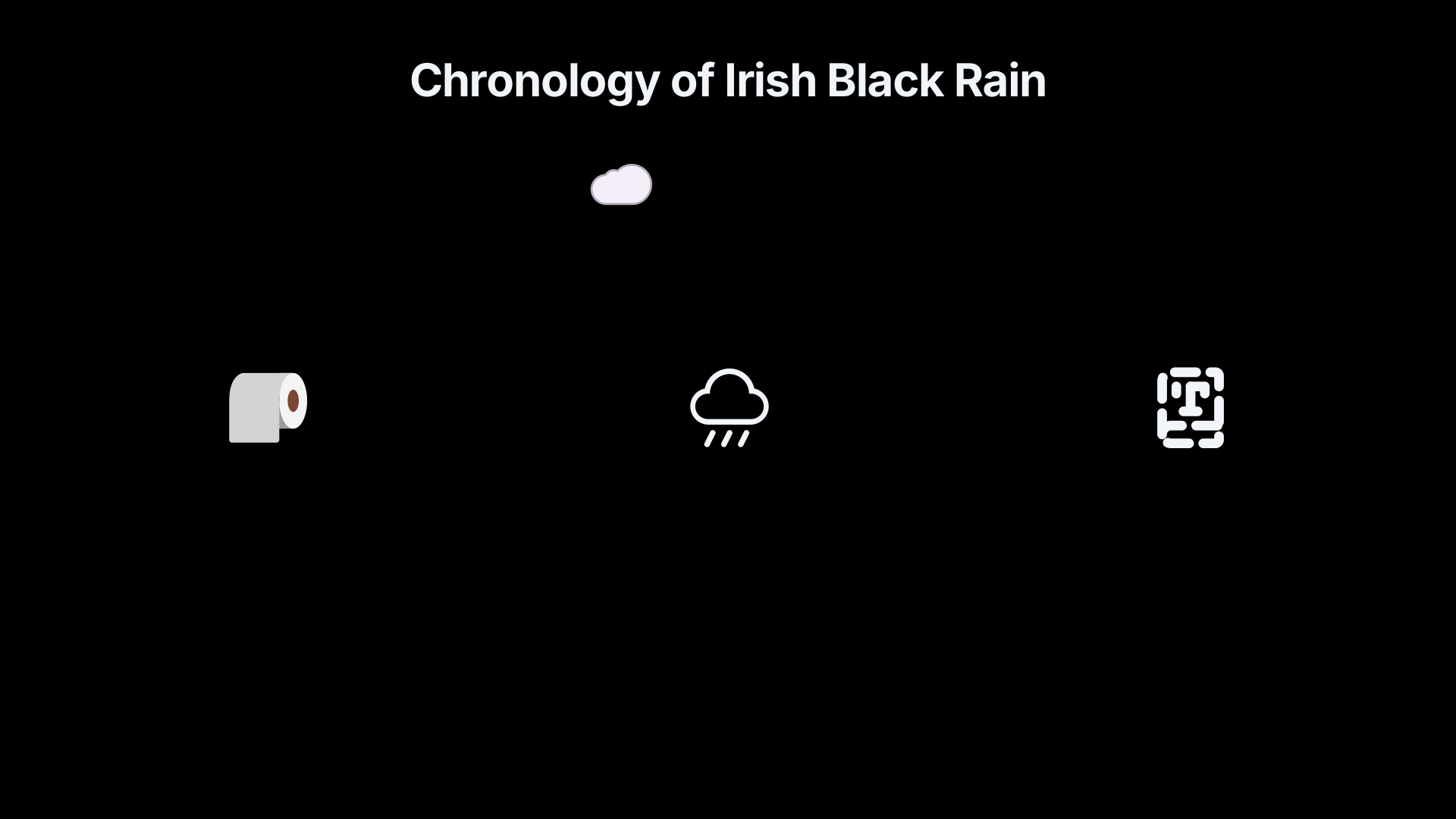
One of the best-known incidents occurred near Castlecomer, County Kilkenny, on 30 April 1887. Contemporary reports described thunderstorms followed by rain that was “thick” and black enough to stain white fabrics. Observers noted that the colour came from fine insoluble particles suspended in the water rather than from the water itself. The event was remarkable enough to be reported internationally in meteorological publications.[kilkennyweather.com]kilkennyweather.com1983 warm july and wettest day1887 Shower of Black Rain - Kilkenny WeatherAt about 7.50 p.m., a thick black rain fell, sufficiently black to stain any white cloth, and…
Earlier accounts were even more dramatic. A report from May 1849 described rain falling over a large area that was compared to ink in colour and accompanied by an unpleasant smell and taste. Such descriptions sound sensational to modern readers, but they appeared in scientific annuals as well as newspapers, suggesting they were treated as genuine meteorological curiosities rather than mere gossip.[Project Gutenberg]gutenberg.orgProject Gutenberg The Book of the Damned The rain at Castlecommon, Ireland,Project GutenbergThe Book of the DamnedThe rain at Castlecommon, Ireland, April 30, 1887—"thick, black rain." (Amer. Met. Jour., 4-193.)…
Another widely discussed episode occurred on 8–9 October 1907, when black rain reportedly fell across parts of Ireland. Contemporary observers commented not only on its appearance but also on the disagreeable odour that lingered afterwards, adding to the sense that something extraordinary had happened.[Wikisource]en.wikisource.orgChapter 3The Book of the Damned/Chapter 3A black rain fell in Ireland, Oct. 8 and 9, 1907. The orthodox explanation of this rain occurs…
These reports naturally found their way into collections of unexplained phenomena. The American writer Charles Fort later gathered Irish black-rain cases in The Book of the Damned, presenting them as examples of atmospheric events that conventional science struggled to explain fully at the time.[Wikisource]en.wikisource.orgChapter 3The Book of the Damned/Chapter 3A black rain fell in Ireland, Oct. 8 and 9, 1907. The orthodox explanation of this rain occurs…
Soot, dust and other natural explanations
What seemed mysterious to eyewitnesses became much less mysterious as atmospheric science developed.
The explanation favoured by meteorologists was surprisingly mundane: industrial pollution. During the late nineteenth and early twentieth centuries, Britain contained vast concentrations of coal-fired industry. Smoke from factories, foundries and domestic coal fires released enormous quantities of soot into the atmosphere. Under suitable wind conditions, these particles could travel hundreds of kilometres before being washed out by rainfall.
For the Irish events, scientific journals suggested that strong air currents had carried soot from the industrial regions of northern England, southern Scotland or South Wales across the Irish Sea. When rain developed, the suspended particles were scavenged from the atmosphere, producing water that appeared black or very dark grey.[Wikisource]en.wikisource.orgChapter 3The Book of the Damned/Chapter 3A black rain fell in Ireland, Oct. 8 and 9, 1907. The orthodox explanation of this rain occurs…
This process is now well understood. Rain naturally removes airborne aerosols—including soot, ash, smoke and mineral dust—from the atmosphere. Depending on the concentration and composition of those particles, precipitation may leave visible deposits on buildings, vehicles or clothing. Modern examples occur after large wildfires or major pollution events, although environmental regulations have made coal-smoke black rain far less common in western Europe.[Wikipedia]WikipediaBlack rainBlack rain
Not every dark rainfall necessarily has the same cause. Atmospheric dust transported over long distances, volcanic ash, wildfire smoke and industrial emissions can all discolour precipitation to varying degrees. The important point is that the colour usually reflects material already suspended in the atmosphere rather than something unusual forming within the rain itself.

Why people found the events so disturbing
To modern readers accustomed to pollution science, black rain may seem little more than dirty weather. For people living in Victorian Ireland, however, it could be genuinely frightening.
Several factors amplified its impact:
- Its appearance was startling. Rain was expected to be clear. Water resembling ink or leaving black stains challenged everyday experience.
- Industrial pollution was poorly understood. Although smoke-filled cities were familiar, the idea that soot could travel across seas and fall with rain was not widely appreciated.
- The smell reinforced the mystery. Reports of unpleasant odours encouraged speculation that the rain itself had somehow become corrupted.
- Newspapers spread the story quickly. Strange weather made excellent copy, ensuring local events reached national and international audiences.
These reactions help explain why black-rain reports entered both scientific literature and the wider culture of curious phenomena.
Why explained events still feel Fortean
Black rain demonstrates an important feature of Irish Forteana: not every mystery remains mysterious.
Many of Ireland’s strange weather stories sit on the boundary between genuine observation and incomplete scientific knowledge. Witnesses accurately described something unusual, but lacked the tools to identify its cause. Later research provided a convincing explanation without suggesting that the original observers were dishonest or deluded.
That pattern distinguishes black rain from hoaxes or legends. The rain almost certainly was black to those who experienced it. The real puzzle was not whether it happened, but why.
The cases also reveal how rapidly science can change the meaning of extraordinary reports. A Victorian observer might reasonably have suspected volcanic activity, divine judgement or some unknown atmospheric phenomenon. A modern meteorologist is more likely to examine wind trajectories, industrial emissions and airborne particulates.
Yet the emotional impact survives. Even today, the thought of rain dark enough to stain clothing and leave soot across the landscape carries an unsettling quality that explains why these episodes continue to appear in collections of unexplained history.

Black rain in Ireland’s wider strange-weather tradition
Irish Forteana contains numerous reports of unusual weather, from coloured rains and mysterious atmospheric lights to remarkable storms remembered for generations. Black rain occupies a distinctive place because it illustrates how extraordinary experiences can migrate from mystery into accepted science while remaining culturally memorable.
Rather than diminishing the stories, the scientific explanation arguably makes them more interesting. They preserve a record of an era when industrialisation transformed not only landscapes but even the weather people experienced. Ireland’s black-rain reports remind us that some of the strangest entries in the country’s weird-history record were genuine natural events whose causes took time—and cleaner air—to understand.
Amazon book picks
Further Reading
Books and field guides related to When Ireland's Rain Turned Black. Use these as the next step if you want deeper reading beyond the article.
Extraordinary Popular Delusions and the Madness of Crowds
Rating: 4.0/5 from 5 Google Books ratings
Helps frame sensational reports in historical context.

Meeting the Other Crowd
Connects this story with Ireland's wider strange-history tradition.
eBay marketplace picks
Marketplace Samples
Live-tested eBay searches with available results related to this page.




Endnotes
1.
Source: kilkennyweather.com
Title: 1983 warm july and wettest day
Link:https://www.kilkennyweather.com/index.php/1983-warm-july-and-wettest-day
Source snippet
1887 Shower of Black Rain - Kilkenny WeatherAt about 7.50 p.m., a thick black rain fell, sufficiently black to stain any white cloth, and...
2.
Source: gutenberg.org
Title: Project Gutenberg The Book of the Damned The rain at Castlecommon, Ireland,
Link:https://www.gutenberg.org/files/22472/22472-h/22472-h.htm
Source snippet
Project GutenbergThe Book of the DamnedThe rain at Castlecommon, Ireland, April 30, 1887—"thick, black rain." (Amer. Met. Jour., 4-193.)...
Published: April 30, 1887
3.
Source: en.wikisource.org
Title: Chapter 3
Link:https://en.wikisource.org/wiki/The_Book_of_the_Damned/Chapter_3
Source snippet
The Book of the Damned/Chapter 3A black rain fell in Ireland, Oct. 8 and 9, 1907. The orthodox explanation of this rain occurs...
4.
Source: Wikipedia
Title: Black rain
Link:https://en.wikipedia.org/wiki/Black_rain
5.
Source: gutenberg.org
Title: 22472.txt.utf 8
Link:https://www.gutenberg.org/ebooks/22472.txt.utf-8
Source snippet
The Book of the DamnedThe rain at Castlecommon, Ireland, A black rain fell in Ireland, Oct. 8 and 9, 1907. On the 19th, a black rain fell...
6.
Source: en.wikisource.org
Title: Page:The Book of the Damned (Fort, 1919).djvu
Link:https://en.wikisource.org/wiki/Page%3AThe_Book_of_the_Damned_%28Fort%2C_1919%29.djvu/36
Source snippet
8 and 9, 1907. The orthodox explanation of this rain occurs in Nature, March 2, 1908—cloud of soot that had...
Published: March 2, 1908
7.
Source: facebook.com
Link:https://www.facebook.com/100070121529381/photos/black-rain-once-fell-on-co-kilkennyon-30-april-1887-a-thick-black-liquid-fell-fr/1220072930340080/
Source snippet
Black rain once fell on Co. Kilkenny. On 30 April...Black rain once fell on Co. Kilkenny. On 30 April 1887, a thick black liquid fell fr...
Published: April 1887
Additional References
8.
Source: researchgate.net
Link:https://www.researchgate.net/publication/231861233_Bloody_rain_again_Red_rain_and_meteors_in_history_and_myth
Source snippet
Bloody rain again! Red rain and meteors in history and mythThis paper examines historical and mythical accounts of red rain, to establish...
9.
Source: penguinrandomhouse.ca
Title: Penguin Random House Canada Excerpt from The Book of the Damned Ireland,
Link:https://www.penguinrandomhouse.ca/books/533872/the-book-of-the-damned-by-charles-fort/excerpt
Source snippet
Excerpt from The Book of the DamnedThe rain at Castlecommon, Ireland, April 30, 1887—“thick, black rain.” A black rain fell in Ireland, O...
Published: April 30, 1887
10.
Source: pearl-hifi.com
Title: Charles Fort The Complete Books of Charles Fort
Link:https://pearl-hifi.com/11_Spirited_Growth/01_Books/Fort_Charles/Charles_Fort_The_Complete_Books_of_Charles_Fort.pdf
Source snippet
The Complete Books of Charles Fortextraordinary atmospheric effects of 1883 were first noticed … these phenomena were caused by particles...
11.
Source: facebook.com
Link:https://www.facebook.com/anna.zajac.3363/posts/there-it-came-the-long-awaited-irish-rainand-everything-feels-different-softer-q/10236805779898660/
Source snippet
ort in Kinsale, Charles Fort, Kinsale, Ireland...
12.
Source: westmoorsmiscellany.co.uk
Title: The Diary of John Oram
Link:https://www.westmoorsmiscellany.co.uk/the-diary-of-john-oram/
Source snippet
West Moors MiscellanyThe Diary of John Oram In the autumn of 2012, I was given a DVD containing the scanned copy of the diaries of John O...
13.
Source: cambridge.org
Title: Bloody rain again!
Link:https://www.cambridge.org/core/journals/international-journal-of-astrobiology/article/bloody-rain-again-red-rain-and-meteors-in-history-and-myth/6992ADC2B065A8EC8657C06286E476D4
Source snippet
Red rain and meteors in history and mythby P McCafferty · 2008 · Cited by 24 — This paper examines historical and mythical accounts of re...
14.
Source: youtube.com
Link:https://www.youtube.com/watch?v=BS85o8PX9Fk
Source snippet
What is blood rain and where does it come from?...
15.
Source: allaboutheaven.org
Title: All About Heaven Fort, Charles
Link:https://allaboutheaven.org/observations/fort-charles-the-book-of-the-damned-black-rain-011872/221
Source snippet
Mag. 33-40, to clouds of soot from the manufacturing towns of North England and South...Read more...
16.
Source: facebook.com
Link:https://www.facebook.com/photo.php?fbid=1220072930340080&set=a.385057180508330&type=3
Source snippet
Black rain once fell on Co. Kilkenny. On 30...12 Feb 2026 — On 30 April 1887, a thick black liquid fell from the sky on Castlecomer ・ a...
Published: April 1887
17.
Source: youtube.com
Title: 14 Strange Rains Happened Once on Earth
Link:https://www.youtube.com/watch?v=nXD7u3QVrYA
Source snippet
Wild Talents. By Charles Fort. Audiobook...
Topic Tree