Within Guinea Bissau Strange
Why Are Hippos Swimming by the Sea?
The Bijagos islands turn familiar animals into strange-history material through ocean-edge hippos, sacred places and guarded ecology.
On this page
- The Orango hippo oddity
- Sacred islands and protected wildlife
- Where wonder meets ecology
Page outline Jump by section
Introduction
The Bijagós Archipelago is one of the few places on Earth where an animal usually associated with rivers and lakes can sometimes be seen moving through tidal channels and even swimming in coastal waters. The hippos of Orango National Park have become one of Guinea-Bissau’s most famous wildlife stories, often described as “saltwater hippos”. That description sounds almost mythical, but the underlying phenomenon is real: these are ordinary common hippopotamuses that have adapted their behaviour to an unusual island landscape of mangroves, lagoons and shifting tides rather than becoming a separate species. At the same time, the islands themselves are bound together by sacred traditions that have helped protect habitats and wildlife for generations, creating an unusual meeting point between ecological science and living belief.[unesco.org]whc.unesco.orgUNESCO World Heritage CentreCoastal and Marine Ecosystems of the Bijagós Archipelago17 Jul 2025 — The site is home to a rich biodiversity…
Why are hippos swimming by the sea?
The heart of the story lies on Orango and neighbouring islands in the Bijagós Archipelago. Unlike most hippos, which spend their days in permanent rivers or lakes, the Orango population regularly travels through mangrove creeks, tidal flats and coastal lagoons influenced by the Atlantic Ocean. During some seasons they may even be seen crossing stretches of shallow coastal water between feeding areas.
This has led to repeated descriptions of them as “marine” or “saltwater” hippos. The phrase is colourful but can also be misleading. Zoologists do not regard them as a distinct species or recognised subspecies. Instead, they are a geographically isolated population of the common hippopotamus whose behaviour has adapted to an island environment where freshwater, brackish water and seawater are closely connected by the tides. Their movements appear to follow seasonal changes in water levels and food availability rather than any mysterious attraction to the sea itself.[fundacion-biodiversidad.es]fundacion-biodiversidad.esFundación BiodiversidadImproving the food security of the Bijago population and…The project aims to resolve conflicts between rice cro…
From a Fortean perspective, the spectacle is memorable because it overturns expectations. Hippos are almost universally imagined as inhabitants of inland African rivers. Seeing them emerge from mangroves beside Atlantic beaches feels almost surreal, encouraging travellers to describe them as impossible or legendary even though careful ecological research explains how they survive there.
The Orango hippo oddity
The Orango population is scientifically significant for several reasons beyond its unusual habitat.
First, it occupies the western edge of the species’ natural range. Isolation on the islands has created a relatively small and vulnerable population whose conservation is treated as a priority in international hippo action plans. Local conservation projects have also had to balance protection of the animals with the needs of island communities, particularly where hippos raid rice fields.[Fundación Biodiversidad]fundacion-biodiversidad.esFundación BiodiversidadImproving the food security of the Bijago population and…The project aims to resolve conflicts between rice cro…
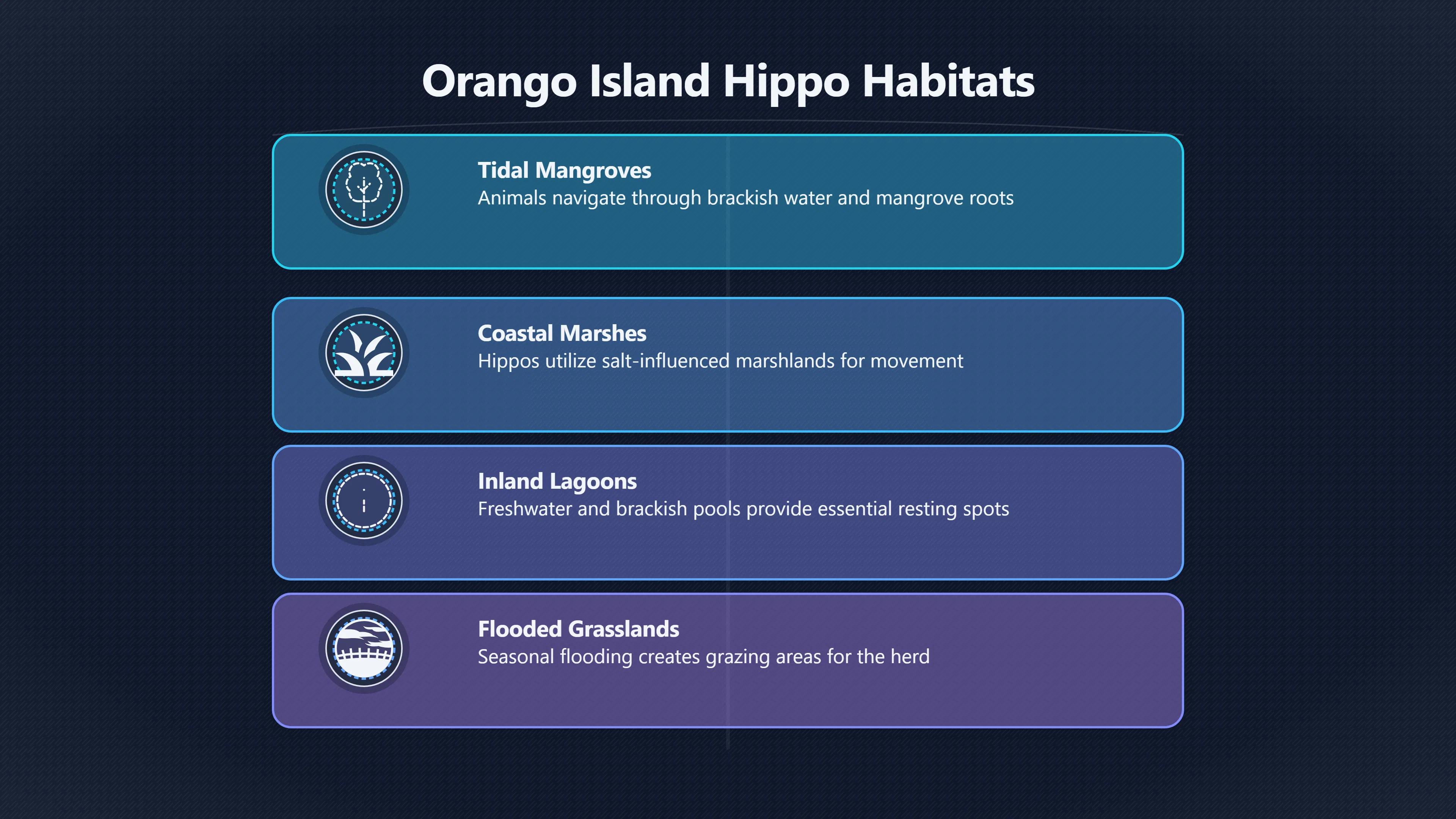
Second, their daily routine differs from the classic picture of hippos resting in broad freshwater rivers. On Orango they make use of:
- tidal mangrove channels;
- coastal marshes;
- inland lagoons;
- seasonally flooded grasslands.
Researchers believe this behaviour reflects the unusual geography of the archipelago rather than any special physiological adaptation to seawater. They still depend on freshwater sources and terrestrial grazing, but they are remarkably comfortable navigating environments shaped by ocean tides.[Fundación Biodiversidad]fundacion-biodiversidad.esFundación BiodiversidadImproving the food security of the Bijago population and…The project aims to resolve conflicts between rice cro…
This distinction matters because popular travel writing sometimes exaggerates the claim into the idea that the animals “live in the sea”. The evidence instead shows a population living within an intricate coastal mosaic where marine and freshwater habitats overlap.
Sacred islands and protected wildlife
The hippos are only one part of a much broader relationship between culture and conservation in the Bijagós.
Many islands are regarded by the Bijagó people as sacred places associated with ancestors, rituals and traditional authority. Some islands remain largely uninhabited because access has long been restricted by religious custom, while others contain sacred forests, initiation sites or ritual landscapes. Estimates suggest that a large proportion of the archipelago’s islands possess some form of sacred status.[Sacred Natural Sites]sacrednaturalsites.orgAlmost three quarters of all 88 islands in the archipelago are…Read more…
These beliefs have had practical ecological consequences.
Traditional restrictions have often limited hunting, tree cutting and permanent settlement in sensitive areas. Long before international conservation programmes arrived, local customs helped preserve habitats that today are recognised as internationally important for biodiversity.
One striking example is Poilão Island. The island has long been considered sacred, and traditional rules limiting disturbance helped protect what scientists later confirmed is one of the Atlantic Ocean’s most important nesting sites for green sea turtles. Modern conservation builds on, rather than replaces, these older traditions.[ResearchGate]researchgate.netResearchGate(PDF) First census of the green turtle at Poilifilo, Bijagos…This study confirmed that Poilão is one of the most important…
In this sense, the “mystery” is not supernatural wildlife but the way spiritual geography and ecological protection reinforce one another.
Where wonder meets ecology
The Bijagós illustrate an important pattern found in several parts of Africa: places described in folklore as spiritually powerful often turn out to be biological refuges.
For sceptics, the explanation is straightforward. Sacred taboos reduced human disturbance, allowing vulnerable species to survive where they might otherwise have disappeared.
For local believers, the direction of cause and effect is often reversed. The abundance of wildlife is itself evidence that the islands remain under the protection of ancestral or spiritual forces. The continued presence of rare animals—including hippos, sea turtles, manatees and migratory birds—confirms that these landscapes deserve respect rather than exploitation.[UNESCO]unesco.orgUNESCO strengthens its support to Guinea-Bissau for the…20 Apr 2023 — They are a sanctuary for hundreds of animal species, inclu…
Neither perspective removes the fascination. Instead, they describe the same landscape through different languages: ecology on one hand and sacred tradition on the other.
Why the Bijagós matter in Guinea-Bissau’s strange history
Within Guinea-Bissau’s wider catalogue of unusual traditions, the Bijagós stand out because the remarkable claims are anchored in observable reality.
Visitors genuinely can encounter hippos using tidal channels close to the Atlantic coast. Scientists genuinely recognise the population as behaviourally unusual and conservation priorities reflect its rarity. Sacred islands genuinely exist within Bijagó culture, and archaeological, anthropological and ecological studies all show that traditional beliefs have influenced how land and wildlife have been protected.[fundacion-biodiversidad.es]fundacion-biodiversidad.esFundación BiodiversidadImproving the food security of the Bijago population and…The project aims to resolve conflicts between rice cro…
That combination makes the archipelago especially attractive to Fortean readers. It is not a story of hidden monsters or impossible beasts, but of a landscape where astonishing wildlife, ancient ritual traditions and modern conservation overlap so closely that folklore and field biology seem to illuminate one another rather than compete.
Amazon book picks
Further Reading
Books and field guides related to Why Are Hippos Swimming by the Sea?. Use these as the next step if you want deeper reading beyond the article.

The Hidden Life of Trees
Broadens the wildlife-and-landscape angle around unusual natural environments.
The Soul of an Octopus
Captures the wonder and intelligence-of-animals theme behind unusual wildlife stories.

The Serengeti rules
Provides accessible ecological context for animal adaptation and conservation.
eBay marketplace picks
Marketplace Samples
Live-tested eBay searches with available results related to this page.

Endnotes
1.
Source: whc.unesco.org
Link:https://whc.unesco.org/en/list/1431/
Source snippet
UNESCO World Heritage CentreCoastal and Marine Ecosystems of the Bijagós Archipelago17 Jul 2025 — The site is home to a rich biodiversity...
2.
Source: unesco.org
Link:https://www.unesco.org/en/mab/bolama-bijagos
Source snippet
It was formed from the ancient delta...Read more...
3.
Source: researchgate.net
Link:https://www.researchgate.net/publication/227943800_First_census_of_the_green_turtle_at_Poilifilo_Bijagos_Archipelago_Guinea-Bissau_the_most_important_nesting_colony_on_the_Atlantic_coast_of_Africa
Source snippet
ResearchGate(PDF) First census of the green turtle at Poilifilo, Bijagos...This study confirmed that Poilão is one of the most important...
4.
Source: unesco.org
Link:https://www.unesco.org/en/articles/unesco-strengthens-its-support-guinea-bissau-protection-bijagos-islands
Source snippet
UNESCO strengthens its support to Guinea-Bissau for the...20 Apr 2023 — They are a sanctuary for hundreds of animal species, inclu...
5.
Source: unesco.org
Title: The Organization
Link:https://www.unesco.org/en
Source snippet
Building Peace through Education, Science and...UNESCO is the United Nations organization that promotes cooperation in educatio...
6.
Source: researchgate.net
Link:https://www.researchgate.net/publication/234554876_Distribution_and_current_status_of_the_West_African_manatee_Trichechus_senegalensis_in_Guinea-Bissau
Source snippet
of the West African manatee in Guinea-Bissau.Read more...
7.
Source: researchgate.net
Link:https://www.researchgate.net/publication/271842073_The_Bijagos_Islands_culture_resistance_and_conservation
Source snippet
The Bijagós Islands; culture, resistance and conservationThe Bijagós inhabit a complex of 90 islands and islets, including extensive mang...
8.
Source: fundacion-biodiversidad.es
Link:https://fundacion-biodiversidad.es/en/proyectos_ficha/improving-the-food-security-of-the-bijago-population-and-the-conservation-of-the-hippopotamus-in-the-orango-national-park-guinea-bissau/
Source snippet
Fundación BiodiversidadImproving the food security of the Bijago population and...The project aims to resolve conflicts between rice cro...
9.
Source: sacrednaturalsites.org
Link:https://sacrednaturalsites.org/items/increasing-recognition-for-sacred-natural-sites-in-coastal-regions-in-guinea-bissau/
Source snippet
Almost three quarters of all 88 islands in the archipelago are...Read more...
10.
Source: bijagos.com
Link:https://bijagos.com/
Source snippet
Visit the tropical islands of Bijagos ArchipelagoThe islands are home to a diverse range of animals, including monkeys, hippos...
11.
Source: ceibabissau.com
Title: saltwater hippos
Link:https://ceibabissau.com/saltwater-hippos/
Source snippet
Hotel Ceiba Bissau25 Mar 2023 — The marine hippos of Orango Island are a subspecies of the common hippopotamus (Hippopotamus amphibius) a...
12.
Source: prcmarine.org
Link:https://www.prcmarine.org/bijagos/article/10759
Additional References
13.
Source: responsibletravel.com
Link:https://www.responsibletravel.com/holidays/guinea-bissau/travel-guide/the-bijagos-archipelago
Source snippet
Bijagos Archipelago in Guinea-BissauRare but elusive saltwater hippos can sometimes be spotted swimming along the shoreline and even betw...
14.
Source: got2globe.com
Link:https://www.got2globe.com/en/editorial/orango-marine-hippos-bijagos/
Source snippet
Orangutans and Marine Hippos of the Bijagós IslandsThey are the most lethal mammals in Africa and, in Bijagós, they are venerated. We joi...
15.
Source: mava-foundation.org
Link:https://mava-foundation.org/library/sacred-islands-how-community-and-culture-are-driving-sustainability-in-the-bijagos-archipelago-and-beyond/
Source snippet
Sacred islands – how community and culture are driving...10 Jan 2020 — Today, the Bijagós archipelago hosts a network of protected areas...
16.
Source: iucn.org
Title: protecting chimps hippos and turtles iucn recommends five new world heritage
Link:https://iucn.org/press-release/202505/protecting-chimps-hippos-and-turtles-iucn-recommends-five-new-world-heritage
Source snippet
IUCN recommends five new World Heritage areas27 May 2025 — Protecting chimps, hippos and turtles – IUCN recommends five new World Heritag...
Published: May 2025
17.
Source: consulmartravel.com
Title: To reach it, it is necessary to travel first to Bissau and then take a speedboat
Link:https://www.consulmartravel.com/en/orango-and-its-saltwater-hippopotamus-a-unique-destination-in-the-world/
Source snippet
Orango and its saltwater hippopotamus: a unique...Orango National Park is located in the southwest of the Bijagós archipelago...
18.
Source: seaturtlestatus.org
Title: conservation progress in the bijags archipelago guinea bissau
Link:https://www.seaturtlestatus.org/articles/2016/conservation-progress-in-the-bijags-archipelago-guinea-bissau
Source snippet
Conservation Progress in the Bijagós Archipelago, Guinea-...1 Feb 2016 — The Institute of Biodiversity and Protected Areas (IBAP) has me...
19.
Source: eu-space.europa.eu
Title: tidal landscapes bijagos archipelago guinea bissau
Link:https://eu-space.europa.eu/components/earth-observation-copernicus/image-of-the-day/tidal-landscapes-bijagos-archipelago-guinea-bissau
Source snippet
landscapes of the Bijagós Archipelago, Guinea-Bissau28 Jun 2026 — The Bijagós Archipelago, a system of 88 islands off the coast of Guinea...
20.
Source: orangohotel.com
Title: hippos on the island of orango guinea bissau
Link:https://www.orangohotel.com/en/hippos-on-the-island-of-orango-guinea-bissau/
Source snippet
Hippos on the island of Orango – Guinea Bissau1 Sept 2022 — That animal is the saltwater or marine hippopotamus, which alternates its lif...
21.
Source: responsiblevacation.com
Title: Bijagos Archipelago in Guinea-Bissau
Link:https://www.responsiblevacation.com/vacations/guinea-bissau/travel-guide/the-bijagos-archipelago
Source snippet
Responsible TravelThe Bijagos Islands are the jewel in Guinea-Bissau's crown, an archipelago of 88 islands that are a UNESCO World Herita...
22.
Source: iucnsos.org
Title: new national parks for guinea bissau
Link:https://iucnsos.org/new-national-parks-for-guinea-bissau/
Source snippet
26 Apr 2018 — Guinea Bissau creates two new National Parks, home to the Critically Endangered Western Chimpanzee, with support from IUCN...
Topic Tree