Within Burundi
When Superstition Became Real Violence
The violence against people with albinism shows how magical rumours can become a documented human-rights emergency.
On this page
- Rumours about bodies and luck
- Documented attacks and fear
- How to cover the story responsibly
Page outline Jump by section
Introduction
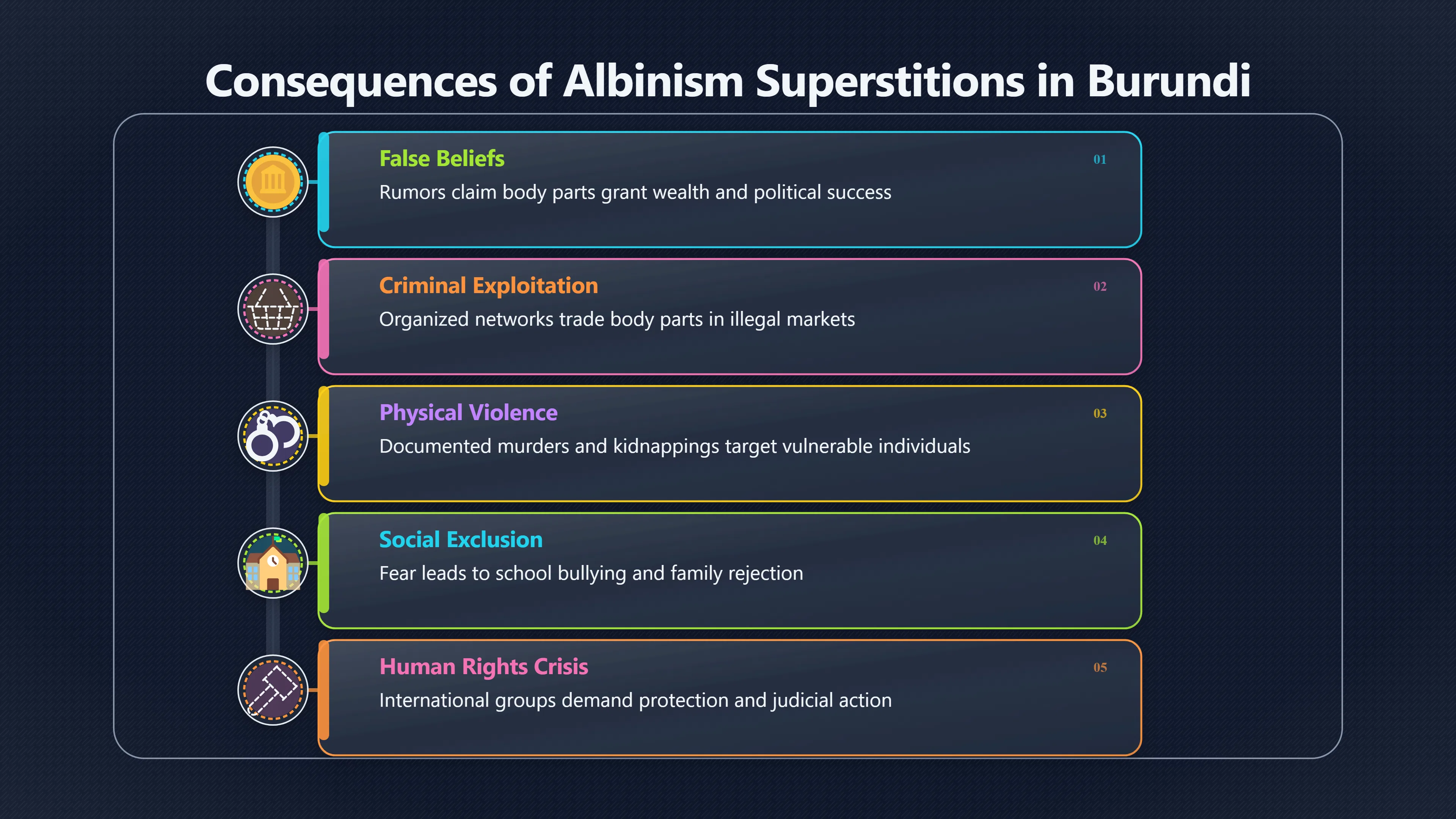
Beliefs about people with albinism in Burundi are not an example of harmless folklore or colourful local legend. They are a documented case of superstition contributing to violence, fear and discrimination. Rumours that body parts from people with albinism can bring wealth, political success or good fortune have been linked to murders, attempted kidnappings and grave robberies across parts of East Africa, including Burundi. These crimes are not evidence for supernatural powers. Instead, they show how magical thinking, criminal networks and social prejudice can combine into a serious human-rights emergency. International organisations, Burundian courts and human-rights groups have treated the issue as a matter of protecting lives rather than investigating paranormal claims.[reliefweb.int]reliefweb.intRelief Web Defending albinos' rights to lifeDefending albinos' rights to life - Burundi8 Jun 2009 — In Burundi last November, however, two men were jailed for life for kill…

Within a survey of Burundi’s strange history and Fortean traditions, this subject occupies a very different place from lake-monster stories or ghost folklore. It illustrates the real-world consequences of belief in the supposedly magical properties of human bodies, making it one of the country’s most sobering examples of rumour becoming deadly reality.
Rumours about bodies and luck
The central superstition is that the bodies of people with albinism possess extraordinary powers. Different versions claim that bones, hair, blood or other body parts can be used in rituals to attract wealth, improve business, guarantee political success or provide protection from misfortune. Such beliefs have circulated in parts of East and Central Africa for decades, although they vary between regions and should never be treated as universal cultural traditions.
Researchers who study these attacks stress that the beliefs are not ancient, fixed customs shared by entire societies. Instead, they are often reinforced by individuals claiming magical expertise who promise clients wealth or influence through ritual practices. Criminal profit also plays a role, with body parts becoming commodities in illegal markets rather than sacred objects in recognised religious traditions.[fu-berlin.de]fu-berlin.deI. (1951): Basutoland Medicine Murder. A Report on the Recent. Outbreak of 'Diretlo' Murders in Basutoland. Presented by the Secretary of…
Just as importantly, harmful myths extend beyond ritual killings. People with albinism have also been falsely described as ghosts, cursed individuals or bearers of bad luck. Such ideas encourage social exclusion, school bullying, family rejection and discrimination long before physical violence occurs. The United Nations has repeatedly highlighted these misconceptions as violations of basic human rights rather than expressions of protected cultural belief.[OHCHR]ohchr.orgReportsThe following table lists the reports of the Independent Expert on the human rights of persons with albinism presented to the…
Documented attacks and fear
Burundi became internationally known for attacks on people with albinism during the late 2000s, when killings in neighbouring Tanzania spread fear across borders. Human-rights organisations documented murders, attempted abductions and the trafficking of body parts linked to magical beliefs. Families began hiding children with albinism or relocating them for safety, while some people avoided travelling alone or attending school because of the perceived risk.[reliefweb.int]reliefweb.intRelief Web Defending albinos' rights to lifeDefending albinos' rights to life - Burundi8 Jun 2009 — In Burundi last November, however, two men were jailed for life for kill…
One widely reported Burundian case occurred in 2008, when a young girl with albinism was murdered and dismembered. The crime attracted international attention because it demonstrated that the violence seen elsewhere in the region had reached Burundi. Authorities subsequently prosecuted several suspects, and in 2009 two men received life sentences for murdering people with albinism, signalling an unusually strong judicial response compared with the widespread impunity that often surrounded similar crimes in the region.[ReliefWeb]reliefweb.intRelief Web Defending albinos' rights to lifeDefending albinos' rights to life - Burundi8 Jun 2009 — In Burundi last November, however, two men were jailed for life for kill…
The violence also affected communities beyond the immediate victims. Families feared grave robbery after relatives with albinism died, prompting extra security at funerals and cemeteries in some areas. Advocacy groups argued that the constant fear itself constituted a human-rights abuse because it prevented ordinary participation in education, employment and public life.[OHCHR]ohchr.orgReportsThe following table lists the reports of the Independent Expert on the human rights of persons with albinism presented to the…
Why the rumours persisted
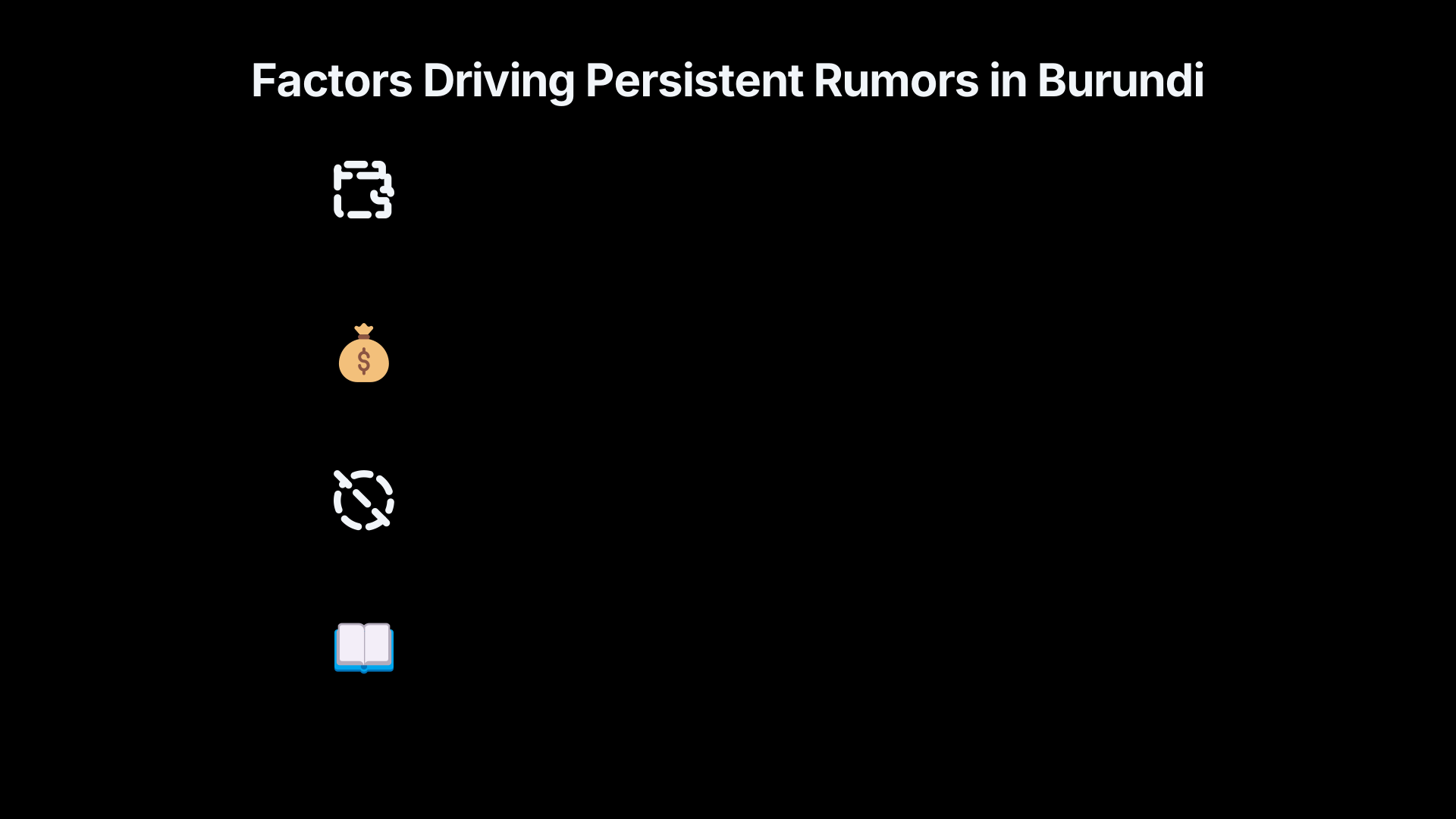
The persistence of these beliefs cannot be explained simply by tradition. Researchers point instead to several overlapping factors:
- Economic desperation, making false promises of sudden wealth more attractive.
- Criminal opportunism, with organised networks exploiting superstition for profit.
- Weak law enforcement in some periods, allowing offenders to believe they could escape punishment.
- Low public understanding of albinism, encouraging myths to flourish where medical knowledge is limited.
This combination explains why the same rumours can appear across national borders despite differences in language, ethnicity and local culture. The beliefs spread through stories, imitation and criminal incentives rather than through any verified supernatural phenomenon.[fu-berlin.de]fu-berlin.deI. (1951): Basutoland Medicine Murder. A Report on the Recent. Outbreak of 'Diretlo' Murders in Basutoland. Presented by the Secretary of…
How to cover the story responsibly
Because this subject sits at the intersection of folklore and violence, responsible reporting requires care. The unusual claims are part of the story, but they should never be presented as plausible paranormal mysteries.
Good reporting distinguishes clearly between three separate things:
- The belief: some people genuinely claim that body parts from people with albinism possess magical properties.
- The evidence: there is no scientific evidence that people with albinism have supernatural powers or that rituals involving body parts produce wealth or luck.
- The consequence: belief in these false claims has contributed to documented murders, assaults, kidnappings and widespread fear.
The United Nations has consistently framed the issue as one of discrimination, violence and human rights. Its Independent Expert on the enjoyment of human rights by persons with albinism has argued that combating these crimes requires criminal prosecutions alongside education about the genetic nature of albinism and stronger protection for vulnerable communities.[OHCHR]ohchr.orgReportsThe following table lists the reports of the Independent Expert on the human rights of persons with albinism presented to the…

Why this belongs in Burundi’s strange-history record
Most Fortean subjects revolve around uncertain sightings, unexplained events or persistent legends. The Burundian story of albinism is unusual because the supernatural claim itself is not the mystery. The claim has been repeatedly investigated and found to have no factual basis.
What gives it lasting significance is the extraordinary influence of the rumour. False ideas about magical bodies shaped criminal behaviour, altered family life, prompted international human-rights interventions and became one of the most disturbing examples of belief producing measurable real-world harm.
For anyone exploring Burundi’s stranger history, this episode serves as an important reminder that not every uncanny story belongs in the same category. Some legends remain fireside tales. Others leave victims, court cases and lasting trauma. The history of violence against people with albinism belongs firmly in the latter group.
Amazon book picks
Further Reading
Books and field guides related to When Superstition Became Real Violence. Use these as the next step if you want deeper reading beyond the article.

The Spirit Catches You and You Fall Down
Helps readers understand how belief systems affect real lives.
African religions & philosophy
Places supernatural beliefs in wider African religious context.

An Anthropologist on Mars
Encourages evidence-based thinking about unusual human conditions.

Burundi: Ethnic Conflict and Genocide
Provides political and social background for Burundi.
eBay marketplace picks
Marketplace Samples
Live-tested eBay searches with available results related to this page.


Endnotes
1.
Source: reliefweb.int
Title: Relief Web Defending albinos’ rights to life
Link:https://reliefweb.int/report/burundi/defending-albinos-rights-life
Source snippet
Defending albinos' rights to life - Burundi8 Jun 2009 — In Burundi last November, however, two men were jailed for life for kill...
2.
Source: ohchr.org
Link:https://www.ohchr.org/en/special-procedures/ie-albinism/reports
Source snippet
ReportsThe following table lists the reports of the Independent Expert on the human rights of persons with albinism presented to the...
3.
Source: digitallibrary.un.org
Link:https://digitallibrary.un.org/record/763417/files/A_HRC_24_57-EN.pdf
Source snippet
un.orgA/HRC/24/57 General Assembly12 Sept 2013 — In the Digo and Maasai tribes, newborn children with albinism were killed after a trial...
4.
Source: fu-berlin.de
Link:https://www.fu-berlin.de/sites/cas/medienordner/CAS-WP/cas_wp_no_2-13.pdf
Source snippet
I. (1951): Basutoland Medicine Murder. A Report on the Recent. Outbreak of 'Diretlo' Murders in Basutoland. Presented by the Secretary of...
5.
Source: ajod.org
Link:https://ajod.org/index.php/ajod/article/view/1874/4275
Source snippet
killings and physical attacks. Between 2000 and 2013, the UN documented over 200 ritual attacks in 15 African countries, although the act...
Additional References
6.
Source: instagram.com
Title: In parts of sub‑Saharan Africa, people with albinism face
Link:https://www.instagram.com/p/DMXeheYMdGD/?hl=en
Source snippet
killed 400 people with guns Pakistan army is killing people. Why are... boost albino rights protection, citing discrimination, attacks i...
7.
Source: europarl.europa.eu
Link:https://www.europarl.europa.eu/doceo/document/B-8-2017-0544_EN.html
Source snippet
killings during the 2010s, according to UN High Commissioner of Human Rights... killings, and abductions against persons with albinism...
8.
Source: africaalbinismnetwork.org
Title: 38 all Africa
Link:https://africaalbinismnetwork.org/wp-content/uploads/2022/09/1604597087348lxxtyfws97j-1.pdf
Source snippet
Africa Albinism Network -Human Rights Violations on Children with Albinism in AfricaThis includes 187 documented murders of people with a...
9.
Source: youtube.com
Title: Albino body organs sold for witchcraft
Link:https://www.youtube.com/watch?v=9F6UpuJIFaY
Source snippet
Cradle to Grave: Discrimination Against Persons with Albinism in Mozambique...
10.
Source: youtube.com
Title: Albinos under threat in Africa | DW News
Link:https://www.youtube.com/watch?v=a4TcNajyEHI
Source snippet
Global Journalist: Africans with albinism face discrimination, attacks...
11.
Source: youtube.com
Title: Global Journalist: Africans with albinism face discrimination, attacks
Link:https://www.youtube.com/watch?v=HxgmnY06-9s
Source snippet
Zeru Zeru The Ghosts - Trailer...
12.
Source: youtube.com
Title: Cradle to Grave: Discrimination Against Persons with Albinism in Mozambique
Link:https://www.youtube.com/watch?v=jOM_Fh_WL9Q
13.
Source: youtube.com
Title: Zeru Zeru The Ghosts
Link:https://www.youtube.com/watch?v=Psc9Wi4rrq8
Source snippet
Albino body organs sold for witchcraft...
Topic Tree